
Integrated Bank ATM Security: A Layered System for Protection, Monitoring, Response, and Fraud Detection
A bank ATM operating in a branch lobby, a retail location, or a standalone off-site enclosure faces a combination of physical, operational, and transactional risks that no single security device can address on its own. Physical attack, unauthorized access, delayed detection, communication disruption, fraudulent or anomalous activity, evidence gaps, and elevated exposure during cash replenishment each require a different type of protective response. An integrated ATM security system addresses this by combining multiple complementary layers — physical protection, detection, video and AI monitoring, alarm response, secure communications, centralized operations, fraud detection, and evidence retention — into one coordinated model rather than treating each capability as an independent add-on.
1. What an Integrated ATM Security System Is Designed to Accomplish
An integrated bank ATM security system combines physical protection, intrusion/environmental detection, video and AI monitoring, alarm and response mechanisms, secure security-data transmission, centralized SOC oversight, cash-handling controls, and AI-powered fraud detection into a single layered model. Rather than functioning as isolated devices, these capabilities are connected: protective measures deter and resist physical threats, detection and monitoring capabilities identify security events, alarm and video integration convert those events into operator awareness, secure communication and centralized operations extend that awareness across a distributed ATM fleet, and fraud detection separately addresses transaction-level anomalies that physical security alone cannot observe.
This layered structure exists to support five defined security objectives:
- Deterrence of opportunistic or planned physical attacks
- Real-time detection and alerting when a security event occurs
- Centralized oversight and control across ATM locations
- Support for fraud identification and dispute resolution
- Forensic readiness through retained evidence
These objectives, as defined for this system, describe the functional purpose that the layered ATM security model discussed here is built to satisfy, rather than a universal regulatory framework. Each capability discussed in the remaining sections maps to one or more of these objectives, and their relationships — rather than any single device — determine how completely an ATM location is protected.
2. Physical Protection and Intrusion Detection Form the First Security Layers
2.1 Physical ATM Protection and Deterrence
Physical protection and deterrence measures reduce ATM exposure by discouraging opportunistic activity and resisting unauthorized physical access before a security event occurs. This layer relies on protection cabins, controlled access to the ATM area, strong enclosures, security signage, and voice warnings. Protection cabins and strong enclosures create a physical barrier around the machine and its immediate surroundings, while controlled access limits who can approach or interact with the unit. Signage and voice warnings serve a deterrent function, signaling active protection and discouraging tampering or loitering without requiring an active response.
This layer is preventive rather than reactive: it is designed to reduce the likelihood that a physical attack or unauthorized access attempt succeeds or even begins, rather than to detect or respond to an event that has already occurred. Specific resistance ratings or installation requirements for enclosures and cabins are outside the scope of this discussion; the relevant point is that physical protection and deterrence occupy a distinct role from detection, described next.
2.2 Intrusion and Environmental Event Detection
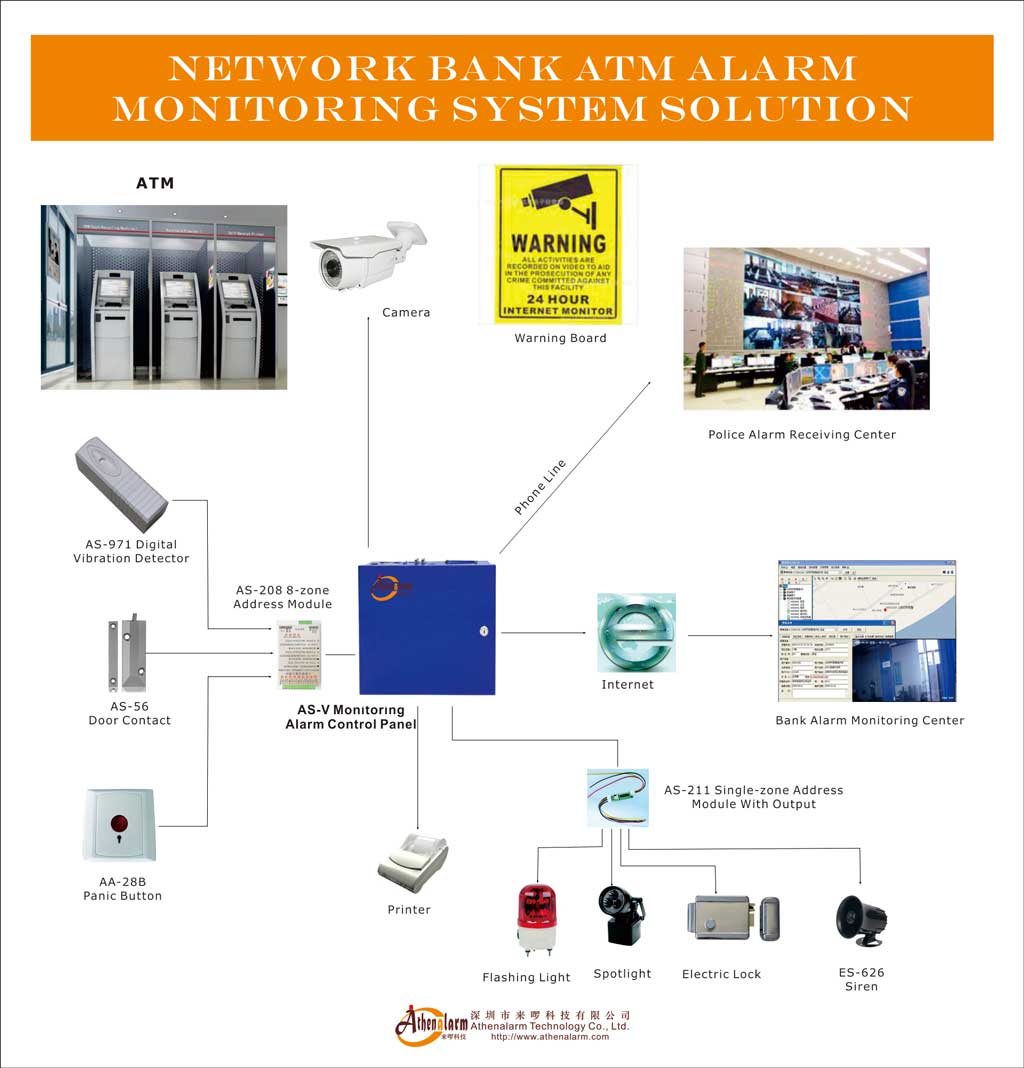
Intrusion and environmental sensors detect physical tampering and specific environmental incidents that passive physical protection cannot prevent or identify on its own. Supported sensor types include vibration sensors, displacement sensors, and contact sensors for detecting physical intrusion or tampering, along with smoke sensors and heat sensors for detecting fire-related environmental events.
These sensors provide the event-detection foundation that connects to the alarm and video response described in Section 3. Where physical protection discourages or resists an attack, sensors identify the moment an intrusion or environmental event actually occurs, allowing the system to move from passive prevention to active detection. Detailed sensor configuration, placement, or detection-range specifications are not established for this system and are not addressed here.
3. Video Monitoring and Alarm Integration Turn Events Into Actionable Awareness
3.1 Video Surveillance and AI Video Monitoring
Video surveillance provides visual awareness and evidence of ATM activity, while AI video monitoring extends this by analyzing footage for unusual or suspicious activity and supporting immediate alerting. Supported video capabilities include IP cameras, night vision, multi-angle coverage, fisheye or panoramic cameras, edge computing, and redundant storage.
Basic video surveillance produces a visual record — useful for awareness and, later, evidence — but does not by itself interpret what is happening. AI video monitoring adds an analytical layer focused on physical and security-related activity, such as identifying unusual or suspicious behavior around the ATM, which supports more immediate alerting than reviewing recorded footage alone. This activity-monitoring function should not be confused with AI-powered fraud detection, which analyzes transaction data rather than video; the two are addressed separately in Section 7. No claims regarding AI detection accuracy or response-time performance are established for this system.
3.2 Sensor-Triggered Alarm and Video Awareness
When an intrusion or environmental sensor detects an event, it can trigger an alarm or security response and bring an associated camera feed into view, giving SOC operators combined sensor and video awareness of the same event. This relationship connects the sensors described in Section 2.2 to the response and video capabilities described throughout this section: sensors, cameras, sirens, strobe lights, and electronic locks all participate in this event-triggered response, and the associated video and alarm information is transmitted to the Security Operations Center (SOC) for operator awareness.
This sensor-to-alarm-to-video linkage is one of the most important relationships in an integrated ATM security system, because it converts a detection event into something an operator can immediately see and evaluate rather than a signal without context. Predefined response capabilities exist within this relationship, but the exact response workflow, timing, or underlying control architecture is not specified and should not be assumed.
3.3 Voice Warning and Two-Way Communication
Voice warning and two-way intercom systems add a human-interaction layer to the automated detection and alarm capabilities described above, supporting deterrence, direct customer assistance, and live communication between an operator and a person at the ATM. Intercom systems are integrated with video, allowing an operator to both see and communicate with someone at the ATM during an incident or a customer-assistance situation.
This communication layer complements rather than replaces automated detection and alarm response: voice warnings function similarly to signage in discouraging unwanted activity, while two-way intercom enables a live operator response when direct interaction is useful. No emergency-service integration or dispatch assumptions are established for this capability.
4. Secure Security-Data Transmission Supports Centralized ATM Monitoring
4.1 Encrypted and Redundant Security-Data Communication
Security-data transmission between ATM security devices and centralized monitoring systems relies on encrypted transmission, redundant communication channels, and continuous monitoring for packet loss or disruption, which together reduce the risk that a communication failure interrupts security monitoring. Named communication options for this transmission include fiber, 5G, and satellite connectivity.
Redundant channels mean that security data is not dependent on a single communication path; if one path experiences disruption, an alternative path can be used to maintain the transmission of alarm, video, and status information to the SOC. Disruption and packet-loss monitoring make communication problems visible rather than silent. It is important to note what is not established here: specific cryptographic standards, named communication protocols, and quantified failover behavior or availability guarantees are not part of the confirmed capability set, and redundancy should be understood as a resilience mechanism rather than an uptime guarantee.
4.2 Monitoring Security-System Health and Communication Disruption
Automated health checks and continuous transmission monitoring allow the system to identify device malfunctions or communication disruptions independently of any specific security incident. This addresses an operational failure mode that event-based detection alone does not cover: a sensor, camera, or communication link can fail silently, without a corresponding intrusion or environmental event, and without automated health monitoring this kind of failure could go unnoticed until it affects an actual security response.
Automated health checks apply to sensors, cameras, and communication links, with results visible to remote monitoring and the SOC. This function is limited to identifying that a malfunction or disruption exists; specific diagnostic mechanisms, root-cause analysis procedures, or maintenance workflows are not defined and fall outside the scope of this security model.
5. Centralized SOC Operations Extend Security Across Distributed ATMs
5.1 Fleet-Level Remote Monitoring and Centralized Oversight
A centralized Security Operations Center (SOC) provides fleet-level visibility by remotely monitoring video and device status, running automated health checks, maintaining centralized dashboards and logs, and coordinating field response teams across multiple ATM locations. This converts individual, location-specific security events into a consolidated operational picture, particularly relevant for geographically distributed ATM fleets where security personnel cannot be physically present at every location at all times.
The SOC’s role extends beyond passive video viewing: it combines device and communication health status, alarm and video awareness from individual events (Section 3.2), and coordination of field teams when physical intervention is required. Specific SOC staffing models, operating procedures, or accreditation are not established and should not be inferred from this description.
5.2 Remote Intervention and ATM Lockdown
Remote monitoring and control capability supports active intervention at a compromised ATM, including remote lockdown, rather than relying solely on physical response. This distinguishes remote monitoring/control from ordinary video surveillance: the SOC is not limited to observing an event but can act on it directly through electronic locks, without waiting for a field team to arrive on site.
Remote lockdown is confirmed as an explicit capability within this system. The specific control architecture behind this capability, including fail-safe behavior in the event of a communication or power interruption, is not specified and should not be assumed to follow any particular design.
6. Cash Replenishment Creates a Distinct ATM Security Risk Context
Cash replenishment is identified as a high-risk operational context because it introduces additional physical exposure at the ATM beyond routine day-to-day operation, and it is supported by a distinct set of security controls rather than relying solely on the standing physical protection and detection layers described earlier. Supported controls for this context include door and wall sensing, infrared detection, smoke and heat sensing, dual-control protocols, armored vehicles, and GPS tracking for those vehicles.
These controls address the specific exposure created by opening the ATM or its cash compartment for servicing, a moment at which passive deterrence and standard intrusion sensing may not be sufficient on their own. Dual-control protocols add a procedural safeguard by requiring more than one person to be involved in the replenishment activity, while armored-vehicle use and GPS tracking address the transport of cash to and from the ATM. Detailed replenishment procedures or step-by-step cash-handling workflows are not defined by this security model and are not addressed here; the relevant point is that cash handling is treated as a distinct risk context requiring its own supported controls.
7. AI Video Monitoring and AI Fraud Detection Address Different Threat Domains
7.1 AI Video Monitoring for Physical and Security Activity
AI video monitoring analyzes physical and security-related activity at the ATM, identifying unusual or suspicious behavior and supporting immediate alerting, as introduced in Section 3.1. Its input domain is video — camera feeds covering the ATM and its surrounding area.
7.2 AI-Powered ATM Fraud Detection for Transaction Activity
AI-powered fraud detection analyzes transaction and ATM activity data — rather than video — for anomalies, using machine learning, biometric verification, cross-ATM monitoring, and analysis of cloned-card-related activity. Its input domain is transactional and activity data associated with ATM usage, including patterns observed across multiple ATMs, rather than camera footage.
7.3 Why the Two AI Functions Should Remain Separate
| AI Function | Input Domain | Focus |
|---|---|---|
| AI Video Monitoring | Camera/video feeds | Physical/security activity around the ATM (e.g., unusual or suspicious behavior) |
| AI Fraud Detection | Transaction and activity data | Transaction anomalies, cross-ATM patterns, cloned-card-related activity, biometric verification |
AI video monitoring and AI fraud detection are complementary but technically distinct functions because they analyze different types of data to address different threats. Treating them as a single capability risks obscuring what each function can and cannot detect: AI video monitoring cannot identify a transaction anomaly that produces no unusual physical activity at the ATM, and AI fraud detection cannot identify a physical security event that produces no anomalous transaction pattern. Maintaining this separation preserves an accurate understanding of how physical security and fraud protection cover different parts of the overall risk picture. No quantitative accuracy or performance claims are established for either function.
8. Security Evidence Connects Monitoring With Investigation and Dispute Support
Video evidence and centralized logs generated by the security capabilities described above support forensic investigation, reporting, audits, and dispute resolution after a security or fraud-related event. Because video is retained and logs are centralized at the SOC, records from a specific ATM and time period can be reviewed after the fact rather than being available only in real time.
The stated retention period for this article is at least 90 days. This retention figure is specific to the system described here and should not be treated as a universal regulatory retention requirement; organizations evaluating their own retention needs would need to consider requirements beyond what is established in this discussion. Evidence readiness connects the real-time detection, monitoring, and response capabilities covered earlier in this article to the post-incident needs of investigation and dispute handling, closing the loop between active protection and accountability after an event.
9. How the Integrated Model Addresses Key ATM Security Risks
This section consolidates the risk-to-capability relationships already established in the preceding sections; it does not introduce new capabilities.
- Physical attack and unauthorized access are addressed by physical protection and deterrence (Section 2.1) together with intrusion and environmental detection (Section 2.2).
- Delayed detection or response is addressed by the sensor-triggered alarm and video awareness relationship (Section 3.2), which brings a detected event to SOC operator attention along with corresponding video.
- Security-data transmission disruption is addressed by encrypted, redundant communication channels and disruption monitoring (Section 4.1), and by automated health checks that can identify a communication problem independent of a security incident (Section 4.2).
- Fraudulent or anomalous ATM activity is addressed by AI-powered fraud detection operating on transaction and cross-ATM activity data, kept distinct from physical/security-event monitoring (Section 7).
- Insufficient evidence for investigation or dispute resolution is addressed by video evidence and centralized logs, retained for at least 90 days in this system (Section 8).
- Additional exposure during cash replenishment is addressed by the distinct set of controls described for that context, including sensing, dual control, and armored-vehicle/GPS tracking (Section 6).
Read together, these relationships illustrate why an integrated model — rather than an isolated camera, alarm, or fraud tool — is positioned to address a broader range of ATM security risk than any single measure could cover on its own. This integration is what distinguishes a layered ATM security system from a single-device solution, and it is the basis on which the completeness of an ATM security deployment should be evaluated.
10. FAQ
Q1: What constitutes a layered and integrated bank ATM security system?
Answer: It is a system that combines physical protection, intrusion/environmental detection, video and AI monitoring, alarm and response, secure security-data transmission, centralized SOC oversight, cash-handling controls, evidence retention, and AI-powered fraud detection into one coordinated model rather than a set of separate devices.
Q2: What are the main functional objectives of integrated ATM security?
Answer: Deterrence, real-time detection and alerting, centralized oversight, fraud/dispute support, and forensic readiness.
Q3: How does alarm-video integration support ATM incident response?
Answer: A sensor-detected event can trigger an alarm/security response and bring an associated video feed to the SOC, giving operators combined awareness rather than an isolated signal.
Q4: How does AI video monitoring differ from AI-powered ATM fraud detection?
Answer: AI video monitoring analyzes camera footage for unusual or suspicious physical/security activity; AI fraud detection analyzes transaction and cross-ATM activity data for anomalies. They operate on different data and address different threats.
Q5: Why is secure and redundant security-data transmission relevant to remote ATM monitoring?
Answer: Encrypted transmission, redundant communication channels, and disruption/packet-loss monitoring reduce the risk that a communication failure interrupts security monitoring of an ATM.
Q6: How does a centralized SOC support security across multiple ATMs?
Answer: A centralized SOC provides fleet-level visibility through remote video/device monitoring, automated health checks, centralized logs, and coordination of field response teams.
Q7: What remote intervention capability is supported for a compromised ATM?
Answer: Remote monitoring/control supports remote lockdown of a compromised ATM.
Q8: Why does cash replenishment require additional ATM security controls?
Answer: Cash replenishment introduces additional physical exposure beyond routine operation, addressed through door/wall sensing, infrared and smoke/heat detection, dual-control protocols, and armored-vehicle GPS tracking.
Q9: How can ATM security systems support forensic investigation and dispute resolution?
Answer: Video evidence and centralized logs, retained for at least 90 days in this system, provide records that support investigation, reporting, audits, and dispute resolution.
Q10: How can remote monitoring identify security-system failures in addition to security incidents?
Answer: Automated health checks and continuous communication-disruption monitoring can identify device malfunctions or transmission problems independent of any specific security incident.
11. System Component Checklist Appendix
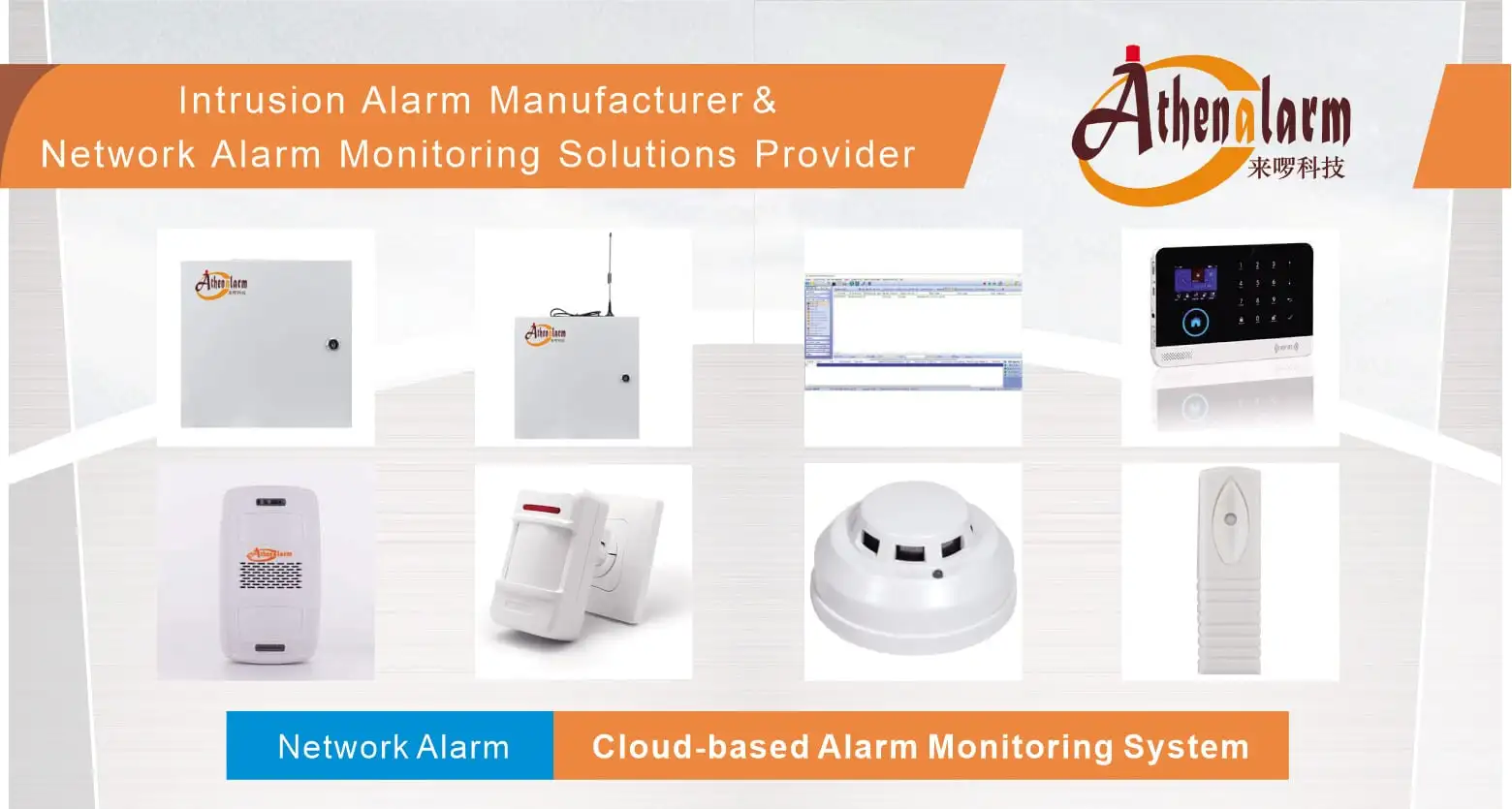
To support comprehensive physical deployment across distributed environments, the architecture accommodates the following specialized hardware components:
- Core Control Panels: Alarm Control Panel
- Intrusion & Motion Sensors: PIR Motion Sensor | Wide Angle PIR Motion Sensor
- Structural & Tamper Detection: Digital Vibration Detector | Door Contact Sensor
- Environmental Sensors: Photoelectric Smoke Detector | Gas Detector
- Emergency Trigger & Deterrence Accessories: Panic Button | Wireless Panic Button | Warning Light | Motion Sensor Sound Player
- Secondary Wireless/Cellular Backup Systems: GSM/WiFi Alarm System
