
Network Bus Alarm Architecture: RS-485 Physical Layer Diagnostics and Commercial Security Integration
1. Failure Reality as the Engineering Entry Point
A repeating pattern emerges across medium-to-large commercial security installations: a network bus alarm system is commissioned, passes initial walk-tests, and enters service — only to generate intermittent module dropouts within the first operational quarter. Field technicians cycle power. Modules return. The fault vanishes. Days later, it returns. The diagnostic loop consumes labor budget, erodes customer confidence, and produces no durable resolution because the root cause was embedded in the physical installation, not the hardware.
That failure pattern — addressable modules cycling online and offline without a traceable trigger — has a well-defined root cause within RS-485 bus architectures. The 120 Ω end-of-line termination resistors were either omitted entirely or installed on intermediate nodes rather than at the two physical extremities of the bus run. Without correct termination, high-frequency data signals transmitted by the Master Control Panel reflect back along the conductor pair, colliding with legitimate polling packets mid-transit. The resulting signal corruption causes modules to miss acknowledgment windows, appearing to the panel as offline devices. The fault is electrical, deterministic, and preventable — yet it remains one of the most common commissioning failures encountered across large-scale bus deployments.
This diagnostic entry point is instructive for understanding network bus alarm systems as an engineering discipline rather than a product category. The architecture’s capability profile — centralized intelligence, distributed addressable expansion, multi-zone scalability, and cross-system interoperability — is well-established and commercially proven. What separates reliable deployments from chronically problematic ones is engineering discipline applied across the physical layer, the protocol stack, the integration interfaces, and the operational lifecycle. Each of those layers carries its own failure modes. Understanding those failure modes is prerequisite to designing, deploying, and maintaining systems that perform as specified.
The following analysis proceeds from system architecture through physical layer mechanics, protocol stack telemetry, cross-system integration, deployment lifecycle, engineering friction diagnostics, scenario-specific configurations, and operational maintenance — organized to reflect the engineering workflow that governs real commercial security infrastructure.
2. System Definition and Architecture Typology
A network bus alarm system is a Hybrid Distributed-Bus Architecture in which processing intelligence is centralized at a Master Control Panel while zone data collection, power distribution, and output execution are distributed across addressable modules deployed along physical multi-drop serial bus networks or linked via localized RF transceivers.
2.1 System Typology: Hybrid Distributed-Bus Architecture
The signal flow follows a structured hierarchy:
[Field Sensors] ──(Zone Loops)──> [Bus Expanders] ──(RS-485 Bus)──> [Master Control Panel] ──(IP/SIA DC-09)──> [CMS / VMS / ACS]
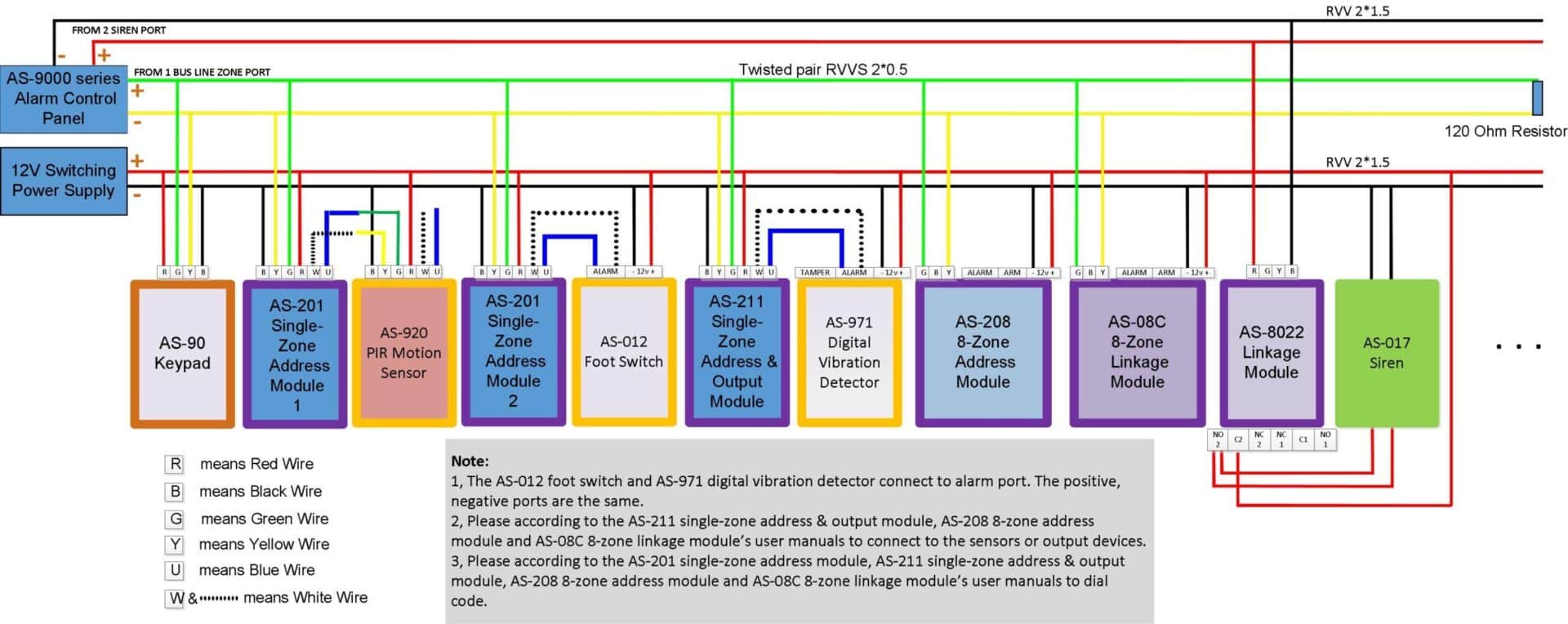
The Master Control Panel coordinates half-duplex polling tokens across all addressable Bus Expander Modules deployed on the RS-485 serial backbone. Each Bus Expander Module manages a defined set of supervised wired sensor zones through dual or triple end-of-line resistor loops, and reports zone status back to the panel within each polling cycle. Wireless sensors connect through dedicated Wireless Transceiver Hubs, which translate RF event packets into bus-compatible data for panel ingestion.
Core System Components:
| Component | Function |
|---|---|
| Master Control Panel | Central processing, polling coordination, output logic, upstream telemetry |
| RS-485 Bus Infrastructure | Differential serial backbone connecting panel to addressable modules |
| Addressable Bus Expander Modules | Distributed zone input collection and local status reporting |
| Wired Field Sensors | Dry-contact or digital edge devices monitored via supervised EOL loops |
| Wireless Transceiver Hubs | RF reception and bus conversion for wireless sensor zones |
| Communication Modules | IP/LTE upstream egress to Central Monitoring Stations |
| Power Supply Modules | Auxiliary current injection at remote bus segments |
The distinction from conventional star-topology alarm architectures is structural. Home-run wiring topologies route individual zone conductors from each sensor directly back to the control panel — a model that delivers complete fault isolation per zone but requires substantial copper infrastructure and panel termination capacity. The bus topology routes all addressable devices onto a shared differential conductor pair, reducing copper consumption by up to 75% compared to equivalent home-run installations. Scalability is achieved by appending additional addressable expansion modules up to the addressing limit of the master CPU — commonly 512 to 1024 zones — constrained by serial address allocation and aggregate power budgets rather than physical panel termination blocks.
System inputs terminate at the end-of-line resistor networks of dry-contact sensors or digital edge devices. System outputs terminate at supervised notification appliance circuits, onboard dry-contact programmable relays, and network egress ports delivering telemetry to upstream platforms.
3. RS-485 Physical Layer Architecture and Bus Design
The RS-485 differential serial bus is the physical foundation of the network bus alarm system. All communication between the Master Control Panel and its addressable Bus Expander Modules traverses this conductor pair using a master-slave half-duplex token-passing polling loop.
3.1 Physical Layer Parameters:
RS-485 Physical Layer: 1200 m maximum un-repeated run, 120 Ω characteristic impedance, twisted pair medium, differential signaling
The 1200 m (4000 ft) maximum un-repeated physical length is a hard constraint imposed by signal attenuation characteristics at RS-485 data rates. Installations requiring bus runs beyond this threshold require RS-485 repeater modules at appropriate intervals to regenerate signal integrity. Exceeding this limit without repeaters produces progressive signal degradation that manifests as intermittent module dropouts at the far end of the bus — a failure pattern diagnostically similar to termination errors.
The bus conductor must be a nominal 120 Ω characteristic impedance twisted pair throughout its entire physical run. Substituting standard two-conductor shielded cable without verified impedance characteristics introduces impedance discontinuities that generate signal reflections independent of termination resistor placement.
3.2 Termination Resistor Placement Rule:
120 Ω termination resistors must be installed exclusively at the two furthest physical ends of the bus run. All intermediate nodes — Bus Expander Modules, Power Supply Modules, and any other mid-run devices — must remain in a high-impedance state with no termination. Installing termination resistors at intermediate nodes creates multiple reflection points along the bus, worsening signal integrity rather than correcting it. This is the most common physical layer commissioning error in RS-485 bus deployments.
3.3 Bus Topology and Branching Constraints:
The RS-485 multi-drop bus requires a linear daisy-chain topology. Star configurations and T-tap branches create impedance mismatches at the branch points that generate signal reflections proportional to the electrical length of each branch stub. Long T-tap lines within a building floor plan — often improvised by installation teams attempting to minimize conduit runs — introduce chronic intermittent communication faults that are difficult to locate with standard multimeter diagnostics and require Time-Domain Reflectometry (TDR) testing for reliable fault location.
3.4 Addressing and Zone Scaling:
Each addressable Bus Expander Module occupies a unique address within the panel’s addressing space, assigned via hardware DIP switches or software configuration depending on the product platform. Address conflicts — two modules assigned the same address — generate bus communication collisions that produce erratic behavior across both conflicting devices. Maintaining an accurate asset tracking register of all assigned module addresses is an operational requirement, not a convenience. As installations scale toward high zone counts, undocumented address changes during field modifications become a significant source of commissioning failures during system expansions.
Auxiliary Power Supply Modules are deployed along extended bus segments to inject operating current locally, preventing the voltage sag that occurs when distant modules draw current across a long, resistive conductor run.
4. Bus Voltage Drop and Power Distribution Engineering
The voltage drop relationship governing network bus alarm system reliability is expressed as:
Vdrop=I×RV_{text{drop}} = I times RVdrop=I×R
where III represents the aggregate current draw of all devices on the bus segment and RRR represents the total loop resistance of the conductor run at the selected wire gauge.
Critical Voltage Threshold: Addressable bus modules require a minimum operating voltage of approximately 10.5 V DC. Modules drop offline when bus voltage falls below this threshold under peak load conditions.
The engineering consequence of this relationship is wire gauge selection. A 24 AWG conductor pair carries significantly higher resistance per unit length compared to 18 AWG. Over extended horizontal runs — common in logistics warehouses or multi-floor commercial buildings — the resistance differential between 24 AWG and 18 AWG can determine whether all modules remain operational during a simultaneous multi-zone alarm event.
4,1 Failure Mechanism Under Peak Load:
The critical failure scenario is not steady-state operation but alarm activation. During routine polling, current draw from quiescent sensors is low and bus voltage at the far end of the run remains within specification. When an alarm event occurs, motion detectors activate, notification appliances draw current, and multiple zones simultaneously enter alarm state. The aggregate current spike causes voltage to sag along the full resistance of the conductor run. If wire gauge was sized for normal operating current rather than peak load, distant modules drop below 10.5 V DC precisely when the system requires their operation — at the moment of an active alarm event.
[Master Panel: 13.8V] ═══════(Long Thin Cable Run)═══════> [End Module: < 10.5V = Drop Out]
4.2 Power Distribution Strategy:
Auxiliary Power Supply Modules positioned at calculated intervals along the bus inject local current, reducing the effective resistance path between voltage source and current-drawing devices. Power injection points are determined by DC power drop calculations performed during the design phase, using the measured resistance per unit length of the specified conductor and the estimated peak current draw of all devices served beyond each injection point.
4.3 Design Phase Requirement:
Power budget calculations must account for peak simultaneous load, not average operational load. Designs sized only to steady-state current draw will exhibit alarm-correlated module failures — a diagnostic pattern that is particularly damaging because it causes the system to degrade exactly when security response is most critical, and the failure only manifests under real alarm conditions that are difficult to reproduce during commissioning walk-tests.
5. Signal Reflection, Termination Diagnostics, and Ground Loop Management
Signal reflection and ground loop corruption represent two distinct but frequently conflated physical layer failure modes. Both generate intermittent bus communication faults, but their root causes, diagnostic signatures, and corrective actions differ structurally.
5.1 Signal Reflection Diagnostics:
Signal reflections arise from impedance discontinuities on the RS-485 bus. The most common source is missing or misplaced termination resistors, as described in the physical layer section. Additional sources include long T-tap branches, impedance-discontinuous cable transitions (connecting different cable types mid-run), and damaged or water-ingressed connectors that alter the local impedance of the line.
Diagnostic Signature: Modules at the far end of the bus are disproportionately affected. Modules nearest the panel remain stable while far-end modules cycle offline. TDR testing locates impedance discontinuities along the run.
Corrective action requires verifying that 120 Ω termination resistors are present only at the two physical extremities of the bus, confirming that all intermediate devices are in high-impedance mode, and inspecting all field splice points for moisture ingress or mechanical damage.
5.2 Ground Loop Management:
The RS-485 bus shield drainage wire must be grounded at a single point only — at the Master Control Panel enclosure’s earth ground connection. Grounding the shield at multiple distribution enclosures or junction boxes along the run creates ground loop current paths. When two ground reference points exist at different potentials — a common condition across large commercial facilities where electrical distribution panels on different floors or buildings carry slight potential differences — current flows continuously through the shield. This ground loop current couples directly into the differential signal pair, raising the noise floor and corrupting data packets.
Ground Shield Rule: Single-point earth ground at Master Control Panel only. Shield must remain floating and isolated at all downstream distribution enclosures.
Ground loop symptoms manifest as persistent low-level communication errors, increased module polling retry rates, and sporadic bus faults that have no consistent geographic or temporal pattern — making them among the most difficult physical layer faults to diagnose without a protocol analyzer.
5.3 Loop Isolation Modules for Fault Containment:
Physical loop isolation modules deployed at structural zone boundaries — floor transitions, building separations, or high-risk external perimeters — provide active fault containment. When a localized short circuit occurs on one bus segment, the adjacent isolation module trips and electrically removes the faulted section from the bus, preserving communication to all remaining operational modules on the loop. Without isolation modules, a single unisolated short circuit disables all downstream addressable devices from the fault point to the bus terminus.
6. EOL Resistor Drift, False Alarm Generation, and Anti-Tamper Supervision
Supervised zone loops in network bus alarm systems use end-of-line resistor networks to monitor the electrical integrity of the conductor path between the Bus Expander Module and the field sensor. The Master Control Panel — via the Bus Expander — continuously measures the analog resistance of each loop. Deviations from configured baseline values are interpreted as alarm, tamper, or fault conditions.
Zone Supervision Logic: Normal loop resistance matches configured EOL value. Short circuit indicates alarm or line cut. Open circuit indicates sensor removal or wire break. Resistance outside tolerance band indicates tamper or fault.
6.1 EOL Resistor Drift Mechanism:
Oxidation at field wire splice points, water ingress in exterior-mounted junction boxes, and use of low-tolerance resistors introduce progressive resistance drift in the supervised loop. As aggregate loop resistance drifts away from the configured baseline — whether upward through oxidation-increased contact resistance or downward through moisture-induced partial short — the panel begins misinterpreting normal operating conditions as active tampers or zone faults.
The operational consequence is chronic false tamper alarms with no associated physical intrusion event. Field technicians dispatched to investigate find sensors physically intact and correctly installed. The fault is at a corroded splice or a compromised junction box seal. Unless technicians specifically measure loop resistance with a calibrated meter and compare against the configured EOL baseline, the root cause remains hidden and the dispatches continue.
6.2 DEOL and TEOL Supervision Configurations:
Standard Double End-of-Line (DEOL) resistor configurations provide supervision for normal, tamper, and alarm states. Triple End-of-Line (TEOL) configurations add a third resistor state that enables micro-ampere loop current shift detection, providing anti-masking capability against sophisticated parallel resistor shunt attacks — where an adversary places a calibrated resistor across the sensor to hold the loop at normal resistance while defeating the sensor mechanically.
TEOL Application: Required for external perimeter zones, banking environments, and critical infrastructure where insider tamper threats using resistor shunts are a credible risk vector. DEOL is appropriate for internal building perimeters.
TEOL installation increases field calibration time during commissioning, as each zone loop resistance must be verified within tighter tolerance bands. The engineering decision to standardize TEOL across all zones — while appealing from a security maximization perspective — creates significant commissioning overhead in large zone-count installations. Engineering practice calls for DEOL on interior zones and TEOL reservation for high-risk external and access-point zones.
7. RF Desensitization in Hybrid Wireless Deployments
Hybrid network bus alarm systems incorporate Wireless Transceiver Hubs as addressable bus nodes, extending zone coverage to locations where wired infrastructure is impractical. The transceiver hub communicates with wireless field sensors over sub-GHz RF channels — typically 433 MHz or 868 MHz frequency bands — and reports received sensor events to the Master Control Panel via the RS-485 bus.
7.1 RF Propagation Constraints:
The engineering challenge in commercial hybrid deployments is RF signal path integrity within environments that contain significant sources of propagation interference. Structural steel framing, reinforced concrete walls, and dense mechanical equipment attenuate sub-GHz RF signals through absorption and reflection. The practical consequence is reduced sensor transmission range and increased packet error rates between wireless sensors and the transceiver hub.
7.2 Noise Floor Elevation from Co-Located Wi-Fi Infrastructure:
Commercial office environments and enterprise campuses typically deploy high-density 802.11 Wi-Fi access point infrastructure operating on 2.4 GHz and 5 GHz bands. While these bands do not directly overlap with 433 MHz or 868 MHz alarm sensor frequencies, high-power Wi-Fi transmitters installed near wireless transceiver hubs elevate the local RF noise floor through broadband emissions. The noise floor elevation reduces the effective signal-to-noise ratio for sub-GHz alarm transmissions, causing the transceiver hub to require multiple packet retries before successfully receiving a sensor event.
Operational Impact of RF Desensitization: Delayed sensor event transmission, accelerated wireless sensor battery drain from continuous packet retry loops, and recurring “zone supervision fault” alerts generated when the hub misses scheduled sensor check-in transmissions.
7.3 Pre-Installation RF Survey Requirement:
Hybrid wireless zone placement requires a pre-installation RF signal propagation survey. The survey maps received signal strength at planned sensor locations relative to each proposed transceiver hub position, identifies structural attenuation paths, and confirms that the local noise floor at the hub’s operating frequency remains below the transceiver’s sensitivity threshold. Skipping the RF survey and placing transceiver hubs based on visual inspection alone is the primary cause of chronic wireless zone supervision faults in commercial retrofit deployments.
Transceiver hub placement should avoid proximity to Wi-Fi access points, large steel structural members, elevator shafts, and HVAC mechanical rooms. In environments with unavoidable interference sources, frequency-agile transceiver hubs that can shift operating channels in response to detected noise floor elevation provide a significant operational reliability advantage.
8. Protocol Stack and Alarm Telemetry Architecture
The network bus alarm system protocol stack operates across three functional layers, each governing a distinct segment of the signal path from field sensor event to Central Monitoring Station response.
| Architecture Layer | Implementation |
| Application Layer | SIA DC-09 XML / Contact ID DTMF / Modbus RTU / BACnet IP |
| Transport Layer | TCP / UDP (For IP-Based Telemetry) |
| Data Link & Physical Layer | RS-485 Half-Duplex (Master-Slave Polling Loops) |
8.1 RS-485 Polling Layer:
The physical RS-485 half-duplex polling loop governs local communication between the Master Control Panel and all addressable Bus Expander Modules. The panel transmits polling tokens sequentially across all registered module addresses. Each module responds within its assigned window with its current zone status. This deterministic polling model provides predictable communication latency under normal load but introduces a bandwidth saturation constraint when large numbers of devices trigger concurrently — addressed in the Engineering Friction section.
8.2 SIA DC-09 IP Event Reporting:
SIA DC-09 (SIA Receiver Profile over IP) is the current standard protocol for upstream alarm telemetry transmission from the panel’s communication module to Central Monitoring Station automation servers. SIA DC-09 encapsulates alarm event codes within XML packet structures transmitted over TCP/UDP, supporting 128-bit and 256-bit AES encryption of the telemetry payload and maintaining supervision heartbeat polling at sub-minute intervals.
SIA DC-09 Parameters: AES 128/256-bit encryption, sub-minute heartbeat supervision, TCP/UDP transport, native dual-path routing over Ethernet primary and LTE/4G cellular backup.
The communication module connects to the Master Control Panel via high-speed SPI bus links or onboard UART ports and transmits outbound telemetry across public Internet or secure cellular APN pathways to CMS receiver automation servers.
8.3 Contact ID Legacy Signaling and Deprecation:
Contact ID (SIA DC-05) uses dual-tone multi-frequency DTMF signaling over analog PSTN or cellular audio channels for alarm event transmission. The protocol functions reliably over true analog PSTN circuits. The critical failure mode is VoIP analog telephone adapter conversion: ATA devices used to connect legacy PSTN alarm dialers to IP-based phone infrastructure apply audio compression codecs that corrupt DTMF tone sequences, causing high packet error rates and unreliable CMS delivery. Contact ID is in phased deprecation across the commercial security industry, with SIA DC-09 as the designated replacement pathway.
8.4 Network Egress Configuration:
SIA DC-09 telemetry requires outbound access on dedicated ports — standardly Port 9999 or Port 10002 — through the enterprise firewall. Blocked outbound firewall ports are among the most common causes of SIA DC-09 transmission failures identified during CMS onboarding. This failure mode produces a scenario where the panel reports events locally but CMS receives no transmission, leaving the facility unprotected without visible indication at the panel itself. Firewall rule verification must be a mandatory step in the CMS onboarding validation protocol.
9. Polling Saturation and Event Latency Under High Concurrent Load
The half-duplex RS-485 polling architecture introduces a bandwidth constraint that becomes operationally significant during simultaneous multi-zone alarm events — specifically the scenario in which the alarm system’s communication reliability is most critical.
9.1 Half-Duplex Bandwidth Mechanics:
The RS-485 bus operates in half-duplex mode: the bus conductor pair carries data in only one direction at any moment. The Master Control Panel transmits a polling token to one module, waits for the module’s response, processes it, then transmits the next polling token. This sequential token-passing loop processes all modules on the bus in sequence before any module receives a second polling cycle.
Polling Saturation Threshold: As the number of addressable modules and the frequency of concurrent event transmissions increase, the total polling cycle time extends. Under simultaneous multi-zone alarm conditions, high-priority intrusion zone events must compete with lower-priority environmental sensor status updates for the same bus bandwidth.
9.2 Latency Consequence During Concurrent Events:
If a large-scale alarm event causes multiple zones across multiple Bus Expander Modules to trigger simultaneously, each module must wait for its sequential polling slot before the panel acknowledges its alarm state. Modules polled late in the sequence experience measurable event reporting latency. In high-security environments where sub-second response coordination between the intrusion system and the Video Management System or Access Control System is operationally required, this latency has functional consequences.
9.3 Mitigation Strategy — Priority Polling Scheduling:
The engineering mitigation is polling priority scheduling: grouping high-security intrusion perimeter zones on dedicated high-priority bus segments or assigning them event-driven interrupt capability distinct from the standard polling sequence. Non-critical environmental sensors — temperature monitors, humidity detectors, HVAC status inputs — are assigned to low-priority polling intervals that do not compete with intrusion zone bandwidth during alarm events.
Oversaturating a single bus segment with both critical intrusion zones and low-priority environmental inputs is an architectural error committed during initial system design, typically when zone planning prioritizes physical installation convenience over operational performance requirements.
10. Cross-System Integration Architecture
The Master Control Panel functions as an integration node within a broader physical security ecosystem. Its integration interfaces connect to three primary subsystems: the Video Management System, the Access Control System, and the Fire Alarm Control Panel.
10.1 Video Management System Integration:
Master Control Panel → VMS integration operates through hardware-level SDK commands, IP API calls, or dry-contact relay triggers that direct the VMS to execute predefined responses upon zone breach. A typical integration workflow triggers PTZ camera preset positioning to frame the alarmed zone within seconds of the intrusion detection event, simultaneously initiating edge recording at cameras covering the affected area.
VMS Integration Flow: Zone breach at Bus Expander → Master Control Panel alarm state → SDK command or IP packet → VMS server → PTZ preset repositioning + edge recording activation.
10.2 Access Control System Integration:
Master Control Panel → ACS integration uses TTL outputs, dry-contact relays, or API polling loops to communicate arm/disarm state changes and alarm events to the Access Control System. The ACS dynamically alters door lock profiles based on received alarm states — locking down access-restricted zones during intrusion events while simultaneously unlocking designated egress routes during forced panic or duress conditions. The directionality of this relationship matters for integration design: the intrusion panel pushes state changes to the ACS rather than the ACS polling the panel, which requires correct API endpoint configuration at both systems.
10.3 Fire Alarm Control Panel Integration:
Master Control Panel → FACP integration addresses a specific operational problem: HVAC smoke-clearing actions that activate fire alarm detectors create environmental conditions that can trigger motion detector false positives in adjacent spaces. Without FACP integration, the intrusion system interprets these activations as zone breaches and dispatches CMS alerts.
FACP Integration Function: The FACP transmits supervisor status relay signals to the Master Control Panel. The panel processes these signals as exception conditions, suppressing intrusion dispatch for HVAC smoke-clearing activations while maintaining full alarm response for genuine intrusion events during the same fire condition.
10.4 Building Automation Integration:
Integration with Building Automation Systems requires secondary communication interface modules or protocol translation gateways. Modbus RTU and BACnet IP translate alarm system attributes into registers or data points readable by BAS platforms. MQTT enables event-driven topic publishing for integration with IoT management layers. These gateways must maintain electrical isolation between the critical life-safety alarm network and the commercial building network to prevent cross-network fault propagation.
11. Deployment Lifecycle Engineering
Network bus alarm system deployment follows a five-phase lifecycle in which the engineering decisions made in early phases directly determine the operational stability of later phases.
[Design & Survey] ──► [Cabling & Install] ──► [Commissioning] ──► [CMS Onboarding] ──► [O&M / Lifecycle]
11.1 Phase 1: Site Survey and Design
Site survey establishes the physical constraints that govern all subsequent engineering decisions. Key survey outputs include cumulative DC power drop calculations for all planned bus segments, physical bus layout verification against the 1200 m distance limit, RF signal propagation profiling for all planned hybrid wireless zones, and electromagnetic interference source mapping.
Common design-phase failures: underestimating conductor resistance over actual cable routing paths (which differ from plan-view distances), inaccurate zone-count scaling that exhausts bus addressing capacity during later expansion, and overlooking proximity to EMI sources such as large electrical switchgear or industrial motors that will affect both RS-485 data integrity and RF transceiver performance.
11.2 Phase 2: Cabling and Installation
Physical installation introduces friction points independent of design quality. Running low-voltage RS-485 data cables in parallel with high-voltage AC mains — a routing shortcut common in constrained conduit environments — induces electromagnetic interference directly onto the differential bus pair. National electrical codes and RS-485 specifications require physical separation of low-voltage data conductors from AC power conductors. Improper bus branching — T-tap configurations introduced for installation convenience — creates the impedance discontinuities described in the physical layer section.
Hardware module address assignment must be documented at installation. DIP switch address records captured in a commissioning register during installation prevent address conflict investigations during expansion projects executed by different technicians months or years later.
11.3 Phase 3: Commissioning and Integration
Commissioning begins with firmware verification across all installed modules. Firmware mismatches between Bus Expander Module firmware versions and Master Control Panel firmware create incompatibilities that generate communication errors indistinguishable from physical bus faults. All modules must be updated to the firmware version validated against the installed panel before zone programming begins.
Zone parameter definition, output cross-zone logic mapping, and VMS/ACS integration verification follow firmware validation. Testing cross-system integration in a live environment without a defined test mode risks generating false alarm dispatches to the CMS during logic validation — a risk with direct financial consequences through potential municipal false alarm fines.
11.4 Phase 4: CMS Onboarding and Signal Validation
CMS onboarding requires completing a full transmission validation matrix across all programmed communication paths — primary Ethernet/IP and backup LTE/cellular — for every configured CMS account. Outbound firewall port verification (Ports 9999/10002), account number matching between the panel configuration and the CMS receiver automation server, and primary/secondary path failover testing are mandatory validation steps.
The transition period between installation completion and CMS account activation represents a window of facility vulnerability. Handover protocols must account for this gap explicitly rather than treating it as an administrative detail.
11.5 Phase 5: Operations and Lifecycle Management
Operational performance requires structured maintenance discipline. Event log analysis — specifically identifying zone fluttering anomalies, repeated tamper alerts from specific modules, and polling retry rate increases — provides early warning of physical layer degradation before faults escalate to false alarm dispatches or CMS communication failures.
12. Troubleshooting Decision Framework
Systematic troubleshooting of network bus alarm system faults maps symptoms to probable physical or logical causes through a defined diagnostic sequence.
12.1 Symptom: Modules Randomly Going Online and Offline
| Step | Action |
|---|---|
| 1. Validate | Confirm 120 Ω termination resistors present only at the two physical bus extremities |
| 2. Measure | Check DC bus voltage at the furthest module under simulated load conditions |
| 3. Inspect | Examine all field splice points and junction boxes for moisture ingress or mechanical damage |
| 4. Test | Use TDR equipment to locate impedance discontinuities on long runs if above steps are inconclusive |
This symptom pattern has three distinct root causes — termination errors, voltage sag, and impedance discontinuities — that require different corrective actions. Replacing hardware without systematic diagnosis wastes resources and leaves the actual fault unresolved.
12.2 Symptom: Persistent Tamper or Fault Conditions on Specific Zones
Persistent zone tamper or fault conditions that do not correspond to physical sensor disturbance typically indicate EOL resistor drift. The diagnostic sequence measures the actual loop resistance at the Bus Expander terminal and compares it against the configured baseline resistance value. Discrepancy exceeding the panel’s tolerance band confirms loop resistance drift. Resolution requires tracing all splice points in the affected loop for oxidation or moisture damage and replacing degraded resistors with metal film units of the specified tolerance.
12.3 Symptom: SIA DC-09 Transmission Failures to CMS
| Probable Cause | Validation Test | Resolution |
|---|---|---|
| Outbound firewall blocking Port 9999/10002 | Verify firewall outbound rules for telemetry ports | Create explicit allow rules for CMS destination IPs on required ports |
| Account number mismatch | Compare panel account ID against CMS receiver programming | Correct account number in panel IP configuration |
| Primary path failure without cellular backup activation | Disconnect primary Ethernet and verify LTE failover within defined timeout | Confirm cellular SIM activation and APN configuration |
12.4 Symptom: Wireless Zone Supervision Faults
Wireless zone supervision faults indicate the Wireless Transceiver Hub is not receiving scheduled check-in transmissions from one or more sensors. Diagnostic steps: measure received signal strength at the transceiver hub for the affected sensor, identify physical obstructions or noise sources in the RF path, and verify sensor battery voltage. Low battery accelerates packet retry frequency and reduces transmission power, compounding reception failures. Repositioning the transceiver hub or adding an intermediate hub reduces path attenuation when structural obstructions cannot be eliminated.
13. Scenario-Specific Deployment Architectures
Network bus alarm system architecture selection is driven by the specific risk profile, physical environment, and operational requirements of each deployment scenario.
13.1 Logistics Centers and Warehouses
Risk profile: Extended linear perimeters, high forklift impact exposure on conduit and wiring, and significant ambient temperature variation between climate-controlled storage areas and loading dock environments.
Recommended architecture: Extended single-bus loops paired with remote isolated Power Supply Modules at distributed injection points along the perimeter. All bus wiring in forklift-accessible areas requires steel conduit protection. Sensor selection must specify industrial-grade units with operating temperature ranges matching the actual ambient conditions at each installation point — standard commercial PIR sensors specified for indoor ambient temperatures fail at sub-zero loading dock environments.
13.2 Multi-Building Campuses
Risk profile: Ground potential differences between buildings fed by separate electrical distribution panels, high lightning surge exposure on inter-building cable runs, and long cable distances that compound both voltage sag and ground loop risks.
Recommended architecture: Fiber-optic network backbone between buildings with localized IP-to-Bus network drops providing panel-to-expansion-module communication isolation. Fiber eliminates the ground potential difference problem entirely by removing the conductive path between buildings. All inter-building data paths require mandatory opto-isolation at each building entry point. Dedicated lightning surge protection modules must be installed on all cable runs exposed to outdoor routing.
13.3 Commercial Office Retrofits
Risk profile: Limited cable routing access in finished ceilings and walls, potential asbestos in older construction, and aesthetic restrictions that prevent exposed conduit.
Recommended architecture: Hybrid topology with wired RS-485 infrastructure at core distribution points and wireless expansion hubs covering zones where cable routing is impractical or cost-prohibitive. Pre-installation RF survey is mandatory before hub placement commitment. Legacy fire alarm and access control systems in retrofit environments require compatibility verification before integration design, as older proprietary systems may not support the API or relay interface configurations required for cross-system coordination.
13.4 Banking and Critical Infrastructure
Risk profile: Insider threat vectors including deliberate line-cutting and resistor shunt attacks against supervised zones, sophisticated physical bypass attempts, and strict regulatory compliance requirements.
Recommended architecture: Interlocking dual-bus ring configuration with TEOL resistor supervision on all external and access-point zones. Dual-path communication with 256-bit AES encryption on SIA DC-09 telemetry and sub-minute supervision heartbeat polling rates between the panel and CMS. Physical loop isolation modules at all zone boundaries prevent line-cutting from cascading beyond the targeted segment.
14. Operational Maintenance and Lifecycle Optimization
Network bus alarm system operational reliability degrades predictably over time through battery capacity reduction, sensor mechanical wear, terminal connection oxidation, and firmware obsolescence — all of which are manageable through structured preventive maintenance protocols.
14.1 Quarterly Preventive Testing Protocol:
Physical walk-tests of all integrated sensor zones confirm that each sensor activates its assigned zone within the panel and that zone boundary mapping remains accurate following any facility layout changes. Terminal torque verification on RS-485 bus connection points — particularly in high-vibration environments such as logistics facilities — prevents intermittent open faults caused by terminal screw loosening. Live DC bus voltage measurement at the furthest point of each expansion line confirms adequate power delivery under normal operating load.
14.2 Battery Lifecycle Management:
Sealed lead-acid backup battery arrays require replacement on a strict 3-to-5-year cycle regardless of apparent operational status. SLA batteries maintain surface charge while progressively losing amp-hour capacity — a degradation pattern that is invisible during normal operation but results in insufficient backup runtime during AC mains failure. Automated internal panel load-testing protocols simulate full load conditions and report calculated amp-hour capacity, providing objective battery health data that supplements visual inspection.
Battery Maintenance Rule: Schedule SLA replacement on cycle-based intervals, not condition-based assessment. Condition assessment alone misses internal capacity degradation that only manifests under sustained load.
14.3 Remote Diagnostics and SLA Optimization:
Upload/download software access allows remote zone sensitivity threshold adjustment, module status verification, and event log retrieval without deploying service technicians to the facility. Remote review of panel event history logs — specifically identifying zone fluttering patterns, increased polling retry rates, or communication error bursts — allows pre-emptive maintenance scheduling before anomalies escalate to false alarm dispatches. Remote diagnostics reduce emergency truck rolls, which represent the highest per-incident maintenance cost in commercial alarm system operations.
14.4 Firmware Lifecycle Management:
Each firmware version deployed across panel CPUs, Bus Expander Modules, and Communication Modules must be tracked in a centralized asset register. Firmware updates must be tested on a subset of modules before fleet-wide deployment, as firmware updates occasionally introduce compatibility issues with specific hardware revisions. Maintaining firmware version records also enables root cause analysis when post-update communication anomalies emerge — a diagnostic capability that requires historical records, not just current state snapshots.
15. Engineering Trade-Off Analysis and Architecture Selection
Commercial network bus alarm system architecture selection requires explicit evaluation of four engineering trade-offs. Each decision has quantifiable operational consequences.
15.1 Trade-Off 1: Wired Bus Topology vs. Star Topology
| Dimension | Wired Bus Topology | Star Topology |
|---|---|---|
| Copper Consumption | Up to 75% reduction vs. star | Full home-run conductor per zone |
| Fault Isolation | Shared failure domain — line fault affects downstream modules | Complete fault isolation per zone |
| Scalability | Addressable expansion to panel addressing limit | Limited by panel termination block capacity |
| Installation Labor | Lower for large zone counts | Higher for large zone counts |
| Recommended Use Case | Medium-to-large multi-zone commercial facilities | Small installations requiring complete zone independence |
Engineering Decision: Adopt bus topology for cost and labor efficiency at commercial scale. Compensate for shared failure domain risk by deploying physical short-circuit isolation modules at structural zone boundaries.
15.2 Trade-Off 2: DEOL vs. TEOL Supervision
DEOL provides normal, tamper, and alarm state detection adequate for internal building perimeters. TEOL adds micro-ampere current shift detection for anti-masking capability against parallel resistor shunt attacks. TEOL increases commissioning calibration time per zone and requires field technicians with higher precision measurement capability. Standardizing TEOL across all zones in a large installation carries significant commissioning cost overhead without proportional security benefit at low-risk interior zones.
Engineering Decision: DEOL for interior zones. TEOL for external perimeters, access points, and high-value asset zones in high-security environments.
15.3 Trade-Off 3: Shield Grounding Strategy
Single-point earth ground at the Master Control Panel provides EMI protection through the shield while preventing ground loop current from flowing through the shield. Multi-point grounding introduces ground loop currents proportional to the potential difference between grounding locations. In large commercial facilities, inter-floor and inter-building potential differences are common and generate ground loop corruption that degrades bus data integrity.
Engineering Decision: Enforce single-point earth ground at the Master Control Panel. All downstream enclosures maintain floating shield isolation.
15.4 Trade-Off 4: High-Frequency Polling vs. Bandwidth Utilization
Increasing polling frequency improves event detection latency and response coordination speed. At high polling densities with large module counts on a single bus segment, the half-duplex serial bus approaches bandwidth saturation, causing extended polling cycle times and event reporting delays during concurrent multi-zone activations.
Engineering Decision: Assign high-security intrusion perimeter zones to dedicated high-priority bus segments or event-driven interrupt pathways. Assign environmental monitoring inputs to separate low-priority polling intervals that do not compete with intrusion zone bandwidth.
16. FAQ Section
Q1: What is a network bus alarm system? A network bus alarm system is a Hybrid Distributed-Bus Architecture where a Master Control Panel coordinates polling across addressable Bus Expander Modules connected via an RS-485 differential serial backbone. Sensors report zone status through supervised end-of-line resistor loops to the expanders. The panel transmits encrypted alarm telemetry to Central Monitoring Stations via SIA DC-09 over IP or LTE.
Q2: How far can an RS-485 alarm bus run without a repeater? The maximum un-repeated RS-485 bus run is 1200 m (4000 ft). Beyond this distance, signal attenuation degrades communication integrity between the Master Control Panel and far-end Bus Expander Modules. RS-485 repeater modules regenerate signal strength at the 1200 m limit, enabling further extension while maintaining reliable half-duplex polling performance.
Q3: Why are 120 Ω termination resistors required on the RS-485 bus? 120 Ω termination resistors match the characteristic impedance of the RS-485 twisted pair conductor at the bus extremities, absorbing transmitted signal energy instead of reflecting it back toward the source. Without termination, data signals reflect from the open cable ends and collide with subsequent transmissions, causing data corruption and intermittent module communication failures.
Q4: What happens if termination resistors are installed on intermediate nodes? Installing 120 Ω resistors at intermediate bus nodes creates multiple reflection points, compounding signal integrity problems rather than resolving them. Each incorrectly terminated intermediate node divides the bus impedance, increasing signal attenuation and reflection amplitude. The corrective action is to remove all intermediate terminations and confirm that resistors exist only at the two physical bus extremities.
Q5: What causes voltage drop in a network bus alarm system? Bus voltage drop follows Vdrop=I×RV_{text{drop}} = I times RVdrop=I×R, where III is the aggregate current draw of all connected devices and RRR is the total conductor loop resistance at the installed wire gauge. Using 24 AWG conductors instead of 18 AWG over long runs significantly increases RRR, causing voltage at far-end modules to fall below the 10.5 V DC operating threshold under peak load conditions.
Q6: Why do bus modules fail during alarm events specifically? Module failures during alarm events result from peak-load voltage sag. During normal polling, device current draw is low and bus voltage remains adequate. When an alarm triggers multiple simultaneous activations — motion detectors, notification appliances, multiple zone sensors — aggregate current spikes, dropping far-end bus voltage below the module operating threshold. This failure mode only manifests under real alarm load conditions, making it difficult to detect during low-current commissioning tests.
Q7: How does auxiliary power injection improve reliability? Auxiliary Power Supply Modules positioned at calculated intervals along the bus inject operating current locally, reducing the effective resistance path between the voltage source and current-drawing devices beyond each injection point. This limits the actual voltage drop experienced by far-end modules, ensuring operating voltage remains above the 10.5 V DC minimum threshold even under simultaneous peak-load alarm conditions.
Q8: Why do addressable modules randomly go online and offline? This behavior indicates RS-485 signal reflections from missing or misplaced 120 Ω termination resistors, or bus voltage sag falling below module operating thresholds. Verify termination resistors are present only at the two physical bus extremities, confirm all intermediate devices are in high-impedance mode, and measure DC bus voltage at the far-end module under simulated load to distinguish between the two root causes.
Q9: What causes recurring tamper alarms with no physical disturbance? Recurring tamper alarms without physical activity typically indicate EOL resistor loop resistance drift caused by oxidation at splice points, moisture ingress in junction boxes, or degraded resistor components. Measure the actual loop resistance at the Bus Expander terminal and compare against the configured baseline. Resistance outside the panel’s tolerance band confirms drift — trace all loop splice points for oxidation or moisture and replace degraded resistors.
Q10: What causes SIA DC-09 alarm events to fail reaching the CMS? The most common causes are outbound enterprise firewall rules blocking Port 9999 or Port 10002, and account number mismatches between the panel’s IP configuration and the CMS receiver automation server. Verify outbound firewall rules explicitly allow CMS destination IPs on the required ports, and confirm exact account ID matching between panel programming and CMS account configuration.
Q11: Why must commercial security systems migrate from Contact ID to SIA DC-09? Contact ID uses DTMF audio signaling over analog PSTN circuits. VoIP conversion via ATA devices applies audio compression codecs that corrupt DTMF tones, causing high packet error rates and unreliable CMS delivery. SIA DC-09 encapsulates alarm telemetry natively in encrypted IP packets, supporting AES-256 encryption, sub-minute heartbeat supervision, and resilient dual-path routing over Ethernet and LTE simultaneously.
Q12: What are supervision heartbeats in a network bus alarm system? Supervision heartbeats are periodic polling transmissions that the Master Control Panel’s communication module sends to the CMS receiver at defined intervals — typically sub-minute for SIA DC-09 implementations. The CMS monitors receipt of these heartbeats continuously. If the CMS misses a defined number of consecutive heartbeats, it generates a communication failure alert, enabling the monitoring station to identify a severed communication path before any alarm event occurs.
Q13: What is the difference between bus topology and star topology for alarm systems? Bus topology routes all addressable devices onto a shared RS-485 differential pair, reducing copper consumption by up to 75% but creating a shared failure domain where a line fault affects all downstream modules. Star topology routes individual conductors from each sensor directly to the panel, providing complete per-zone fault isolation at significantly higher material and labor cost. Bus topology is preferred for large multi-zone commercial installations; star topology suits small installations requiring complete zone independence.
Q14: When should TEOL supervision replace DEOL in alarm zone loops? TEOL supervision is required when the risk model includes sophisticated tamper attacks using parallel resistor shunts — where an adversary places a calibrated resistor across the sensor terminals to hold the loop at normal DEOL resistance while defeating the sensor mechanically. TEOL’s micro-ampere current shift detection identifies this masking attempt. TEOL is recommended for external perimeter zones, banking environments, and critical infrastructure. DEOL is appropriate for internal building zones.
Q15: Why do wireless alarm zones show supervision faults? Wireless zone supervision faults indicate the Wireless Transceiver Hub is not receiving scheduled sensor check-in transmissions. Root causes include RF path attenuation from structural steel, concrete, or distance; noise floor elevation from co-located Wi-Fi infrastructure reducing transceiver sensitivity; or low sensor battery causing reduced transmission power and increased packet retry failure. Pre-installation RF surveys identify path attenuation issues before sensor and hub placement is committed.
Q16: How does FACP integration prevent false alarms from HVAC operations? The Fire Alarm Control Panel transmits supervisor status relay signals to the Master Control Panel when HVAC smoke-clearing operations activate fire detectors. The intrusion panel processes these supervisor signals as exception conditions, suppressing alarm dispatch for activations occurring within the FACP-signaled window. Without this integration, motion detectors in smoke-affected zones would trigger intrusion alerts during routine HVAC events, generating false CMS dispatches.
Q17: What maintenance schedule is required for sealed lead-acid backup batteries? SLA backup batteries require replacement on a strict 3-to-5-year cycle independent of apparent operational condition. SLA batteries maintain surface charge voltage while internally losing amp-hour capacity — a degradation pattern invisible during normal operation but causing insufficient backup runtime during AC mains failure. Automated panel load-testing protocols measure actual amp-hour capacity under simulated full load, providing objective replacement scheduling data.
Q18: What single-point grounding rule applies to RS-485 bus shield cables? The RS-485 cable shield drainage wire must be earthed at a single point only — at the Master Control Panel’s earth ground connection. All downstream distribution enclosures must maintain the shield in a floating, isolated state. Grounding the shield at multiple enclosures creates ground loop current paths driven by potential differences between grounding locations, which couple directly into the differential signal pair and corrupt bus data transmissions.
