
Commercial Burglar Alarm Monitoring: System Architecture, Workflows, and Integration Standards
1. The Central Engineering Problem in Commercial Alarm Monitoring
Signal delivery failure is the most consequential and least discussed failure mode in commercial intrusion detection. A sensor can detect a breach with perfect accuracy, a control panel can execute its alarm logic without error, and the entire security investment still delivers zero operational value if the encrypted alarm payload never reaches the Central Monitoring Station (CMS). This is the engineering problem that separates superficial alarm system deployments from architectures designed for genuine commercial reliability.
The failure modes are not hypothetical. Network firewalls blocking outbound UDP/TCP ports required by the SIA DC-09 protocol silently prevent signal delivery while the panel continues to operate normally. Cellular modules installed deep within steel-reinforced commercial structures encounter Faraday cage attenuation that reduces LTE signal strength below the threshold required for reliable transmission. ISP outages during off-hours, when intrusion risk is highest, remove the primary IP communication path entirely. Each scenario represents an architecture that detected the event and failed to report it.
Commercial burglar alarm monitoring exists precisely to close this gap — not merely by adding a monitoring center to receive signals, but by engineering the entire chain from physical detection through encrypted transmission through human verification to emergency dispatch as a single integrated operational system. Each layer in that chain carries its own failure probability. Engineering discipline applied across every layer is what converts an alarm system from a local deterrent into a business-critical security infrastructure.
The analysis that follows traces each segment of that chain: the edge detection and processing architecture, the transmission protocols and redundancy models, the CMS operational workflows, the compliance frameworks that validate system performance, and the engineering trade-offs that determine long-term reliability under real commercial conditions.
2. What Commercial Burglar Alarm Monitoring Actually Does
2.1 Definition of Commercial Alarm Monitoring
Commercial burglar alarm monitoring is the professional, continuous process of receiving authenticated intrusion detection events from a remotely deployed alarm system, verifying those events through trained human operators, and executing emergency dispatch protocols within contractually defined response timeframes. It is operationally distinct from the alarm hardware itself: the detection layer generates the event, while the monitoring architecture ensures that the event produces a verified, coordinated response.
A standalone alarm — one that activates a local siren without transmitting to a remote monitoring center — functions as a deterrent only at the moment of breach. It generates no verified dispatch, produces no audit trail, and provides no response capability when the protected site is unoccupied. Commercial monitoring extends the operational consequence of every detection event beyond the physical perimeter of the site.
2.2 Why Monitoring Is Different from Standalone Alarms
The functional difference between monitored and unmonitored systems is not speed — it is verified response continuity. A monitored commercial alarm system transmits an authenticated, encrypted event record to a CMS receiver within seconds of alarm activation. A trained operator then validates the event against the account profile, executes a contact list protocol, and initiates emergency dispatch, all within a defined SLA window. No human presence at the protected site is required for this chain to execute.
2.3 Where Monitoring Fits Within Enterprise Physical Security
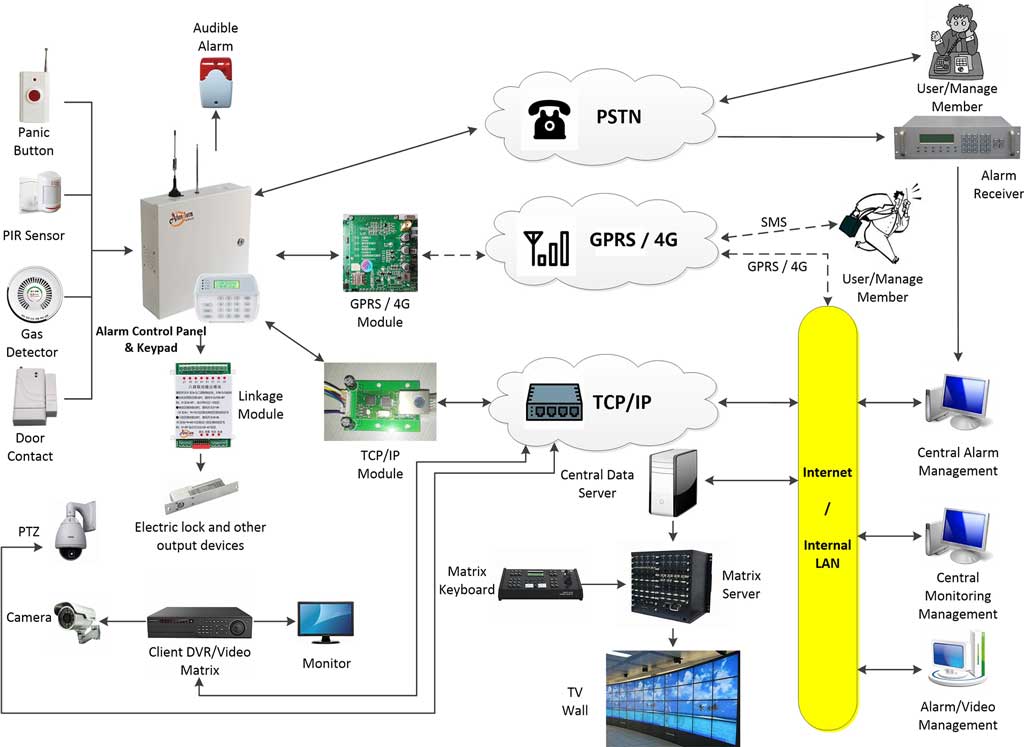
Burglar alarm monitoring occupies a specific position within the broader enterprise physical security stack. It operates as the detection and response layer, interfacing upstream with access control systems (ACS) that govern authorized entry and downstream with video management systems (VMS) that provide visual verification of triggered events. At the management layer, it connects to cloud dashboards, ERP platforms, and building management systems (BMS) through RESTful APIs for unified facility status reporting. The monitoring function itself — the CMS — is not a peripheral service; it is the operational consequence engine for the entire intrusion detection infrastructure.
3. Commercial Alarm Monitoring System Architecture: From Sensor to CMS
3.1 Physical Detection Layer
The architecture originates at the physical edge. Perimeter sensors — magnetic door contacts, window contacts, and glass break detectors — establish the first detection boundary at building entry points. Interior detection devices, primarily passive infrared (PIR) detectors and dual-technology sensors combining PIR with microwave motion detection, cover interior zones where perimeter protection is insufficient. Specialized sensors including panic buttons, hold-up devices, and seismic vault sensors serve environment-specific risk profiles in banking and high-value retail deployments.
Each physical sensor is wired to a specific input zone on the control panel. The zone assignment determines how the panel interprets sensor state changes and what alarm logic is executed in response. This zone-to-sensor mapping is not incidental — misconfigured zone assignments are a primary source of operational failure during commissioning.
3.2 Control Panel as the Edge Intelligence Layer
The control panel functions as the autonomous edge processing unit for the entire detection architecture. It continuously polls all connected zones, monitors supervision loop integrity via End-of-Line (EOL) resistors, and applies programmed logic to sensor state changes. This logic includes entry and exit delay management, cross-zoning verification requirements, partition management, and local siren activation sequences.
Cross-zoning is a significant reliability mechanism: it requires two independently triggered sensor zones to activate before the panel generates a full alarm condition. This reduces false alarm dispatch rates in environments where single-sensor triggers are operationally unreliable due to HVAC airflow, thermal gradients, or mechanical vibration. The control panel executes this logic locally, independent of any network connection, preserving alarm functionality even when WAN connectivity is unavailable.
3.3 Communication Layer
The communication module, physically connected to the control panel via serial bus, receives packaged alarm event codes and routes them over the transmission network. In commercial deployments, this module supports both IP (primary) and cellular LTE (secondary) communication paths simultaneously. The dual-path architecture is not a redundancy feature in the traditional sense — it is a continuous parallel monitoring configuration in which automatic failover to the secondary cellular path occurs without operator intervention when the primary IP path fails.
3.4 Central Monitoring Station Infrastructure
The CMS receiver decodes incoming encrypted payloads, decapsulates the alarm event data, and routes the parsed signal to the automation software platform. The automation software maps the incoming event codes against the registered account profile, applies pre-configured Standard Operating Procedures (SOPs), and presents prioritized events to available operators. The receiver infrastructure in a UL-listed CMS is itself a redundant system: dual receiver hardware, backup power, and geographically separated failover facilities are standard requirements for certified monitoring operations.
| Layer | Primary Function | Failure Impact |
|---|---|---|
| Physical Detection | Sensor state change detection | Undetected breach |
| Control Panel | Edge logic, zone supervision | False or missed alarm activation |
| Communication Module | Encrypted payload transmission | Signal delivery failure |
| CMS Receiver | Decoding, routing, automation | No operator alert generated |
| Operator | Verification and dispatch | No emergency response |
4. How Alarm Events Move Through the Monitoring Workflow
4.1 Event Detection and Signal Validation
The alarm workflow initiates when a sensor registers a state change — a door contact opening, a motion detector crossing its detection threshold, or a glass break detector registering the acoustic signature of breaking glass. The control panel reads this state change against its current armed/disarmed partition status. If the zone is armed and the sensor triggers, the panel begins executing its programmed response logic.
Signal validation occurs at the panel level before any external transmission. Entry delay zones allow a grace period during which a valid user code entry cancels the alarm sequence. Cross-zone configurations require confirmation from a second sensor zone before the panel escalates to full alarm status. This pre-transmission verification step is the primary technical mechanism for reducing false dispatch rates without compromising detection sensitivity.
4.2 Alarm Generation and Event Transmission
Once the panel determines that alarm conditions are confirmed, it packages an alarm event code — formatted in either SIA DC-09 or Contact ID protocol — and passes it to the communication module. The communicator encrypts this payload and transmits it over the active communication path. If the primary IP path is available, transmission occurs over the broadband connection. If the IP path has failed, the communicator routes automatically over the cellular LTE path without delay or manual intervention.
4.3 CMS Processing and Operator Verification
The CMS receiver acknowledges receipt of the encrypted payload, decrypts the data, and routes the decoded event to the automation software. The software matches the incoming zone and event codes against the account record, identifies the event type and priority level, and presents the alarm to the next available operator. Standard CMS operation targets signal receipt within two to five seconds of transmission initiation.
The operator validates the event by reviewing the account profile, checking for scheduled testing periods that would explain a legitimate signal, and attempting contact with designated account holders. If the alarm is unresolved after contact attempts, the operator executes emergency dispatch according to the account’s SOP. Full event logging occurs continuously throughout this sequence, generating an auditable record for insurance claims, incident investigations, and regulatory audits.
4.4 Typical Timeline Benchmarks
| Phase | Benchmark Target |
|---|---|
| Detection to transmission | < 1 second (panel processing) |
| Transmission to CMS receipt | 2–5 seconds |
| CMS processing to operator alert | Immediate (automation software) |
| Operator verification and dispatch | < 30 seconds total |
The 30-second total response window — from signal receipt to emergency dispatch initiation — represents the operational standard for high-security commercial monitoring environments.
5. Signal Transmission Engineering: Why Reliable Delivery Matters More Than Detection
5.1 Primary Communication Paths
Three communication media are available for alarm signal transmission: IP broadband, cellular LTE/GSM, and legacy POTS (Plain Old Telephone Service) copper landlines. Each carries a distinct reliability and vulnerability profile.
IP broadband delivers the highest data throughput and lowest per-event transmission latency. Its operational weakness is shared infrastructure dependency: the same ISP circuit and routing equipment that supports general business operations also carries alarm signals. A local network equipment failure, ISP outage, or deliberate broadband line cut removes the IP communication path entirely.
Cellular LTE operates on independent carrier infrastructure and is physically difficult to disrupt from the protected site. Its primary vulnerabilities in commercial deployments are deep interior signal attenuation — particularly in reinforced concrete and steel structures — and carrier network congestion during high-demand events. Cellular communicators require adequate signal strength at the installation location, which must be verified during commissioning rather than assumed.
POTS landlines are operationally obsolete for commercial monitoring. Physical wire cuts disable POTS paths trivially. The copper network infrastructure is being actively decommissioned across multiple markets. Crucially, POTS bandwidth is insufficient to support modern transmission protocols, limiting it to legacy Contact ID DTMF tone transmission and preventing the delivery of rich diagnostic payloads that modern CMS automation software requires.
5.2 Dual-Path and Tri-Path Failover Architecture
Commercial deployments rely on dual-path communication as the baseline reliability architecture. In dual-path operation, the communicator maintains active monitoring of both the IP and cellular paths simultaneously. Path failure detection and failover execution are automatic — no CMS notification, operator action, or panel interaction is required for the secondary path to become active. This automatic failover characteristic is the critical reliability distinction between a dual-path communicator and a simple backup communicator that requires manual activation.
Tri-path configurations, incorporating IP, cellular, and an additional redundant path, are deployed in environments where transmission SLA compliance is subject to contractual or regulatory enforcement.
5.3 Alarm Transmission Protocols: SIA DC-09 and Contact ID
| Feature | SIA DC-09 | Contact ID (Ademco) |
|---|---|---|
| Transport | TCP/IP or UDP over cellular | DTMF tones over analog circuit |
| Payload capacity | Rich: zone names, partition status, diagnostics | Limited: numeric event codes only |
| Encryption | AES-128 or AES-256 | None (inherently analog) |
| Modern network compatibility | Native | Requires encapsulation |
| Obsolescence status | Current commercial standard | Legacy; backward compatibility only |
SIA DC-09 is the current industry standard for commercial alarm transmission over IP and cellular networks. It encapsulates alarm event data in TCP or UDP packets encrypted with AES-128 or AES-256, and supports rich payload structures that include zone descriptors, partition status, and system diagnostic information. This payload richness enables CMS automation software to present operators with contextually detailed event records rather than numeric codes requiring manual lookup.
Contact ID remains relevant only as a backward-compatibility encapsulation format. Modern communicators that support IP and cellular transmission frequently encapsulate Contact ID payloads for interoperability with older panels that cannot generate native SIA DC-09 output. However, Contact ID’s limited payload structure and absence of native encryption make it unsuitable as a primary transmission protocol for new commercial deployments.
5.4 Encryption Requirements
AES-128 provides the minimum encryption baseline for commercial alarm transmission. AES-256 is preferred in deployments subject to financial sector, critical infrastructure, or government security standards. Encryption is applied at the communicator before transmission and decrypted at the CMS receiver — the network infrastructure between these endpoints handles only the encrypted payload and has no access to the underlying alarm data.
5.5 Communication Failure Scenarios
The most operationally damaging communication failures are those that are invisible at the panel level. A network firewall rule blocking outbound port 50000 — the default UDP port for many SIA DC-09 implementations — will cause every transmission attempt to time out silently from the panel’s perspective. The control panel may show no fault condition while being completely unable to deliver events to the CMS. This class of failure is identified only through scheduled end-to-end signal testing, not through panel diagnostic indicators alone.
6. Engineering Realities Behind Alarm Monitoring Reliability
6.1 False Alarm Sources and Operational Consequences
False alarms represent the primary operational friction in commercial alarm monitoring. Their consequences extend beyond inconvenience: repeated false dispatches trigger alarm fatigue in CMS operators, erode the credibility of legitimate signals, and in jurisdictions that enforce verified alarm response policies, result in the withdrawal of law enforcement dispatch — forcing facility operators to contract guard response services or implement video verification upgrades at significant additional cost.
False alarm generation is rarely attributable to hardware malfunction. The dominant causes are environmental interference, commissioning errors, and user behavior.
6.2 Sensor Placement Mistakes and Environmental Interference
Passive infrared (PIR) detectors operate by measuring differential thermal radiation in their detection field. Mounting a PIR directly in front of an HVAC diffuser creates a continuous source of thermal variation that produces repeated motion triggers when the system is armed and the HVAC system cycles. Large bay windows in commercial facilities present a similar problem: solar thermal loading across the detection field during early morning hours generates false triggers with predictable regularity.
In warehousing environments, standard single-technology PIR detectors face additional challenges from forklift exhaust heat, large inventory masses that create thermal boundaries, and the mechanical vibration transmitted through concrete floors. Dual-technology sensors — combining PIR detection with microwave Doppler motion analysis — address this by requiring simultaneous confirmation from both detection technologies before generating a zone trigger. A thermal source without associated physical motion does not satisfy the dual-technology threshold.
6.3 Voltage Drop and Long Cable Runs
The RS-485 peripheral bus used to connect keypads, zone expanders, and remote output modules to the control panel has defined cable length limitations based on wire gauge (AWG) and the aggregate current draw of all connected peripherals. In large commercial facilities — distribution centers exceeding 100,000 square feet, multi-level parking structures, campus environments with satellite buildings — cable runs routinely approach or exceed these limits.
Voltage drop along extended RS-485 runs causes peripheral devices to operate intermittently, generating supervision fault conditions that appear as tamper alerts or system errors on the panel. Diagnostically, these faults are distinguishable from genuine tamper events because they correlate with peripheral location relative to the panel and disappear when the affected device is tested with a local power source. Mitigation requires either reducing cable run length through repeater insertion, selecting heavier AWG wire, or redistributing peripheral load across multiple bus segments.
6.4 EOL Resistor Drift and Supervision Failures
End-of-Line (EOL) resistors are installed at the terminal end of each supervised zone loop. The control panel continuously measures the loop resistance and interprets deviations from the expected resistance value as either a fault (open circuit), tamper (short circuit), or alarm condition. EOL resistors are passive components, but their effective resistance value can drift over time due to terminal corrosion, moisture ingress at junction boxes, or mechanical stress on splice connections.
As EOL resistance drifts, the control panel reads fluctuating resistance values that may periodically cross zone threshold boundaries while the system is armed. This produces phantom alarms — alarm activations with no corresponding physical detection event — that are diagnostically identified by their correlation with temperature and humidity changes in the zone wiring environment. Corrective action requires either terminal cleaning and re-termination or resistor replacement at the affected zone end.
6.5 Cellular Coverage Challenges in Commercial Structures
Steel-reinforced concrete construction — standard in commercial, industrial, and multi-story facilities — attenuates cellular RF signals progressively with interior depth. Communications equipment rooms, server rooms, and basement security closets are common installation locations for control panel and communicator hardware, frequently corresponding to the locations of maximum cellular attenuation within a building.
Cellular signal strength at the communicator installation location must be measured during site survey, not assumed from exterior carrier coverage maps. Where coverage is inadequate, external cellular antenna installation with appropriate low-loss coaxial cabling provides the necessary signal improvement. Accepting marginal cellular signal strength at commissioning guarantees periodic communication failures that the installation team will diagnose remotely as intermittent CMS connectivity problems months after the original deployment.
| Failure Mode | Root Cause | Diagnostic Indicator | Mitigation |
|---|---|---|---|
| HVAC-triggered PIR alarms | Thermal airflow across detection field | Alarms correlate with HVAC cycles | Relocate sensor or use dual-tech |
| RS-485 peripheral dropouts | Voltage drop on extended cable runs | Intermittent fault at specific devices | Repeater insertion or AWG upgrade |
| EOL resistance phantom alarms | Terminal corrosion or splice degradation | Alarms correlate with environmental conditions | Re-termination or resistor replacement |
| Cellular transmission failure | Building RF attenuation | Persistent “Comm Trouble” panel fault | External antenna with low-loss coaxial |
| Silent IP transmission failure | Firewall port blocking | No panel fault; signal testing failure | Port configuration audit and end-to-end test |
7. Inside the Central Monitoring Station
7.1 CMS Receiver Infrastructure
The CMS receiver is purpose-built hardware that accepts incoming encrypted alarm transmissions, manages protocol acknowledgment (ACK) handshakes, and routes decoded event data into the automation software platform. Commercial-grade CMS receivers maintain persistent connection monitoring with each registered communicator — the absence of a scheduled supervisory poll from a communicator triggers a “failure to communicate” event in the automation software, alerting operators to a potential transmission path problem before an actual alarm event fails to deliver.
Receiver infrastructure in certified monitoring centers is itself redundant. Dual receiver hardware with hot standby capability, continuous backup power from UPS systems with generator support, and geographic failover to secondary CMS facilities are standard requirements for monitoring operations certified under UL 1610 (Central-Station Burglar-Alarm Units).
7.2 Signal Decoding and Event Prioritization
Incoming SIA DC-09 packets are decrypted at the receiver using the shared cryptographic key established during account provisioning. The decoded payload is parsed to extract the event code, zone identifier, partition number, and account identifier. The automation software matches these parameters against the registered account record and applies the pre-configured SOP template to determine event priority, required contact list sequence, and dispatch thresholds.
Event prioritization distinguishes alarm signals by type — burglary, hold-up, supervisory, trouble — and routes high-priority events to available operators immediately while queuing lower-priority supervisory events. This prioritization ensures that genuine intrusion events are not queued behind supervisory fault notifications during periods of high signal volume.
7.3 Operator Verification Procedures
Upon receiving a prioritized alarm event, the CMS operator executes a structured verification protocol. The operator reviews the account record for scheduled test periods, recent alarm history, and any temporary dispatch suspension authorizations. If no exemption applies, the operator initiates the account’s contact list sequence — typically beginning with the primary account holder or on-site security contact — and attempts verbal confirmation of the alarm status.
Failure to establish contact within defined attempt thresholds, or positive confirmation of an intrusion event, triggers immediate emergency dispatch. The operator contacts the appropriate law enforcement or guard response service, provides account and site information, and remains engaged to coordinate response activities as needed.
7.4 Audit Trails and Event Logging
Every signal received, operator action taken, contact attempted, and dispatch initiated is logged with timestamp precision in the automation software’s event journal. These audit trails serve multiple operational functions: they provide the evidentiary record required for insurance claims following confirmed intrusion events, they support incident reconstruction during post-event analysis, and they demonstrate SLA compliance during regulatory audits. The completeness and tamper-evidence of event logging is a primary criterion in UL listing assessments for monitoring centers.
8. Compliance, Certifications, and Performance Benchmarks
8.1 UL Requirements
Underwriters Laboratories (UL) provides the primary certification framework for commercial alarm monitoring infrastructure in North America. UL 1610 governs Central-Station Burglar-Alarm Units, establishing requirements for CMS physical security, personnel staffing, equipment redundancy, power backup, and operational procedures. UL 827 addresses the Central-Station Alarm Services standard from a service delivery perspective. Specifying a UL-listed monitoring center for commercial deployments provides procurement teams with an objective, third-party validated baseline for CMS operational capability.
8.2 TMA Five Diamond Standards
The Monitoring Association (TMA) Five Diamond certification adds an operator training and procedural competency layer above hardware certification. Five Diamond status requires that all CMS operators complete TMA-approved training and testing, and that the monitoring center undergoes independent operational audits. This certification is the recognized industry benchmark for operator quality in commercial monitoring contracts and is frequently cited as a minimum requirement in enterprise security procurement specifications.
8.3 Insurance Requirements
Professional burglar alarm monitoring by a certified CMS is a standard condition in commercial property insurance policies for facilities exceeding defined risk thresholds. Insurers assess monitoring capability as a direct variable in premium calculation: facilities with UL-listed, dual-path monitored systems demonstrably qualify for reduced premiums relative to unmonitored or self-monitored equivalents. Non-compliance with monitoring requirements — either through system degradation or selection of non-certified providers — can void coverage for burglary-related losses.
8.4 SLA Expectations and Response Time Benchmarks
| Performance Metric | Commercial Benchmark |
|---|---|
| Signal receipt at CMS | 2–5 seconds post-transmission |
| Operator alert generation | Immediate (automation software) |
| Total verification and dispatch | < 30 seconds |
| Supervisory poll interval | Typically every 24 hours or 3 minutes (supervised) |
| Backup power duration | Minimum 4 hours (UL); commercial standard 24+ hours |
| Standard | Governing Body | Primary Relevance |
|---|---|---|
| UL 1610 | Underwriters Laboratories | CMS physical and operational requirements |
| UL 827 | Underwriters Laboratories | Central-station alarm service delivery |
| TMA Five Diamond | The Monitoring Association | Operator training and procedural audit |
| SIA DC-09 | Security Industry Association | Transmission protocol standard |
9. Professional Monitoring vs. Self-Monitoring for Commercial Operations
9.1 Operational Differences
Self-monitoring — in which alarm notifications are routed to the facility operator’s mobile device rather than a staffed CMS — transfers the entire verification and dispatch burden to the account holder. The practical consequence is response capability that is bounded by the account holder’s availability, attention, and physical ability to act on an alarm notification. During travel, sleep, or periods of notification fatigue after repeated false alarms, self-monitored systems provide no guaranteed response capability.
Professional CMS monitoring eliminates availability dependency. The CMS is staffed continuously, operates under defined SOPs that do not require per-event decision-making, and executes dispatch within contractual time limits regardless of account holder availability.
9.2 Risk Exposure Differences
The risk differential between professional and self-monitoring is measurable in terms of verified dispatch reliability. A professional CMS operates under UL certification and contractual SLA obligations that create accountability for response performance. Self-monitoring systems have no equivalent accountability structure — if the account holder fails to respond to a notification, the system has no fallback execution path.
For facilities subject to regulatory security requirements, insurance mandates, or contractual security obligations, self-monitoring typically fails to satisfy compliance criteria. The absence of a certified third-party monitoring record — with timestamped signal receipt, contact attempts, and dispatch logs — leaves the facility unable to demonstrate compliance during audits or substantiate insurance claims following loss events.
9.3 When Self-Monitoring Fails in Commercial Use Cases
The failure profile of self-monitoring becomes acute under specific commercial conditions: multi-site operations where no single account holder can maintain availability across all locations simultaneously; critical infrastructure where response time SLAs are regulatory obligations; high-value inventory environments where loss events occur predominantly during off-hours; and any facility where staff turnover creates gaps in notification list maintenance. These conditions represent standard operating realities for commercial operators, not edge cases.
| Capability | Self-Monitoring | Professional Monitoring |
|---|---|---|
| Availability | Account holder dependent | 24/7 staffed CMS |
| Verification | Manual, delayed | Operator-assisted, immediate |
| Emergency dispatch | Account holder initiated | CMS SOP-driven, < 30 seconds |
| Audit trail | Incomplete or absent | Full event log, UL-compliant |
| Insurance compliance | Frequently non-compliant | Certified, auditable |
| Multi-site management | Operationally impractical | Centralized dashboard |
10. Integration with Modern Enterprise Security Platforms
10.1 Video Verification
The integration of the alarm monitoring system with a Video Management System (VMS) converts alarm events from signal-only notifications into visually verified incidents. The control panel → VMS integration path works as follows: an alarm activation on a defined zone triggers the VMS to tag the corresponding camera feed with a timestamped alarm marker and, in systems configured for CMS video push, deliver a pre-alarm and post-alarm video clip to the monitoring center simultaneously with the alarm signal.
Video verification materially changes the dispatch calculus at the CMS. An operator who can visually confirm an active intrusion can execute dispatch with higher confidence and priority. Conversely, a video feed showing no physical presence after a sensor trigger provides grounds for downgrading the dispatch response, reducing unnecessary law enforcement deployment and preserving operator credibility with responding agencies.
10.2 Access Control Synchronization
Access control system (ACS) integration creates operational automation at the arming and disarming boundary. When a credentialed user presents a valid card or credential at a designated entry reader, the ACS can signal the alarm panel to disarm the relevant partition automatically — eliminating the manual keypad entry step and the associated user error that generates a significant proportion of false alarms in commercial deployments. The reverse process — automatic arming when the last credentialed user exits the facility — enforces arming discipline without requiring staff coordination.
ACS and alarm system integration also enables more granular user access management. Changes to user credentials in the ACS can be synchronized to alarm panel user codes, ensuring that terminated employees cannot use previously issued codes to generate false arming or disarming events.
10.3 Cloud Management Platforms
Cloud-based alarm management overlays enable centralized visibility and control across multiple panel deployments without requiring on-site access to individual panels. Security managers can review real-time armed/disarmed status, examine event logs, push firmware updates, and adjust panel configurations remotely through authenticated cloud portals. For multi-site enterprise operators managing dozens to hundreds of panel deployments, cloud management is not an optional feature — it is the operational infrastructure that makes centralized security administration feasible.
10.4 Geofencing and API Integration
Geofencing integration links alarm arming and disarming schedules to GPS-based user location data. When authorized personnel approach or depart the facility perimeter, the alarm system can arm or disarm automatically based on geofence boundary crossing. This automation eliminates manual arming errors and provides a documented arming event record tied to a specific user’s location.
Open API architectures — particularly REST API and ONVIF interfaces — enable the alarm system to exchange event data with ERP platforms, BMS systems, and third-party analytics engines. Alarm activation events can automatically trigger facility management workflows: generating incident tickets in facility management software, triggering HVAC or lighting responses in the BMS, or populating loss event records in ERP systems for insurance claim preparation.
11. Deployment Architectures by Industry Scenario
11.1 Retail and Banking
The risk profile in retail and banking centers on armed robbery, after-hours burglary of high-value assets, and internal theft. Architectural requirements in these environments include hold-up (panic) buttons at cashier positions and manager stations with direct CMS dispatch protocols that bypass standard verification delays, dual-path communication as a non-negotiable baseline, and seismic vault sensors in banking environments that detect attack on vault structures through vibration and acoustic signature analysis.
User code management is operationally significant in retail: high staff turnover demands disciplined user code provisioning and deactivation procedures integrated with HR workflows. Multi-site retail operators require centralized cloud management to enforce code policies across all locations without requiring on-site integrator visits for each user change.
11.2 Warehousing and Logistics
Warehousing environments present distinct architectural challenges. Large floor areas — facilities exceeding 200,000 square feet are not unusual in logistics operations — require correspondingly large numbers of interior detection zones. Standard PIR detectors are poorly suited to these environments: forklift exhaust, thermal gradients from large exterior door cycling, and the physical obstruction created by racking and inventory create high false alarm rates. Dual-technology sensors addressing both thermal and Doppler motion confirmation are the appropriate specification for warehouse interior detection.
Extended RS-485 bus runs across large warehouse footprints introduce voltage drop risks for wired peripheral devices. Metal racking structures create RF attenuation zones that wireless sensor deployments must account for through repeater placement — verified by RF survey rather than assumed from product specifications. Perimeter detection around vehicle access points requires ruggedized outdoor contacts capable of surviving the mechanical stress of frequent large-format door operation.
11.3 Multi-Site Corporate Enterprises
Corporate enterprise deployments prioritize ACS integration and cloud management above detection hardware specificity. The dominant risk — unauthorized after-hours access by individuals who possess building knowledge but lack current credentials — is addressed through tight ACS and alarm system synchronization. Valid credential use automatically manages alarm partition status, while invalid credential attempts generate both ACS audit events and alarm notifications simultaneously.
Cloud management platforms are operationally essential for multi-site corporate operations. Security operations teams require centralized dashboards showing real-time armed/disarmed status, active faults, and communication path health for every panel in the estate. Without centralized visibility, multi-site alarm management requires individual site access for routine status verification — an operationally unsustainable model at scale.
| Industry | Primary Risk Model | Architecture Priority |
|---|---|---|
| Retail and Banking | Armed robbery, after-hours burglary | Dual-path communication, hold-up integration, cloud user management |
| Warehousing and Logistics | Perimeter breach, inventory theft | Dual-tech sensors, RS-485 bus planning, RF survey for wireless |
| Multi-Site Corporate | Unauthorized access, intellectual property | ACS synchronization, cloud management, centralized dashboards |
| Critical Infrastructure | Sabotage, forced entry | Tri-path communication, redundant detection layers, strict SLA compliance |
12. Engineering Trade-Offs Every Security Integrator Must Understand
12.1 Wired vs. Commercial Wireless Detection
Wired detection offers the highest long-term reliability and lowest per-device maintenance burden. A properly installed wired zone — correct AWG selection, supervised EOL loop, correctly installed terminations — operates without battery management concerns for the life of the installation. The trade-off is installation labor cost and the physical constraints of cable routing in occupied commercial facilities where concealed wiring is not always accessible.
Commercial wireless detection platforms, such as PowerG operating at 915MHz with frequency-hopping spread spectrum (FHSS) and encrypted payloads, reduce installation time significantly and enable sensor placement in locations that wired installation cannot economically reach. The operational trade-off is transferred to ongoing battery management and periodic RF environment verification. Battery replacement cycles for wireless sensors range from two to seven years depending on sensor type and transmission frequency — a maintenance overhead that must be factored into O&M contract pricing for commercial deployments.
12.2 Sensitivity vs. False Alarm Rate
Detection sensitivity and false alarm rate exist in direct tension. Configuring PIR detectors at maximum sensitivity guarantees that low-mass, slow-moving targets are detected — but also guarantees that environmental variations that would not register at standard sensitivity settings produce zone triggers. Cross-zoning is the primary engineering mechanism for managing this trade-off: by requiring two independent sensor zones to trigger before the panel generates a full alarm condition, the system maintains high detection capability while imposing a logical verification requirement that environmental noise sources are unlikely to satisfy simultaneously.
12.3 Edge Processing vs. Cloud-Dependent Logic
Cloud-based management and analytics platforms provide genuine operational value for multi-site management, remote diagnostics, and AI-driven event analysis. The critical engineering constraint is that cloud dependence must not extend to core alarm processing logic. The control panel must execute all intrusion detection, zone supervision, delay management, and local siren activation functions independently of network connectivity. Cloud platforms serve as management and reporting overlays; the alarm system’s functional integrity cannot be contingent on WAN availability.
This distinction has direct consequences for product selection: alarm panels that rely on cloud connectivity to execute core alarm logic introduce a WAN outage as a single point of failure for the entire detection system. Engineering discipline requires that cloud dependency be bounded to non-life-safety functions.
12.4 Redundancy vs. Operational Expenditure
Single-path IP communication has no recurring carrier cost beyond the existing site ISP service. Dual-path operation adds a monthly SIM card and cellular data service cost for the LTE secondary path. This recurring Opex is the operational cost of transmission reliability: during a power outage that simultaneously disrupts the local ISP service, the cellular path is the sole channel through which the alarm system can deliver events to the CMS. The probability of a simultaneous ISP and power outage is precisely the scenario most correlated with deliberate intrusion — making the Opex trade-off straightforward for commercial risk analysis.
| Trade-Off Decision | Primary Benefit | Primary Limitation |
|---|---|---|
| Wired detection | Long-term reliability, no battery O&M | High installation labor cost |
| Commercial wireless detection | Flexible placement, rapid installation | Ongoing battery management, RF verification |
| High sensitivity configuration | Maximum detection capability | Elevated false alarm rate |
| Cross-zoning | Reduced false dispatch rate | Requires multiple sensor coverage per zone |
| Edge processing priority | WAN-independent alarm function | Limited remote management capability |
| Cloud management overlay | Centralized multi-site visibility | WAN dependency for management functions |
| Dual-path communication | Transmission continuity during ISP failure | Recurring cellular Opex |
13. Conclusion: Monitoring Is an Operational System, Not Just an Alarm Service
Commercial burglar alarm monitoring is an engineered operational chain in which each component layer — physical detection, edge processing, encrypted transmission, CMS reception, and operator dispatch — is a functional dependency for the layer that follows it. The failure of any single layer negates the operational value of every layer preceding it. This is the engineering reality that distinguishes a monitoring architecture designed for genuine commercial reliability from one designed to satisfy a procurement checkbox.
13.1 Key Architectural Takeaways
The control panel is the edge intelligence node. Its programming — zone types, cross-zoning logic, entry/exit delays, reporting codes — determines whether the detection layer produces actionable signals or operational noise. Programming errors at commissioning are the most cost-effective point of failure to prevent and among the most expensive to diagnose after deployment.
SIA DC-09 over dual-path IP and cellular is the current baseline transmission architecture for commercial deployments. Legacy Contact ID over POTS is an obsolescence liability. AES-128 encryption is the minimum acceptable standard; AES-256 is appropriate where regulatory or contractual requirements impose higher security standards.
The CMS is not a passive receiver — it is an active operational system with its own redundancy requirements, personnel certifications, and SLA obligations. UL 1610 and TMA Five Diamond certification provide the objective verification framework for CMS operational capability.
13.2 Deployment Priorities
End-to-end signal testing — from panel alarm activation through CMS event receipt and operator notification — is the only reliable method for confirming that a commissioned system will perform as designed. Panel-level diagnostics confirm local operation; they cannot confirm transmission path integrity, CMS receiver compatibility, or automation software mapping accuracy. Signal testing must be performed at commissioning and on a scheduled periodic basis throughout the operational life of the system.
13.3 Future-Proofing Recommendations
Architectural decisions made at deployment determine the system’s capacity to incorporate video verification, ACS synchronization, cloud management, and API integration as operational requirements evolve. Panels with open protocol support and cloud connectivity options preserve this architectural flexibility. Proprietary closed systems that cannot expose alarm events to external platforms through documented APIs impose costly rip-and-replace upgrade cycles when integration requirements change. Specifying interoperability capability alongside detection and transmission performance is the forward-looking approach to commercial alarm monitoring investment.
14. FAQ
Q: What is commercial burglar alarm monitoring?
Commercial burglar alarm monitoring is the continuous professional process of receiving encrypted intrusion detection events from a remote alarm system, verifying those events through trained CMS operators, and executing emergency dispatch within defined SLA timeframes. It differs from standalone alarms by extending detection consequences beyond the physical site through verified, documented response — 24 hours per day, independent of account holder availability.
Q: How does a monitored alarm system work?
A sensor detects a physical event and changes zone state at the control panel. The panel validates the signal against its programmed logic, packages an event code, and passes it to the communication module. The communicator encrypts the payload in SIA DC-09 format and transmits it over IP or cellular to the CMS receiver. The CMS decodes the signal, routes it to automation software, and presents it to an operator for verification and dispatch execution.
Q: What is the difference between SIA DC-09 and Contact ID?
SIA DC-09 is the current commercial standard: it transmits encrypted alarm data over IP or cellular networks using TCP/UDP packets with AES-128 or AES-256 encryption, supporting rich payloads including zone names and diagnostic data. Contact ID is a legacy DTMF-based protocol developed for analog POTS transmission. It carries only numeric event codes with no encryption. Modern communicators may encapsulate Contact ID for backward compatibility, but SIA DC-09 is the required protocol for new commercial deployments.
Q: How does dual-path alarm communication failover work?
The communicator simultaneously monitors both the primary IP path and the secondary cellular LTE path. When the primary IP path fails — due to ISP outage, router failure, or physical line disruption — the communicator routes subsequent transmissions automatically over the cellular path without delay or manual intervention. This automatic failover behavior is inherent to dual-path communicator design; it does not require CMS action or panel reprogramming to execute.
Q: Why do commercial alarm systems generate false alarms?
The dominant causes are sensor placement errors — mounting PIR detectors facing HVAC outlets or windows with high thermal variation — and commissioning misconfiguration of entry/exit delays and sensitivity zones. Environmental interference from HVAC airflow, forklift exhaust in warehouses, and solar thermal loading across large windows generates detector triggers that are indistinguishable from human motion at the sensor level. Cross-zoning, dual-technology sensors, and careful placement during site survey are the primary engineering mitigations.
Q: What is cross-zoning in alarm programming?
Cross-zoning requires two independently triggered sensor zones to activate before the control panel generates a full alarm condition. If only one zone triggers, the panel registers a potential alarm but does not initiate transmission or siren activation until the second zone confirms. This logic reduces false dispatch rates in environments where single-sensor triggers are unreliable, without reducing the overall detection coverage of the zone layout.
Q: How do EOL resistors improve alarm system reliability?
End-of-Line resistors are installed at the terminal end of each supervised zone loop. The control panel continuously measures the loop resistance value and interprets specific resistance bands as normal, open circuit (fault), or short circuit (tamper). This continuous supervision detects wiring damage, sensor tampering, and terminal degradation without requiring active signal events. Without EOL supervision, a severed zone circuit produces the same panel reading as a normal closed loop — making tamper-based circumvention of the detection layer undetectable.
Q: What certifications should a commercial monitoring center have?
UL 1610 (Central-Station Burglar-Alarm Units) establishes baseline operational requirements for CMS physical infrastructure, redundancy, staffing, and procedures. TMA Five Diamond certification adds operator training and procedural audit requirements above the hardware baseline. Both certifications together represent the recognized commercial standard for CMS operational capability. These certifications are verifiable through the certifying bodies’ public registries and should be specified as minimum requirements in commercial monitoring contracts.
Q: Is professional alarm monitoring required for insurance compliance?
For commercial properties above defined risk thresholds, professional monitoring by a certified CMS is typically a condition of burglary coverage in commercial property insurance policies. Insurers use monitoring certification status as a direct variable in premium assessment and coverage eligibility. Self-monitoring systems without a certified third-party CMS generating auditable event logs frequently fail to satisfy policy conditions, leaving facilities without coverage for burglary-related losses even when a monitored alarm system is physically installed.
Q: Can alarm monitoring integrate with video surveillance systems?
Yes. The control panel → VMS integration path allows alarm zone activations to trigger timestamped video tagging and, in systems configured for CMS video push, delivery of pre-alarm and post-alarm video clips to the monitoring center simultaneously with the alarm signal. This integration enables visual verification of alarm events before dispatch, reducing unnecessary law enforcement response and providing operators with visual confirmation context that numeric alarm codes alone cannot supply.
Q: How does alarm monitoring integrate with access control systems?
The ACS can signal the alarm panel to arm or disarm specific partitions based on credential events at designated readers. A valid credential entry at the primary access point automatically disarms the relevant alarm partition; the last valid departure can trigger automatic arming. This integration eliminates manual keypad-based arming and disarming — a significant source of false alarms in commercial deployments — and provides synchronized audit records correlating user access events with alarm system state changes.
Q: What are the advantages of cloud-managed alarm systems for multi-site enterprises?
Cloud management platforms provide real-time centralized visibility into armed/disarmed status, active faults, communication path health, and event logs for every panel in a multi-site deployment. Security administrators can push firmware updates, adjust panel configurations, and review system health remotely without requiring on-site technician visits for routine management tasks. At scale — managing dozens to hundreds of panels across geographically distributed sites — centralized cloud management is operationally necessary, not discretionary.
