
Intruder Alarm System Selection and Implementation for Banking Facilities
Selecting an Intruder Alarm System for a banking facility is not a hardware decision. It is a decision that must account for the bank’s threat environment, the response capability available to act on an alarm, human-safety conditions during an active robbery, the facility’s layout and coverage requirements, applicable compliance references, false-alarm exposure, and the ongoing maintenance and training needed to keep the system operationally ready. These seven dimensions are connected, and a system that performs well on one dimension while remaining mismatched on another does not deliver a workable security outcome for a bank. The sections below address each dimension in turn and close with a synthesis check for confirming whether a proposed Intruder Alarm System approach is genuinely suited to a specific banking facility.
1. Start with the Bank’s Threat Environment
Alarm selection should begin with the threat conditions the facility actually faces — robbery, theft, fraud-related exposure, and fire or arson risk — rather than with a generic alarm configuration. A configuration that is appropriate for one bank branch is not automatically appropriate for another, because the relevant threats, the response conditions, and the physical layout differ from site to site.
1.1 Match Alarm Selection to the Actual Threat Context
Treating threat assessment as the starting point matters because an Intruder Alarm System is only as useful as its fit to the conditions it is meant to address. A system selected without reference to the bank’s specific threat exposure may detect intrusion events technically while still failing to support an appropriate response — for example, by activating in a way that is unsuitable for a robbery-in-progress scenario, or by leaving areas uncovered that are relevant to the facility’s actual risk profile. Threat-specific selection is therefore treated here as a decision input, not as a general commentary on banking risk, fraud, or cybersecurity, which remain outside the scope of this evaluation.
1.2 Evaluate the Response Capability Alongside the Threat
Threat environment identifies what the alarm system needs to address; response capability determines whether the selected alarm behavior is operationally meaningful once activated. An alarm is only useful if the information it generates can reach the people or monitoring function responsible for responding, and if that response function is actually available under the facility’s operating conditions. This response relationship — including the role of IP, cellular, and radio communication in transmitting alarm information — is addressed in full in Section 4; at the selection stage, it should be treated as a second foundational constraint alongside the threat environment, not as an afterthought once equipment has already been chosen.
2. Match Alarm Behavior to Robbery and Human-Safety Conditions
Silent or discreet alarm activation is particularly relevant to robbery scenarios because audible activation during an active robbery may alert or provoke the individuals involved, increasing risk to staff and customers. This is the central safety-driven distinction in bank alarm-system selection, and it should be evaluated before any broader coverage or communication decisions are made.
2.1 Why Silent Alarms Matter During Robbery
In an active robbery, the priority shifts from deterrence to human safety. An audible alarm, by design, signals to everyone present — including the person committing the robbery — that an alarm has been triggered. Where the response context involves an ongoing confrontation, that signal can escalate the situation. Silent alarm activation, including discreet panic-button use, allows staff to notify a response function without alerting the individuals responsible for the threat, which is why the source context specifically associates silent and discreet activation with robbery response rather than with intrusion detection generally.
2.2 Audible and Silent Alarms Are Context-Dependent
Audible and silent alarm behavior should not be treated as universally superior alternatives. Audible alarms remain relevant to deterring or interrupting unauthorized entry outside of an active robbery confrontation, while silent alarms address the escalation risk specific to robbery. Which behavior is appropriate depends on the threat scenario and the response conditions available at the facility, not on a fixed rule that applies to every banking environment. Selection decisions should therefore evaluate alarm behavior against the scenario it is intended to address rather than defaulting to one mode across all threat types.
2.3 Panic and Discreet Activation Options
Panic buttons and wearable panic devices are relevant within this robbery-specific, discreet-activation context. Their role, as supported here, is to allow staff to trigger a silent alarm response without requiring an audible system activation. Device-level specifications, placement, or performance characteristics are not established at this level of evaluation and are not addressed here; the relevant decision point is that discreet activation options exist and are tied specifically to robbery and human-safety conditions.
3. Translate Facility Layout into Detection Coverage
Complex banking facilities may require multiple, layered detection points rather than a single-point alarm configuration, because architectural areas and access points within the same facility can carry different risk and coverage requirements.
3.1 Identify Areas That Require Different Detection Consideration
Banking facilities are rarely uniform spaces. Vaults, ATM lobbies, teller areas, multiple floors, rear access points, and ATM-only sites each present a different combination of access patterns and asset exposure. A single detection point sized for one of these areas does not necessarily provide adequate coverage for the others. Evaluating facility layout as part of alarm selection means identifying which of these areas are present at a given site and treating each as a distinct coverage consideration rather than assuming one configuration serves the entire facility.
3.2 Use Layered Detection Where Facility Complexity Requires It
Where a facility’s layout is complex, layered detection — combining motion, glass-break, and vibration sensing across the relevant areas — is a supported approach for addressing that complexity. Motion detection, glass-break detection, and vibration sensing each respond to a different type of intrusion behavior, and using them together across a facility’s higher-risk or higher-complexity areas reduces the likelihood that a single detection method leaves a relevant area unprotected. This evaluation stops at the level of which detection types are relevant to which areas; detector placement calculations, coverage ranges, and installation-level specifications are engineering details outside the scope of this selection-level discussion.
4. Match Communication and Response Capability
IP, cellular, and radio are the communication methods relevant to transmitting alarm information to a response function, and redundant communication channels are recommended without a specific architecture being established.
4.1 Evaluate Communication Methods in the Context of Response
An Intruder Alarm System’s communication method determines how alarm information reaches the monitoring or response function once an alarm is activated. IP, cellular, and radio are each viable methods for this transmission. Evaluating which of these fits a given facility depends on the response capability and site conditions at that location — for example, whether a reliable IP connection is available, whether cellular coverage is adequate, or whether radio communication is already part of the facility’s operational environment. The relevant decision point is functional: does the communication method reliably connect alarm activation to the people or systems responsible for responding.
4.2 Consider Communication Redundancy Without Assuming an Architecture
Redundant communication channels are recommended as a way to reduce the risk that a single point of communication failure prevents an alarm from reaching the response function. This recommendation should be understood at the level of a general principle — using more than one communication path — rather than as evidence of a specific redundancy topology, failover protocol, or monitoring-center architecture, none of which are established here. Decision-makers evaluating communication redundancy should treat it as a resilience consideration to raise with their response provider rather than as a specification to select from a fixed set of architectural options.
5. Control False Alarms Without Undermining Response
False alarms can consume response resources and reduce confidence in the alarm system, and video verification, sensor calibration, and staff training are the supported controls for reducing this exposure.
5.1 Use Verification to Support Alarm Response
Video verification, including AI-driven video verification, is a mechanism for confirming whether an alarm activation corresponds to an actual event before committing response resources. Its role in this context is to reduce false-alarm exposure by adding a verification step between detection and response, rather than to serve as an independent surveillance capability. Any specific detection accuracy, analytics performance, or verification success rate is not established and should not be assumed when evaluating this control.
5.2 Maintain Sensors and Train Staff
False alarms are not only a technology issue; they are also influenced by sensor condition and by how staff operate the system day to day. Sensor calibration addresses false triggers caused by environmental conditions or drift in detection thresholds, while staff training addresses false activations caused by improper system operation. Both are identified as supported measures for reducing false-alarm exposure, alongside video verification, and both should be evaluated as ongoing operational practices rather than one-time setup steps. No quantified false-alarm reduction figures are established and none should be assumed from these measures.
6. Evaluate Integration for Verification, Coordination, and Investigation
CCTV, video verification, access control, and fire systems are the adjacent systems relevant to Intruder Alarm System integration, and they function as supporting context for verification, coordination, and investigation rather than as independent design subjects.
6.1 Use CCTV, Video Verification, Access Control, and Fire Systems as Supporting Context
Integrating an Intruder Alarm System with CCTV and video verification supports the false-alarm verification role described in Section 5. Integration with access control can provide contextual information about who entered a space around the time of an alarm event, and integration with fire systems can support coordinated response where fire and intrusion detection share operational relevance. In each case, the Intruder Alarm System remains the primary subject; these adjacent systems are addressed only to the extent that they affect alarm verification, coordination, or investigative value, not as a design specification for CCTV, access control, or fire-system architecture in their own right.
6.2 Correlate Alarm and Access-Control Records for Investigation
Alarm logs can be combined with access-control data to support investigation after an incident, providing a correlated record of alarm activations and access events around the same timeframe. Alarm audit logs used for this purpose should be tamper-resistant, since their investigative value depends on the reliability of the record. This capability is addressed here at the level of the relationship between alarm logs and access-control data; forensic platforms, database architecture, or specific log-management implementations are not established and are outside this evaluation.
7. Consider Compliance References Within the Selection Process
EN 50131 and UL 681 are compliance references relevant to bank Intruder Alarm System selection, but their applicability by jurisdiction and any certification implications are not established here.
7.1 Treat EN 50131 and UL 681 as Source-Stated References
EN 50131 and UL 681 should be considered during selection as references worth raising with a compliance or regulatory contact rather than treated as automatically applicable requirements for every banking facility. Whether either standard applies to a given site depends on jurisdiction and regulatory context that is not established in this evaluation. Decision-makers should confirm applicable requirements independently rather than assuming that identifying these references satisfies a specific certification obligation.
8. Maintain Operational Readiness After Deployment
Quarterly inspections covering batteries, sensors, and communication lines, together with recurring staff training and drills, are the supported requirements for keeping a deployed Intruder Alarm System operationally ready.
8.1 Inspect the Alarm System Regularly
A properly selected alarm system can still become ineffective if it is not maintained. Quarterly inspection is the recommended interval for checking the condition of batteries, sensors, and communication lines — the components most likely to degrade or fail silently between active alarm events. Treating inspection as a recurring requirement, rather than a one-time installation step, is part of what keeps the system’s detection and communication functions reliable over time. Detailed service procedures and service-contract terms are not addressed here.
8.2 Maintain Staff Readiness Through Training and Drills
Alarm-system effectiveness also depends on trained operation. Recurring training and drills should cover both audible and silent alarm procedures, since staff need to know how to activate the correct alarm behavior for a given situation — including discreet activation during a robbery scenario, as discussed in Section 2. Without this recurring training component, correctly selected alarm behavior can still fail in practice if staff are unfamiliar with how or when to use it.
9. Final Selection and Implementation Check
Before treating an Intruder Alarm System approach as appropriate for a specific banking facility, the following connected questions should be confirmed together rather than evaluated in isolation:
| Decision Dimension | Confirming Question |
|---|---|
| Threat environment | Does the alarm configuration correspond to this facility’s actual threat conditions? |
| Response capability | Can alarm information reliably reach the available response function? |
| Human safety | Does alarm behavior account for robbery-specific escalation risk? |
| Facility coverage | Does detection coverage reflect the facility’s layout and relevant areas? |
| Communication | Are IP, cellular, or radio communication methods matched to site conditions, with redundancy considered? |
| False-alarm control | Are verification, calibration, and training measures in place? |
| Integration | Does integration with CCTV, access control, or fire systems support verification, coordination, or investigation where relevant? |
| Compliance | Have EN 50131 and UL 681 been checked against applicable jurisdictional requirements? |
| Lifecycle readiness | Are quarterly inspection and recurring training/drills built into ongoing operation? |
No single dimension in this table determines whether an Intruder Alarm System approach is appropriate on its own. A system that scores well on detection coverage but is mismatched with response capability, or one that includes silent-alarm functionality but lacks the staff training to use it correctly, has not completed the selection process. Confirming all nine dimensions together is what distinguishes a decision-level selection from a hardware purchase.
10. FAQ
Q1: How should robbery risk affect the choice between audible and silent alarms?
Robbery risk favors silent or discreet alarm activation because audible activation during an active robbery may alert or provoke the individuals involved, increasing danger to people present. This does not make silent alarms universally preferable — audible alarms remain relevant outside active robbery confrontations — but for robbery scenarios specifically, discreet activation through silent alarms or panic buttons is the supported approach.
Q2: What compliance references should be considered when evaluating a bank Intruder Alarm System?
EN 50131 and UL 681 are the compliance references relevant to this evaluation. Their applicability depends on jurisdiction and regulatory context that is not established here, so they should be treated as references to confirm with a compliance contact rather than as universally applicable certification requirements.
Q3: Which communication methods are relevant to bank alarm-system selection?
IP, cellular, and radio are the communication methods relevant to transmitting alarm information to a response function. Redundant communication channels are recommended to reduce single-point communication failure, without a specific redundancy architecture being established.
Q4: What ongoing maintenance and training should be considered after alarm deployment?
Quarterly inspection of batteries, sensors, and communication lines, together with recurring staff training and drills covering both audible and silent alarm procedures, are the supported ongoing requirements for keeping a deployed system operationally ready.
Q5: How can alarm logs and access-control data support investigation?
Alarm logs can be combined with access-control data to build a correlated record of alarm activations and access events for post-incident investigation. Alarm audit logs used for this purpose should be tamper-resistant to preserve their investigative value.
11. System Component Checklist Appendix
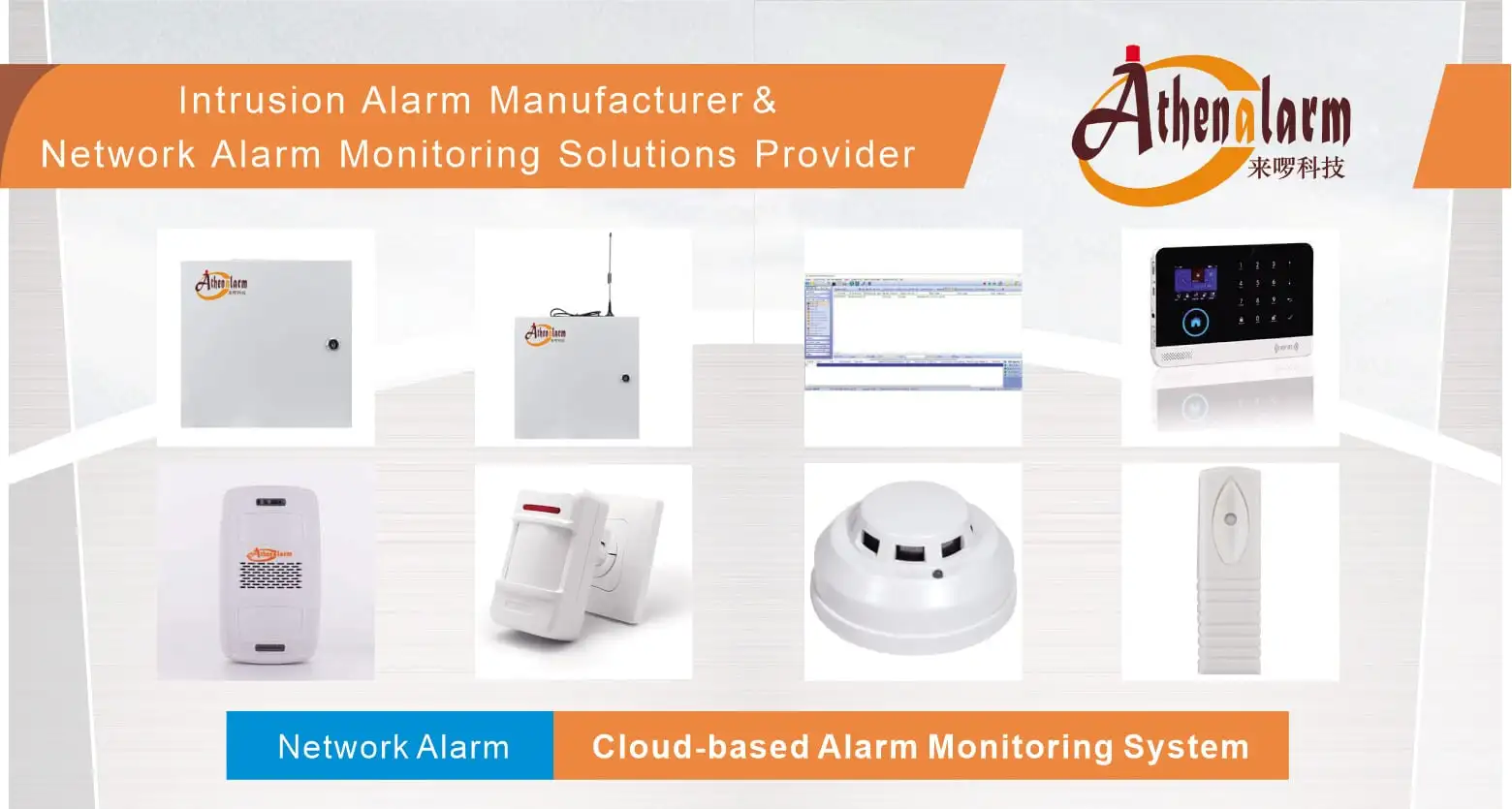
To support full-scale security architecture and physical deployment across diverse bank environments, the following standard detection and notification peripherals are integrated into the primary network ecosystem:
- Intrusion Motion Sensing: PIR Motion Sensor Devices and Wide Angle PIR Sensors for volumetric coverage in teller areas and corridors.
- Perimeter and Barrier Point Monitoring: Heavy-duty Door Contacts for vault doors and restricted access portals.
- Environmental & Safety Detectors: Photoelectric Smoke Detectors and Combustible Gas Detectors integrated with emergency reporting channels.
- Local Warning & Annunciation: Strobe Warning Lights and Voice Alert Sound Players for deterrence outside active robbery scenarios.
- Enterprise Infrastructure: Multi-site connectivity via Enterprise Alarm Monitoring Systems and physical site protection through Perimeter Intrusion Alarm Systems.
