Product Categories
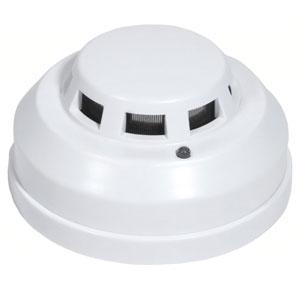
Photoelectric Smoke Detector
2-Wire / 4-Wire Conventional Smoke Detector for Fire Alarm Systems
Type: AS-603PC
Related: Alarm Detector
The Athenalarm AS-603PC Photoelectric Smoke Detector is a wired smoke detection device engineered for conventional intrusion alarm system and conventional fire alarm system applications. It uses an infrared photoelectric detection principle, identifying smoke particles inside a controlled optical sensing chamber.
The AS-603PC is available in 2-wire and 4-wire configurations, allowing importers, distributors, wholesalers, and system integrators to select the interface that matches their target alarm panels:
- 2-wire version — non-polarized DC power input with remote LED indicator output
- 4-wire version — DC power input with relay output for system integration
With a DC 9–35V operating range, 0.5 dB/m ±0.1 dB/m sensitivity, 50 μA standby current (2-wire), and an operating range of -10°C to +50°C, the AS-603PC is positioned for B2B sourcing, OEM/private-label supply, and conventional alarm system integration projects.
Suitable for:
- Fire alarm system importers
- Security and fire alarm distributors
- Wholesalers
- Fire alarm system integrators
- Commercial and industrial project suppliers
GET QUOTATION — Tell us your required configuration (2-wire / 4-wire), quantity, target market, and OEM/certification requirements.
1. Key Technical Features
- Photoelectric infrared smoke detection
- Available in 2-wire and 4-wire configurations
- DC 9–35V operating range
- 0.5 dB/m ±0.1 dB/m sensitivity
- 50 μA standby current (2-wire version)
- Remote LED output (2-wire) / Relay output (4-wire)
- Non-polarized power input (2-wire version)
- Red LED alarm indication, flashing LED power indication, 360° twin-LED visibility
- Metal shield for electromagnetic interference resistance
- -10°C to +50°C operating temperature, 0–95% RH non-condensing
- Ø103 × 53 mm compact form factor
(Full specification values are consolidated once, in the Technical Specifications table below, to avoid repetition.)
2. 2-Wire vs 4-Wire Configuration
Selecting the correct configuration is the first decision a buyer needs to make. Use the table below to match the AS-603PC to your fire alarm system architecture.
| Feature | 2-Wire Version | 4-Wire Version |
| Power input | DC 9–35V | DC 9–35V |
| Power polarity | Non-polarized | As specified by system wiring |
| Remote LED output | Yes | Not specified |
| Relay output | Not specified | Yes |
| Relay contact rating | N/A | 100 mA @ DC 28V |
| Standby current | 50 μA | 2 mA (24V N.O.) / 13 mA (24V N.C.) |
| Alarm current | 35 mA @ DC 12V | 18 mA (24V N.O.) / 60 mA @ DC 24V / 6 mA (24V N.C.)* |
| Typical use case | Systems using detector loop wiring with remote indicator | Systems requiring relay-based interface |
System compatibility must be verified against the target alarm panels before ordering.
3. Technical Specifications
| Parameter | Specification |
| Product Model | AS-603PC |
| Product Type | Photoelectric Smoke Detector |
| Configuration | 2-wire / 4-wire |
| Detection Principle | Infrared photoelectric detection |
| Operating Voltage | DC 9–35V |
| 2-Wire Standby Current | 50 μA |
| 2-Wire Alarm Current | 35 mA @ DC 12V |
| 4-Wire Standby Current | 2 mA (24V, N.O.) / 13 mA (24V, N.C.) |
| 4-Wire Alarm Current | 18 mA (24V, N.O.) / 60 mA @ DC 24V / 6 mA (24V, N.C.)* |
| Alarm Indication | Red LED |
| Sensitivity | 0.5 dB/m ±0.1 dB/m |
| Operating Temperature | -10°C to +50°C |
| Relative Humidity | 0–95% RH, non-condensing |
| 2-Wire Alarm Output | Remote LED output |
| 4-Wire Alarm Output | Relay output |
| Relay Contact Rating | 100 mA @ DC 28V |
| Dimensions | Ø103 × 53 mm |
| EMC-related Construction | Metal shield |
4. Detection Principle
Inside the AS-603PC, infrared diodes are installed in a specially designed sensing chamber. The chamber limits the effect of external light while allowing smoke to enter. As smoke particles enter the chamber, they reflect infrared light toward the receiving diode. When the detected light reaches the specified level, the detector generates an alarm signal.
The emitting circuit uses a pulsed signal to help reduce interference and lower power consumption.
5. Wiring & Connection
5.1 2-Wire Version
| Terminal | Function |
| 1 | POWER (-) IN |
| 2 | POWER (+) IN |
| 3 | POWER (+) OUT |
| 4 | Remote LED (-) |
The 2-wire detector uses a non-polarized DC power input. When a remote indicator is used, terminal “2” must be connected to the positive input line, per the product manual.
5.2 4-Wire Version
| Terminal | Function |
| 1 | POWER (-) IN |
| 2 | POWER (+) IN |
| 3 | RELAY OUTPUT (COM) |
| 4 | RELAY OUTPUT (N.O.) |
Important: Wiring should follow the supplied product manual and the requirements of the target alarm panel/system.
6. Applications
The AS-603PC is positioned for conventional alarm detection applications where the selected configuration and system interface are compatible with the target system.
- Commercial Buildings — subject to local fire codes and system design requirements
- Industrial Facilities — subject to the specified environmental operating range and system interface
- Warehouses and Storage Facilities — subject to project-specific fire protection requirements
- Fire Alarm System Integration — 2-wire or 4-wire selection according to required connection architecture
Application suitability must be evaluated against local regulations, fire protection codes, environmental conditions, detector spacing requirements, and compatibility with the selected alarm panel.
7. Installation Considerations
- Keep at least 0.5 m clear around the detector
- Keep the detector more than 0.5 m from a wall
- Distance between detectors should be less than 15 m
- Distance between a detector and a corner should be less than half the distance between detectors
- Install horizontally where possible; if inclined, keep the angle below 45°
- Detector base must be installed securely; wiring connections must be reliable
- Avoid installation in excessively cold, hot, or dusty environments
- Keep the dustproof cover in place until the detector is ready for use
- A simulated fire test every six months is recommended to verify operation
Actual placement and spacing should follow the applicable fire protection code, system design, and local authority requirements.
8. OEM / Private-Label Supply
The AS-603PC is available for OEM and private-label sourcing.
| OEM Item | Status |
| Logo customization | Yes |
| Private labeling | Yes |
| Product label customization | Yes |
| Housing customization | Yes |
| Packaging customization | Yes |
| Model number customization | Yes |
| Documentation customization | Yes |
| Hardware / electronics customization | Not Available |
OEM Order Information
| Item | Value |
| Standard order MOQ | 10 pcs |
| OEM order MOQ | 200 pcs |
| Standard lead time | 10 days |
| OEM lead time | 15 days |
Lead time may vary according to order quantity, configuration, customization scope, and production schedule.
For OEM inquiries, please specify the required configuration, target market, branding requirements, certification requirements, packaging requirements, and expected order quantity.
9. Manufacturing & Quality Control
| QC Stage | Status |
| Incoming material inspection | Sampling Inspection |
| Production testing | 100% Production Testing |
| Finished-product inspection | Sampling Inspection |
| Visual inspection | Yes |
10. Procurement Information
| Procurement Item | Confirmed Information |
| Standard MOQ | 10 pcs |
| OEM MOQ | 200 pcs |
| Standard Lead Time | 10 days |
| OEM Lead Time | 15 days |
| Sample Availability | Available |
| Warranty | 1 year |
| Technical Support | Available |
| Packaging | Hard paper box packaging |
| OEM / Private Label | Available (see confirmed scope above) |
| Unit Price / Pricing Tiers | Contact Athenalarm for quotation |
11. Warranty & After-Sales
| Item | Status |
| Warranty duration | 1 year |
| Warranty coverage | Applies to all products |
| Defective product handling | Defective items are eligible for a free replacement upon verification. |
| Replacement | 100% free replacement for all confirmed defective products. |
| Technical support | Available |
Lead time may vary according to order quantity, configuration, customization requirements, and production schedule.
12. Frequently Asked Questions
Q1: Is the AS-603PC available in both 2-wire and 4-wire versions?
Yes. The 2-wire version provides a remote LED indicator output; the 4-wire version provides relay output.
Q2: What is the operating voltage?
DC 9–35V.
Q3: Does the 2-wire version support a remote LED?
Yes, per the manual’s terminal specification.
Q4: Does the 4-wire version provide relay output?
Yes, with a contact rating of 100 mA @ DC 28V.
Q5: What is the detection sensitivity?
0.5 dB/m ±0.1 dB/m.
Q6: What is the standby current?
50 μA for the 2-wire configuration. The 4-wire configuration has separate values depending on N.O./N.C. wiring — see Technical Specifications.
Q7: Is the AS-603PC designed for conventional fire alarm systems?
Yes, it is positioned as a wired photoelectric smoke detector for conventional fire alarm system applications. Compatibility with a specific alarm panel should be verified before deployment.
Q8: What are the detector dimensions?
Ø103 mm × 53 mm.
Q9: What is the MOQ?
10 pcs for standard orders; 200 pcs for OEM orders.
Q10: What is the standard lead time?
10 days for standard orders; 15 days for OEM orders. Actual lead time may vary by quantity and customization.
Q11: What OEM/private-label options are available?
Logo, private label, product label, housing, packaging, model number, and documentation customization are available. Hardware/electronics customization is not available.
Q12: What warranty is provided?
1 year.
Q13: Can Athenalarm provide technical support?
Yes.
13. Request a Quotation
Send your AS-603PC requirements:
- Required quantity
- 2-wire or 4-wire configuration
- OEM / private-label requirement
14. Download Product Documentation
- AS-603PC Photoelectric Smoke Detector User Manual — includes product overview, technical indicators, terminal descriptions, 2-wire and 4-wire wiring information, installation precautions, and testing recommendations.