
Commercial Wireless Business Security Systems: Enterprise Selection and Risk Strategy Analysis
1. When Wireless Becomes a Strategic Commercial Security Choice
A commercial facility’s decision to evaluate a wireless business security system rarely begins with an interest in wireless technology itself. It begins with a deployment constraint: a leased retail unit that cannot be rewired before opening, a distribution hub that must stay operational during installation, or a multi-site enterprise that needs consistent oversight across locations that were never designed with a shared security infrastructure in mind. The wireless architecture becomes relevant only because the wired alternative introduces cost, delay, or disruption that the business cannot absorb.
This is the correct starting point for a selection decision. A Wireless Business Security System is a distributed architecture of RF-connected sensors, cameras, and control devices that communicate with a central control hub and a cloud management layer, without requiring structural cabling between endpoints and the panel. That architectural difference changes how the system is deployed, but it does not remove the engineering requirements associated with commercial-grade security. It relocates them—from conduit and cable routing toward RF planning, communications resilience, and device lifecycle management.
1.1 Facilities Where Cabling Creates Deployment Friction
Wireless architecture provides the clearest commercial advantage in specific site conditions: leased or short-term commercial space where structural modification is restricted, heritage or landmark buildings where wiring is impractical, pop-up or temporary retail formats, occupied facilities that cannot tolerate construction downtime, and distributed multi-site operations where consistent, centrally managed coverage matters more than any single-site installation method. In each case, the constraint is physical or operational, not a general preference for wireless technology.
1.2 The Decision Is Broader Than Installation Speed
Installation speed is the most visible wireless benefit, but it is not the only variable a commercial buyer should weigh. The decision also depends on total cost of ownership over the equipment’s service life, the facility’s RF environment, the scalability required for future growth, the resilience of remote communications, and the integration requirements tied to existing video, access control, or building systems. Evaluating wireless purely on deployment speed produces an incomplete procurement decision.
1.2.1 Site Conditions That Strengthen or Weaken the Wireless Case
Certain conditions favor wireless deployment: structurally constrained buildings, frequent relocation or expansion, multi-site operations requiring centralized visibility, and facilities where downtime carries a direct operational cost. Other conditions weaken the case: dense RF-interference environments without adequate mitigation planning, facilities with strict infrastructure or cabling mandates, or projects with integration requirements that exceed the vendor’s actual interface support. A wireless system is not disqualified by these conditions, but they raise the bar for the RF assessment, communications design, and integration verification discussed in later sections.
2. Where Wireless Creates Commercial Value
The original 13 strategic advantages associated with wireless business security systems can be consolidated into a smaller set of decision-relevant value domains. Each is presented here with its underlying business rationale and its accompanying qualification.
2.1 Faster Deployment With Less Physical Disruption
Wireless endpoints are typically mounted using adhesive or magnetic brackets and communicate over an RF mesh network rather than home-run cabling. This allows installation to proceed during operating hours, without drilling or extended downtime—relevant for facilities such as 24/7 healthcare environments where sensor installation may need to occur during staff breaks rather than through a scheduled shutdown. The commercial value here is measured in avoided disruption, not simply hours saved.
2.2 Lower Infrastructure and Lifecycle Cost Potential
Removing cabling, conduit, and associated labor reduces upfront infrastructure spend, and over-the-air firmware updates combined with modular components can reduce the frequency of on-site service visits. The source material cites figures of up to 40% lower upfront installation cost and up to 30% annual maintenance savings for multi-location deployments. These figures should be treated as claims reported in the source material rather than independently validated benchmarks; actual savings depend on facility size, existing infrastructure condition, and deployment scale.
2.3 Centralized Remote Management Across Sites
A cloud management platform allows administrators to monitor system status, review event logs, manage user credentials, and receive alerts from any authorized device. For multi-site commercial operations—such as a logistics operator overseeing multiple distribution hubs—this consolidates arming, disarming, and event visibility into a single administrative layer rather than requiring site-by-site management.
2.4 Expansion Without Conventional Rewiring
Because new endpoints join the existing RF mesh rather than requiring new cable runs, adding devices to cover additional space is structurally simpler than in a wired system. This matters for businesses that expect to add locations, reconfigure floor plans, or scale coverage incrementally. The practical limits of this advantage are addressed in Section 4.4.
2.5 Risk Verification, Response, and Automation
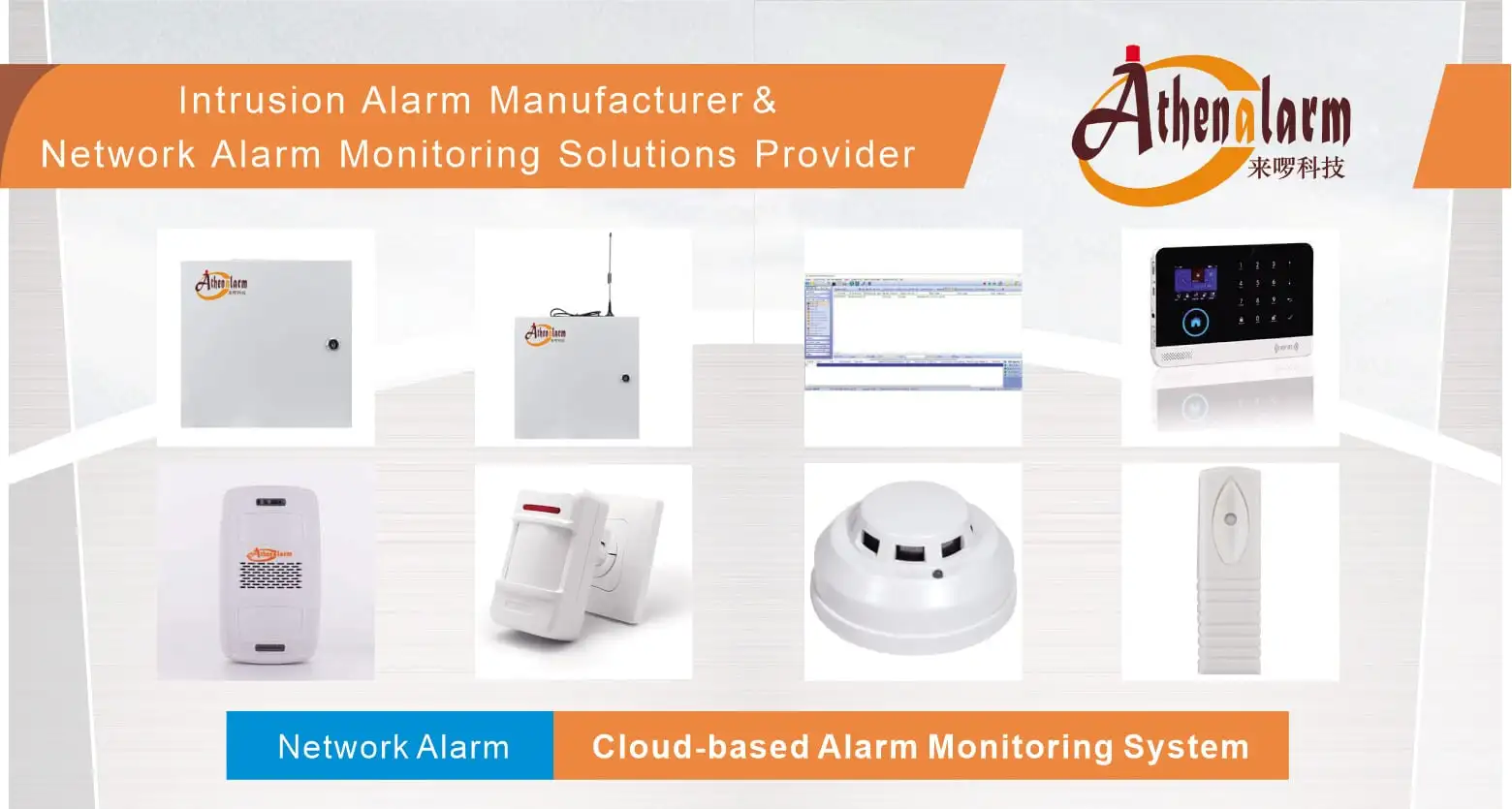
Beyond basic detection, wireless systems can incorporate AI-assisted alarm logic to help distinguish genuine intrusion events from false alarms, along with two-way audio for live verbal intervention. One example referenced in the source material is a smart audio unit—Athenalarm‘s smart audio device—used to provide remote deterrence and real-time interaction from a security operations center. Detection events can also be linked to video verification, siren activation, or selected building-system responses, discussed further in Section 3.6.
2.6 Communication Security and Resilience
Robust systems combine AES-256 encryption with dual-path communication—typically a primary IP connection and an LTE cellular alternative—so that alarm signaling and remote visibility do not depend entirely on a single communication path. This is a resilience mechanism, not a guarantee of uninterrupted uptime; its actual behavior is examined in Section 5.
2.7 Battery and Device-Health Management
Wireless sensors are commonly powered by lithium batteries with a stated service life of 5 to 7 years, and management dashboards can track battery and signal status to support predictive maintenance scheduling. This introduces a lifecycle responsibility that a wired, mains-powered sensor does not carry to the same degree—addressed further in Section 8.
2.8 Audit Readiness and Documented Operations
Event logs, access history, and sensor activity trails support internal audit and incident-review processes. Wireless systems can be configured with reference to HIPAA, PCI-DSS, ISO 27001, and applicable local building codes, and many insurers offer premium considerations for UL-listed or NFPA-compliant deployments. None of this establishes automatic compliance; the boundary between technical capability and certified compliance status is addressed in Section 9.6.
2.9 Risk-Adjusted Long-Term Value
Where deployment friction, multi-site management, and lifecycle maintenance costs are material to the business case, wireless architecture can produce favorable long-term value relative to a wired alternative. The source material’s summary figures—up to 40% lower total cost of ownership, 60% faster installation, and reduced insurance premiums—should be read as conditions dependent on facility type and deployment scale rather than guaranteed outcomes for every commercial site.
3. How the Commercial Wireless Security Architecture Fits Together
Before comparing architectures or vetting suppliers, a buyer needs a working model of what is actually being purchased. A commercial wireless security system is not a single device category; it is a layered architecture.
| Layer | Function | Representative Components |
|---|---|---|
| Endpoint | Detection and field presence | Door, motion, vibration, glass-break, temperature, and flood sensors; wireless cameras; sirens; keypads; badges |
| Control | Event processing and local management | Control hub with LTE/IP dual connectivity, encrypted firmware, mobile app support |
| Communication | Data transport between layers | RF mesh network; IP; LTE; dual-path communication; dual-SIM cellular communicators; repeaters |
| Management | Visibility and administration | Cloud management platform; dashboards; event logs; access history |
| Integration | Cross-system response | NVR/VMS via ONVIF; access control; HVAC, lighting, fire-safety-related systems; PA/audio |
3.1 Wireless Endpoint Layer
Endpoint devices detect security and environmental conditions—door contact, motion, vibration, glass-break, temperature, and flood sensing are all explicitly part of the source component set. Cameras at this layer may include PTZ and IR capability along with edge-based analytics such as facial recognition, license-plate capture, or object tracking.
3.2 Control Layer
The control hub receives and processes device events, manages user credentials, and maintains the local logic that governs arming, disarming, and alert routing before data is passed to the communication layer.
3.3 Communication Layer
RF communication carries data from endpoints to the control hub; IP and LTE carry data from the control hub to the cloud and mobile management environment. This dual-path arrangement is the basis for the communications resilience discussed in Section 5.
3.4 Management and Visibility Layer
The cloud platform aggregates events, logs, battery and signal status, and user activity across one or multiple sites, enabling remote administration from any authorized device.
3.5 Verification and Response Layer
Detection events can be paired with video verification, two-way audio warnings, and siren activation to support faster, more accurate incident response and to reduce reliance on detection alone.
3.6 External Integration Boundary
Wireless business security systems can extend into access control, HVAC, lighting, fire-safety-related functions, and PA systems—for example, triggering door locks, activating strobes, and initiating automated verbal warnings in response to a forced-entry event. This integration boundary expands functional capability but also expands the number of external dependencies the system relies on, a trade-off examined in Section 4.5.
3.6.1 ONVIF as an Integration Reference
ONVIF compliance is referenced in the source material as a practical basis for integrating wireless cameras with existing NVR/VMS platforms. This should be understood as a compatibility reference point, not a guarantee of interoperability with every VMS product or profile; actual compatibility depends on the specific devices, profiles, and platform versions involved in a given project.
4. The Engineering Trade-Offs That Determine Wireless Suitability
Every commercial advantage described in Section 2 carries a corresponding engineering condition. Evaluating wireless suitability means examining both sides of each trade-off.
| Commercial Benefit | Engineering Condition | Operational Consequence | Selection Question |
|---|---|---|---|
| Rapid, cable-free deployment | RF environment must support reliable device communication | Poor placement or interference can create coverage gaps | Has the site been assessed for RF interference? |
| Reduced structural disruption | Battery-powered endpoints require lifecycle management | Batteries must be monitored and eventually replaced | Who owns the battery maintenance schedule? |
| Remote management via cloud | System depends on internet and cellular connectivity | Loss of connectivity reduces remote visibility | What happens locally during a communications outage? |
| Easy physical expansion | Actual capacity is architecture-dependent | Adding devices beyond design capacity can degrade performance | What is the verified device capacity of this specific system? |
| Cross-system integration | Additional external dependencies are introduced | Integration failures can affect automated responses | Which integrations are actually supported and tested? |
| Dual-path communication | Adds communication infrastructure to manage | Redundancy improves resilience but is not a guarantee | What is the documented failover behavior? |
4.1 Deployment Speed vs. RF Planning
Faster physical installation does not eliminate the need for a spectrum scan and a placement plan; it simply moves that work earlier in the deployment sequence, ahead of mounting rather than during cable pulling.
4.2 Installation Flexibility vs. Battery Lifecycle
A battery-powered sensor avoids a wiring run, but it introduces a recurring maintenance variable that a hardwired, mains-powered sensor does not carry in the same way. This shifts maintenance planning from a one-time electrical task to an ongoing monitoring function.
4.3 Remote Management vs. Connectivity Dependency
Cloud-based administration improves visibility across sites, but that visibility is only as reliable as the underlying IP and cellular connections. This dependency is mitigated, not eliminated, by dual-path communication.
4.4 Physical Expansion vs. Actual System Capacity
Adding a wireless device to an existing mesh is usually simpler than pulling new cable, but “easy to add” is not the same as “unlimited capacity.” Practical scalability depends on the control hub’s supported device count, RF channel capacity, and cloud platform’s management limits.
4.4.1 Why “150 Devices” Is Not a Universal Capacity
The source material recommends selecting a system supporting at least 150 device nodes as a future-proofing guideline. This is a stated recommendation for one deployment scenario, not a universal system specification. Buyers should request the actual verified device capacity of the specific control hub and cloud platform under consideration rather than assuming a fixed enterprise-wide number.
4.5 Integration Capability vs. Support Complexity
Each additional integration—video, access control, HVAC, lighting—adds functional value but also adds a dependency that must be configured, tested, and maintained. More integration points generally mean more variables during commissioning and troubleshooting.
4.6 Redundancy vs. Architecture Complexity
Adding an LTE path alongside a primary IP path improves resilience against a single point of communication failure, but it also adds infrastructure—SIM management, cellular signal quality, and failover logic—that must be designed and monitored.
4.7 Wireless Convenience vs. RF Reliability
The clearest summary of this trade-off: wireless removes much of the physical installation burden associated with cabling, but it transfers part of the engineering challenge to spectrum planning, coverage design, and signal-quality monitoring. Neither burden disappears; it changes form.
5. RF Reliability and Communication Resilience
RF and communications performance is the technical area most likely to determine whether a wireless deployment performs as expected in ongoing operation, and it deserves closer treatment than a single line item in a features list.
5.1 Why RF Conditions Matter Before Deployment
Wireless sensors, cameras, and the control hub communicate over radio frequency. Commercial environments—warehouses with metal racking, offices with dense Wi-Fi deployments, or multi-tenant buildings with overlapping RF sources—can introduce interference that degrades signal reliability or creates coverage blind spots if not accounted for during design.
5.2 What Spectrum Assessment Contributes
An RF spectrum scan performed during the design and installation phase identifies existing interference sources and informs sensor placement and repeater positioning before final mounting. This assessment does not certify long-term performance, but it materially reduces the risk of post-installation blind spots that require costly rework.
5.3 How IP + LTE Dual-Path Communication Supports Resilience
A dual-path architecture routes alarm and status data over a primary IP connection, with an LTE cellular path serving as an alternative if the primary path fails. Dual-carrier cellular failover, tamper alerts, and battery supervision are the specific features the source material identifies as relevant to evaluating this resilience. The practical benefit is continued alarm transmission during an internet outage—not elimination of all communication risk.
5.4 Battery and Signal Supervision
Ongoing supervision of battery status and RF signal strength allows a management dashboard to flag degrading devices before they fail outright, converting maintenance from a reactive to a more planned activity.
5.4.1 What “Resilience” Does and Does Not Mean
Dual-path communication and battery/signal supervision improve the system’s ability to continue operating through certain failure conditions. They do not constitute a guarantee of continuous, uninterrupted operation. Buyers should treat resilience claims as a description of failure-mode mitigation, not as an assurance of 24/7 uptime under all conditions.
6. Wireless vs. Wired: A Commercial Selection Framework
This is the central comparative decision a commercial buyer needs to resolve, and it should not default to an assumption that wireless is categorically superior.
6.1 Installation and Operational Disruption
Wireless installation generally involves less structural work and can proceed with reduced disruption to active operations. Wired installation involves cabling and conduit work that typically requires more coordinated downtime or construction scheduling.
6.2 Infrastructure and Lifecycle Cost
Wireless reduces upfront cabling and labor cost but introduces recurring battery and device-monitoring costs. Wired systems carry higher upfront infrastructure cost but avoid endpoint battery dependency.
6.3 Expansion, Relocation, and Site Changes
Wireless expansion is generally simpler because new endpoints join an existing RF mesh. Wired expansion typically requires additional cable runs, which is more disruptive in occupied or leased facilities.
6.4 Reliability and Maintenance
Wireless reliability depends on RF conditions, battery status, and communication-path availability. Wired reliability depends less on RF and battery factors but more on the physical integrity of cabling and conduit.
6.5 Management and Integration
Both architectures can support cloud management and cross-system integration, but the underlying transport—RF/cellular for wireless, hardwired for wired—affects how each is planned, commissioned, and maintained.
6.6 Where Wireless Is Stronger
Wireless architecture tends to offer a stronger commercial case for leased or short-term space, heritage buildings, facilities requiring rapid deployment, distributed multi-site operations, and businesses anticipating frequent relocation or expansion.
6.7 Where Wired May Remain Preferable
A wired architecture may remain preferable in facilities with difficult RF environments that are costly to mitigate, sites with existing cabling infrastructure already in place, or projects with integration requirements that exceed a given wireless vendor’s actual interface support.
6.7.1 Selection Matrix
| Decision Factor | Wireless Consideration | Wired Consideration | Buyer Question |
|---|---|---|---|
| Deployment | Less physical cabling; faster mounting | More infrastructure work; longer install window | How disruptive can installation be at this site? |
| Expansion | Generally easier physical addition of devices | Usually requires additional cable runs | How often will the site change or grow? |
| RF Environment | Requires spectrum assessment and placement planning | Largely unaffected by RF conditions | What is the facility’s RF interference profile? |
| Battery Dependency | Requires ongoing battery lifecycle management | Typically avoids endpoint battery dependency | What maintenance model is acceptable to operations? |
| Communications | IP/LTE dual-path can add resilience | Dependent on the wired network architecture in place | What continuity requirements apply here? |
| Integration | Depends on actual vendor interface support | Depends on existing wired ecosystem | Which systems must interoperate with security? |
7. Matching Wireless Architecture to Commercial Facility Risk
Different commercial sectors carry different dominant risks, which should inform which wireless capabilities are prioritized in a given deployment.
| Industry | Primary Risk | Relevant Wireless Capability | Operational Consideration |
|---|---|---|---|
| Retail | Theft, internal fraud | Glass-break sensors, panic buttons | Coverage of point-of-sale and stockroom areas |
| Warehousing | Blind spots, perimeter breaches | Long-range motion detectors | RF coverage across large, obstructed floor plans |
| Healthcare | Compliance, restricted access | Biometric locks, audit logs | Low-disruption installation in 24/7 operating environments |
| Education | Lockdowns, crowd control | Integrated PA systems, mobile alerts | Coordinated notification across a campus footprint |
| Construction | Remote job sites, theft | Solar cameras, GPS asset tracking | Temporary infrastructure and cellular-only connectivity |
| Offices | Flexible access, visitor management | App-based scheduling, badge readers | Frequent tenant or layout changes |
7.1 Retail
Detection focused on entry points and point-of-sale zones, paired with alarm verification, addresses theft and fraud risk without requiring structural modification of leased retail space.
7.2 Warehousing and Distribution
Large, often obstructed floor plans benefit from long-range detection and centralized remote monitoring across distribution hubs, consistent with the multi-site management value described in Section 2.3.
7.3 Healthcare
Restricted-access requirements and continuous operation favor low-disruption installation methods and access-related functions such as biometric locks, alongside the documented event logs relevant to audit readiness.
7.4 Education
Lockdown and crowd-control scenarios depend on integrated notification—PA systems and mobile alerts—more than on detection sensitivity alone.
7.5 Construction and Temporary Sites
Remote job sites with no permanent infrastructure benefit from cellular-connected, solar-powered wireless devices such as solar cameras and GPS-based asset tracking, reflecting the site’s temporary and unpowered nature.
7.6 Corporate Offices
Frequent tenant changes and flexible access needs are better served by app-based scheduling and badge-based access than by fixed, hardwired access infrastructure.
8. Lifecycle Requirements Beyond Initial Deployment
A wireless business security system should be evaluated as an operating architecture with ongoing requirements, not as a one-time installation project.
8.1 Risk Profiling and System Design
Design work should define the facility’s risk profile, required coverage, device mix, communications plan, RF environment, integration scope, and expansion assumptions before procurement.
8.2 Professional Deployment and RF Assessment
Deployment includes spectrum scanning, device placement, and communication equipment installation—engineering work that persists regardless of the reduced cabling requirement.
8.3 Integration and Commissioning
Commissioning verifies wireless communication, device operation, alarm transmission, IP/LTE redundancy, remote monitoring, and any integrated response behavior with access control, video, or building systems before the system is handed over.
8.4 Ongoing Monitoring and Maintenance
Operation requires monitoring system status, managing user credentials, reviewing logs, and tracking battery and signal conditions across potentially multiple sites.
8.4.1 Battery-Powered Endpoint Lifecycle
Lithium-powered sensors are cited with a service life of 5 to 7 years in the source material; this figure depends on device type, usage, and environmental conditions and should not be treated as a fixed guarantee for every sensor in a deployment. Maintenance dashboards that generate schedules based on device usage and signal strength convert this into a planned rather than reactive task.
8.5 Multi-Site Operational Management
For distributed commercial operations, centralized visibility across sites is one of the more durable value drivers of the wireless architecture, since it reduces the administrative burden of managing security independently at each location.
9. What Buyers Should Verify Before Selecting a System or Supplier
The preceding sections establish what to evaluate. This section converts that evaluation into procurement action.
9.1 Verify the Actual System Architecture
Confirm that the proposed solution genuinely includes the endpoint, control, communication, management, and integration layers described in Section 3—rather than accepting a generic description of “wireless security.”
9.2 Verify Device Capacity and Expansion Assumptions
Request the specific, documented device capacity of the control hub and cloud platform being quoted, rather than relying on generic “enterprise-scale” language or the 150-device figure cited as a general recommendation in the source material.
9.3 Verify RF Engineering Capability
Ask whether the vendor performs spectrum scanning, coverage planning, and placement methodology as a standard part of deployment, and request documentation of the assessment for the specific site.
9.4 Verify Communication Resilience
Confirm the actual IP/LTE architecture, the failover behavior between paths, and the monitoring mechanisms used to detect a degraded or failed communication path.
9.5 Verify Integration Compatibility
Check which VMS/NVR platforms, ONVIF profiles, access-control systems, and building-system interfaces are actually supported and tested—not merely referenced as compatible in general terms.
9.6 Verify Certification and Compliance Claims
Technology capability, product certification, and project-specific regulatory compliance are three distinct things. A system configured with reference to HIPAA, PCI-DSS, ISO 27001, or UL/NFPA standards still requires project-specific verification against the applicable jurisdiction and requirements; deploying wireless hardware does not by itself establish compliance status.
9.7 Verify Documentation, SLA, and Lifecycle Support
Confirm commissioning documentation, staff training, handover procedures, firmware/update support, and the specific terms of any service-level agreement covering maintenance response.
9.7.1 Procurement Evidence Checklist
- Documented architecture matching the endpoint–control–communication–management–integration model
- Verified device capacity for the specific control hub and cloud platform
- RF spectrum assessment report or methodology for the target site
- Documented IP/LTE failover behavior and monitoring approach
- Confirmed list of supported VMS/NVR, ONVIF profiles, and building-system interfaces
- Certification and compliance documentation specific to the project, not generic marketing claims
- Commissioning records, training plan, and handover documentation
- Defined SLA terms for maintenance response and firmware/update support
10. Final Decision Model: When Wireless Is the Better Commercial Fit
10.1 Wireless Is Strong When Deployment Friction Is the Main Constraint
Where structural modification, leased-space restrictions, or operational downtime are the primary obstacles to security deployment, wireless architecture directly addresses that constraint.
10.2 Wireless Is Strong When Sites Change or Expand Frequently
Businesses anticipating relocation, tenant changes, or incremental facility growth benefit from the reduced rewiring burden associated with wireless expansion.
10.3 Wireless Is Strong When Multi-Site Visibility Has High Operational Value
Distributed operations that need centralized, real-time visibility across locations gain more from cloud-based remote management than single-site facilities typically do.
10.4 Wireless Requires Strong RF and Lifecycle Management
The commercial case weakens without a genuine commitment to RF assessment, battery monitoring, and planned maintenance; these are not optional add-ons but core operating requirements.
10.5 Wireless Requires Verified Integration and Communication Design
Where integration with video, access control, or building systems is part of the security strategy, the case depends on verified interface support and documented communication resilience—not on generic compatibility claims.
10.6 The Procurement Decision Should Be Risk-Adjusted
The final selection should follow from site conditions through architecture fit, engineering constraints, and lifecycle requirements, concluding with verified supplier evidence:
Site Conditions → Architecture Fit → Engineering Constraints → Lifecycle Requirements → Supplier Evidence → Procurement Decision
A wireless business security system is appropriate for a given commercial environment when deployment friction and multi-site management are material business problems, when the RF environment can be assessed and managed, and when the selected vendor can document the architecture, capacity, resilience, and compliance evidence outlined above.
11. FAQ
Q1: How does a dual-path LTE + IP wireless security system maintain communication during an internet outage?
The system routes alarm and status data over a primary IP connection and switches to an LTE cellular path if that primary connection fails. This dual-path design, combined with dual-carrier cellular failover, tamper alerts, and battery supervision, is intended to preserve alarm transmission and remote visibility during an internet outage. It improves resilience against a single point of communication failure but does not constitute a guarantee of uninterrupted uptime under every condition.
Q2: What TCO savings can enterprises expect from wireless security compared with wired systems?
Savings typically originate from reduced cabling, labor, and structural work at installation, along with lower maintenance costs through over-the-air updates and modular components. The source material cites figures of up to 40% lower upfront cost, 60% faster installation, and 30% annual maintenance savings for multi-location deployments. These are source-reported figures rather than independently validated universal benchmarks; actual savings depend on facility size, existing conditions, and deployment scale.
Q3: Why is an RF spectrum scan important before deploying a commercial wireless security system?
Commercial environments can contain sources of RF interference—from building materials to other wireless networks—that degrade signal reliability or create coverage gaps if not identified before installation. A spectrum scan performed during design informs sensor and repeater placement, reducing the risk of post-installation blind spots that would otherwise require rework.
Q4: Can a commercial wireless security system integrate with existing ONVIF video platforms and building controls?
ONVIF compliance is referenced as a practical basis for integrating wireless cameras with NVR/VMS platforms, and alarm events can be configured to trigger responses in access control, lighting, or other building systems. Actual interoperability depends on the specific devices, ONVIF profiles, and platform versions involved, and should be verified for the project rather than assumed from general compatibility claims.
Q5: How does wireless security change commercial maintenance requirements?
Wireless deployment shifts maintenance emphasis toward battery status and signal-strength monitoring rather than cable or conduit inspection. Management dashboards can generate maintenance schedules based on device usage and signal condition, converting battery-related maintenance into a planned rather than reactive activity across the deployed endpoints.
Q6: Is a commercial wireless security system more scalable than a wired system?
Physically adding a wireless device is generally simpler than running new cable, which supports easier incremental expansion. However, actual scalability is bounded by the control hub’s supported device capacity, RF channel conditions, and cloud platform limits. A recommendation to plan for at least 150 device nodes appears in the source material as a future-proofing guideline for one scenario, not as a universal system capacity.
Q7: Does a wireless business security system automatically meet HIPAA, PCI-DSS, ISO 27001, UL, or NFPA requirements?
No. Wireless systems can be configured with reference to these standards, and event logs, access history, and sensor trails can support audit documentation, but compliance status depends on the specific system configuration, certification, project requirements, and applicable jurisdiction. Deploying wireless hardware does not by itself establish regulatory or certification compliance.
Q8: Does a commercial wireless security system require professional installation?
For commercial-grade reliability, yes. Professional installation supports RF spectrum assessment, correct device placement, integration with existing building or video systems, compliance-oriented documentation, and staff training and handover—engineering and commissioning work that remains necessary regardless of the reduced cabling burden.
12. System Component Checklist Appendix
To preserve the high-level technical positioning of the primary strategic analysis while ensuring full compliance with enterprise deployment specifications, the supporting hardware endpoints, sensors, and vertical scenario solutions are cataloged below:
- Enterprise Alarm Platform & Hardware: Commercial Burglar Alarm Systems and Enterprise Network Alarm Systems
- Intrusion Control & Hub Modules: Network Alarm Control Panel Solution
- Spatial Motion Detection Endpoints: PIR Motion Sensors and Wide Angle PIR Motion Sensors
- Environmental & Hazard Detection: Photoelectric Smoke Detectors and Combustible Gas Detectors
- Perimeter & Structural Intrusion Sensing: Digital Vibration Detectors, Network Perimeter Alarm Solution, and Heavy-Duty Door Contacts
- Duress, Warning & Audio Deterrence: Panic Alarm Buttons, Wireless Panic Buttons, Visual Warning Lights, and Voice Alert Sound Players
- Modular Gateway Infrastructure: GSM/WiFi Alarm Systems
- Industry-Specific Scenario Extensions:
