
Wired Business Security System Selection Criteria for Enterprise Facilities
1. Why Enterprise Facilities Need More Than a Low-Cost Security Installation
The decision to specify a Wired Business Security System rarely begins with a product comparison. It begins with a facility-level problem: an enterprise site—an industrial plant, a data center, a hospital campus, or a multi-building corporate headquarters—has security requirements that cannot be evaluated on installed price alone. When a security architecture fails under RF interference, battery depletion, or integration gaps, the consequence is not a minor service ticket. It is a monitoring gap, a compliance exposure, or an unplanned capital expense years after the original installation budget was closed.
This is why enterprise procurement teams increasingly frame the wired-versus-wireless question as an infrastructure decision rather than a purchasing decision. A Wired Business Security System depends on physical cabling for signal transmission, power delivery, or both, connecting sensors, alarms, control panels, and surveillance cameras into a single physically controlled communication path. That physical dependency is precisely what changes the risk profile: it removes certain wireless-specific failure modes while introducing its own planning, installation, and lifecycle requirements.
The remainder of this guide treats the wired-versus-wireless decision as a structured evaluation rather than a promotional comparison. It identifies the conditions under which hardwired infrastructure becomes the stronger architectural choice, the trade-offs that buyers must accept in exchange, and the planning requirements that determine whether a wired deployment performs as expected over a multi-year operating life.
1.1 The Decision Is About Infrastructure Risk, Not Only Device Cost
Enterprise security procurement decisions are frequently anchored to the initial cost of sensors, panels, and cameras. This framing understates the actual decision, which spans reliability, recurring maintenance, integration capability, scalability, and lifecycle economics. A lower-cost wireless deployment that requires frequent battery replacement, experiences RF-related connectivity issues, or cannot integrate with a building management system may carry a materially higher operating cost than its purchase price suggests. Conversely, a wired deployment that is poorly planned—undersized cabling paths, no redundancy at critical points, no defined integration scope—can erode the reliability advantages that justified the higher upfront investment in the first place.
1.1.1 Physical Environment Changes the Architecture Decision
Facility construction and operating conditions materially influence which architecture performs more predictably. Reinforced concrete, structural steel, dense equipment racks, and industrial machinery can degrade wireless signal propagation and introduce RF-related interference. Large sites, multi-zone layouts, and multi-building campuses extend the distances and structural obstacles that a wireless network must traverse. These physical conditions do not make wireless architecture unusable, but they do shift the reliability calculus toward infrastructure that is less dependent on uncontrolled RF conditions—one of the core reasons enterprise facilities in industrial, healthcare, financial, and government sectors continue to specify wired infrastructure for critical zones.
2. What Makes a Wired Business Security System an Enterprise Architecture?
A Wired Business Security System is an enterprise security architecture in which core security devices—sensors, alarms, control panels, and surveillance cameras—are connected through structured physical cabling for signal transmission, power delivery, or both. This distinguishes it from wireless architectures, where field devices communicate over RF links and frequently rely on battery power at the device level.
In an enterprise context, this architecture typically spans four functional layers: a field layer of detection and capture devices, a physical transport layer of structured cabling, a control and monitoring layer that processes and centralizes security events, and an enterprise integration layer that connects the security architecture to building management, emergency response, and remote monitoring systems.
2.1 Conceptual System Relationship
The relationship between these layers can be represented conceptually as:
Security Devices → Wired Infrastructure → Control/Monitoring Layer → Enterprise/Facility Systems
Sensors and alarms detect events and transmit them along the physical infrastructure to a control panel or processing layer. Surveillance cameras transmit video over the same class of infrastructure—commonly Power over Ethernet (PoE) or coaxial cabling—to a video platform for monitoring and review. The control and monitoring layer then exchanges information with facility-level systems such as a Building Management System (BMS) or SCADA platform, and with remote-access layers such as VPN or SD-WAN connections used by a Security Operations Center (SOC) or mobile dashboard.
This relationship should be treated as a conceptual model rather than a fixed physical topology. The specific arrangement of switches, servers, recorders, or gateways within a given deployment depends on the design chosen by the integrator and is outside the scope of this architecture-selection discussion.
2.2 What Wired Infrastructure Does—and Does Not—Guarantee
Physical cabling improves the predictability of the communication path between a field device and the control layer by removing dependence on RF propagation conditions. It does not, on its own, guarantee system-level performance. Several boundaries are important for procurement teams to hold onto through the remainder of this evaluation:
- Wired connectivity reduces exposure to RF-related interference, but overall reliability still depends on installation quality, cable routing, and power-path design.
- Remote monitoring and mobile access—delivered through VPN, SD-WAN, or cloud dashboards—introduce a separate cybersecurity dependency that exists regardless of whether the field layer is wired.
- Physical infrastructure can support certain regulatory control objectives, such as auditability and access isolation, but it does not by itself constitute regulatory compliance.
These distinctions matter because they define which claims in the following sections are architectural advantages of wired infrastructure, and which depend on the broader system design.
3. The Eleven Selection Criteria That Determine Enterprise Wired-System Suitability
Enterprise buyers evaluating a Wired Business Security System should treat the following eleven factors as decision dimensions rather than a checklist of universal advantages. Each factor identifies a specific enterprise condition, the reason wired infrastructure tends to respond well to that condition, and the trade-off the buyer should weigh before committing.
3.1 Connectivity Reliability in Difficult Physical Environments
Facilities with metal structures, reinforced concrete, industrial machinery, or high equipment density create conditions where wireless communication is more exposed to RF interference and bandwidth contention. A wired architecture routes signals through structured cabling rather than open RF space, which reduces dependence on ambient RF conditions and building material composition. This does not mean wired infrastructure is immune to all environmental disruption—cable damage, power interruption at the panel, or poor termination can still cause failures—but the failure modes are largely under the control of installation quality rather than ambient interference. Facilities operating in RF-intensive or structurally dense environments should weigh this factor heavily in the architecture decision.
3.2 Total Cost of Ownership: CapEx Versus Recurring OpEx
Wired systems typically carry higher upfront infrastructure and installation costs than comparable wireless deployments. The offsetting consideration is a potentially lower recurring operating cost, driven by the absence of battery-replacement cycles at the device level and, in many cases, a longer service life for the underlying cabling infrastructure. Whether this trade-off favors wired architecture depends on the specific facility’s expansion plans, maintenance staffing model, and expected operating horizon—there is no fixed percentage improvement that applies universally, and any lifecycle-cost projection should be built from the facility’s own assumptions rather than treated as guaranteed.
3.2.1 Cost Categories That Should Be Included in the Lifecycle Model
A defensible TCO comparison should separate cost categories rather than compress them into a single “wired is cheaper” or “wireless is cheaper” conclusion.
| Cost Category | Wired System Consideration | Wireless System Consideration |
|---|---|---|
| Initial infrastructure | Structured cabling, conduit, termination | Device hardware, RF planning |
| Installation labor | Cabling runs, panel wiring, commissioning | Device mounting, network pairing |
| Recurring maintenance | Periodic inspection | Battery replacement, RF troubleshooting |
| Service calls | Fault isolation on cabling/power paths | Connectivity and interference troubleshooting |
| Expansion | Additional cabling and zoning | Additional RF capacity/device planning |
| Component replacement | Longer expected service life for cabling | Shorter device/battery replacement cycles |
Buyers should populate this framework with facility-specific labor rates, maintenance contract terms, and expansion plans rather than relying on generic industry averages.
3.3 Integration With BMS, SCADA, and Facility Systems
Enterprise security systems increasingly function as one node within a larger facility control environment rather than as an isolated alarm loop. Wired security infrastructure can serve as a stable physical foundation for integration with Building Management Systems and SCADA platforms using protocols such as BACnet and KNX, coordinating with HVAC, lighting, and emergency systems. This integration increases operational capability—centralized monitoring, predictive maintenance signals, unified emergency response—but it also increases the number of interfaces that must be defined, tested, and maintained. Each additional integration point is a dependency that must be validated during commissioning, not an automatic benefit realized simply by choosing wired infrastructure.
3.4 Scalability Across Zones, Buildings, and Campuses
Structured cabling architectures can support expansion across security zones, buildings, and multi-site campuses when the underlying cabling, power distribution, and monitoring architecture are planned for growth from the outset. This scalability is not unlimited; it is bounded by the cabling capacity, power infrastructure, and control-layer design chosen at the time of installation. A facility that expects future expansion should specify cabling pathways, panel capacity, and monitoring-platform licensing with that growth in mind, rather than assuming that wired infrastructure scales without additional planning.
3.5 Compliance Alignment Requires More Than Choosing Wired
Regulated sectors operating under GDPR, HIPAA, PCI-DSS, or ISO 27001 require verifiable controls around access, data handling, and auditability. Physical cabling infrastructure can support certain control objectives—for example, isolating a communication path from open RF access and enabling defined access-control zoning—but it does not, by itself, establish regulatory compliance. Compliance is a function of the complete technical and organizational control environment, including logging practices, access governance, data handling procedures, and audit processes. Procurement teams should treat “wired infrastructure” as one supporting element of a compliance program, not as a substitute for it.
3.6 Industry-Specific Security Architecture Requirements
Different enterprise sectors place different structural demands on security architecture. Healthcare facilities require coordinated access control and monitoring around sensitive areas. Financial institutions and data centers require stable, auditable monitoring infrastructure to support regulatory review. Government and defense facilities require controlled, resilient physical infrastructure appropriate to high-security operating environments. Industrial and distribution sites require infrastructure that tolerates dust, vibration, and RF-dense conditions while supporting SCADA integration. These requirements are evaluated in detail by vertical in Section 5.
3.7 Video Surveillance Integration and Event Verification
Wired infrastructure supports high-bandwidth video transmission through PoE or coaxial cabling, which can provide more consistent video delivery than wireless links operating under variable RF conditions. This supports event verification workflows—correlating an alarm trigger with corresponding video footage for review—and can support integration with video analytics platforms. Consistent transmission is an infrastructure characteristic that supports forensic review workflows; it does not by itself guarantee footage quality, storage integrity, or analytics accuracy, which depend on the video platform and configuration chosen.
3.8 Response Performance and Predictable Event Transmission
The value of wired infrastructure in incident response comes from predictable transmission behavior rather than a specific guaranteed transmission speed. A physical cabling path removes the variability introduced by RF contention, allowing the detection-to-transmission portion of the response chain to behave more consistently. This predictability supports automation triggers—such as access lockdown on breach detection or heat-triggered fire-suppression activation—but the overall response time also depends on control-panel processing, monitoring-platform configuration, and operator procedures. Claims of “instantaneous” or “zero-lag” transmission should be understood as design objectives supported by wired infrastructure, not measured performance guarantees.
3.9 False-Alarm Risk and Signal Stability
Unstable or interference-prone signaling can generate uncertain or unwanted alarm events, which increase operator verification workload and reduce confidence in the monitoring system over time. Shielded and properly installed wired connections reduce exposure to environmental signal noise, which can lower this category of false-alarm risk. False alarms also originate from detector selection, sensor placement, configuration errors, and operational procedures, so wired infrastructure should be understood as one contributing factor to alarm stability rather than the sole determinant of false-alarm frequency.
3.10 Remote Monitoring Does Not Eliminate Network Security Requirements
Modern wired platforms are commonly deployed as hybrid architectures, connecting a physically wired field layer to remote monitoring through VPN or SD-WAN links, with alerts delivered to authorized personnel through mobile dashboards or SOC platforms. This remote connectivity extends operational flexibility but introduces a distinct cybersecurity dependency that exists independently of the field-layer wiring. A hardwired sensor network does not reduce the need for access-control governance, encrypted transport, and authentication management on the remote-access layer. Buyers should evaluate remote-access architecture as a separate risk category from physical infrastructure reliability.
3.11 Lifecycle Longevity and Infrastructure Sustainability
Structured cabling infrastructure can support a long operating life, often cited in industry practice as a decade or more, with predictable inspection and maintenance cycles rather than frequent hardware replacement. This should be treated as an achievable outcome under proper design and maintenance, not a guaranteed service life for every installation. Control-layer software, monitoring platforms, and integration interfaces may still require updates or replacement over that period even where the physical cabling remains serviceable. Long-lived cabling infrastructure can reduce future disruption during technology refreshes, but it does not eliminate the need to plan for upgrades at the control and integration layers.
4. Wired vs. Wireless: A Procurement Decision Matrix
4.1 Eight Core Comparison Dimensions
The following matrix consolidates the operational factors most relevant to enterprise procurement decisions. Each dimension should be evaluated against the specific facility’s operating conditions rather than treated as a fixed ranking.
| Dimension | Wired System | Wireless System | Decision Question |
|---|---|---|---|
| Signal Stability | Generally more controlled physical path | More dependent on RF and environmental conditions | How constrained is the physical/RF environment? |
| Power | Hardwired power can reduce battery dependence | Often includes battery-powered endpoints | What is the acceptable maintenance model? |
| Scalability | Strong when infrastructure is planned for growth | Depends more heavily on RF capacity and device architecture | How large is the expansion roadmap? |
| Maintenance | Periodic infrastructure/device inspection | Battery and wireless-device maintenance may add recurring work | What recurring service burden is acceptable? |
| Integration | Physical infrastructure can support broad system architectures | Depends on device/platform compatibility | Which external systems must be integrated? |
| Interference Risk | Less dependent on wireless RF conditions | More exposed to RF/environmental constraints | What interference conditions exist on site? |
| Response Performance | Can provide predictable physical signaling paths | Performance can vary with wireless conditions | How important is predictable transmission behavior? |
| Compliance Readiness | Can support controlled infrastructure requirements | Also depends on complete system/process design | What compliance controls must the full solution satisfy? |
4.2 The Trade-Off Buyers Must Accept
Every row in the matrix above resolves to a single underlying trade-off: higher infrastructure planning and installation effort in exchange for greater control over physical connectivity and, in many deployments, a lower recurring maintenance burden. Buyers who cannot accept the upfront planning and installation cost—due to retrofit constraints, occupied-building disruption limits, or accelerated deployment timelines—should weigh this trade-off against the operational conditions described in Section 3 before defaulting to a wireless architecture.
5. Which Enterprise Environments Are Strong Candidates for Wired Security?
The strength of the business case for wired infrastructure varies by facility type. The table below summarizes the dominant risk driver and the corresponding rationale for wired suitability across the five verticals addressed in this guide.
| Environment | Dominant Risk/Requirement | Why Wired May Fit |
|---|---|---|
| Industrial and Distribution | RF and environmental constraints (metal, dust, vibration) | Controlled physical connectivity, SCADA integration |
| Financial Institutions and Data Centers | Monitoring and auditability requirements | Stable, verifiable infrastructure for regulatory review |
| Government and Defense | High-security operational requirements | Controlled, resilient physical infrastructure |
| Hospitals and Public Buildings | Coordinated monitoring and emergency response | Structured deployment supporting zoning and compliance-relevant controls |
| Multi-Building Corporate Campuses | Multi-site visibility and expansion | Scalable infrastructure supported by structured cabling planning |
5.1 Industrial and Distribution Facilities
Metal structures, dust, and vibration are common in industrial and distribution environments, all of which can degrade wireless signal reliability. These sites also frequently require SCADA integration for conveyor, dock, and process-control monitoring. Wired infrastructure supports the combination of environmental resilience and industrial-system integration that these facilities typically require.
5.2 Financial Institutions and Data Centers
Financial and data-center facilities depend on continuous, verifiable monitoring to support internal audit and regulatory review. Stable, wired infrastructure reduces the connectivity variability that could otherwise interrupt logging continuity, though the audit value of the system still depends on the completeness of the monitoring platform and data-retention practices, not the cabling alone.
5.3 Government and Defense Environments
Government and defense facilities generally require controlled, resilient physical infrastructure appropriate to high-security operating conditions. This guide does not assert specific certifications, EMP resistance, or encryption standards for these environments; any such requirements should be validated against the applicable procurement specification and are outside the evidence boundary of this article.
5.4 Hospitals and Public Buildings
Hospitals and public buildings require coordinated emergency response, access zoning around sensitive areas, and monitoring continuity across large, multi-zone footprints. Structured wired deployment supports this coordination, while privacy and access-control compliance still depend on the complete organizational control environment described in Section 3.5.
5.5 Multi-Building Corporate Campuses
Corporate campuses spanning multiple buildings require unified visibility and centralized monitoring across dispersed assets. Structured cabling planned with future expansion in mind supports this multi-site consolidation, subject to the scalability qualifications discussed in Section 3.4.
6. What Must Be Planned Before Deployment?
Deployment planning determines whether the architectural advantages described above are realized in practice. The following stages summarize what enterprise teams should define before installation begins, without expanding into a wiring or installation tutorial.
6.1 Infrastructure and Zone Planning
Zone mapping, cabling routes, and power distribution should be planned using facility CAD data before procurement is finalized. This planning stage should also account for known future expansion, since retrofitting cabling paths after occupancy is materially more disruptive than planning for growth up front.
6.2 Cabling and Physical Infrastructure Selection
Cabling selection should match the facility’s structural and fire-code requirements. Structured cabling options referenced in enterprise deployments include Cat6 and fiber for data transport, coaxial cabling for certain video applications, shielded cabling for interference-prone areas, and fire-rated, plenum-grade materials for ducts and risers. Material selection is a design decision made with the integrator and facility engineering team, not a step covered by generic guidance.
6.3 Resilience and Critical-Point Planning
High-value or high-risk points within the facility—entry control points, server rooms, critical process areas—may warrant backup sensors and isolated power paths to preserve monitoring continuity if a primary path is disrupted. This resilience planning should be scoped to the specific criticality of each point rather than applied uniformly across the facility.
6.4 Integration Definition
Before commissioning, the project team should define which external systems the security architecture must integrate with—BMS, SCADA, surveillance platforms, emergency systems, and remote-access layers—along with the interface requirements and data flows for each. Undefined integration scope during design is one of the more common sources of commissioning delay in multi-system enterprise deployments.
6.5 Commissioning and Operational Readiness
Commissioning should validate escalation logic, access permissions, and remote-trigger behavior against the design intent, not merely confirm that devices power on. Operational readiness also depends on training personnel in maintenance, troubleshooting, and emergency procedures specific to the deployed architecture.
7. Procurement Decision Framework: When Is Wired the Better Strategic Choice?
7.1 Conditions That Strongly Favor Wired Architecture
Wired infrastructure is more likely to represent the stronger architectural choice when a facility exhibits several of the following conditions simultaneously: a difficult RF environment (metal structures, industrial interference), large fixed facilities with substantial existing or planned cable infrastructure, high availability requirements, multi-zone or multi-building deployment, significant BMS/SCADA integration requirements, low tolerance for recurring battery-related maintenance, and a long infrastructure-planning horizon that justifies higher upfront investment.
7.2 Conditions That Require a More Balanced Architecture Review
A purely wired approach warrants more careful review in retrofit environments where cabling disruption is highly constrained, in facilities requiring rapid deployment timelines, or in locations where wireless installation offers a strong practical advantage that outweighs the reliability considerations described in Section 3.1. In these cases, a hybrid architecture—wired infrastructure at critical points combined with wireless devices in lower-risk areas—may better balance installation constraints against reliability requirements.
7.3 What Buyers Should Put Into an RFP
An enterprise RFP for a wired security architecture should specify: required coverage and zoning, integration requirements with named facility systems (BMS, SCADA, fire/emergency), lifecycle and maintenance expectations, expansion requirements for anticipated growth, commissioning acceptance criteria, remote-access requirements and associated security controls, and documentation and support obligations from the integrator. Specifying these elements up front reduces the risk of scope gaps discovered during commissioning rather than during design.
8. FAQ
Q1: How does connectivity reliability in a wired business security system compare to wireless systems in RF-intensive environments?
Wired infrastructure reduces dependence on RF propagation by routing signals through structured cabling rather than open-air transmission, which can lower exposure to interference in metal structures, industrial equipment areas, and reinforced buildings. This is a reduction in a specific category of risk, not a guarantee of immunity from all interference or communication failure, since cabling faults and power-path issues remain possible failure points.
Q2: How does a wired security system affect long-term Total Cost of Ownership?
A wired system typically carries higher upfront infrastructure and installation cost, offset by potentially lower recurring costs from the absence of device-level battery replacement and a generally longer service life for cabling infrastructure. Whether this produces a net TCO advantage depends on facility-specific labor costs, maintenance model, and expansion plans; it should be modeled using the cost categories in Section 3.2.1 rather than assumed as a fixed savings percentage.
Q3: Can enterprise wired security systems integrate with Building Management Systems and SCADA platforms?
Yes. Wired security infrastructure can serve as a stable physical foundation for integration with BMS and SCADA environments using protocols such as BACnet and KNX, supporting coordination with HVAC, lighting, and emergency systems. Actual interoperability depends on the specific interface and platform design defined during the integration and commissioning stages.
Q4: Does a wired security system automatically satisfy HIPAA, GDPR, PCI-DSS, or ISO 27001 requirements?
No. Physical cabling infrastructure can support certain control objectives, such as isolating a communication path and enabling defined access zoning, but compliance depends on the complete technical and organizational control environment, including logging, access governance, and data-handling procedures. Wired infrastructure should be treated as one supporting element of a compliance program rather than a substitute for it.
Q5: Do wired enterprise security systems support remote access and SOC monitoring?
Yes. Wired platforms are commonly deployed as hybrid architectures, connecting the physically wired field layer to remote monitoring through VPN or SD-WAN links, with alerts delivered to authorized personnel via SOC platforms or mobile dashboards. Remote connectivity introduces a separate cybersecurity dependency that must be managed independently of the field-layer wiring.
Q6: How scalable is a wired enterprise security system across multiple zones or buildings?
Wired infrastructure can support multi-zone and multi-building expansion when structured cabling, power distribution, and monitoring architecture are planned for growth at the design stage. Scalability is bounded by cabling capacity and control-layer design rather than being unlimited, so expansion plans should be defined during initial infrastructure planning.
Q7: Do wired security systems reduce false alarms?
Shielded, properly installed wired connections can reduce a category of false alarms caused by environmental signal noise and unstable connectivity. False-alarm frequency also depends on detector selection, configuration, and operational procedures, so wired infrastructure should be understood as one contributing factor rather than the sole cause of false-alarm reduction.
Q8: What is the main trade-off between wired and wireless enterprise security systems?
The core trade-off is higher infrastructure planning and installation effort for a wired system in exchange for greater control over physical connectivity and, in many cases, lower recurring maintenance burden, versus lower installation effort for wireless systems in exchange for greater dependence on RF conditions and device-level battery maintenance.
Q9: Why does predictable event transmission matter for enterprise security response?
Predictable transmission behavior—supported by a physical cabling path rather than variable RF conditions—allows automation triggers such as lockdown or fire-suppression activation to behave more consistently. Overall response time also depends on control-panel processing and operator procedures, so predictable transmission should be understood as a design objective supported by wired infrastructure rather than a guaranteed response time.
Q10: What should enterprises specify before purchasing a wired security system?
Procurement teams should define required coverage and zoning, integration requirements with named facility systems, lifecycle and maintenance expectations, expansion requirements, commissioning acceptance criteria, and remote-access security controls before finalizing an RFP, to reduce the risk of scope gaps surfacing during commissioning.
9. System Component Checklist Appendix
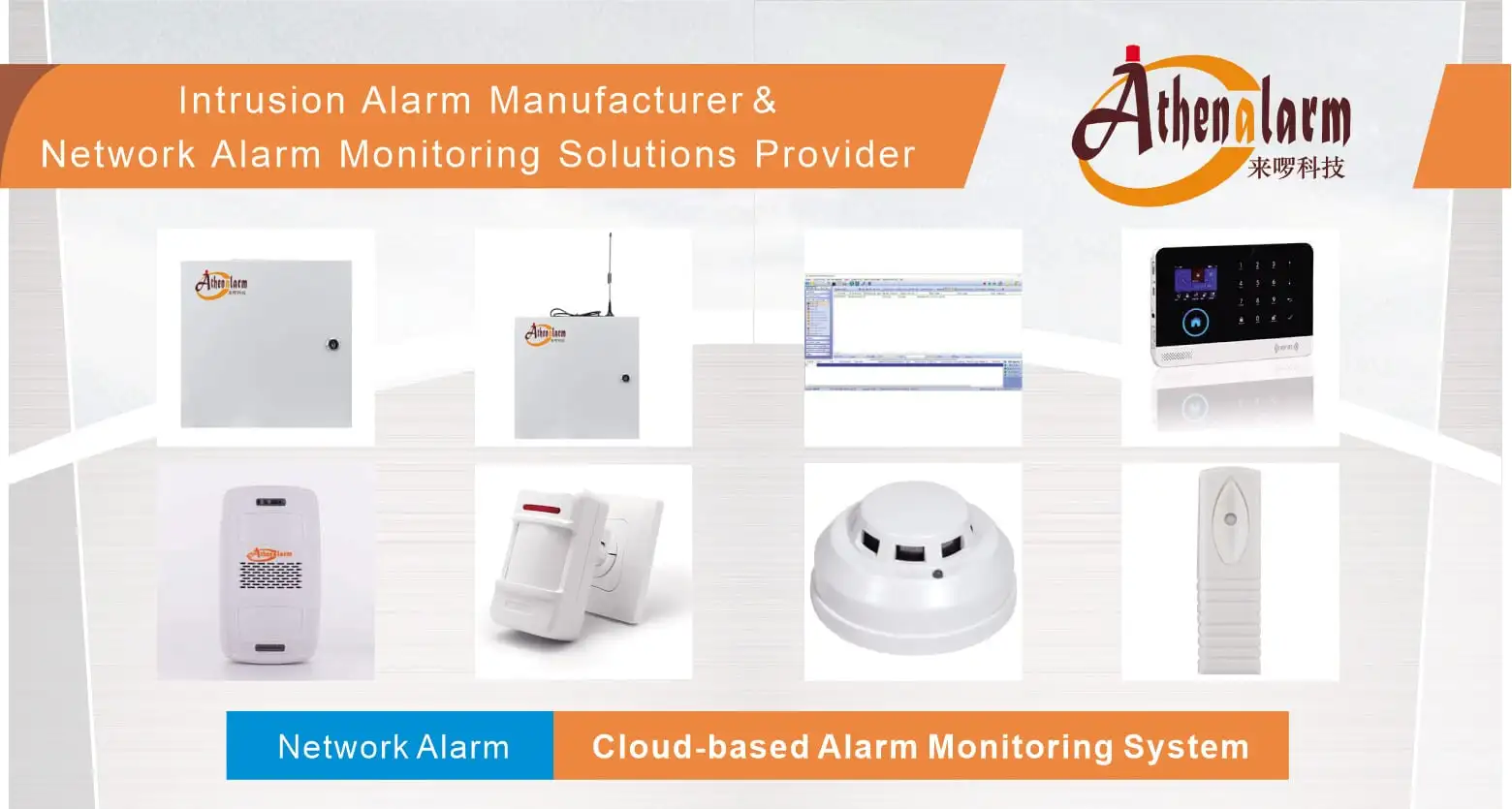
Below is an engineering reference breakdown of hardware components, peripheral sensors, and scenario-specific integrations compatible with high-reliability enterprise security architectures:
- Intrusion Detection & Peripheral Sensors:
- Field-level optical motion capture: PIR Motion Sensors and wide-area coverage Wide Angle PIR Motion Sensors.
- Perimeter & structural integrity: Industrial-grade Door Contacts and high-sensitivity Digital Vibration Detectors.
- Hazard & Environmental Monitoring:
- Early-stage hazard mitigation: Commercial Photoelectric Smoke Detectors and industrial Gas Detectors.
- Emergency Actuation & Deterrence Devices:
- Duress & immediate dispatch triggers: Hardwired Panic Buttons and tactical Wireless Panic Buttons.
- Visual & auditory deterrence: High-visibility Warning Lights and automated Motion Sensor Audio Players.
- Specialized Scenario Solutions & Infrastructure Platforms:
- Financial sub-verticals: Dedicated Bank ATM Alarm Monitoring System Solution and high-security Network Bank Vault Alarm Monitoring System Solution.
- Commercial & hospitality deployments: Tailored Network Hotel Alarm System Solution and retail-grade Network Store Alarm System Solution.
- Residential & multi-tenant facilities: Enterprise-managed Network Community Alarm System Solution, multi-zone Network House Alarm System Solution, and hybrid GSM/WiFi Alarm Systems.
- Enterprise Platform & OEM/ODM Manufacturing:
- Core technology architecture: Comprehensive Network Alarm Systems, enterprise Burglar Alarm Systems, and certified OEM capabilities from an established Burglar Alarm Manufacturer.
