
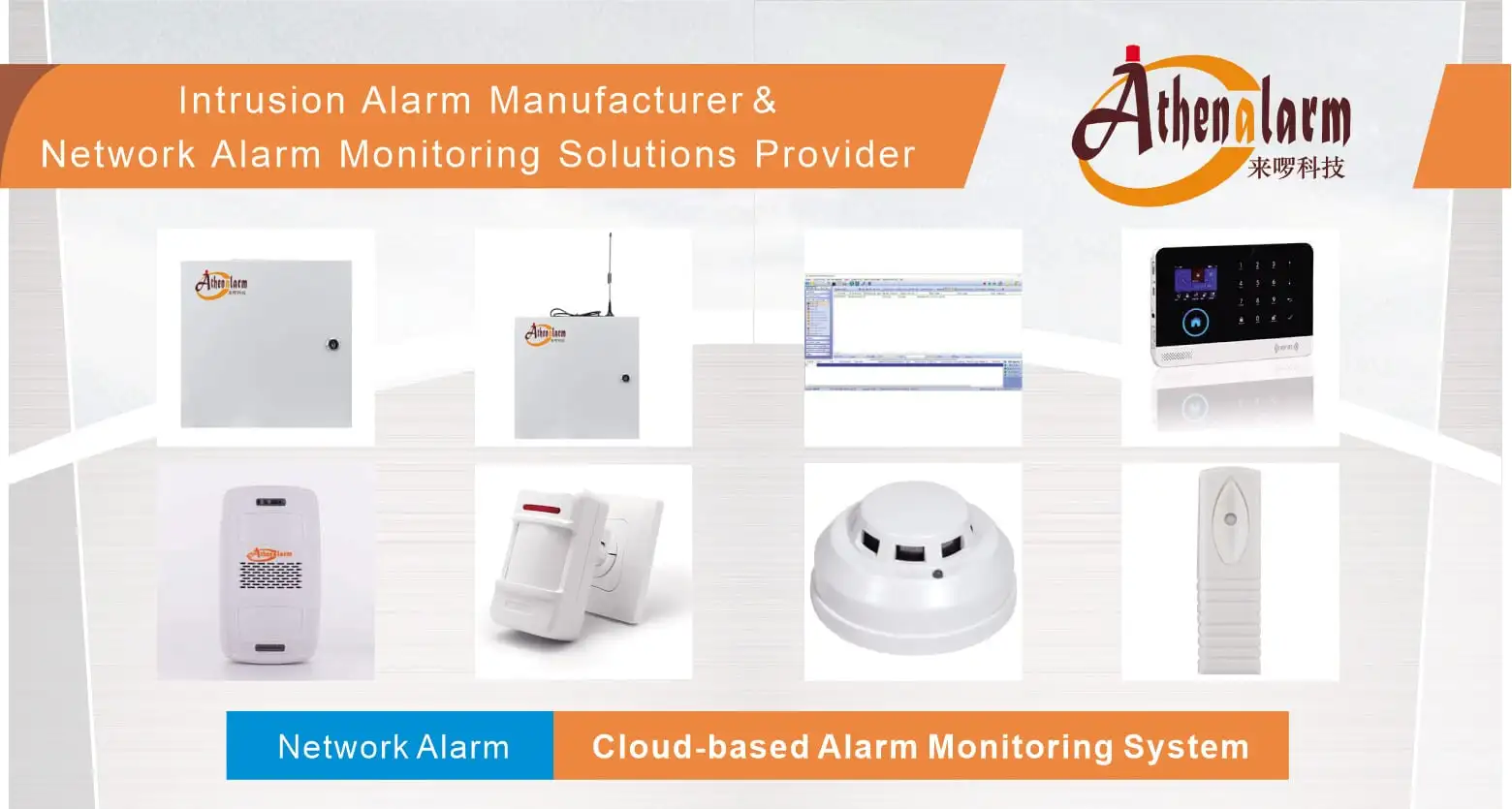
Network Alarm Receiving Centre Architecture: Centralized Monitoring and Intelligent Response for Enterprise Security Operations
A logistics operator running twelve regional depots, a hospital network with satellite clinics, or a retail chain with fifty branch locations all share the same structural weakness: each site’s alarm panel operates as an isolated decision point. When an intrusion sensor triggers at Location A, that event has no relationship to what is happening at Location B, C, or D. There is no shared operator, no shared dashboard, and no shared verification logic. The alarm either reaches a local guard, a site manager’s phone, or a third-party monitoring line — and the outcome depends entirely on who answers and how quickly.
This fragmentation becomes an operational liability once an organization grows beyond a single site. Response times vary by location. Verification quality depends on whoever is on duty. Audit trails are inconsistent because each site logs events differently, if at all. For security leaders responsible for enterprise-wide risk, this creates a governance gap: they cannot answer basic operational questions — how many false alarms occurred last month, which sites have unresolved incidents, or whether response procedures were actually followed — with any confidence.
A Network Alarm Receiving Centre (NARC) exists specifically to close this gap. It is not an alarm panel, a piece of software, or a monitoring product sold by a single vendor. It is an architecture — a centralized operational layer that receives alarm signals from distributed sites, applies consistent classification and verification logic, and coordinates response across all connected locations from a single operational environment. Deployment of high-concurrency network alarm center management software ensures real-time telemetry decoding and automated event classification across all distributed edges.
The remainder of this article examines how that architecture functions: how signals move from detection to verified action, how false alarms are filtered before dispatch, how communication reliability is engineered, how integration with other building systems works, and what trade-offs an organization should weigh before adopting this model.
1. Why Distributed Security Operations Require a Centralized Alarm Architecture
Before evaluating NARC as a solution, it is necessary to understand precisely where standalone alarm architectures fail once an organization operates more than one site.
1.1 Fragmented Alarm Visibility Creates Operational Challenges
In a standalone configuration, each site’s alarm system reports independently — often to a local keypad, a site-specific monitoring contract, or a designated employee’s phone. This produces three recurring problems.
First, there is no aggregated view of security status. A regional security manager cannot see, in one place, which of twenty sites currently have open alarms, which have communication faults, or which have unresolved verification requests. Second, response quality is inconsistent, because verification and escalation depend on whichever individual receives the alert, rather than on a standardized procedure. Third, historical data is scattered across separate systems, making it difficult to identify patterns — for example, whether a particular site experiences a disproportionate number of false triggers relative to its counterparts.
None of these problems stem from a lack of detection capability at the sensor level. They stem from the absence of a centralized layer that can correlate, prioritize, and manage alarm events across the organization as a whole.
1.2 Enterprise Security Requires Standardized Response Workflows
A second structural issue is procedural inconsistency. When each site defines its own escalation path, the organization effectively operates multiple, uncoordinated security policies rather than one. This becomes a measurable business risk in regulated sectors — healthcare, finance, logistics — where auditors and insurers expect demonstrable, repeatable incident-handling procedures rather than ad hoc, site-specific practices.
Centralizing alarm reception does not eliminate the need for local response resources (guards, facility staff, emergency services), but it does standardize the decision logic that determines when and how those resources are engaged. This is the operational gap that a Network Alarm Receiving Centre architecture is designed to close.
| Dimension | Standalone Alarm Systems | NARC Architecture |
|---|---|---|
| Monitoring scope | Single site, isolated | Multiple sites, unified |
| Verification consistency | Depends on local staff availability | Standardized verification workflow |
| Response coordination | Site-specific, manual | Centralized, procedure-driven |
| Incident visibility | Fragmented, site-by-site | Consolidated across all locations |
| Audit and reporting | Inconsistent record-keeping | Centralized event logging |
2. Network Alarm Receiving Centre Architecture: From Alarm Signals to Security Decisions
2.1 Core Role of a Network Alarm Receiving Centre
Within the security architecture of a distributed organization, a NARC occupies the position between the alarm-generating systems at each site and the parties who must act on verified threats. It does not replace field-level detection hardware — motion sensors, smoke detectors, heat and flood sensors remain the source of raw alarm data. Instead, the NARC receives the signals those devices generate, applies classification and verification logic, and converts the result into a coordinated response instruction.
This positioning matters for scope clarity: the NARC’s system boundary includes signal reception, event classification, verification workflows, and response coordination. It does not include field wiring, detector selection, or intrusion alarm control panel configurations — those remain site-level engineering decisions that sit outside the centralized architecture.
2.2 The Signal-to-Action Workflow
The operational value of a NARC is best understood as a sequence of four dependent stages. Each stage depends on the reliability of the one before it — a failure at signal reception, for instance, makes classification and verification irrelevant.
2.2.1 Signal Reception
Alarm systems at each site transmit event data to the NARC over one or more communication channels. Inputs typically include motion-related alarms, smoke and heat alarms, and flood or environmental alarms, tagged with site identifiers, zone information, and timestamps. Reception must be continuous — the NARC’s operational value depends on its ability to receive signals from any connected site at any time, without gaps.
2.2.2 Event Classification and Prioritization
Once received, each alarm event is classified by type, location, and time context, then queued according to severity. This step exists because not every alarm carries equal operational weight — a fire alarm at a data center and a door-contact alarm at an unoccupied warehouse zone require different urgency levels. When deploying a dedicated network perimeter alarm system solution, perimeter breaches are prioritized dynamically based on physical zone sensitivity and structural delay factors. Classification allows operators to work through a prioritized queue rather than a raw, unordered stream of events.
2.2.3 Verification Before Response
Before any response is dispatched, the classified event passes through a verification stage. This is a deliberate architectural checkpoint: dispatching guards or emergency services on unverified signals is operationally expensive and, over time, damages the credibility of the monitoring relationship. Verification methods are addressed in detail in Section 3, but structurally, this stage sits between classification and response for every alarm event that the architecture processes.
3. Multi-Layer Alarm Verification: Reducing False Responses Through Intelligence and Human Validation
3.1 Why False Alarm Management Becomes an Enterprise Challenge
False alarms are not a minor inconvenience at enterprise scale — they consume operator time, trigger unnecessary guard dispatches or emergency-service call-outs, and, over repeated occurrences, erode confidence in the monitoring system itself. For an organization operating dozens of sites, even a modest false-alarm rate per site compounds into a significant volume of unnecessary responses across the network. This is the operational friction that makes verification architecture a core design requirement, not an optional feature.
3.2 Combining Automated Analysis With Operator Verification
NARC architectures address this through a dual-layer model rather than relying on automation alone or human judgment alone. Machine learning-based anomaly detection performs an initial pass, flagging event patterns that deviate from expected behavior at a given site or time of day. This automated layer narrows the volume of events that require direct attention, but it does not make the final determination.
The second layer is operator-assisted verification, where a trained operator reviews available video or audio feeds associated with the alarm zone to confirm whether the triggering event reflects a genuine security concern. This division of labor reflects a deliberate engineering choice: automation improves processing speed and reduces operator workload, while human verification provides contextual judgment that automated systems cannot fully replicate. Neither layer is designed to operate as a full replacement for the other.
3.3 Behavioral Correlation and Multi-Event Analysis
A further verification technique is behavioral correlation — assessing whether multiple related triggers occur within a short time window (for example, several sensors activating within five minutes) to increase or decrease confidence in the event’s authenticity. A single isolated trigger may be treated with more caution than a cluster of correlated triggers across adjacent zones, which more strongly indicates an active event rather than a sensor anomaly.
| Verification Layer | Method | Primary Function |
|---|---|---|
| Automated anomaly detection | Machine learning pattern analysis | Initial filtering of low-confidence events |
| Operator-assisted verification | Video/audio feed review | Human confirmation of event authenticity |
| Behavioral correlation | Multi-sensor, time-windowed analysis | Confidence adjustment based on event clustering |
4. High-Availability Communication Architecture for Continuous Alarm Monitoring
4.1 Why Communication Reliability Determines Monitoring Effectiveness
A NARC’s entire operational value depends on one precondition: alarm signals must actually reach the centre. If the communication path between a site and the NARC is interrupted, the most sophisticated classification and verification logic becomes irrelevant, because no event data arrives for processing. This makes communication architecture a first-order engineering concern, not a peripheral detail.
4.2 Dual Communication Paths and Redundancy Considerations
To reduce the risk of monitoring loss, NARC architectures typically rely on more than one transmission path per site. A primary connection over TCP/IP-based broadband is commonly paired with a cellular backup path using GSM, LTE, or 5G, often implemented through dual-SIM failover so that a fault on one cellular network does not eliminate the backup entirely. Cloud-based redundancy layers add a further recovery mechanism at the platform level, supporting continued operation if a primary data path or processing node becomes unavailable.
Compatibility across legacy and modern transmission protocols is also a practical requirement, since multi-site organizations rarely operate identical alarm infrastructure across every location — some sites may still run older transmission hardware while others use newer IP-based or cellular-native equipment.
| Communication Path | Technology | Role in Architecture |
|---|---|---|
| Primary transmission | TCP/IP | Main signal transmission path |
| Cellular backup | GSM / LTE / 5G | Failover when primary path is unavailable |
| Redundancy mechanism | Dual-SIM failover | Reduces single-point cellular failure risk |
| Platform resilience | Cloud-based redundancy | Supports continuity if a processing node fails |
4.3 Reliability Trade-Off: Availability vs Infrastructure Complexity
Redundant communication paths measurably reduce the risk of monitoring gaps, but they are not without cost. Each additional path — a second SIM, a backup broadband circuit, a cloud failover layer — adds infrastructure to provision, configure, and maintain across every connected site. For an organization with a small number of locations, this overhead is manageable; for an organization scaling into dozens or hundreds of sites, redundancy design becomes a significant recurring cost and maintenance responsibility. This is an engineering trade-off that should be sized to the criticality of each site rather than applied uniformly by default.
5. NARC Integration Architecture: Connecting Security Systems Into One Operational Workflow
5.1 Moving From Independent Systems to Integrated Security Operations
Alarm monitoring rarely exists in isolation at the facility level. Most enterprise sites also operate CCTV, access control, fire detection, and, increasingly, building automation systems. When these systems function independently, an incident response team may need to check several separate interfaces to understand what is actually happening at a site — the intrusion panel shows a triggered zone, but confirming the event may require separately pulling CCTV footage or checking an access log on a different platform entirely.
A NARC architecture addresses this by acting as an integration point where data from these adjacent systems becomes available within the same operational workflow used for alarm verification and response.
5.2 Automated Response Workflows Across Connected Systems
Integration enables response logic that spans multiple systems rather than acting on a single alarm input alone. A verified intrusion alarm, for example, can be cross-referenced against access control logs to determine whether a valid credential was used at the same door around the same time — a detail that materially changes how the event should be handled. Similarly, a verified fire alarm can trigger coordinated actions across connected systems, such as unlocking egress doors through the access control system, rather than requiring separate manual intervention on each platform.
| Connected System | Integration Function |
|---|---|
| CCTV Systems | Provides video verification for alarm confirmation |
| Access Control Systems | Cross-references credential activity with alarm events |
| Fire Detection Systems | Coordinates emergency actions such as door unlocking |
| Building Automation Systems | Supports automated environmental or access responses |
Each additional integration increases the operational capability of the architecture, but also introduces a compatibility burden: every connected system has its own data format, update cadence, and failure behavior, which the NARC platform must accommodate without degrading the reliability of core alarm processing.
6. Remote Visibility and Security Operations Management
6.1 Real-Time Security Information Access
Enterprise clients managing distributed sites need visibility into security status without needing physical presence at each location. NARC architectures typically expose this through encrypted client portals and mobile applications, allowing authorized users to view current alarm status, zone conditions, and, where video verification is used, associated snapshots — without requiring direct contact with monitoring operators for routine status checks.
6.2 Operational Records and Accountability
Beyond real-time status, historical event logs serve a distinct operational function: they create an auditable record of what occurred, when, and how it was handled. For organizations with compliance or insurance reporting obligations, this record supports internal reviews and external audits. SLA-oriented dashboards extend this further by tracking response-time and verification-accuracy metrics against agreed service expectations, giving security managers a basis for evaluating monitoring performance over time rather than relying on anecdotal impressions.
7. Evaluating NARC Adoption: Architecture Decisions for Enterprise Security
Adopting a centralized architecture is not a decision that improves every metric simultaneously. It involves trade-offs that organizations should evaluate deliberately rather than assume away.
7.1 Centralization vs Complexity
Centralizing monitoring improves cross-site visibility and procedural consistency, but it also concentrates operational dependency into a single architecture. If the central platform experiences a fault, the impact is felt across all connected sites simultaneously, rather than being isolated to one location as it would be under a standalone model. This makes the design and resilience of the central platform itself a critical evaluation point.
7.2 Automation vs Human Verification
Automated filtering reduces operator workload and speeds up initial triage, but automation alone does not eliminate the need for human judgment in ambiguous cases. Organizations should evaluate how a prospective NARC balances these two elements rather than assuming that greater automation is inherently better — over-reliance on automated dismissal carries its own risk of missed genuine events.
7.3 Scalability vs Operational Management Requirements
A centralized architecture generally scales more predictably than expanding a patchwork of independent, site-specific alarm contracts. However, each additional connected site still requires onboarding, integration verification, and inclusion in existing response procedures. Scalability at the architectural level does not eliminate the operational management work required to bring new sites into the system correctly.
| Trade-off | Engineering Consideration |
|---|---|
| Centralization vs Complexity | Improves visibility; concentrates dependency on core platform reliability |
| Redundancy vs Cost | Improves availability; increases infrastructure and maintenance cost |
| Automation vs Human Verification | Improves processing speed; requires validation logic to avoid missed events |
| Integration vs Management Complexity | Expands capability; requires ongoing compatibility management |
8. Business Value of Network Alarm Receiving Centre Architecture
8.1 Supporting Multi-Site Security Governance
For organizations such as retail chains, logistics networks, hospital systems, data centers, and critical infrastructure operators, a NARC architecture provides a single point from which security policy can be applied consistently across sites. In mission-critical sectors, integrating a specialized network bank alarm monitoring system solution enforces strict compliance with institutional audit trails and multi-tiered panic escalation procedures. This matters most where governance requirements — internal audit, insurer reporting, or regulatory oversight — depend on demonstrating that incident handling follows a defined, repeatable procedure rather than varying by location.
8.2 Improving Operational Consistency and Risk Management
Centralized verification reduces the volume of unnecessary dispatches, which lowers guard and emergency-service call-out costs over time. Consolidated event logging supports more accurate risk assessment, since security managers can identify which sites generate disproportionate false-alarm volumes or repeated incident types and address root causes rather than treating each event in isolation. These outcomes are a direct extension of the architecture described in the preceding sections — they are not separate benefits, but the operational result of centralizing signal reception, verification, and response coordination.
9. FAQ
How does a Network Alarm Receiving Centre differ from traditional local alarm systems?
A NARC centralizes monitoring, verification, and response coordination across multiple sites, whereas traditional local alarm systems process and respond to events independently at each location. The difference is architectural rather than device-level: local systems still generate the raw alarm signals, but a NARC applies consistent classification and verification logic across all connected sites instead of leaving that logic to vary by location.
What techniques are used by a NARC to minimize false alarms?
A NARC combines automated anomaly detection, operator-assisted video or audio verification, and behavioral correlation across multiple sensor triggers within a defined time window. This layered approach exists because no single method reliably distinguishes genuine threats from false triggers on its own — automation narrows the volume of events requiring attention, while human verification and correlation analysis provide the contextual confirmation needed before dispatch.
How does NARC architecture handle communication outages or network failures?
NARC architectures typically pair a primary TCP/IP connection with cellular backup paths (GSM, LTE, or 5G), often using dual-SIM failover, supplemented by cloud-based redundancy at the platform level. This matters because the entire verification and response workflow depends on alarm signals actually reaching the centre; without redundant paths, a single communication fault can eliminate visibility into a site entirely.
What types of security platforms can be integrated into a central NARC platform?
Commonly integrated systems include CCTV for video verification, access control for credential cross-referencing, fire detection for coordinated emergency actions, and building automation systems for environmental or access responses. Integration allows the NARC to correlate data across systems during verification rather than treating each alarm input as an isolated data point.
Is a Network Alarm Receiving Centre suitable for multi-site enterprises?
NARC architectures are specifically structured to address the visibility and coordination gaps that arise once an organization operates more than one site. Single-site operations may not require the same level of centralized coordination, since the operational problem a NARC solves — fragmented visibility and inconsistent response across locations — becomes significant primarily at multi-site scale.
What factors should organizations evaluate before adopting a NARC architecture?
Organizations should assess the resilience of the central platform itself, the balance between automated filtering and human verification in the proposed verification workflow, the communication redundancy available for each site, and the integration compatibility with existing CCTV, access control, and fire systems. These factors determine whether the architecture will reduce operational friction or simply relocate it to a different point in the system.
10. System Component Checklist Appendix
To support end-to-end operational integration within a Network Alarm Receiving Centre architecture, standard enterprise deployments incorporate certified edge devices, specialized sensors, and scenario-specific hardware configurations. Below is a structured checklist of compatible components and application solutions:
1. Edge Intrusion & Environmental Detection Devices
- Volumetric Intrusion Detection: High-immunity industrial PIR motion sensors and wide-coverage wide-angle PIR motion sensors.
- Life Safety & Hazardous Environment Sensing: Certified photoelectric smoke detectors and industrial combustible gas detectors.
- Perimeter & Physical Access Sensors: High-sensitivity digital vibration detectors and surface-mounted perimeter-secure door contacts.
- Emergency Duress Hardening: Hardwired industrial panic buttons and supervised encrypted wireless panic buttons.
- Local Audio-Visual Deterrence: Strobe-integrated industrial warning lights and programmable motion-sensor voice sound players.
2. Specialized Vertical Scenario Architectures
- Financial & Critical Infrastructure: Highly secure ATM alarm monitoring solutions and vault-grade network bank vault alarm monitoring systems.
- Commercial & Hospitality Assets: Scalable hotel network alarm system solutions, multi-branch store alarm system solutions, and broad-acre community alarm system solutions.
- Residential & Small Office Telemetry: Integrated GSM/Wi-Fi dual-path alarm systems and perimeter residential network house alarm solutions.
3. Core OEM Hardware & Systems Infrastructure
- Core Platform & Hardware OEM: Enterprise-grade hardware engineered by an established burglar alarm manufacturer, leveraging full-stack network alarm systems, specialized burglar alarm infrastructure, and multi-tenant alarm monitoring system applications backed by the Athenalarm official portal.
