
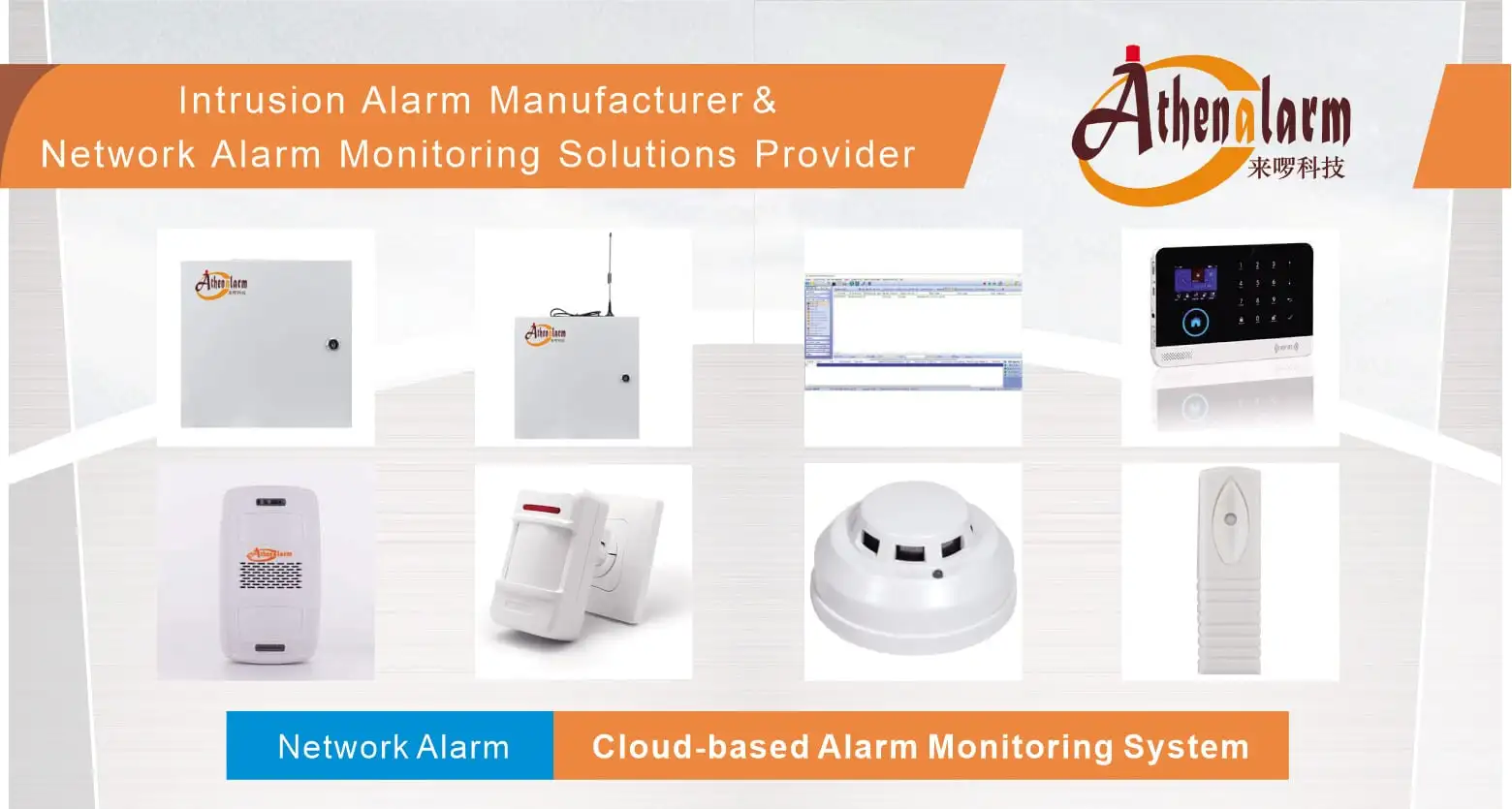
Key Technology Trends and Strategic Shifts in the Burglar Alarm Market
Traditional intrusion alarm systems were organized around a simple, local sequence: a detector identified motion, a control panel generated an alarm condition, and a siren or dialer notified whoever was nearby. That architecture is being replaced. Across commercial, enterprise, and specialized verticals, the burglar alarm system is increasingly distributed across detection hardware, control electronics, wireless and IP communication paths, cloud management platforms, and analytics layers that classify events before a human ever sees them.
This shift creates a direct problem for security integrators, OEMs, system designers, and B2B buyers: a portfolio or specification built around standalone, reactive alarm logic no longer matches what many commercial and enterprise buyers are asking for. Procurement teams are evaluating wireless mesh coverage, IP-based signaling, modular control architecture, and AI-assisted monitoring alongside conventional intrusion sensing. Specifying the wrong architecture—or assuming that legacy PSTN-style signaling and fixed panels remain sufficient—can result in systems that are harder to integrate, more expensive to service, and less competitive against connected alternatives.
The Burglar Alarm Market is not being reshaped by a single innovation. It is being reshaped by eleven distinguishable but interrelated developments, each acting on a different layer of the system: deployment scope, field detection, control architecture, communication, remote operations, and cloud-based analytics. Understanding which layer each trend affects—and which deployment conditions make it relevant—is more useful to a B2B decision-maker than treating all eleven as equally urgent everywhere.
The sections below examine each trend in its original sequence, explain the engineering logic behind it, and then consolidate the findings into a single decision framework and trade-off analysis for system design and procurement.
1. The Burglar Alarm Market Is Shifting From Standalone Alarms to Connected Security Ecosystems
1.1 The Architectural Transition Behind the Market Trends
The burglar alarm system, as an entity, historically performed a narrow function: detect intrusion, generate a local alarm, and signal a monitoring station over a dedicated phone line. The system boundary discussed throughout the rest of this article is broader. It includes detection devices (wireless detectors, infrared and multi-beam sensors, anti-masking detectors), an alarm control panel (increasingly modular), a communication layer (wireless, cellular, or IP), a management layer (cloud platforms and mobile applications), and an analytics layer (AI-assisted event classification).
A generalized relationship across these layers looks like this:
| Layer | Representative Entities | Function |
|---|---|---|
| Detection | Wireless Detector, Infrared Sensor, Multi-Beam Infrared Sensor, Anti-Masking Detector | Identifies intrusion or tamper conditions |
| Control | Alarm Control Panel, Modular Control Panel | Processes detector input, manages arming state |
| Communication | Wireless/Cellular Communication, IP Alarm Transmission, Telecom Infrastructure | Transmits alarm and status data |
| Management | Cloud Platform, Mobile Application, Centralized Dashboard | Provides remote visibility and control |
| Analytics | AI Monitoring, Event Classification, Pattern Analysis | Filters and prioritizes events before operator response |
This is a generalized industry-level model rather than a specification of any single deployable system; specific panel topologies, redundancy architectures, and cloud implementations vary by manufacturer and are not defined here.
1.1.1 From Local Alarm Generation to Distributed Operations
In the legacy model, the alarm control panel was the effective endpoint of the system. In the model now common in commercial and enterprise deployments, the control panel becomes one node in a longer chain that extends to a cloud platform and, in many cases, to an analytics process that classifies the event before it reaches an operator.
1.1.2 From Standalone Devices to Connected Security Functions
Alarm systems increasingly exchange information with video systems, access control systems, and building automation platforms rather than operating in isolation. This does not mean every alarm system supports every integration; it means the architectural expectation has shifted toward interoperability as a normal design consideration rather than an exception.
1.1.3 From One-Time Installation to Continuous Management
Because detection, communication, and cloud layers now depend on each other, alarm deployment is better understood as an ongoing operational lifecycle—covering diagnostics, connectivity monitoring, and remote firmware or configuration management—rather than a single installation event.
2. Trend 1: Expanding Demand Across Commercial, Enterprise, and Specialized Industries
2.1 Different Verticals Create Different Technology Priorities
Burglar alarm adoption is no longer concentrated in residential and light-commercial use. Demand is expanding into sectors with distinct technical requirements:
| Sector | Primary Driver | Dominant Technical Requirement |
|---|---|---|
| Military and sensitive installations | Layered perimeter defense | Tamper-resistant, high-integrity detection |
| Financial institutions | Vault and asset protection, regulatory resilience | System uptime, integration with vault systems |
| Education campuses | Open layouts, distributed buildings | Scalable, connected detection |
| Residential complexes | Smart-living integration | Aesthetic, user-friendly system design |
| Mining and industrial zones | Harsh outdoor conditions | Rugged, environmentally tolerant detectors |
2.2 High-Security Environments Versus Infrastructure-Constrained Environments
These verticals do not share a single dominant requirement. Financial institutions and military sites prioritize detection integrity and tamper resistance; mining, logistics, and remote industrial sites are more often constrained by power availability, wiring access, and environmental durability. This distinction matters for portfolio planning: a detector line optimized for high-security detection integrity is not automatically the right specification for a rugged outdoor perimeter, and vice versa.
3. Trend 2: Wireless Detectors and More Flexible Deployment Models
3.1 Why Wireless Deployment Is Attractive in Difficult or Multi-Building Environments
Wireless detectors reduce the cabling effort associated with intrusion detection, which shortens installation time and simplifies deployment across multiple buildings or renovated interiors where running new cable is impractical. This deployment model is reinforced by improvements in 4G/5G connectivity and mesh networking, which extend the practical range and reliability of wireless detector networks beyond what earlier RF systems could support.
3.2 Wireless Flexibility Versus Connectivity Dependency
Removing cabling does not remove infrastructure dependency; it relocates it. A wireless detector still depends on radio connectivity to the alarm control panel and, in many architectures, on a cellular or broadband uplink for further transmission. System designers evaluating wireless detectors should treat wireless coverage and network reliability as a design variable with the same seriousness previously given to cable routing.
4. Trend 3: IoT Integration and Broader Security Ecosystem Interoperability
4.1 From Standalone Security Device to Connected Building Function
Modern alarm control panels increasingly support two-way communication with detectors—covering functions such as battery status and fault diagnostics—and, where platform support exists, interoperability with protocols such as Z-Wave, Zigbee, and Matter. This allows the burglar alarm system to interact with lighting, HVAC, and other automation systems rather than operating as an isolated security appliance.
4.2 Interoperability Benefits Versus Platform Dependency
Z-Wave, Zigbee, and Matter support should be treated as a conditional capability rather than a baseline feature of all burglar alarm systems. Not every control panel implements every protocol, and interoperability claims should be evaluated per product line. Broader interoperability increases functional scope, but it also increases the number of compatibility relationships—firmware versions, protocol revisions, third-party device support—that must be managed over the system’s operating life.
5. Trend 4: Telecom and Broadband Providers Are Entering the Alarm Ecosystem
5.1 Security as Part of a Connectivity Offering
Telecom and broadband providers are embedding intrusion detection functions into existing router and broadband hardware, bundling security features with connectivity services. This lowers the barrier to entry for small businesses and urban residential customers by offering plug-and-play deployment without a separate alarm installation project.
5.2 Accessibility Versus Infrastructure Dependence
This model improves accessibility, but it ties alarm functionality to the reliability and continuity of the telecom or broadband service itself. Where the broadband connection is interrupted, alarm functions bundled into that infrastructure may be affected as well. Integrators evaluating telecom-bundled offerings should account for this dependency rather than treating it as equivalent to a dedicated, independently powered alarm communication path.
6. Trend 5: Modular Control Panels for Flexible System Configuration
6.1 Modularity as an Adaptation Strategy
Legacy fixed-function control panels are being supplemented or replaced by modular platforms that accept plug-in components such as GSM/3G/4G communication modules, voice/SMS units, and smart-home interfaces. A modular control panel therefore functions as a core control platform plus optional communication and interface modules, allowing a single base product to be configured for different budgets, regional communication standards, and project requirements.
6.2 Flexible Expansion Versus Configuration Complexity
Modularity gives OEMs and integrators the ability to tailor one panel family to many use cases without maintaining separate fixed-function product lines. The trade-off is that each additional module introduces a configuration and compatibility relationship that must be verified and, over the system’s lifecycle, maintained—particularly when modules are updated or replaced independently of the core panel.
7. Trend 6: Remote Access and Intelligent Notifications Are Changing Alarm Operations
7.1 From Local Control to Remote Operational Visibility
Cloud-connected panels increasingly support app-based arming and disarming, two-way voice alerts over SIP or mobile channels, and live fault and intrusion notifications. This shifts the operational model from a facility manager or homeowner needing to be physically present to one where the same personnel can act on system status from any location with network access.
7.2 Remote Access Versus Network Dependency
The practical value of remote access depends entirely on the reliability of the communication path connecting the panel to the mobile application or cloud service. Remote-access features should be evaluated alongside the communication architecture supporting them—wireless, cellular, or IP—rather than as an independent feature.
8. Trend 7: IP-Based Alarm Transmission Is Expanding Connectivity and Cybersecurity Requirements
8.1 IP Connectivity Expands Integration and Remote Diagnostics
IP networking is increasingly used in place of traditional PSTN-based alarm signaling. This supports real-time data sharing with other systems such as video and access control, enables remote troubleshooting and diagnostics without a site visit, and allows for more scalable alarm management across multiple sites through a shared network infrastructure.
8.2 Network Connectivity Creates Additional Cybersecurity Requirements
This capability comes with a corresponding obligation: any alarm system transmitting over IP networks becomes a networked endpoint and inherits the general cybersecurity considerations of connected infrastructure. At minimum, this implies attention to encryption of transmitted data, regular firmware updates, and secured remote-access protocols. The article does not specify—and this analysis does not assume—particular encryption algorithms, cybersecurity standards, or certifications; these should be confirmed against individual product documentation during specification.
9. Trend 8: Enhanced Infrared and Multi-Beam Detection for Challenging Environments
9.1 Detection Challenges in Warehouses, Airfields, and High-Risk Assets
Large open spaces, long sightlines, and variable environmental conditions—wind-blown debris, animals, temperature fluctuation—make simple single-beam infrared detection prone to both missed detections and unwanted alarms. Warehouses, airfields, and other high-risk assets are the environments where this challenge is most pronounced.
9.2 Advanced Detection as a False-Alarm Reduction Approach
Multi-beam and dual-sensor infrared technologies are designed to improve discrimination between genuine human intrusion and environmental or animal movement, and to extend coverage across wide-angle or long-range perimeters. These technologies address a specific detection problem rather than eliminating false alarms outright; their relevance should be assessed against the actual environmental conditions of the deployment site, not treated as a universal upgrade for every installation.
10. Trend 9: Active Anti-Masking and Tamper Detection Are Strengthening Detector Integrity
10.1 Why Detector Integrity Matters Beyond Motion Detection
A motion detector can be defeated without visibly failing—spray masking, adhesive coverings, or mirror-based deflection can blind a sensor’s field of view while the device otherwise appears operational. In vaults, data centers, and logistics hubs, this kind of deliberate compromise is a more relevant threat than simple motion-detection failure.
10.2 How Active Anti-Masking Supports Detection Integrity
Active anti-masking functions typically monitor the detector’s own infrared reflection or sensing field through a self-test process, and raise a tamper alarm when the expected reflection pattern is disrupted—as would occur with a physical obstruction, adhesive layer, or reflective deflector. This adds a layer of detector-integrity verification that plain motion sensing does not provide, which is why anti-masking is treated as a specification requirement for high-security sites rather than a general-purpose feature.
11. Trend 10: Solar-Powered Detection Is Expanding Remote Deployment Possibilities
11.1 Power Availability as a Security Architecture Constraint
Farms, oil fields, solar farms, and other remote or infrastructure-poor sites frequently lack conventional wiring or a stable power grid connection. In these environments, power availability—not detection technology—is often the limiting factor in whether perimeter security can be deployed at all.
11.2 Off-Grid Autonomy Versus Environmental and Power Uncertainty
Solar-powered detectors, paired with lithium battery storage and low-power circuit design, address this constraint by removing the need for wired power and enabling zero-wiring installation. According to the source data referenced for this analysis, solar-powered detectors of this type can maintain operation for over 20 days without direct sunlight. This figure should be treated as a stated design characteristic of the specific product category described, not as a universal specification across all solar-powered security hardware; actual autonomy will vary with battery capacity, panel sizing, and local solar conditions.
12. Trend 11: Cloud Platforms and AI-Powered Monitoring Are Adding an Analytical Layer
12.1 Centralized Multi-Site Visibility
Cloud platforms increasingly provide centralized dashboards that give facility managers and monitoring operators a single point of visibility across multiple sites, replacing the site-by-site model associated with legacy standalone panels.
12.2 AI as an Analytics Layer Above Detection Hardware
Within these platforms, AI-assisted monitoring performs event classification and pattern analysis, aiming to reduce false alarms and support predictive alerting by identifying behavioral patterns in incoming event data. This analytics layer operates on top of detection hardware; it does not replace the underlying detector’s sensing function. A cloud platform can only classify and prioritize the events that field detection hardware actually generates, which is why detection quality (Trends 8 and 9) and analytics quality (Trend 11) should be evaluated as complementary, not substitute, capabilities.
13. What the 11 Trends Mean for B2B System and Portfolio Decisions
Not all eleven trends carry equal weight in every deployment. Treating them as a uniform checklist risks over-specifying some projects and under-specifying others. A more useful approach ties trend relevance to deployment environment.
13.1 Prioritize by Deployment Environment
| Deployment Environment | Dominant Requirement | Most Relevant Trend Direction |
|---|---|---|
| High-security sites (vaults, data centers) | Detection integrity | Anti-masking / tamper detection (Trend 9) |
| Warehouses / logistics hubs | Detection discrimination | Advanced infrared / multi-beam detection (Trend 8) |
| Multi-building or renovated properties | Deployment flexibility | Wireless detectors (Trend 2) |
| Enterprise / multi-site operations | Centralized visibility | Cloud platforms, remote access (Trends 6, 11) |
| Remote or infrastructure-poor sites | Power autonomy | Solar-powered detection (Trend 10) |
| Connected building environments | Interoperability | IoT integration (Trend 3) |
| Networked enterprise deployments | Remote transmission and diagnostics | IP-based transmission (Trend 7) |
13.2 Evaluate the System as a Whole Rather Than Feature by Feature
Because detection, control, communication, management, and power depend on one another, selecting a feature in isolation—an AI-capable cloud platform, for example—without confirming that the underlying detection hardware and communication path can support it, tends to produce a system that underperforms its individual specifications.
13.3 Treat Relevance as Context-Dependent
Eleven trends do not equal eleven equally important priorities for any single project. The more useful question for a system integrator, OEM, or buyer is not “which trend is most advanced,” but which trend addresses the dominant operational problem in a specific deployment environment, and what new dependency it introduces in exchange.
14. Engineering Trade-Offs Behind the Market Shift
Each of the trends above provides operational or functional benefit while introducing a corresponding engineering dependency. Consolidating these trade-offs in one place avoids repeating the same reasoning across multiple sections.
| Trade-Off | Benefit | Corresponding Dependency |
|---|---|---|
| Wired infrastructure vs. wireless flexibility | Faster installation, multi-building deployment | Reliance on wireless/network availability |
| Standalone operation vs. system integration | Broader functional scope (video, access control, automation) | More cross-system dependencies to manage |
| Local control vs. cloud management | Centralized, remote, multi-site visibility | Dependence on network-connected architecture |
| Basic detection vs. advanced detection/analytics | Improved discrimination, false-alarm reduction | More sophisticated hardware and data requirements |
| Fixed architecture vs. modular control panels | Configuration flexibility across projects/regions | More compatibility and configuration variables |
| Connectivity vs. cybersecurity exposure | Remote diagnostics, integration, real-time data sharing | Corresponding need for encryption, updates, secure access |
| Conventional power vs. solar-powered autonomy | Deployment in infrastructure-poor sites | Dependence on battery capacity and solar conditions |
These trade-offs illustrate why the transition described throughout this article is not a straightforward upgrade path. Each gain in connectivity, flexibility, or analytical capability is paired with a new operational responsibility that did not exist in the standalone, reactive model.
15. FAQ
Q1: How do modular control panels improve deployment flexibility for system integrators?
Modular control panels allow a single core platform to be adapted through plug-in components such as GSM/3G/4G communication modules, voice/SMS units, and smart-home interfaces. This lets integrators configure one base product for different project budgets and regional communication requirements instead of stocking separate fixed-function panels. The trade-off is that each added module introduces an additional compatibility and configuration relationship that must be verified during commissioning and maintained over the system’s operating life.
Q2: What technical mechanisms enable active anti-masking in high-security detectors?
Active anti-masking works by continuously monitoring the detector’s own infrared reflection or sensing field through a self-test process, generating a tamper alarm when that expected pattern is disrupted—as occurs when spray, adhesive, or a reflective deflector is used to obstruct the sensor. This matters because a masked detector can otherwise appear operational while failing to detect intrusion, which is why anti-masking is specified for vaults, data centers, and other high-security environments rather than treated as a general-purpose feature.
Q3: How does AI-powered cloud monitoring support false-alarm reduction in commercial systems?
AI-powered cloud monitoring analyzes incoming event data through classification and pattern analysis, aiming to distinguish genuine intrusion events from environmental or non-threat conditions before they reach a human operator. This analytics layer operates above the physical detection hardware and depends on the quality of the events that hardware generates; it supports false-alarm reduction but does not replace the underlying detector’s sensing function.
Q4: What factors determine the reliability of solar-powered alarm detectors at remote sites?
Reliability depends on the combination of low-power circuit design, lithium battery storage capacity, and available solar exposure at the deployment site. Under the design parameters described for this category of detector, operation for over 20 days without direct sunlight has been stated, though this figure reflects a specific product design rather than a universal specification, and actual autonomy will vary with local solar conditions, battery sizing, and detector power draw. Zero-wiring installation is a key advantage where conventional power or cabling is unavailable.
16. Appendix: System Component & Vertical Specification Checklist
For detailed hardware specifications and vertical deployment architectures, refer to the technical reference links below:
16.1 Core Platform & Network Solutions
- Alarm System Manufacturer Overview: Burglar Alarm System Manufacturer Solutions
- Enterprise Network Monitoring Architecture: Enterprise Network Alarm System Platform
- Integrated Centralized Solution: Network Alarm Monitoring System Solution
- Multi-Site Deployment Framework: Network Alarm System Application Scenarios
- Commercial Enterprise Monitoring: Enterprise Alarm Monitoring Systems
16.2 Vertical & Specialized Sector Implementations
- Financial Infrastructure: Bank ATM Alarm Monitoring Solution
- Hospitality Security: Network Hotel Alarm System Solution
- Commercial Retail Infrastructure: Network Store Alarm System Solution
- Residential & Multi-Tenant Facilities: Network Community Alarm System Solution and Network House Alarm System Solution
16.3 Hardware Detection Edge Devices & Peripheral Accessories
- Precision Motion Sensing: PIR Motion Sensors and Wide-Angle PIR Sensors
- Environmental Safety Detectors: Photoelectric Smoke Detectors and Combustible Gas Detectors
- Structural & Perimeter Compromise Sensing: Digital Vibration Detectors and Heavy-Duty Door Contacts
- Duress & Manual Signaling: Wired Panic Buttons and Wireless Panic Trigger Units
- Visual & Audio Alert Units: Strobe Warning Lights and Voice Alert Sound Player Modules
- Integrated Residential Control: GSM/WiFi Smart Alarm Hub
