
Industrial Intrusion Detection Alarm Systems: Architecture and Operational Capabilities
Industrial facilities—refineries, substations, data centers, distribution warehouses—combine large physical footprints with restricted internal zones, high-value equipment, and increasingly networked control systems. Security teams responsible for these environments face a structural mismatch: many legacy alarm installations were built around a single function—triggering a signal when one sensor activates—rather than around the layered detection, verification, and response workflow that industrial risk now requires. An Industrial Intrusion Detection Alarm System (IIDAS) is the architectural response to that mismatch. It is not one device or one sensor category; it is a coordinated set of detection, analytics, access control, monitoring, escalation, and maintenance functions operating together across a facility’s perimeter, internal zones, and connected infrastructure.
The practical consequence of treating intrusion detection as an architecture rather than a component purchase shows up directly in procurement and operations decisions. A facility that adds sensors without addressing event correlation, escalation logic, or cybersecurity exposure may detect more activity without closing the gap between “something happened” and “someone responded correctly.” An architecture that connects detection to monitoring and response can only be evaluated once the interactions between these layers—and the operational load of running them—are understood.
This document explains how an IIDAS is structured, how its layers interact, where engineering trade-offs and failure points typically occur, and what a security director or system designer should evaluate before specifying or upgrading an industrial intrusion detection architecture.
1. Why Industrial Intrusion Detection Requires an Integrated Architecture
Isolated alarm functions were designed for simple, low-complexity spaces. Industrial sites introduce three conditions that a single-function alarm does not address on its own: layered physical exposure, environmental interference, and the gap between detecting an event and acting on it.
1.1 Industrial Security Problems That Drive Architectural Integration
The following conditions recur across industrial facility types and directly shape how an IIDAS must be structured.
1.1.1 Perimeter and Restricted-Zone Exposure
Industrial sites carry both an outer boundary and multiple internal restricted areas—control rooms, data halls, chemical storage, cleanrooms, and IP-sensitive production zones. A single alarm point at a building entrance leaves the perimeter and every internal zone unmonitored in between. An IIDAS treats perimeter detection and restricted-zone detection as distinct but linked layers, each with its own sensor logic and escalation path, rather than a single undifferentiated trigger.
1.1.2 Environmental and False-Alarm Conditions
Outdoor perimeters and industrial interiors expose sensors to heat, moisture, dust, humidity, and electromagnetic interference from machinery. These conditions can produce nuisance alarms or mask genuine intrusion signals when sensor selection and calibration do not account for them. Alarm architecture has to be evaluated against the specific environmental profile of each zone rather than assumed to perform identically everywhere.
1.1.3 Detection-to-Response Gaps
Detecting an event is not equivalent to resolving it. A signal that is not correlated with context—identity data, camera confirmation, severity classification—or not routed to the correct responder produces delay. The architectural problem is bridging detection and response through analytics, escalation logic, and monitoring, rather than assuming that detection alone constitutes protection.
1.2 IIDAS Versus an Isolated Conventional Alarm Approach
The distinction between a conventional alarm and an IIDAS is architectural rather than purely technological: it concerns how many functions are connected, not simply how many sensors are installed.
| Dimension | Isolated Conventional Alarm | Integrated IIDAS |
|---|---|---|
| Detection scope | Typically one sensor type or entry point | Perimeter, restricted zones, and multiple sensor categories operating together |
| Event interpretation | Binary trigger / no trigger | Analytics-assisted classification intended to reduce false positives |
| Integration | Often stands alone | Connects to access control, surveillance, and monitoring functions |
| Monitoring | Local signal or on-site panel | Centralized and/or remote monitoring across one or more sites |
| Response | Manual, site-dependent | Structured escalation with defined alert channels |
| Lifecycle | Device-level maintenance | System-level maintenance including software, firmware, and analytics upkeep |
This comparison describes architectural tendencies rather than a claim that every conventional alarm installation lacks these capabilities.
2. The IIDAS Event Architecture: From Threat Detection to Operational Response
The functional core of an IIDAS is a repeatable event path: Threat → Detection → Analysis → Decision/Escalation → Response → Monitoring → Maintenance. Each stage depends on the one before it; a weakness at any point limits the value of the layers around it.
2.1 Detection Layer
Physical events enter the architecture through detection hardware—perimeter sensors, PIR motion detectors, thermal cameras, lidar with AI-assisted classification, door contacts, and infrared sensors. Each device type is suited to a different detection objective (movement, heat signature, object classification, access-point status), which is why detection is described as a layer rather than a single device category.
2.2 Analysis and Event Identification Layer
Raw detection signals are interpreted rather than simply forwarded. AI analytics functions—anomaly detection and behavioral profiling—assess whether an event corresponds to a genuine security concern or a non-threatening occurrence such as environmental movement or authorized activity. This layer is what differentiates a detection event from an actionable security event.
2.3 Decision and Escalation Layer
Once an event is classified, it is assigned a severity level that determines how it is escalated. This layer converts an analyzed event into a prioritized alert rather than treating all detections identically. The article’s source material describes severity-based escalation conceptually; it does not define a specific escalation protocol or standard.
2.4 Response Layer
Response actions vary by severity and site policy. Common outputs include on-site sirens and strobes, mobile push notifications, and cloud dashboard alerts. Some architectures may extend response to access lockdowns or equipment shutdown; these are possible response mechanisms tied to specific operational policy, not universal or automatic outcomes of every IIDAS deployment.
2.5 Monitoring and Oversight Layer
Centralized and remote monitoring—through a Security Operations Center (SOC), cloud portal, or mobile application—gives decision-makers visibility into sensor status and event history across single or multi-site operations. This layer supports situational awareness but depends on reliable connectivity between distributed detection points and the monitoring platform.
2.6 Maintenance as an Operational Layer
An IIDAS does not remain effective by default after installation. Diagnostics, sensor calibration, firmware and software updates, AI model retraining, and emergency drills are part of the operational architecture, not optional add-ons. Section 9 addresses lifecycle maintenance in more detail, including the site-dependent nature of maintenance cadence.
3. Perimeter and Restricted-Zone Detection Architecture
The event architecture in Section 2 operates across two physically distinct protection layers: the facility perimeter and internal restricted zones.
3.1 Perimeter Detection as the Outer Security Layer
Perimeter detection—fence-mounted detectors, microwave barriers, and buried seismic cables—forms the outermost layer intended to identify unauthorized entry before an intruder reaches core operational areas. When correlated with surveillance and access control, a perimeter breach can be escalated before the intrusion progresses further into the facility.
3.2 Restricted-Zone Detection for Critical Internal Areas
Beyond the perimeter, IIDAS extends detection into control rooms, data centers, chemical storage areas, cleanrooms, and IP-sensitive production zones using door contacts, infrared sensors, badge authentication, and behavioral analytics. This layer addresses risks—theft, vandalism, insider activity—that perimeter detection alone cannot capture, since these events originate inside the boundary.
3.3 Correlating Perimeter and Internal Detection
Perimeter and restricted-zone detection produce more operational value when correlated rather than evaluated independently. A perimeter alert followed by an unrelated restricted-zone event, for example, carries different implications than either event alone. Correlation depends on the analytics and monitoring layers described in Section 2, not on the sensors themselves.
4. Sensor Deployment Strategy for Industrial Zones and Environmental Conditions
Sensor selection is a deployment decision tied to zone function and environmental exposure, not a generic hardware specification.
4.1 Matching Sensor Type to Detection Objective
Each sensor category answers a different detection question: is a human present, is a heat source moving in a dark area, is an object at an entry point classifiable as a threat, or is a protected access point being used. Matching sensor type to detection objective—rather than deploying uniform hardware across all zones—is the deployment logic that determines whether coverage gaps exist.
4.2 Sensor Deployment Matrix
| Sensor Type | Typical Zone / Context | Detection Objective | Key Engineering Consideration |
|---|---|---|---|
| PIR Motion Detector | Chokepoints, interior movement paths | Detect human movement | Sensitive to placement height and line-of-sight obstructions |
| Thermal Camera | Unlit outdoor or hazardous areas | Detect heat signatures in darkness | Performance depends on ambient thermal contrast |
| Lidar + AI | Entry points and corridors | Classify objects, reduce false positives | Requires analytics support for object classification |
| Microwave Barrier | Perimeter | Boundary intrusion detection | Susceptible to environmental and RF interference |
| Buried Seismic Cable | Perimeter | Ground-level intrusion detection | Affected by soil conditions and ground disturbance |
| Door Contact | Restricted access points | Door/access event detection | Reflects access-state, not identity |
| Infrared Sensor | Internal intrusion areas | Detect intrusion activity | Sensitive to heat sources and airflow |
4.3 Placement, Calibration, and Detection Reliability
Sensor placement and calibration determine whether detection is trustworthy. A correctly selected sensor placed at the wrong height, angle, or distance from a chokepoint will generate either missed events or nuisance alarms. Calibration is not a one-time installation step; environmental drift, equipment vibration, and seasonal conditions can shift sensor behavior over time, which is why placement and calibration decisions connect directly to the false-alarm engineering discussed in Section 8.
5. Integrated Access Control, Surveillance, and Security Analytics
Detection alone identifies that something occurred; access control, surveillance, and analytics interpret whether that occurrence is authorized, verified, or actionable.
5.1 Access Control and Identity Verification
Access control systems establish whether activity in a zone is authorized. Common mechanisms include badge or biometric authentication, role-based access logic, and time-sensitive zone permissions. Behavioral indicators such as tailgating or loitering can be tracked where the underlying analytics support it, allowing an access-control event to be evaluated alongside a detection event rather than in isolation.
5.2 Surveillance as an Event-Verification Layer
Surveillance technology supplies visual or thermal confirmation of a detected event. A sensor trigger paired with a camera view allows an operator or analytics engine to confirm whether an event reflects a genuine intrusion, which reduces reliance on sensor output alone.
5.3 AI Behavioral and Anomaly Analytics
AI analytics functions—anomaly detection and behavioral profiling—assess patterns of movement or access against expected activity. Some platforms extend this with capabilities such as facial recognition linked to watchlists or predictive alerts for route deviations. These are possible advanced capabilities available on some platforms, not baseline characteristics of every IIDAS deployment, and their effectiveness depends on the quality of the underlying data and ongoing model maintenance rather than being inherently predictive.
5.4 AI Analytics and False-Alarm Reduction
The operational purpose of AI classification in this context is to distinguish relevant activity from non-threatening environmental or human movement, reducing the volume of alarms that require manual review. This directly addresses operator alarm fatigue, but it introduces an ongoing dependency: classification accuracy depends on model retraining as facility conditions and behavior patterns change, which is addressed further in Section 8.4.
6. Real-Time Alerting, Escalation, and Response Logic
Once an event is analyzed, the architecture must convert it into a timely and proportionate action.
6.1 Alert Channels and Operational Visibility
Alerts are typically distributed through on-site sirens and strobes, mobile push notifications, and cloud-based dashboards, often supplemented by centralized SOC visibility. Multiple channels reduce the likelihood that a single point of failure—such as a disconnected local panel—prevents notification.
6.2 Severity-Based Incident Escalation
Escalation logic differentiates events by severity so that a minor anomaly does not consume the same response resources as a confirmed perimeter breach. The source material describes this as a general escalation concept rather than a defined industry protocol, and specific escalation thresholds should be established per facility rather than assumed as a fixed standard.
6.3 Automated Response Boundaries
Some architectures support automated responses such as access lockdown or equipment shutdown triggered by high-severity events. These are policy-dependent capabilities that require clearly defined boundaries for when automation is permitted to act without human confirmation; they should not be treated as a default behavior of every IIDAS installation.
6.4 Automation Versus Human Verification
Faster automated response reduces the window of exposure during an incident, but it also reduces the opportunity for human verification before an action—such as a lockdown affecting personnel movement—takes effect. This is a genuine engineering trade-off: response speed versus operational control, and facilities should define where automated action is acceptable and where human confirmation is required before response.
7. Cyber-Physical Security for Connected Industrial Alarm Architectures
Because IIDAS components increasingly operate as part of the Industrial IoT (IIoT), the physical security architecture also carries a cybersecurity dependency.
7.1 Why Connected IIDAS Introduces Cybersecurity Exposure
Sensors, cameras, access-control devices, and monitoring dashboards that communicate over a network extend the facility’s attack surface beyond physical entry points. A compromise of the connected environment could affect the integrity of detection, alerting, or event records, which makes cybersecurity a direct extension of physical security rather than a separate concern.
7.2 Core Cyber-Hardening Controls
The architecture typically relies on a defined set of controls: encryption of data in transit and at rest (commonly AES-256), multi-factor authentication (MFA) for administrative console access, network segmentation to isolate security traffic from other operational networks, and protected event logging to preserve the integrity of incident records. Some deployments may extend event-logging protection using additional verification methods; such measures should be understood as implementation options rather than assumed defaults.
7.3 Remote Monitoring Versus Cybersecurity Exposure
Remote and cloud-based monitoring improves visibility across multi-site operations, but it also expands the connected attack surface. Cloud monitoring is not inherently secure; its safety depends on how encryption, access control, and network segmentation are implemented around it. The trade-off is between accessibility and exposure, not between “secure” and “insecure” platforms in the abstract.
7.4 Compliance Framework Context
Frameworks such as NIST SP 800-82, ISO 27001, and OSHA provide relevant context for industrial security and safety practice, and IIDAS design decisions are commonly reviewed against them during risk assessment. Referencing these frameworks does not mean that a given IIDAS implementation automatically satisfies their requirements; compliance depends on how the architecture, documentation, and operational procedures are actually implemented and audited.
8. Engineering Friction: Where IIDAS Architectures Become Difficult to Operate
A well-designed IIDAS architecture does not eliminate operational friction; it concentrates that friction into predictable, manageable points.
8.1 Integration Complexity Across Security Domains
Connecting detection, access control, surveillance, analytics, monitoring, and response introduces interdependency: a failure or misconfiguration in one domain can disrupt event correlation across the others. Integration breadth increases functional coverage, but it also increases the number of interfaces that must be maintained correctly.
8.2 Environmental Interference and Detection Degradation
Heat, moisture, dust, humidity, and electromagnetic interference can degrade sensor performance over time, independent of installation quality. Facilities operating in harsh conditions should treat environmental review as an ongoing input to sensor selection and calibration rather than a one-time design step.
8.3 Detection Sensitivity Versus False Alarms
Increasing detection sensitivity to reduce missed events tends to increase the rate of nuisance alarms; reducing sensitivity to control false alarms increases the risk of missed detections. Sensor optimization, placement, and AI-assisted classification are the primary tools for managing this trade-off, but none eliminate it entirely.
8.4 Advanced Analytics Versus Maintenance Complexity
AI-based behavioral profiling and predictive alerting improve event classification, but they require ongoing model retraining to remain accurate as facility conditions and behavior patterns evolve. Advanced analytics therefore shift some operational burden from sensor hardware to software and model lifecycle management.
8.5 Multi-Site Expansion and Operational Complexity
As deployments extend across multiple sites, centralized monitoring and escalation coordination become more complex. The source material does not establish a numerical scalability limit; the reasonable interpretation is that operational and coordination complexity increases with scale rather than remaining constant.
| Trade-Off | Benefit | Risk / Constraint |
|---|---|---|
| Integration vs. complexity | Unified security workflow | More interdependencies to maintain |
| Sensitivity vs. false alarms | Stronger detection coverage | More nuisance events requiring review |
| Automation vs. human control | Faster response | Requires clearly defined action boundaries |
| Remote monitoring vs. exposure | Better multi-site visibility | Larger connected attack surface |
| Advanced analytics vs. maintenance | Better event classification | Ongoing model retraining requirement |
9. IIDAS Lifecycle: From Risk Assessment to Continuous Optimization
An IIDAS is evaluated across a lifecycle, not a single installation event.
9.1 Design and Risk Assessment
Design begins with asset and workflow mapping, identification of environmental threats (such as EMI, moisture, or heat), review of prior incident data, and consideration of relevant compliance requirements. This stage determines whether the architecture is matched to actual site risk rather than a generic template.
9.2 Deployment and Integration
Deployment involves installing detection, surveillance, and access-control components, then connecting them into a shared monitoring and analytics environment. Integration quality at this stage determines whether detection events later correlate correctly with access and surveillance data.
9.3 Commissioning and Validation
Before full operation, sensors require calibration and diagnostic verification, and alert/escalation behavior should be validated against expected scenarios. The source material does not define a formal commissioning standard for IIDAS; validation should be treated as a necessary but site-specific process.
9.4 Continuous Operation
Ongoing operation depends on continuous monitoring, event handling, remote oversight, and access-control governance. This is the stage where the architecture is expected to deliver its detection-to-response value consistently, not only during initial testing.
9.5 Maintenance and Change Management
Maintenance includes diagnostics, sensor recalibration, firmware and software updates, AI model retraining, and emergency drills. The source material contains inconsistent maintenance cadences—monthly diagnostics in one section, quarterly checks and annual reviews in another—and these should not be resolved into a single universal schedule. Maintenance frequency is more accurately described as dependent on site conditions, sensor technology, and facility risk profile.
10. How IIDAS Capabilities Map to Different Industrial Environments
The same architectural layers apply across industrial sectors, but the relative importance of each layer shifts with the operating environment.
10.1 Sector-Specific Application Patterns
Oil & Gas — perimeter protection and monitoring of hazardous or restricted zones are typically the dominant concerns, given large outdoor footprints and process-safety requirements.
Manufacturing — restricted-zone detection and access control are prioritized to protect production areas, intellectual property, and robotic or automated zones.
Data Centers — identity verification and restricted-area intrusion monitoring are central, given the concentration of high-value assets in a comparatively small footprint.
Logistics & Warehousing — perimeter coverage and asset-area monitoring dominate due to large distributed floor space and material movement.
Utilities — remote and often unstaffed infrastructure, such as substations, depends heavily on centralized remote monitoring and escalation rather than on-site response.
10.2 Industry Application Matrix
| Sector | Primary Security Challenge | IIDAS Role | Relevant Functional Layers |
|---|---|---|---|
| Oil & Gas | Perimeter and hazardous-area exposure | Early intrusion detection and monitoring | Perimeter + Zone Detection + Monitoring |
| Manufacturing | Restricted production and IP zones | Unauthorized-access detection | Zone Detection + Access Control + Analytics |
| Data Centers | High-value restricted areas | Identity and intrusion monitoring | Access Control + Detection + SOC |
| Logistics | Large distributed areas | Perimeter and asset-area protection | Perimeter + Monitoring + Response |
| Utilities | Remote, often unstaffed infrastructure | Centralized remote oversight | Perimeter + Remote Monitoring + Escalation |
11. Evaluating an IIDAS Architecture for Upgrade or Investment
Technical understanding of the architecture translates into a decision framework once it is applied to a specific facility.
11.1 Core Evaluation Criteria
Security leaders evaluating an upgrade or new specification should assess six areas: coverage (does the architecture address both perimeter and critical internal zones); sensor-to-environment suitability (are selected sensors appropriate for the site’s environmental conditions); integration and event workflow (does detection meaningfully connect to analytics, monitoring, and response, or does it terminate in an isolated alert); cybersecurity controls (are encryption, MFA, segmentation, and event-log protection in place for connected components); lifecycle maintenance capacity (does the organization have the resources for ongoing calibration, updates, and AI maintenance); and automation boundaries (are the conditions under which automated response is permitted clearly defined).
11.2 Evidence-Based Performance Claims
Vendor and industry material sometimes cites figures such as a 70 percent reduction in incident response time, a 50 percent reduction in false alarms, or an 18–24 month return on investment. These figures may reflect specific deployments, but they should be requested and verified against methodology, facility conditions, and baseline measurements before being used as planning assumptions. They should not be treated as guaranteed or universal outcomes of implementing an IIDAS architecture.
12. FAQ
Q1: How does an Industrial Intrusion Detection Alarm System integrate with legacy facility infrastructure?
Integration is generally handled through centralized monitoring, access-control bridging, and shared analytics rather than a single defined protocol. Because facility infrastructure varies significantly, integration depth depends on the compatibility of existing surveillance, access-control, and monitoring systems with the new architecture, and this should be assessed case by case rather than assumed to be plug-and-play.
Q2: What makes IIDAS sensors suitable for harsh or outdoor industrial environments?
Suitability depends on matching sensor type to the specific environmental conditions present—heat, moisture, dust, humidity, or electromagnetic interference—combined with correct placement and regular calibration. No single sensor category performs equally well across all conditions, which is why deployment strategy, not device selection alone, determines reliability.
Q3: What maintenance routines are required to ensure long-term IIDAS detection reliability?
Maintenance typically includes diagnostics, sensor recalibration, firmware and software updates, AI model retraining, and periodic drills. The frequency of these activities is site- and technology-dependent rather than fixed; industry material references both monthly and quarterly cadences, and facilities should establish a schedule based on their own risk profile and equipment rather than a universal interval.
Q4: How do cloud-monitored intrusion alarm systems mitigate cybersecurity risks in IIoT environments?
Cloud monitoring is protected through encryption (commonly AES-256), multi-factor authentication for administrative access, network segmentation isolating security traffic from other systems, and protected event logging. Cloud monitoring is not inherently secure by virtue of being cloud-based; its security depends entirely on how these controls are implemented.
Q5: How does AI improve industrial intrusion detection without increasing alarm fatigue?
AI analytics classify detected activity to separate genuine security events from non-threatening triggers such as environmental movement, reducing the number of alerts requiring manual review. This benefit depends on continuous model maintenance, since classification accuracy degrades as facility conditions and behavior patterns change without retraining.
Q6: What should security leaders evaluate before upgrading to an IIDAS architecture?
Six areas warrant evaluation: detection coverage across perimeter and internal zones, sensor suitability for site environmental conditions, integration between detection and response functions, cybersecurity controls for connected components, lifecycle maintenance capacity, and defined boundaries for automated response actions.
Q7: How does IIDAS support business continuity?
Earlier detection and structured escalation reduce the window during which an unresolved security event can disrupt operations or damage assets. This causal chain—detection, escalation, situational awareness, response—supports continuity, but the source material does not establish a specific, verified downtime or financial impact figure that applies universally.
Q8: What is the difference between physical intrusion detection and cyber-physical security in an industrial facility?
Physical intrusion detection covers perimeter and zone-level sensing, surveillance, and access control. Cyber-physical security addresses the exposure created when these physical components are connected to a network, requiring encryption, authentication, and segmentation controls around the connected environment. The two domains operate together in an IIDAS but address different categories of risk.
13. System Component Checklist Appendix
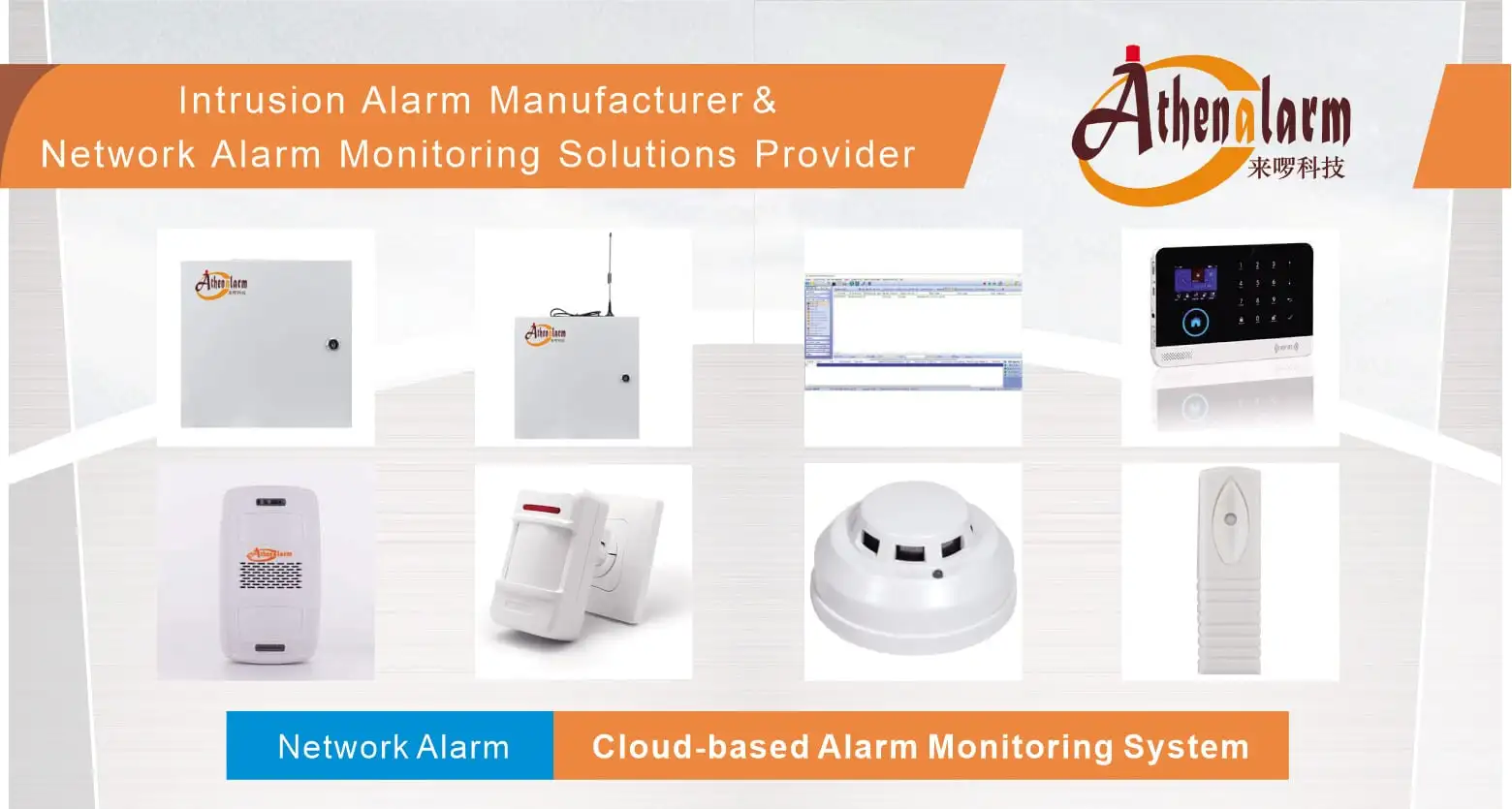
For enterprise deployments requiring specialized edge sensors, localized physical intrusion detectors, or sector-specific integration modules, the following core system components and targeted solutions provide standardized compatibility across network alarm architectures:
- Core Systems & Brand Portal: Athenalarm Official System Architecture
- Intrusion Alarm Systems Catalog: Burglar Alarm System Hardware Portfolio
- Network Alarm Monitoring Platform: Network Alarm Monitoring System Solution
13.1 Sector-Specific & Facility Application Solutions
- Financial & Banking Infrastructure: Network Bank Alarm Monitoring System Solution
- Bank Vault Security: Network Bank Vault Alarm Monitoring System Solution
- Automated Teller Machines (ATM): Bank ATM Alarm Monitoring System Solution
- Commercial & Retail Environments: Network Store Alarm System Solution
- Hospitality Facilities: Network Hotel Alarm System Solution
- Residential & Community Integration: Network Community Alarm System Solution
- Perimeter & Residential Nodes: Network House Alarm System Solution
- Smart Home Integration: GSM/WiFi Alarm System Component
13.2 Specialized Detection Hardware & Edge Devices
- Motion Detection: Wide-Angle PIR Motion Sensor Component
- Structural Intrusion Detection: Digital Vibration Detector
- Access Point Monitoring: Door Contact Sensor Component
- Environmental Safety Detectors: Photoelectric Smoke Detector
- Gas Leak Detection: Combustion & Hazardous Gas Detector
- Manual Incident Activation: Panic Button Sensor
- Wireless Panic Activation: Wireless Panic Button Node
- Visual Annunciation: Industrial Warning Light Indicator
- Audio & Voice Alerts: Motion Sensor Sound Player
