
Commercial 24/7 Security Monitoring: A 5-Step Operational Deployment Framework
A break-in that lasts four minutes does not become a security failure because a sensor missed the intrusion. It becomes a failure when the alarm signal reaches no one in time to act, when the event is never verified, or when the escalation call goes to a number that no longer belongs to anyone with decision authority. For security decision-makers evaluating commercial facilities, this distinction matters more than most vendor literature suggests. A facility can have fully functional sensors, a signed monitoring contract, and still experience an unmanaged incident because the operational chain between detection and response was never validated as a whole.
This is the core deployment problem behind commercial 24/7 security monitoring: continuous coverage is not the same as continuous readiness. A monitoring system is not a single product decision — it is an interdependent chain of detection, communication, human verification, decision-making, escalation, and response. Each link carries its own failure mode, and a weakness in any one of them can neutralize the value of the others. For facility managers, procurement teams, and enterprise security directors, the practical question is not “should we monitor continuously,” but “what does a monitoring deployment actually need to guarantee that a detected event produces a coordinated response.”
That question shapes how a monitoring provider should be qualified, how a system should be integrated, and how the resulting deployment should be operated over time. The following framework addresses that question directly, structured around five deployment decisions — assessment, provider selection, installation and integration, protocol governance, and staff readiness — supported by the underlying response-chain architecture, provider qualification criteria, and the operational governance practices that keep a technically functional system operationally effective.
1. Why Continuous Monitoring Requires More Than Alarm Detection
A conventional alarm system and a commercial 24/7 monitoring environment can use overlapping hardware — motion detectors, glass-break sensors, door contacts — while producing fundamentally different operational outcomes. The difference is not the sensor. It is what happens after the sensor activates.
1.1 The Response Gap Between Detection and Action
A passive alarm establishes that an event occurred. It does not, by itself, verify what occurred, decide what should happen next, or ensure the right person is notified. In many conventional deployments, the interval between detection and any human action is unmanaged — dependent on whoever happens to notice a notification, call back a monitoring line, or return to a facility after hours.
1.1.1 Detection Is the First Stage, Not the Complete Response
Detection confirms that a sensor was triggered. It does not confirm that the triggering event was legitimate, that the correct escalation contact was reached, or that a response action was actually initiated. Treating detection as functionally equivalent to response is the most common conceptual error in commercial security planning, and it is the reason passive alarm architectures often fail during the window when losses actually occur — between the trigger and the first verified human action.
1.2 From Passive Notification to Active Monitoring
Commercial 24/7 monitoring adds a professional monitoring center between the sensor and the outcome. Instead of relying on whoever receives a notification, a trained operator receives the alarm signal, has access to verification tools, and follows a predefined decision process.
1.2.1 Verification, Decision, and Escalation
The added stages are verification (confirming the nature of the event), decision (determining whether and how to escalate), and escalation (notifying the correct party through a predefined path). These stages do not eliminate human involvement — they structure it, replacing an ad hoc reaction with a repeatable operational sequence.
1.3 Response-Time Evidence
Response-time figures are frequently cited in monitoring evaluations, but they should be treated as evaluation benchmarks tied to a specific system’s documented performance, not as guaranteed outcomes for any monitoring deployment.
1.3.1 Source-Stated Transmission and Operator-Action Figures
Within the operational model described here, alarm signal transmission to the monitoring center is expected to occur in under two seconds, and operator decision-making and dispatch initiation in under 30 seconds represents a commonly cited best-in-class benchmark. These figures should be requested as documented evidence from a specific provider’s operating history — not assumed as an industry-wide default.
2. The Commercial 24/7 Monitoring Response Chain
Before evaluating a provider or planning deployment, a facility team needs a working model of what the monitoring chain must actually do. The architecture below expresses the entities and dependencies that determine whether an alarm produces a coordinated outcome or an unmanaged event.
2.1 The End-to-End Monitoring Workflow
The functional chain runs as follows:
Detection → Communication → Monitoring → Verification → Decision → Escalation → Response
Each stage depends on the one before it. A break in communication interrupts monitoring regardless of detection accuracy. A break in verification can cause unnecessary escalation or, conversely, a missed one. A break in escalation — even after correct detection, transmission, and verification — still produces a delayed or absent response.
2.1.1 Detection → Communication → Monitoring
A monitored device — a motion detector, glass-break sensor, smoke detector, panic button, or diagnostic input — generates an event. That event must be transmitted through a communication framework to the monitoring center. Monitoring capability is contingent on that transmission actually arriving; a facility cannot be “monitored” during a communication outage, regardless of how well the sensors themselves are functioning.
2.1.2 Verification → Decision → Escalation
Once an event reaches the monitoring center, an operator evaluates it — often supported by video feeds or sensor analytics — before deciding on an escalation path. This is the stage where an ambiguous signal (a motion trigger with no corroborating context) is distinguished from a verified incident warranting immediate escalation.
2.1.3 Escalation → Response
Escalation follows a predefined path to a specific decision-maker or responder. The response itself — whether dispatch, notification of site personnel, or activation of an emergency procedure — depends on that escalation reaching an accurate, current contact.
2.2 What the Monitoring Center Contributes
A monitoring center is not simply a location where alarms are received; it is the operational core of the chain.
2.2.1 Continuous Human Coverage
Shift-based operators are the mechanism by which continuous coverage is actually delivered. Coverage gaps between shifts, or reliance on a single operator without redundancy, directly undermine the “24/7” premise of the deployment.
2.2.2 Power and Communication Resilience
Because the monitoring center depends on both power and communications infrastructure to receive and act on signals, redundant power and communications infrastructure is a baseline operational requirement rather than an optional enhancement. A monitoring center without tested redundancy is a single point of failure for every facility it serves.
2.2.3 Multi-System Monitoring Capability
Many commercial deployments require a monitoring center capable of aggregating intrusion, fire/life-safety, video, environmental, and system-health inputs within a single operational view, rather than treating each subsystem as an isolated notification stream.
2.3 Monitored Event Categories and Operational Value
The scope of what a commercial monitoring environment should be capable of handling falls into five categories, each with a distinct operational role.
| Event Category | Representative Devices | Operational Value |
|---|---|---|
| Intrusion | Motion detectors, glass-break sensors | Immediate break-in detection |
| Fire/Life Safety | Smoke detectors, CO detectors, sprinkler monitors | Early life-safety alerting |
| Panic/Duress | Silent panic buttons | Discreet emergency signaling |
| Environmental | Leak sensors, gas detectors | Damage-prevention awareness |
| System Health | Battery and connectivity diagnostics | Blind-spot and downtime awareness |
System-health monitoring deserves particular attention because it does not detect an external incident — it detects degradation in the monitoring capability itself, such as a failing battery or a disconnected communication path, before that degradation becomes an actual blind spot during a real event.
2.4 Verification Before Escalation
An alarm signal indicates that a sensor activated. It does not, by itself, establish whether that activation reflects an actual security event, environmental condition, or false trigger.
2.4.1 Video and Sensor-Based Verification
Video feeds and sensor analytics give the monitoring operator additional context before committing to an escalation decision. Multi-sensor approaches — corroborating a motion event with a door-contact or glass-break signal, for example — reduce the likelihood that an operator escalates on a single, unverified data point. This verification stage is what separates a monitoring environment from a system that simply forwards raw alarms.
3. Provider and Deployment Criteria That Determine Suitability
Once the response-chain architecture is understood, it becomes the basis for evaluating a specific monitoring provider or deployment approach — converting an abstract model into concrete procurement criteria.
3.1 Monitoring-Center Qualification References
| Evaluation Criterion | What It Establishes | Evaluation Caution |
|---|---|---|
| UL Listing or equivalent qualification | Independently assessed operational standards for the monitoring center | Qualification does not by itself guarantee response performance for a specific facility |
| EN 50518 | A recognized monitoring-center operating standard in relevant markets | Should be reviewed alongside staffing and infrastructure evidence, not treated as a stand-alone proof point |
| Staffing model | Whether coverage is provided in-house or outsourced, particularly after hours | Neither model is universally superior; the relevant question is documented coverage continuity |
| Response-time evidence | Actual historical performance data for the provider | Figures should come from the provider’s own operating record, not generic industry claims |
3.1.1 UL Listing or Equivalent Qualification Considerations
A UL listing or comparable qualification for the monitoring center indicates that the facility operates under externally assessed standards. It functions as a due-diligence input into provider selection, not as an independent guarantee of end-to-end response performance.
3.1.2 EN 50518 Considerations
Where relevant, EN 50518 alignment addresses monitoring-center operating discipline. As with UL listing, this reference should be evaluated in combination with staffing and infrastructure details rather than in isolation.
3.2 Staffing and Coverage Model
3.2.1 In-House vs. Outsourced Coverage
A facility team should determine directly whether the provider’s monitoring is fully staffed in-house around the clock or transitions to an outsourced arrangement during certain hours. This affects consistency of verification quality and escalation familiarity, and it is a reasonable procurement question regardless of which model a given provider uses.
3.3 Response Performance Evidence
3.3.1 Signal Transmission Figure
An under-two-second alarm transmission figure, where documented, indicates that the communication path between the monitored device and the monitoring center introduces minimal delay. This should be requested as measured performance data specific to the provider under evaluation.
3.3.2 Operator Action Figure
A dispatch or decision-initiation time of 30 seconds or less represents a stated best-in-class reference point for operator response after verification. Enterprises should request comparable historical data rather than accepting this figure as an assumed default across all providers.
3.4 Integration Compatibility
3.4.1 Compatibility Validation Before Deployment
Before deployment, an enterprise should require an integration compatibility report describing how intrusion, video, fire/life-safety, environmental, and system-health inputs will be consolidated within the monitoring environment. Integration breadth increases operational visibility, but it also increases the number of systems that must interoperate correctly — a compatibility gap discovered after installation is materially more costly to resolve than one identified during evaluation.
3.5 Communication and Interaction Capability
3.5.1 Multi-Channel Notification
Voice, SMS, and app-push notification paths give the monitoring center multiple ways to reach designated contacts, reducing the risk that a single failed channel breaks the escalation chain.
3.5.2 Two-Way Audio
Two-way audio allows a monitoring operator to communicate directly with on-site individuals during an event, supporting real-time verification and instruction without requiring a physical response before the situation is better understood.
4. The 5-Step Operational Deployment Framework
The response-chain architecture and provider criteria above converge into a five-step deployment sequence. Each step resolves a distinct implementation decision.
4.1 Step 1 — Assess Facility Risk and Monitoring Objectives
4.1.1 Map Facility Zones and Critical Assets
Before any provider or equipment decision is made, facility zones and critical asset locations should be documented, establishing where monitoring coverage carries the greatest operational consequence.
4.1.2 Conduct a Threat & Vulnerability Assessment
A Threat & Vulnerability Assessment (TVA) identifies which risk categories — intrusion, fire, environmental, insider — are most relevant to the specific facility, rather than assuming a uniform risk profile across all sites.
4.1.3 Prioritize Monitoring Objectives
Intrusion, life-safety, environmental, and system-health monitoring objectives should be ranked according to the facility’s risk profile, since this prioritization directly shapes provider requirements and device selection in later steps.
4.2 Step 2 — Choose the Monitoring Provider
4.2.1 Validate Provider and Monitoring-Center Capability
Using the criteria from Section 3, confirm the provider’s qualification references, staffing model, and infrastructure resilience before proceeding to contract discussions.
4.2.2 Verify Response Performance Evidence
Request documented transmission and operator-action figures specific to the provider’s operating history rather than relying on generic marketing claims.
4.2.3 Evaluate Integration Compatibility
Confirm, in writing, that the provider’s monitoring platform can accommodate the specific event categories and systems identified during the assessment step.
4.3 Step 3 — Install and Integrate the Required Monitoring Environment
4.3.1 Establish Required Detection Coverage
Deploy the monitored device categories identified as priorities during Step 1, using multi-sensor approaches where appropriate to support later verification.
4.3.2 Integrate Video Verification
Video verification should be integrated from the outset of deployment rather than added afterward, since retrofitting verification capability into an already-operational alarm environment introduces avoidable integration friction.
4.3.3 Test Power and Communication Resilience
Before commissioning, test redundant power and communication paths under simulated failure conditions. Redundancy that has not been tested should be treated as unverified, not as a completed requirement.
4.4 Step 4 — Establish and Maintain Communication and Escalation Protocols
4.4.1 Define Escalation SOPs
Escalation standard operating procedures should specify, for each event category, who is contacted, in what order, and under what conditions escalation proceeds further.
4.4.2 Maintain Notification Paths
Multi-channel notification paths (voice, SMS, app push) should be kept current and tested, since an unused or outdated channel provides no practical redundancy.
4.4.3 Review Contact Hierarchies Quarterly
Escalation contact hierarchies should be reviewed on a quarterly basis. This single practice addresses one of the most common causes of response failure in otherwise functional monitoring deployments: personnel changes that leave escalation paths pointing to contacts who are no longer available or no longer authorized to act.
4.5 Step 5 — Train Personnel and Validate Response Readiness
4.5.1 Establish Incident-Response SOPs
Document what site personnel are expected to do once an escalation is received, separate from what the monitoring operator does upstream.
4.5.2 Conduct Scenario-Based Drills
Biannual scenario-based drills validate that documented procedures function in practice, rather than assuming that a written SOP guarantees correct execution during an actual event.
4.5.3 Define the Relationship With On-Site Security Personnel
Monitoring should be defined explicitly as a complement to on-site security personnel, not an automatic substitute. The appropriate division of responsibility between monitoring-center escalation and on-site response should be documented as part of deployment, not assumed by default.
5. Operational Governance: Keeping the Response Chain Effective
A monitoring deployment that passes commissioning is not permanently validated. Personnel change, infrastructure ages, and procedures drift out of alignment with organizational reality. Operational governance is the set of recurring practices that keep the response chain functioning after the initial deployment.
5.1 Monitoring as an Ongoing Lifecycle
5.1.1 Continuous Monitoring
Coverage itself is continuous by design, but continuous coverage does not equal continuous readiness — readiness depends on the governance practices below.
5.1.2 System-Health Awareness
Battery and connectivity diagnostics should be reviewed on an ongoing basis so that degraded devices are identified and addressed before they create a monitoring blind spot during an actual event.
5.1.3 Periodic Operational Review
Beyond escalation contacts, the broader set of procedures — SOPs, notification paths, integration status — should be subject to periodic review rather than being treated as fixed at commissioning.
5.2 The Hidden Failure Point: Outdated Escalation Information
5.2.1 Organizational and Personnel Changes
Staff turnover, role changes, and organizational restructuring are ordinary business events that nonetheless directly threaten escalation accuracy if contact data is not maintained.
5.2.2 Quarterly Contact and Escalation Review
This is the practice that most directly protects the deployment from the failure pattern below:
Outdated Contact Data → Escalation Failure → Delayed Response → Quarterly Contact Review (mitigation)
A system can be technically operational — sensors functioning, communication intact, monitoring center responsive — and still fail at the escalation stage because the person the operator is instructed to call is no longer the correct contact. Quarterly review is a low-cost practice relative to the operational risk it addresses.
5.3 Operational Validation
5.3.1 Communication Resilience Testing
Redundant communication paths should be periodically re-tested, not only validated once during commissioning, since infrastructure conditions change over time.
5.3.2 Scenario-Based Drills
Recurring drills serve the same validation function for human procedures that resilience testing serves for technical infrastructure — confirming that the documented process still functions as intended.
6. Engineering Trade-Offs That Shape Monitoring Reliability
No element of a monitoring deployment is cost-free. Each capability that improves response performance introduces a corresponding operational dependency.
6.1 Passive Detection vs. Active Response
Active monitoring adds verification, decision-making, and escalation capability beyond passive alarm detection, but it also introduces dependency on monitoring-center staffing, communication resilience, and escalation governance. The trade-off is added operational capability in exchange for added operational dependency — not a free upgrade.
6.2 Multi-System Integration vs. Integration Complexity
Consolidating intrusion, video, fire/life-safety, environmental, and system-health inputs into one monitoring environment improves situational visibility, but each additional integrated system increases the number of interfaces that must remain compatible. Integration breadth should be matched to actual facility risk priorities rather than pursued for its own sake.
6.3 Redundancy vs. Infrastructure Complexity
Redundant power and communication paths reduce the risk of a monitoring blackout during an infrastructure failure, but redundant infrastructure must itself be deployed, maintained, and periodically tested. Untested redundancy provides a false sense of resilience.
6.4 Human Verification vs. Automation
6.4.1 AI/Analytics as Decision Support
Sensor analytics and AI-driven pattern detection can flag anomalies — such as repeated access-credential failures or motion after facility hours — for operator attention, but within the architecture described here, these tools function as decision support for human operators, not as a substitute for human verification, decision-making, or escalation authority.
6.5 Continuous Monitoring vs. Operational Governance
Twenty-four-hour technical coverage does not eliminate the need for recurring organizational work — quarterly contact review, SOP maintenance, and drills remain necessary regardless of how sophisticated the underlying technical architecture is.
7. Business Outcomes and Compliance Alignment
The deployment decisions above ultimately connect to outcomes that matter at the executive and procurement level, though these outcomes should be understood as potential, evidence-linked benefits rather than guaranteed results.
7.1 Risk Reduction Through Verified Response
Reducing the interval between detection and verified response reduces the operational window during which a security or safety event can escalate unmanaged. The magnitude of that reduction depends on the specific deployment’s actual performance, not on the theoretical architecture alone.
7.2 Business Continuity and Operational Resilience
A verified, escalation-governed monitoring environment supports faster recovery from disruptive incidents by reducing the time between an event occurring and an appropriate organizational response being initiated.
7.3 Insurance Considerations
Certified monitoring arrangements are commonly associated with potential insurance premium reductions in the range of 5–20%. This figure should be treated as a potential range subject to insurer, policy, facility, and certification conditions — not as a guaranteed discount available to every monitored facility.
7.4 Compliance Alignment
7.4.1 PCI DSS
Continuous physical monitoring can support elements of a PCI DSS-aligned security posture in facilities handling relevant payment infrastructure, though PCI DSS does not itself mandate a specific 24/7 monitoring architecture.
7.4.2 HIPAA
Facilities subject to HIPAA may find that continuous physical monitoring supports broader safeguard requirements, but HIPAA compliance depends on a wider set of administrative, physical, and technical controls beyond monitoring alone.
7.4.3 ISO 27001
An ISO 27001-aligned information security management system may incorporate physical monitoring as one control among many; monitoring supports, but does not independently satisfy, ISO 27001 alignment.
These compliance frameworks should be understood as contexts in which continuous monitoring is relevant — not as standards that inherently require a specific 24/7 monitoring deployment.
8. Emerging Directions in Continuous Monitoring
The following technologies represent directions in which commercial monitoring environments are evolving. They should be evaluated as emerging capabilities relevant to future planning, not as components that every current deployment requires.
8.1 AI and Machine Learning Analytics
Pattern-based analytics are increasingly used to flag anomalous behavior for operator review, supporting — rather than replacing — human verification.
8.2 Cloud-Based Monitoring Platforms
Cloud-based platforms are described as a direction toward greater scalability in monitoring operations, allowing broader integration across facilities.
8.3 IoT Integration
Integration of IoT-connected sensors extends monitoring visibility into a wider range of environmental and operational conditions beyond conventional security and life-safety devices.
8.4 Cyber-Physical Convergence
As physical and digital infrastructure increasingly intersect, monitoring environments are trending toward addressing hybrid threat conditions that span both domains.
8.5 Sustainable Security Technology
Reducing the operational footprint of monitoring infrastructure is an emerging consideration in facility-level technology planning.
9. Commercial 24/7 Monitoring Decision Checklist
| Category | Verification Item |
|---|---|
| Facility Risk | Facility zones mapped; critical assets identified; TVA completed; monitoring objectives prioritized |
| Provider Qualification | Monitoring-center qualification examined; staffing model verified; response-performance evidence requested; integration compatibility assessed |
| Technical & Operational Resilience | Detection coverage established; verification capability established; power resilience tested; communication resilience tested; system-health visibility considered |
| Escalation Governance | Escalation SOP defined; contact hierarchy current; notification paths validated; quarterly review scheduled |
| Human Readiness | Incident-response SOPs documented; personnel trained; scenario-based drills scheduled; relationship with on-site security defined |
10. FAQ
Q1. What certifications and response performance should an enterprise examine when selecting a 24/7 security monitoring provider?
Enterprises should examine the monitoring center’s qualification references (such as UL listing or EN 50518 alignment), staffing model, documented response-performance history, and integration compatibility. This matters because certification alone does not establish end-to-end response performance — it must be paired with evidence of staffing continuity, tested infrastructure resilience, and a provider’s actual transmission and operator-action record.
Q2. How does video and sensor verification support alarm decision-making in commercial facilities?
Video feeds and sensor analytics give monitoring operators additional context to distinguish an actionable incident from an ambiguous sensor trigger before committing to escalation. This matters because raw alarm signals alone often lack sufficient context, and unverified escalation can produce delayed or misdirected responses.
Q3. Why are quarterly escalation reviews important for enterprise 24/7 monitoring?
Quarterly reviews prevent outdated contact information from breaking an otherwise functional response chain. This matters because personnel turnover and organizational changes are constant, and a technically operational monitoring system can still fail to produce a response if the escalation path points to the wrong person.
Q4. Can 24/7 security monitoring reduce insurance costs and support compliance objectives?
Certified monitoring is commonly associated with a potential 5–20% insurance premium reduction, and continuous monitoring can support elements of PCI DSS, HIPAA, and ISO 27001-aligned security postures. This matters with qualification: the discount range depends on insurer and policy conditions, and none of these compliance standards inherently mandates a specific 24/7 monitoring architecture.
Q5. What types of events can a commercial 24/7 monitoring environment cover?
A commercial monitoring environment typically covers five categories: intrusion, fire/life safety, panic/duress, environmental, and system health. This matters because monitoring scope should be matched to the facility’s actual risk profile rather than assumed to be uniform across all categories.
Q6. Does AI replace human operators in 24/7 security monitoring?
No. AI and machine-learning analytics support human operators by flagging anomalous patterns for review, but verification, decision-making, and escalation authority remain functions performed by trained personnel. This matters because treating automation as a substitute for human response introduces unmanaged risk into the escalation chain.
Q7. Can 24/7 monitoring integrate with IoT and other monitored systems?
IoT integration is an emerging direction that extends monitoring visibility into a broader range of environmental and operational sensors. This matters for planning purposes, but it should not be assumed as a standard feature of every current monitoring deployment.
Q8. Does 24/7 monitoring replace on-site security personnel?
No. Monitoring complements on-site security by providing continuous verification and escalation capability, while on-site personnel handle physical response actions. This matters because facilities that assume monitoring alone eliminates the need for on-site response may leave a gap in physical incident handling.
Q9. How often should monitoring escalation procedures be reviewed?
Quarterly reviews are recommended. This matters because personnel changes create ongoing risk to contact-data accuracy, and a quarterly cycle keeps the escalation path aligned with current organizational responsibilities without becoming an excessive administrative burden.
11. System Component Checklist Appendix
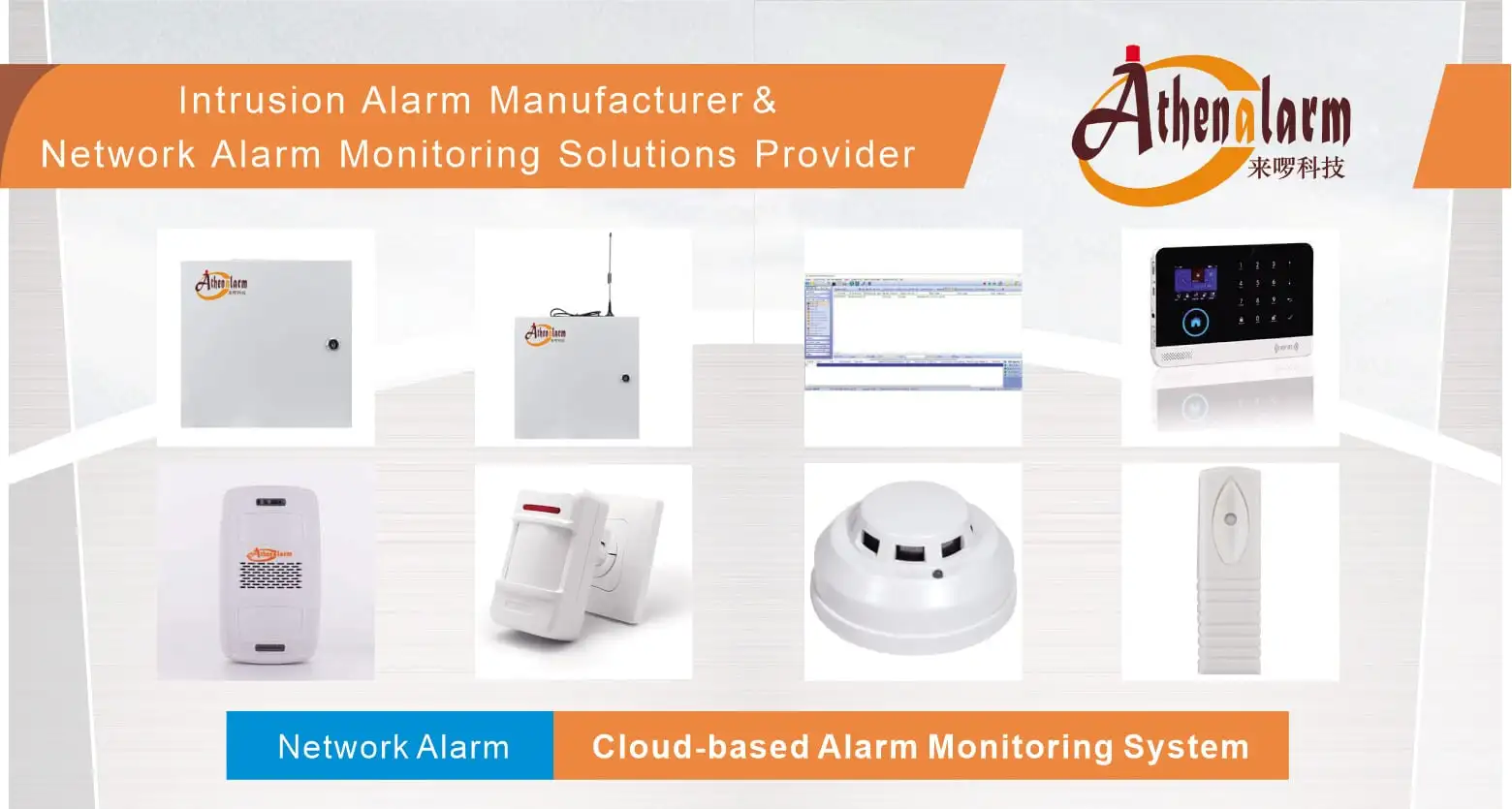
- Enterprise Brand Portal: Athena Alarm Manufacturing & Systems
- Core Architecture Platform: Network Alarm System Platform
- Deployment Applications: Network Alarm Monitoring System Application
- Financial Security Solutions: Network Bank Alarm Monitoring System Solution
- ATM Terminal Protection: Bank ATM Alarm Monitoring System Solution
- High-Security Vault Protection: Network Bank Vault Alarm Monitoring System Solution
- Multi-Tenant Campus Solutions: Network Community Alarm System Solution
- Single-Tenant Property Solutions: Network House Alarm System Solution
- Hospitality Facility Solutions: Network Hotel Alarm System Solution
- Retail Facility Solutions: Network Store Alarm System Solution
- Dual-Path Gateway Console: GSM & WiFi Alarm System Unit
- Motion Detection Subsystem: PIR Motion Sensor
- Extended Range Motion Sensing: Wide-Angle PIR Motion Sensor
- Life Safety Smoke Monitoring: Photoelectric Smoke Detector
- Environmental Gas Monitoring: Combustible Gas Detector
- Physical Security Impact Detection: Digital Vibration Detector
- Perimeter Access Monitoring: Magnetic Door Contact Sensor
- Fixed Emergency Signaling: Hardwired Panic Button
- Mobile Emergency Signaling: Wireless Panic Button
- Visual Alarm Annunciators: Visual Strobe Warning Light
- Local Audio Intervention Unit: Motion Sensor Sound Player
