
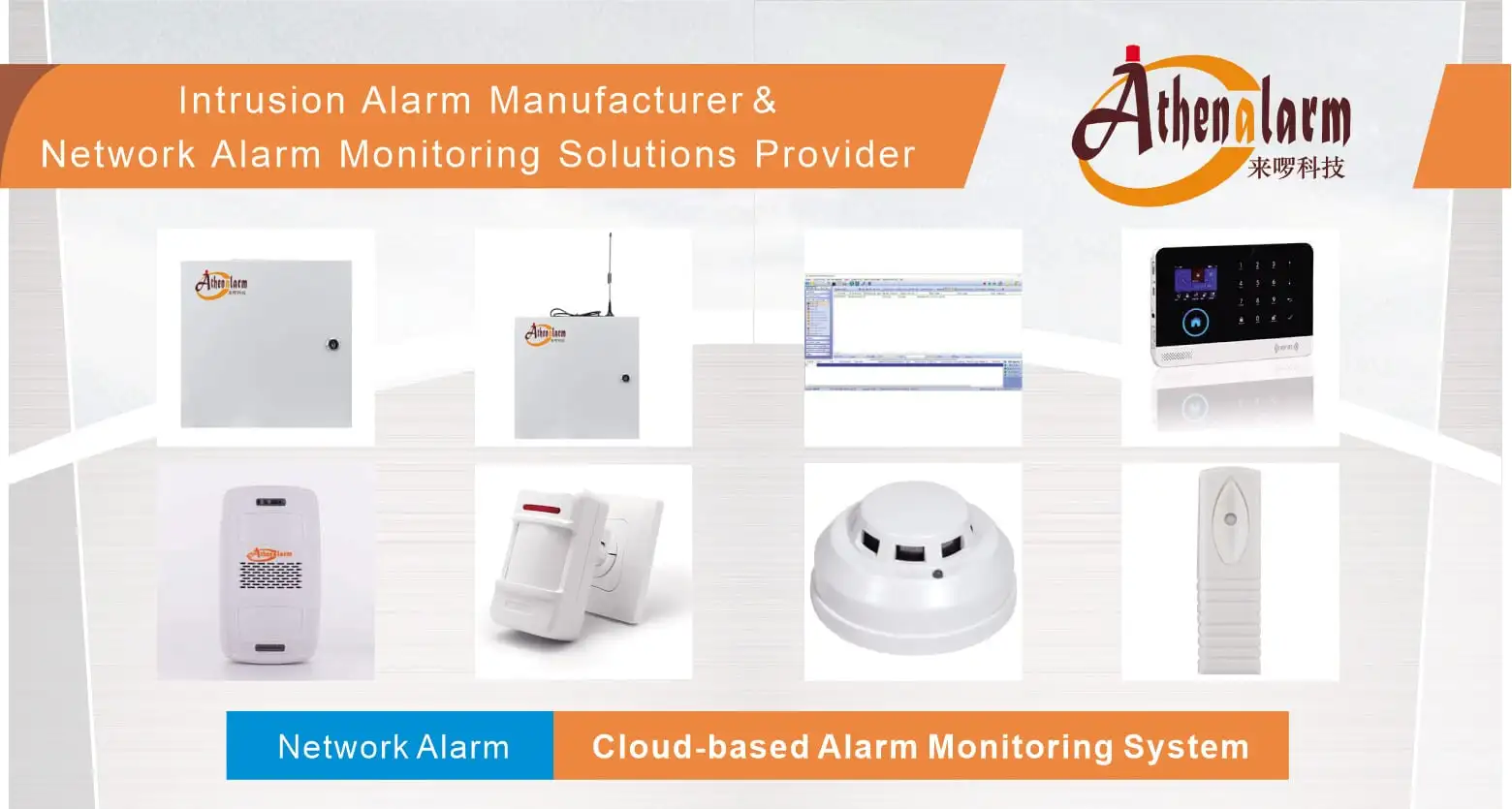
Anti-Theft Alarm Systems: From Passive Sirens to Hybrid Cloud-Edge Security Platforms
1. Modern Anti-Theft Alarm Systems Have Become Hybrid Security Platforms
For most of their operational history, anti-theft alarm systems followed a narrow engineering model: a control panel monitored a set of hardwired loops, and a triggered condition produced a local siren and, at best, a dial-out over a PSTN line using Contact ID (SIA DC-05) tone signaling. That legacy model had a hard ceiling — no video context, no remote visibility, no encrypted transport, and a total dependency on a single copper telephone circuit that is now being phased out globally. The modern successor to that architecture is the Integrated Intrusion Alarm & Video Verification System (IIDS), a hybrid cloud-edge commercial physical security system in which detection and actuation remain local while verification, fleet management, and analytics move to a cloud SaaS engine. Deploying an enterprise-grade solution like the Athenalarm enterprise security management platform ensures seamless cloud-edge coordination and centralized event verification. This shift did not happen because sirens became obsolete; it happened because enterprise buyers needed verified events, multi-site visibility, and integration with access control and video infrastructure that a standalone panel could never deliver. The engineering implication is significant: every component in the stack, from the sensor loop to the mobile dashboard, now has a defined role in a distributed system rather than a self-contained appliance.
1.1 What Defines a Modern Anti-Theft Alarm System
A modern anti-theft alarm system is defined by four core functions executed across the edge-to-cloud chain: detection (continuous monitoring of perimeter and interior zones for motion, glass breakage, and tamper conditions), verification (cross-validation of a triggered sensor against a secondary technology or an AI video analytics feed), response (local siren/strobe activation and physical interlocks such as door lockouts, executed within millisecond latencies at the panel level), and event management (structured transmission of alarm telemetry and visual evidence to a Central Monitoring Station and end-user interfaces). Detection and response remain edge-resident by design, since a Central Monitoring Station or Cloud SaaS Engine cannot be assumed reachable at the moment of intrusion.
1.2 From Standalone Alarms to Cloud-Edge Security Architecture
The transition from standalone alarms to cloud-edge architecture redistributes responsibility rather than eliminating local intelligence. Edge intelligence in the Hybrid Control Panel continues to execute zone logic, sensor polling, and immediate actuation regardless of connectivity state. This resilient edge processing foundation is integral to modern enterprise network alarm system platforms, maintaining uninterrupted localized defense. Cloud services extend this local logic with multi-site aggregation, AI Video Verification pipelines that are too compute-intensive for edge hardware, and a Mobile Dashboard that gives facility managers real-time visibility across distributed sites. Implementing a centralized network alarm monitoring system solution allows organizations to streamline cross-facility telemetry into unified operational workflows. AI verification depends on the Edge Sensing Layer generating a trigger event, which is then cross-referenced against an ONVIF-compliant video stream before an alert is escalated — meaning cloud AI augments edge detection but does not replace it.
1.3 Enterprise System Boundaries
Precise boundary definition matters because enterprise procurement teams frequently conflate the alarm system with adjacent physical security subsystems during RFQ drafting. The anti-theft alarm system’s in-scope elements are detection sensors, zone expansion modules, the Hybrid Control Panel, local keypads/readers, backup power, and the cloud management backend. Out-of-scope responsibilities belong to neighboring systems: primary access decision-making resides in the Access Control System (ACS), continuous video storage resides in the Video Surveillance System (VSS), and suppression logic resides in dedicated fire systems. The alarm system interfaces with each of these — via dry contacts or OSDP with the ACS, via ONVIF events with the VSS, and via BACnet/IP or Modbus TCP with the Building Management System (BMS) — but does not assume their core functions.
2. Reference Architecture of Modern Anti-Theft Alarm Systems
2.1 Hybrid Cloud-Edge Architecture
The reference architecture places core alarm logic, zone processing, and local actuation entirely at the edge inside the Hybrid Control Panel, while cross-site telemetry aggregation, AI video processing, and management dashboards reside in the Cloud SaaS Engine. This split is deliberate: it guarantees that a facility retains full local alarm/siren functionality during a total WAN failure, while still allowing centralized administration across dozens or hundreds of sites without physical headend changes at each location. The trade-off is a dual attack surface — both the physical panel and the cloud API endpoints require independent hardening — and latency variability in cloud-based video cross-verification depending on backhaul bandwidth.
2.2 Edge Components
The edge tier consists of three tightly coupled component classes. Field sensors (PIR, Dual-Tech PIR+Microwave, glass-break detectors, door contacts) connect via hardwired N/C loops or Sub-GHz RF to Zone Expansion Modules, which in turn communicate with the Hybrid Control Panel over an RS-485 bus using polling-address logic. The Hybrid Control Panel is the authoritative local decision point: it evaluates loop states, applies partition arming logic, and drives local sirens, strobes, and interlocks independently of cloud availability. Deploying commercial intrusion alarm control panels ensures that hardware-level zone evaluation remains active even during total communication failures.
2.3 Cloud Components
The cloud tier is composed of the Cloud SaaS Engine, the AI Video Verification pipeline, and the Mobile Dashboard. At the operational core, robust network alarm center management software platforms ingest multi-site sensor telemetry to give security teams actionable insight. The Cloud SaaS Engine receives device state and event telemetry from the panel over MQTT/TLS, using a device token and MAC-bound identity for session authentication. The AI Video Verification module ingests ONVIF/RTSP streams from IP cameras, generates event pre-roll clips, and exposes them to the Cloud SaaS Engine via REST API. The Mobile Dashboard consumes this processed data via push notification, giving the end user authenticated, real-time access to verified events rather than raw sensor noise.
2.4 Alarm Event Flow
The canonical event flow moves through seven stages: Sensor → Panel → Verification → Cloud → CMS → Operator → Response. A field sensor trip is first evaluated locally by the panel against zone and partition rules; if the condition qualifies as an alarm, the panel simultaneously triggers local actuation and forwards the event over SIA DC-09/IP to the Central Monitoring Station (CMS) and over MQTT/TLS to the Cloud SaaS Engine. The cloud engine correlates the panel event with any available AI Video Verification clip before surfacing it to a human operator, who then determines the appropriate response — dispatch, callout via intercom, or a benign-event dismissal. Each stage depends on the integrity of the one before it, which is why account ID mismatches or encryption key errors at the CMS handoff stage can silently break the entire chain even when edge detection functioned correctly.
3. Technology Trends Driving Enterprise Alarm Systems
3.1 AI-Based Threat Verification
AI-based threat verification exists to solve a specific engineering problem: single-technology motion sensors cannot distinguish a human intruder from HVAC-driven air currents, small animals, or sunlight-induced thermal shifts. By cross-referencing a PIR or Dual-Tech trigger against an AI Video Verification clip pulled through ONVIF, the system adds a second, independent confirmation layer before an event is escalated to the CMS or Mobile Dashboard. This does not replace dual-technology sensor logic — it supplements it, adding a visual evidentiary layer that also satisfies insurance and law-enforcement verification requirements.
3.2 Cloud-Native Security Management
Cloud-native management exists because multi-site enterprises cannot operate dozens of isolated control panels through individual local interfaces. The Cloud SaaS Engine centralizes user credential management, scheduled auto-arming logic, and health monitoring across a distributed fleet, while the underlying edge panels retain autonomous execution. This pattern directly addresses the operational reality of Distributed Retail Chain deployments, where a single security administrator may be responsible for hundreds of geographically dispersed sites. To manage these complex topologies efficiently, security operators deploy enterprise-grade alarm monitoring systems that consolidate access rights and scheduled arming workflows.
3.3 Unified Security Platform Integration
Unified platform integration exists because intrusion detection alone has diminishing value in isolation. Linking the alarm system to the Access Control System, Video Surveillance System, and Building Management System allows a single verified event to trigger a coordinated response — door lockdown, PTZ camera repositioning, and lighting/HVAC state changes — rather than requiring separate operator actions across disconnected consoles.
3.4 Mobile-First Operations
Mobile-first operations reflect the reality that facility managers are rarely stationed at a fixed console. The Mobile Dashboard consumes push notifications, video pre-roll clips, and intercom audio channels, allowing a manager to assess and respond to an event — including speaking to an intruder — from any location with network access, provided the Cloud SaaS Engine session remains authenticated.
3.5 Intelligent Automation
Intelligent automation refers to rules-based and pattern-recognition workflows layered on top of verified events — for example, automatically initiating video recording, locking all doors, and dispatching an alert with footage the moment an after-hours motion event is confirmed. This automation tier depends entirely on the reliability of the underlying verification stage; automating a response to an unverified false trigger simply propagates the false alarm faster.
4. Integration Architecture Across Enterprise Security Systems
4.1 Alarm + Video Verification
The alarm-to-video integration path uses ONVIF Profile S/G/T event metadata to bridge the Hybrid Control Panel and IP cameras. When a zone trips, the panel issues an ONVIF event trigger that commands the associated camera to execute a PTZ preset and isolate a pre-roll clip spanning the seconds immediately before and after the trigger. This clip is what the AI Video Verification engine analyzes before an event reaches the CMS or Mobile Dashboard, making ONVIF the functional dependency that turns a raw sensor trip into a verified, evidentiary alarm.
4.2 Alarm + Access Control
Integration with the Access Control System operates over OSDP or physical dry contacts. The alarm panel ingests arming/disarming status from the ACS to determine partition state, and conversely, a validated alarm condition can command the ACS to execute automatic door lockdown. This bidirectional dependency means partition arm state and door lock state must remain synchronized; a mismatch — for example, a partition reporting armed while the ACS still shows doors unlocked — indicates a configuration fault rather than a hardware failure.
4.3 Alarm + Building Management
The BMS integration path exports arming state via BACnet/IP or Modbus TCP so that HVAC schedules and lighting states can be optimized against occupancy logic. This is a one-directional dependency: the BMS consumes alarm state to adjust environmental systems, but does not issue commands back into the alarm panel, preserving the alarm system’s authority over its own actuation logic.
4.4 Alarm + Cloud APIs
Cloud API integration is handled through MQTT for lightweight, low-bandwidth telemetry and REST/HTTPS for dashboard and third-party application access. MQTT/TLS carries device state synchronization and push-triggering payloads optimized for cellular backhaul, while REST/HTTPS supports heavier operations such as historical event queries and user provisioning. Both protocols terminate at the Cloud SaaS Engine, which is the single integration point exposed to downstream enterprise applications.
5. Communication Protocol Stack
The protocol stack spans four layers — application (SIA DC-09, Contact ID, MQTT, REST/HTTPS, ONVIF Profile S/G/T), transport (TCP/TLS, UDP, RS-485), and physical/link (Ethernet, 4G/LTE, Sub-GHz RF, 2-wire loop) — with each protocol occupying a distinct functional role rather than competing for the same task.
5.1 RS-485
RS-485 is the local bus standard connecting the Hybrid Control Panel, Zone Expansion Modules, and keypads. Its differential signaling provides high noise immunity over distances up to 1200 meters, but only when deployed in a strict daisy-chain topology.
| Parameter | Specification | Engineering Consequence |
|---|---|---|
| Maximum bus length | 1200 meters | Exceeding this without repeaters degrades signal integrity |
| Termination resistance | 120 Ω at end nodes | Omission causes reflection and packet corruption |
| Required topology | Daisy-chain only | Star/tree wiring produces intermittent dropouts |
| Shield grounding | Single-point only | Dual-ended grounding introduces ground-loop noise |
RS-485 remains a mature workhorse standard specifically because it does not depend on IP infrastructure, making it the preferred choice for Industrial Logistics Warehouse deployments where hardwired reliability outweighs installation labor cost.
5.2 SIA DC-09
SIA DC-09 (formalized under ANSI/SIA CP-04) is the IP-based protocol carrying alarm signal transmission from the Hybrid Control Panel to the Central Monitoring Station. It replaces analog DTMF signaling with structured, AES-encrypted XML/JSON payloads over TCP/TLS, and is the current dominant industry standard for IP-based CMS reporting. Because SIA DC-09 depends on Account ID and encryption key matching between the panel and the receiver, a mismatch at commissioning is a leading cause of rejected CMS alerts during onboarding.
5.3 MQTT
MQTT operates over TLS to handle edge-to-cloud device management, state synchronization, and push notifications. Its binary payload format is optimized for low-bandwidth cellular connections, which is why it is the preferred transport for the Cloud SaaS Engine’s continuous heartbeat and telemetry channel rather than heavier REST calls.
5.4 ONVIF
ONVIF Profile S/G/T is the interoperability standard governing streaming and event metadata exchange between the alarm panel and IP cameras. It is the mechanism by which a panel-side trigger becomes a camera-side PTZ preset execution and clip isolation, making it the structural dependency underlying every AI Video Verification workflow described in Chapter 4.
5.5 Contact ID
Contact ID (SIA DC-05) is the legacy DTMF tone-based protocol for transmitting alarm events over PSTN/POTS lines. It is in a legacy/end-of-life transition globally as telecom carriers retire PSTN infrastructure, requiring IP or cellular converters to bridge older panels into modern CMS receivers. Enterprises operating legacy panel fleets must budget for these converters as an explicit migration cost rather than assume native compatibility with SIA DC-09 receivers.
5.6 Sub-GHz RF
Sub-GHz RF (433MHz, 868MHz, 915MHz) provides wireless connectivity for peripheral sensors such as PIRs and door contacts. Compared to 2.4GHz Wi-Fi or Zigbee, Sub-GHz frequencies offer superior wall penetration and lower power draw, which is the basis for its standard adoption in commercial wireless security and in Retrofit Commercial Office deployments where cabling is structurally constrained.
6. Deployment Strategy Across Different Commercial Environments
6.1 Multi-Site Retail
Distributed Retail Chain deployments prioritize high installation volume with low per-site labor, favoring Sub-GHz wireless door contacts and PIRs over hardwired loops. Such real-world environments represent high-volume multi-site network alarm monitoring system applications where deployment efficiency directly impacts overall operational costs. The dominant risk vector is internal — employee disarm-code sharing and after-hours back-door access — rather than external perimeter breach. Engineering priority centers on centralized user management through the Cloud SaaS Engine’s API, scheduled auto-arming logic, and automatic video clip generation on entry/exit events, all coordinated through SIA DC-09 and MQTT. Implementing standardized commercial store alarm monitoring solutions allows franchise operators to maintain consistent security policies across retail locations.
6.2 Logistics Warehouses
Industrial Logistics Warehouse environments involve large physical footprints, heavy electrical noise, and dust, which pushes the architecture toward hardwired RS-485 zone expanders and Dual-Technology (PIR + Microwave) sensors specifically to resist thermal air-current false triggers common in large open structures. Long-range active IR perimeter beams tied to PTZ camera presets address the primary risk of external loading-dock intrusion and cargo theft, with ONVIF video verification serving as the confirmation layer. Integrating networked perimeter alarm protection system solutions ensures early warning detection along expansive facility boundaries.
6.3 Commercial Offices
Retrofit Commercial Office deployments face physical cabling restrictions from finished drywall or historical architecture, making a hybrid panel with encrypted wireless expansion modules the practical choice. Where corporate Ethernet LAN already exists, VLAN separation allows the alarm system to reuse existing network infrastructure as its primary communication backhaul without new cable pulls, reducing both labor cost and construction disruption.
6.4 Banking
Banking and Financial Branch deployments carry the highest compliance and redundancy requirements, given safe and ATM tampering and vault penetration risk profiles. Architecting a dedicated financial-grade bank alarm monitoring solution provides the rigorous signal redundancy and tamper resistance mandated by regulatory frameworks. These environments favor redundant dual-path, hardwired-only architectures using encrypted SIA DC-09, OSDP for ACS integration, and dry-contact logic — wireless links are generally avoided given the sensitivity of vault and cash-handling zones to RF jamming risk. Specifically, specialized sub-architectures like a bank ATM alarm monitoring system solution isolate high-risk cash dispensing units with dedicated vibration and tilt sensors. Similarly, deploying a high-security network bank vault alarm monitoring system solution guarantees multi-layered seismic and thermal line supervision for physical vaults.
6.5 Campus & Education
Campus and education deployments combine characteristics of multi-site retail and retrofit office scenarios: multiple buildings across a shared property require centralized Cloud SaaS Engine administration similar to retail chains, while individual older buildings often carry the same cabling constraints seen in retrofit offices. Multi-building properties benefit from adopting a network community security alarm solution to unify peripheral zone alerting with site-wide response plans. BMS integration is comparatively higher-value here, since occupancy-linked HVAC and lighting scheduling across large campuses produces measurable energy savings when tied to alarm arming state.
7. Engineering Realities Behind Reliable Alarm Systems
7.1 False Alarm Reduction
Problem: Single-technology PIR sensors trigger on non-intrusion events. Root Cause: PIR sensors placed facing glass facades, near HVAC diffusers, or in direct sunlight paths misinterpret thermal shifts as motion. System Impact: Thermally induced false alarms cluster around HVAC startup cycles and sunrise/sunset periods. Engineering Solution: Deploy Dual-Technology (PIR + Microwave) sensors requiring simultaneous thermal and Doppler triggers, eliminating roughly 90% of environmentally induced false alarms at the cost of a small probability of missed detection if an intruder’s trajectory fails to trigger both elements concurrently.
7.2 RS-485 Wiring Mistakes
Problem: Intermittent expansion module dropouts and corrupted keypad responses. Root Cause: Star or tree topology used instead of daisy-chain, missing 120 Ω termination resistors, or dual-ended shield grounding creating ground loops. System Impact: Packet corruption and delayed bus response that is difficult to reproduce during diagnosis. Engineering Solution: Enforce strict daisy-chain wiring, terminate both physical bus ends with 120 Ω resistors, and ground shielding at a single point only — reworking this after sheetrock installation carries substantial labor cost, making correct initial topology a commercial risk-avoidance measure, not just a technical preference.
7.3 EOL Supervision
Problem: Persistent line-fault or trouble alarms, or undetectable short circuits. Root Cause: Field technicians install End-of-Line resistors with incorrect values — 2.2 kΩ, 4.7 kΩ, or 10 kΩ depending on panel specification — or place them inside the control panel cabinet instead of at the physical sensor terminal. System Impact: Placing the EOL resistor at the panel defeats anti-tamper line supervision entirely, since a cut or shorted cable between the panel and sensor becomes electrically indistinguishable from a normal loop. Engineering Solution: Confirm the panel-specified resistance value and install the resistor at the sensor terminal, preserving the loop’s ability to report Normal, Alarm, Short, and Tamper/Cut states independently.
7.4 RF Interference
Problem: Sub-GHz sensor communication drops or false triggers in RF-dense environments. Root Cause: Heavy EMI sources such as HVAC motors, thick reinforced concrete, or nearby high-power RF transmitters degrade the 433/868/915MHz link. System Impact: Undetected during design, this produces unexpected hardware costs for repeaters or high-gain antennas discovered only during site survey. Engineering Solution: Conduct Sub-GHz spectrum analysis during the site survey phase and budget for signal repeaters or bus boosters in structures with heavy steel or reinforced concrete before committing to a wireless-first architecture.
7.5 Cellular Failover
Problem: Missed cloud heartbeats and delayed mobile notifications.
Root Cause: Control panels installed in basement utility rooms experience high signal attenuation, often below -110 dBm RSRP.
System Impact: High packet jitter during SIA DC-09 transmission risks total failure to transmit alarm signals during an actual intrusion if the local IP network is simultaneously severed.
Engineering Solution: Measure cellular signal strength during site survey and specify dual-SIM, dual-carrier 4G/LTE modules with external antenna extensions for below-grade installations, paired with a local non-volatile event buffer capable of caching up to 10,000 events during a network blackout. For sites requiring hybrid connectivity failover, integrating a dual-path GSM/Wi-Fi intrusion alarm system provides essential redundant paths for telemetry transmission.
7.6 Auxiliary Power Planning
Problem: Sensor resets or panel shutdown during simultaneous siren activation.
Root Cause: Connecting excessive current-draw peripherals — external sirens, active IR beams, laser barriers — to the panel’s 12VDC auxiliary terminals without calculating cumulative load.
System Impact: Voltage drop under load causes catastrophic system failure precisely at the moment an alarm condition activates multiple actuators simultaneously.
Engineering Solution: Sum the rated current draw of every auxiliary-powered device against the panel’s rated 12VDC output budget before installation, and route high-draw devices through a separately regulated power supply rather than the shared auxiliary bus.
8. Engineering Trade-Offs Every Buyer Should Understand
8.1 Wired vs Wireless
Hardwired RS-485 systems require substantial upfront labor — conduit runs, wire pulling, wall penetration — but deliver near-zero long-term maintenance and immune line integrity over decades. Wireless Sub-GHz systems cut installation labor by up to 70%, but introduce recurring battery replacement cycles, RF jamming exposure, and distance limitations inside heavy steel structures. The correct choice depends on whether the buyer is optimizing for lowest installed cost (wireless) or lowest lifetime operating cost (wired).
8.2 Edge Processing vs Cloud Processing
Fully localized edge processing in the Hybrid Control Panel guarantees operation during WAN outages and is required to meet strict certifications such as EN 50131 Grade 3 or UL 609, but increases hardware complexity and unit cost. Cloud-centric architectures allow ultra-low-cost edge hardware, but leave the site vulnerable to loss of remote alerting during backhaul disruption unless paired with multi-carrier cellular failover, which reintroduces cost the cloud-centric model was meant to avoid.
8.3 High Sensitivity vs False Alarm Resistance
Maximizing sensor sensitivity ensures detection of slow-moving or low-thermal-signature intruders but dramatically increases false triggers from animals, temperature shifts, or RF noise. Dual-technology logic requiring simultaneous PIR and Microwave triggering eliminates roughly 90% of environmental false alarms, at the cost of a small residual probability of missed detection if an intruder’s movement fails to trigger both elements concurrently — the same trade-off introduced in Section 7.1, now framed as a deliberate procurement decision rather than a field defect.
8.4 Fast Polling vs Cellular Cost
Ultra-fast heartbeat polling — for example, every 10 seconds over SIA DC-09 — enables near-instant detection of line cuts or cellular jamming, but consumes significant cellular data volume across large multi-site fleets. Deployers typically compromise with adaptive polling: 5-minute heartbeat intervals under normal conditions, collapsing to 10-second intervals during active alarm states, balancing SIM data cost against detection latency.
8.5 CapEx vs SaaS
Hardware-ownership (CapEx) models front-load cost into panel, sensor, and installation purchase, giving the buyer full asset control but leaving update and cloud-feature costs as separate line items. Security-as-a-Service (SaaS) models shift cost into a recurring monthly fee covering rental, firmware updates, and cloud storage, reducing upfront barriers but creating long-term dependency on the vendor’s SaaS platform continuity. Enterprises with long asset-holding horizons typically favor CapEx; multi-site retail operators prioritizing rapid rollout typically favor SaaS.
9. Operational Lifecycle and Long-Term Maintenance
9.1 Design
Solution design establishes zone partitioning, sensor type selection (Dual-Tech vs PIR-only), and cabling path planning. Inadequate zone planning at this stage is the most common source of blind spots or mass false-trigger clusters discovered only after commissioning, and underestimated wiring lengths or structural obstacles are a leading cause of budget overruns.
9.2 Site Survey
Site survey covers Sub-GHz RF spectrum analysis, cellular signal measurement, and line-of-sight verification. Failure to detect heavy EMI sources — HVAC motors, thick reinforced concrete — at this stage forces unplanned hardware additions such as repeaters or high-gain antennas later in the project, directly linking survey rigor to downstream cost predictability.
9.3 Installation
Installation covers sensor and panel mounting, tamper switch wiring, and RS-485 bus ID assignment. Incorrect EOL resistor value selection at this stage produces perpetual supervision faults, and physical damage to sensitive optical lenses during ongoing construction is a recurring commercial risk in occupied retrofit sites.
9.4 Commissioning
Commissioning includes zone walk-testing, SIA DC-09 receiver handshake, and cloud account provisioning. Mismatched Account IDs or encryption keys at this stage cause CMS alert rejection, which can constitute an SLA breach if it delays contractual sign-off — making commissioning validation a commercial checkpoint as much as a technical one.
9.5 Maintenance
Ongoing maintenance follows a defined interval schedule rather than reactive service calls.
| Maintenance Activity | Frequency | Operational Objective |
|---|---|---|
| RF & Physical Walk-Test | Bi-annually | Verify zone mapping & sensor field coverage |
| Battery Impedance Test | Annually | Predict SLA battery degradation |
| Battery Replacement | 36–48 months | Prevent backhaul drop during power outages |
| Firmware Patching | Quarterly (remote) | Mitigate zero-day vulnerabilities and bugs |
| Sensor Lens Cleaning | Annually | Prevent optical attenuation |
Truck rolls driven by battery failure and false alarms remain the highest variable O&M cost, ahead of SLA compliance fines and recurring SaaS licensing fees.
9.6 Remote Diagnostics
Remote diagnostic capability shifts a large share of the traditional field technician skill set — low-voltage wiring, relay logic, multimeter diagnostics — toward IP subnetting, TLS troubleshooting, RF survey tooling, and REST/MQTT API familiarity. This transition reduces truck-roll frequency for software-resolvable faults but requires deliberate personnel retraining investment.
9.7 Firmware Management
Firmware updates delivered over-the-air (OTA) mitigate zero-day vulnerabilities but carry integration risk: an unmanaged firmware push at the Hybrid Control Panel level can break compatibility with downstream RS-485 expander modules running older firmware revisions, producing exactly the intermittent dropout symptoms described in Section 7.2 despite no physical wiring change having occurred.
10. Compliance and Procurement Considerations
10.1 EN 50131
EN 50131 Grade 2/3 certification defines intrusion detection system resilience requirements, including resistance to tamper and specific supervision behaviors. Grade 3 compliance typically mandates fully localized edge processing, directly connecting this standard to the edge-vs-cloud trade-off discussed in Section 8.2.
10.2 UL Standards
UL 609 certification addresses local burglar-alarm unit construction and performance requirements in North American deployments, and functions as a procurement filter for enterprises in regulated sectors requiring third-party-verified hardware performance.
10.3 Insurance Requirements
Certified systems are increasingly a prerequisite for commercial insurance policies rather than an optional upgrade. Insurers reference explicit certification (EN 50131, UL 609) and audit-trail capability when underwriting commercial property policies, making compliance a direct commercial enabler rather than a purely technical checkbox.
10.4 Smart City Integration
Regulatory frameworks such as China’s Security Services Law require formal operator certification, and smart city programs increasingly mandate linkage between private alarm infrastructure and citywide surveillance networks. Enterprises operating in regulated verticals — healthcare, logistics — should treat pre-certified, standards-compliant systems as a procurement differentiator that unlocks otherwise inaccessible contracts. Partnering with a recognized industrial burglar alarm manufacturer solutions partner ensures long-term hardware availability, compliance support, and certified firmware cadence.
10.5 Vendor Evaluation Checklist
| Evaluation Criterion | What to Verify |
|---|---|
| Protocol support | SIA DC-09 (ANSI/SIA CP-04), MQTT/TLS, ONVIF Profile S/G/T |
| Edge survivability | Local event buffer capacity, dual-SIM 4G/LTE failover |
| Certification | EN 50131 Grade 2/3, UL 609, regional Public Security Product Certification |
| Integration depth | OSDP for ACS, BACnet/IP or Modbus TCP for BMS |
| Lifecycle support | OTA firmware cadence, remote diagnostic tooling, battery lifecycle guidance |
11. Strategic Recommendations for Future Deployments
11.1 Architecture Selection
Architecture selection should follow deployment scale rather than vendor preference: hardwired RS-485-centric designs suit Logistics Warehouse and Banking environments where line integrity and certification grade dominate, while Sub-GHz wireless-first designs suit Multi-Site Retail and Retrofit Commercial Office deployments where installation speed and structural constraints dominate.
11.2 Integration Priorities
ONVIF-based video verification integration should be prioritized first, since it delivers the highest reduction in false-alarm dispatch cost relative to implementation effort. ACS and BMS integration should follow once the verification layer is stable, since both depend on trustworthy alarm state as an input.
11.3 Operational Planning
Operational planning should budget explicitly for truck-roll frequency, municipal false-alarm fines, and battery replacement cycles as recurring line items rather than unplanned costs, using the 36–48 month battery interval and quarterly OTA firmware cadence from Chapter 9 as baseline planning assumptions.
11.4 Investment Roadmap
Enterprises transitioning from legacy Contact ID panels should sequence migration toward SIA DC-09/IP reporting ahead of full PSTN sunset timelines, pairing this migration with an evaluation of CapEx versus SaaS economics based on projected multi-site expansion rate rather than current single-site cost alone.
12. FAQ
Q: What is a hybrid anti-theft alarm system?
A hybrid anti-theft alarm system executes core detection, verification, and actuation logic locally at the edge control panel while offloading multi-site management, AI video analytics, and remote dashboards to a cloud SaaS engine. This split preserves alarm functionality during WAN outages while enabling centralized administration.
Q: What is SIA DC-09?
SIA DC-09 (ANSI/SIA CP-04) is the IP-based protocol used to transmit encrypted alarm event data from a control panel to a Central Monitoring Station over TCP/TLS. It replaces legacy Contact ID/DTMF signaling and supports structured XML/JSON payloads.
Q: Why is RS-485 still widely used?
RS-485 provides differential signaling with high noise immunity over distances up to 1200 meters at low cost, without dependency on IP infrastructure. It remains standard for connecting zone expansion modules and keypads to the control panel in hardwired deployments.
Q: Why should EOL resistors be installed at the sensor rather than the panel?
Placing the End-of-Line resistor at the panel defeats line supervision, making a cut or shorted cable indistinguishable from a normal loop state. Installing it at the sensor terminal preserves the system’s ability to detect tamper, short, and cut conditions along the entire cable run.
Q: Why does RS-485 communication fail intermittently?
Star or tree wiring instead of daisy-chain topology, missing 120 Ω termination resistors, or dual-ended shield grounding creating ground loops are the primary causes. These produce packet corruption and expansion module dropouts that are difficult to reproduce without a topology audit.
Q: How do dual-technology sensors reduce false alarms?
Dual-technology sensors require simultaneous PIR thermal change and microwave Doppler displacement before triggering, eliminating approximately 90% of false alarms caused by HVAC air currents or sunlight, at the cost of a small risk of missed detection for atypical intrusion trajectories.
Q: What happens to hybrid alarm systems during an internet outage?
The edge panel continues executing local alarm logic and actuation using cached rules, buffers up to 10,000 events in non-volatile memory, and fails over to 4G/LTE cellular telemetry for CMS and cloud reporting until IP connectivity restores.
Q: Which architecture suits logistics warehouses?
Hardwired RS-485 zone expanders with Dual-Technology sensors and long-range active IR perimeter beams tied to PTZ camera presets, since large open structures and heavy electrical noise favor wired reliability over wireless convenience.
Q: Should companies purchase hardware or subscribe to SaaS?
CapEx ownership suits enterprises with long asset-holding horizons and single-site stability; SaaS suits multi-site retail operators prioritizing rapid rollout and predictable recurring costs over asset ownership.
Q: Which standards matter most for commercial procurement?
EN 50131 Grade 2/3 for intrusion resilience, UL 609 for North American hardware certification, and ANSI/SIA CP-04 for IP alarm signaling compliance are the primary standards insurers and regulators reference during procurement evaluation.
13. Appendix: System Component & Peripheral Specification Checklist
- Commercial Burglar Alarm Hardware: commercial burglar alarm hardware series
- Hotel Security Architecture: commercial hotel alarm monitoring system solution
- Residential Intrusion Security: residential network intrusion protection system
- Passive Infrared Motion Sensing: industrial PIR motion sensors
- Wide-Angle Optical Detection: wide-angle PIR motion detection sensors
- Environmental Life Safety Sensing: photoelectric smoke detection sensors
- Hazardous Gas Detection: combustible gas detection sensors
- Vault & Structural Intrusion Sensing: digital vibration detection sensors
- Perimeter Contact Supervision: perimeter-secure heavy-duty door contacts
- Hardwired Emergency Triggers: emergency panic button systems
- Wireless Threat Annunciation Triggers: wireless emergency panic trigger devices
- Visual Alarm Indication Units: industrial warning light visual signaling units
- Audio Deterrence & Guidance Systems: motion-activated voice alert sound notification systems
