
7 Technology Developments Transforming Modern Security Alarm Technology
1. Why Security Alarm Technology Is Moving Beyond Reactive Alarm Signaling
Security Alarm Technology occupies a specific position within enterprise security infrastructure: it is the layer responsible for detecting unauthorized activity and initiating a response sequence. For decades, that position was narrowly defined—a sensor triggered, a signal transmitted, a siren activated. The architectural role stopped there. Verification, classification, and decision support were left almost entirely to human operators working from limited information.
That architecture is becoming insufficient in environments where alarm events increasingly carry more than a binary trigger. Logistics hubs, retail chains, transportation facilities, and multi-site enterprise campuses generate alarm volumes that a purely reactive signaling model struggles to process efficiently. When an alarm event contains no visual context, no classification, and no supporting data, the operator has only one input: an unverified signal that may or may not represent a genuine threat.
This gap between detection and assessment is the operational problem driving the seven technology developments examined in this article. Video verification adds visual context. AI-powered alarm intelligence adds classification and filtering. Advanced network transmission carries the resulting data load. Mobile applications extend control beyond the control room. Cloud architecture enables centralized, multi-site management. Enterprise integration connects alarm functions to adjacent security subsystems. Future-oriented technologies extend the architecture further through modular, interoperable design.
None of these developments function as an isolated feature. Each addresses a specific limitation of the reactive alarm model, and each introduces its own architectural dependencies and trade-offs—points this article addresses directly rather than treating every technology as an unconditional improvement.
1.1 From Isolated Alarm Events to Verified Security Information
A traditional alarm event is a notification without context: a zone identifier, a timestamp, and a trigger type. Operators historically had to infer the nature of the event from limited metadata, often defaulting to dispatch or investigation regardless of actual risk. This model persists in many legacy deployments, and it is the direct cause of much of the operational friction discussed later in this article—particularly false alarms and operator workload.
When an alarm event is accompanied by video evidence, object classification, or behavioral context, the operator receives security information rather than a bare signal. This shift—from event to information—is the conceptual foundation for the remaining six developments.
1.1.1 Detection Is Becoming Only the First Layer
Detection identifies that something occurred; it does not establish what occurred or whether it warrants a response. In the architecture described throughout this article, detection functions as the entry point to a longer processing chain rather than as the complete workflow. Everything downstream of detection—verification, analysis, communication, and management—exists to close the gap between “an event happened” and “here is what should be done about it.”
1.2 The Seven Developments as Connected Architectural Layers
The seven developments should be read as layers of a single evolving architecture rather than seven unrelated product categories:
- Video Verification — adds visual confirmation to detection
- AI-Powered Alarm Intelligence — adds classification and filtering
- Advanced Network Transmission — carries the resulting data
- Mobile Alarm Management — extends control beyond fixed locations
- Cloud-Based Alarm Architecture — centralizes and scales management
- Enterprise Integration — connects alarm functions to related security subsystems
- Future / Predictive Technologies — extend the architecture through modularity and interoperability
Each layer depends, to some degree, on the layer beneath it. Video verification generates additional data that must be transmitted; AI analysis requires that data to be available in a usable form; mobile and cloud interfaces require reliable communication to function; enterprise integration requires all preceding layers to interoperate; future technologies assume that the architecture underneath them is adaptable rather than fixed.
1.2.1 From Reactive Alarm to Intelligent Security Infrastructure
The progression described by the original technology framework can be summarized as:
Reactive Alarm → Connected Alarm → Verified Alarm → AI-Assisted Alarm → Cloud-Managed Alarm → Integrated Enterprise Security → Increasingly Predictive Security
This is a logical interpretation of how the seven developments relate to one another, not a formally standardized reference model. It provides the structural spine for the sections that follow.
2. Video Verification Turns Alarm Events into Verifiable Security Information
2.1 Why Unverified Alarm Events Create Operational Friction
An alarm event without supporting evidence forces a binary operator decision: dispatch or ignore. Because neither option is informed by actual observation, unverified alarms are a recognized source of wasted operational resources and inconsistent response quality. This is not a hypothetical concern—it is the specific problem video verification is designed to address.
2.1.1 The Information Gap Between Detection and Threat Assessment
Detection answers “did something trigger the sensor.” Threat assessment answers “does this event represent a genuine security concern.” Without video or equivalent contextual evidence, the distance between these two questions is filled by assumption rather than observation. Video verification narrows that gap by supplying direct visual evidence at the point the operator makes a decision.
2.2 How Video Verification Changes the Alarm Workflow
Video verification integrates a video stream directly with the alarm event rather than treating footage as a separate, after-the-fact review artifact.
2.2.1 Alarm Event → Video Evidence → Threat Assessment → Response
The resulting workflow follows a defined sequence:
Alarm Event → Video Evidence → Threat Assessment → Operator Response
At each step, the operator’s decision is grounded in observable information rather than in the alarm signal alone. This sequence is the core operational value of video verification: it converts an assumption-based response model into an evidence-based one.
2.3 The Evolution of Alarm-Video Integration
Video verification has developed through several identifiable models, each representing a different degree of integration between the alarm event and the video system.
2.3.1 Legacy DVR/NVR Pairing
In this model, video is stored on a separate DVR/NVR system, and footage is reviewed after the alarm event has already occurred. Verification is retrospective rather than real time, limiting its value for immediate response decisions.
2.3.2 AI-Driven Verification
Motion detection is fused with human/object classification, allowing the system to distinguish between activity types before an alert reaches the operator. This reduces the volume of alarms that require full manual review.
2.3.3 Cloud-Based Video Platforms
Video is made accessible remotely, with machine-learning-enhanced analytics applied to the stream. This extends verification beyond a fixed monitoring location.
2.3.4 Integrated Alarm and Video Platforms
Alarm and video functions operate through a centralized dashboard rather than as separate systems, streamlining the operator’s workflow and reducing the need to correlate information manually across platforms.
2.4 Where Video Verification Creates the Most Operational Value
The article’s deployment context—logistics, retail, public infrastructure, and enterprise facilities—points to environments where unverified alarms are both frequent and costly to investigate. In these settings, video verification functions as a filter that concentrates operator attention on events with observable evidence of genuine risk, rather than distributing equal attention across every triggered signal regardless of context.
3. AI-Powered Alarm Intelligence Shifts Systems from Event Detection to Event Analysis
3.1 From Alarm Signals to Classified Events
AI-Powered Alarm Intelligence extends the verification layer by adding classification: determining not just that motion occurred, but what type of activity produced it. This shifts alarm processing from a signal-based model to an analysis-based model.
3.1.1 Human, Vehicle, and Environmental Activity Classification
Real-time object recognition distinguishes between humans, pets, vehicles, and other environmental activity. This classification step is what allows a system to suppress alerts generated by non-relevant movement—a common source of false alarms in network perimeter alarm system applications—without suppressing alerts generated by legitimate activity.
3.2 Contextual and Behavioral Analysis
Beyond basic classification, AI intelligence applies additional analytical layers to alarm and video data.
3.2.1 Object Recognition
Object recognition differentiates between categories of triggering entities (human, vehicle, animal), forming the base layer of AI-assisted filtering.
3.2.2 Behavioral Analysis
Behavioral analysis flags unusual movement patterns or suspicious dwell time, adding a temporal and contextual dimension beyond simple object classification.
3.2.3 Contextual Learning
Contextual learning analyzes patterns across time, allowing the system to reduce false positives that arise from recurring, non-threatening activity specific to a given site or schedule.
3.3 AI as Operator Decision Support
AI intelligence functions as a filtering and decision-support mechanism positioned between event generation and human response—it does not replace the operator within the architecture described in the source material. Its role is to reduce the volume and improve the relevance of the information an operator must evaluate.
3.3.1 Filtering Noise Before Human Assessment
By filtering out non-relevant motion and classifying activity before an alert reaches the operator, AI intelligence reduces the raw volume of events requiring manual assessment. In high-traffic zones such as transportation hubs or corporate campuses, this filtering step is directly connected to faster incident resolution and reduced operator fatigue, since operators are evaluating fewer, more relevant events rather than the same event volume without classification.
3.4 The Operational Trade-off: Automation vs. Human Judgment
AI classification and contextual learning reduce noise, but they do not eliminate the need for human judgment in complex or ambiguous security events. The architecture described here treats AI as augmentation rather than autonomous decision-making: the system filters and prioritizes, while the operator retains responsibility for the final response decision. This distinction matters for enterprise planning—AI capability should be evaluated as a workload-reduction and accuracy-improvement mechanism, not as a substitute for monitoring personnel.
4. Advanced Network Transmission Becomes a Core Requirement for Data-Rich Alarm Events
4.1 Why Richer Security Events Change Communication Requirements
As alarm events begin to carry video streams and analytics metadata rather than a simple trigger signal, the underlying communication infrastructure must handle a fundamentally different data profile. Legacy transmission approaches designed for basic signaling were not built to carry this expanded payload.
4.1.1 From Basic Alarm Signaling to Video and Analytics Data
A conventional alarm signal is a small, infrequent data packet. A verified, AI-classified alarm event may include HD video and classification metadata transmitted in near real time. This difference in data volume and timing sensitivity is the reason communication technology has become a distinct architectural concern rather than a secondary consideration.
4.2 Communication Technologies Supporting Modern Alarm Systems
Different communication technologies serve different architectural roles within a modern alarm deployment:
| Communication Category | Architectural Role |
|---|---|
| TCP/IP | IP-based alarm and data communication over standard networks |
| Encrypted IP Networks | Secure transport for alarm and video data |
| Wi-Fi | Wireless connectivity for flexible, scalable deployments |
| 5G | High-capacity, low-latency cellular connectivity supporting near real-time video and sensor data transmission |
| Hybrid Communication | Combination of wired and wireless paths for redundancy and uptime |
| RF | Wireless communication suited to specific site conditions |
| Microwave Links | Communication option for remote or industrial environments where wired infrastructure is impractical |
4.2.1 TCP/IP and Encrypted IP Networks
TCP/IP and encrypted IP networks provide high-speed, secure data transfer and form the baseline transport layer for most modern IP-connected alarm deployments.
4.2.2 Wi-Fi and 5G
Wi-Fi supports flexible, scalable deployments without extensive cabling. 5G is positioned as a technology capable of ultra-low-latency transmission, which is relevant where HD video and sensor data need to move with minimal delay to support near-real-time decisions at the edge.
4.2.3 Hybrid Wired and Wireless Communication
Hybrid models combine wired and wireless paths so that a failure or limitation in one path does not necessarily interrupt alarm communication, supporting uptime through redundancy rather than through a single transmission method.
4.2.4 RF and Microwave Links for Remote or Industrial Environments
RF and microwave links are identified as effective options specifically in remote or industrial environments, where standard wired or cellular infrastructure may be limited or unavailable.
4.3 The Communication Trade-off: Simplicity vs. Data Capacity
Basic alarm signaling requires minimal communication capacity and is comparatively simple to maintain. Video- and analytics-enabled alarm events require substantially greater data capacity and more resilient transmission paths. This is a direct architectural trade-off: the richer the alarm data, the greater the dependency on capable communication infrastructure, and the more communication failures or limitations can degrade the value of verification and AI analysis layers built on top of it.
4.3.1 Legacy PSTN vs. Data-Rich Alarm Communication
PSTN represents the legacy communication model referenced in the source material—adequate for basic signaling but insufficient for HD video and analytics metadata. Its limitations illustrate why alarm architecture increasingly depends on IP-based, wireless, and hybrid transmission rather than legacy telephony infrastructure.
5. Mobile Alarm Management Extends Security Operations Beyond the Control Room
5.1 From Local Control to Remote Operational Access
Mobile applications shift alarm control from a fixed control-room interface to a distributed access model, allowing authorized users to interact with the system regardless of physical location.
5.1.1 Remote Arming and Disarming
Remote arming and disarming allow authorized personnel to change system state without being physically present at a control panel, which is directly relevant to multi-site or after-hours operational scenarios.
5.1.2 Push Notifications and Video Previews
Push notifications deliver event alerts directly to a mobile device, and video previews allow a preliminary visual check before a full response decision is made—extending a lightweight form of the verification workflow described in Section 2 to the mobile interface.
5.2 Enterprise Mobile Management Requires More Than Remote Control
Basic remote arming and notification features are sufficient for a single-site, single-user context. Enterprise environments introduce additional requirements that a consumer-oriented mobile interface is not necessarily designed to meet.
5.2.1 Secure Authentication
Enterprise mobile access requires authentication controls appropriate to a multi-user, multi-role environment, rather than a single shared credential model typical of consumer applications.
5.2.2 Multi-Site Management
Enterprise users often need to monitor and control alarm systems across multiple locations from a single interface, a functional requirement absent from most consumer-grade mobile apps.
5.2.3 Event Logging and Auditability
Enterprise operations require event logs that support after-the-fact review and auditability—a governance requirement that consumer applications, oriented toward convenience rather than accountability, typically do not prioritize.
5.3 Consumer Convenience vs. Enterprise Operational Control
The distinction between consumer and enterprise mobile management is architectural, not cosmetic. A consumer app optimized for ease of use assumes a single user managing a single site. An enterprise mobile platform must support multiple users, multiple sites, differentiated access permissions, and a record of system activity. This distinction anticipates the broader enterprise-versus-consumer architectural comparison developed in Section 7.
6. Cloud-Based Alarm Architecture Changes the Scalability Model
6.1 From Fixed Infrastructure to Scalable Alarm Platforms
Cloud-based architecture changes where alarm-system intelligence and management functions reside. Rather than depending entirely on on-premise servers and fixed hardware, alarm functions can be hosted, managed, and scaled through a cloud platform.
6.1.1 Reducing Dependence on On-Premise Infrastructure
By moving processing and management functions to a cloud platform, organizations reduce the extent to which alarm-system capability is constrained by the capacity of on-site hardware. This is presented as a reduction in capital infrastructure dependency rather than its complete elimination.
6.2 What Cloud Architecture Enables
6.2.1 Centralized Remote Access
Cloud platforms allow central monitoring from any authorized device, extending the remote-access principle introduced in Section 5 to a full management platform rather than a single mobile interface.
6.2.2 Multi-Site Scalability
Because cloud infrastructure is not tied to a single physical location’s hardware capacity, it supports expansion across additional sites with less incremental infrastructure investment than a purely on-premise model.
6.2.3 Cloud-Based Automation and Analytics
Cloud platforms can host automated threat-detection and analytics functions, applying processing capability that would otherwise require dedicated on-site systems.
6.2.4 Backup and Resilience
Cloud architecture supports data backup and disaster-readiness, reducing the risk that a single point of on-premise failure results in a total loss of alarm-system data or functionality.
6.3 Cloud Architecture Introduces Its Own Decision Constraints
Cloud adoption is not without architectural trade-offs. Centralizing alarm data and management functions in a cloud platform introduces dependency on the security and reliability of that platform.
6.3.1 Encryption and Data Protection Considerations
Data should be encrypted in transit and at rest. This is a stated precaution for cloud-connected alarm data rather than a guarantee of security in itself.
6.3.2 Provider Qualification and Regulatory Alignment
Organizations are encouraged to choose providers with recognized certifications—such as ISO 27001, SOC 2, or GDPR-aligned practices—and to align cloud usage with regulatory frameworks relevant to their industry. These certifications indicate a provider’s documented practices; they do not, on their own, constitute proof that a given alarm deployment is fully secure or compliant. Compliance depends on how the architecture is configured and operated, not solely on the provider’s credentials.
6.4 Processing Location: Local and Cloud-Based Analysis Considerations
Cloud-based analytics is not the only processing model relevant to alarm intelligence. Edge-based AI processing—handling classification or analysis closer to the point of detection rather than exclusively in the cloud—is identified as a future-oriented direction for reducing dependence on continuous data transmission. The choice between cloud-based and local processing is best understood as a trade-off involving communication dependence, data movement, and operational urgency, rather than as a settled architectural standard. Cloud processing offers centralized scalability and easier multi-site management; local processing can reduce reliance on constant connectivity for time-sensitive classification tasks. Neither model is established in the source material as universally preferable; the appropriate balance depends on the specific deployment’s communication infrastructure and operational requirements.
7. Enterprise Alarm Systems Require a Different Architectural Model from Consumer Alarms
7.1 Deployment Scale Changes System Requirements
Consumer alarm systems are designed around a single site and a small number of users. Enterprise deployments operate at a fundamentally different scale, involving multiple locations, multiple user roles, and centralized oversight requirements that a consumer-oriented architecture is not built to support.
7.1.1 Single-Site Convenience vs. Multi-Site Operations
A consumer system optimized for DIY installation and app-based control addresses the needs of one location. An enterprise deployment must support coordinated operation across many locations through centralized security operations rather than isolated, site-by-site management.
7.2 Enterprise Architecture Extends Beyond Alarm Detection
Enterprise alarm systems typically function as one component within a broader security ecosystem rather than as a standalone detection system.
7.2.1 Alarm and Video Surveillance
Integration with video surveillance extends the verification capability described in Section 2 across the full facility rather than isolated alarm zones.
7.2.2 Alarm and Access Control
Integration with access control connects entry/exit activity to alarm events, providing additional context for threat assessment.
7.2.3 Alarm and Biometric Authentication
Biometric authentication adds an identity-verification layer relevant to enterprise environments requiring stronger access assurance than a consumer system typically provides.
7.2.4 Alarm and Environmental Sensors
Environmental sensors extend the alarm system’s detection scope beyond intrusion events to include conditions such as environmental hazards relevant to facility operations.
7.3 Consumer and Enterprise Alarm Architecture Comparison
| Dimension | Consumer-Oriented Model | Enterprise-Oriented Model |
|---|---|---|
| Deployment | Primarily simpler, single-site | Professional, multi-site deployment |
| Control | Individual, app-only | Centralized operational management |
| Integration | Limited to basic detection | Multiple integrated subsystems |
| Management | Basic app control | Centralized, multi-site workflows |
| Governance | Simpler requirements | Stronger authentication, logging, and compliance considerations |
| Scalability | Limited relative to enterprise needs | Designed for organizational expansion |
A representative example described in the source material is a national logistics provider deploying a system that integrates access control, video surveillance, biometric authentication, and environmental sensors, managed through a centralized operations platform—illustrating how enterprise alarm architecture functions as part of a larger operational structure rather than as an isolated device.
7.4 Enterprise Integration Creates a New Operational Complexity
Integrating alarm functions with video, access control, biometrics, and environmental systems improves centralized visibility, but it also increases architectural complexity. Each additional integrated subsystem introduces its own compatibility and interoperability considerations. Centralization improves coordination; it does not eliminate the underlying complexity of managing multiple interacting systems, which is why the future-readiness considerations discussed in the next section—particularly modularity—remain relevant even for well-integrated enterprise deployments.
8. Future Security Alarm Technology Depends on Modularity, Interoperability, and Intelligent Processing
8.1 The Next Technology Layer Is Increasingly Predictive
The technologies discussed in this section extend the architecture described so far rather than introducing an unrelated eighth category. They represent the direction in which verification, intelligence, and integration are expected to continue developing.
8.1.1 AI-Powered Threat Anticipation
AI-powered threat anticipation is identified as a future-oriented extension of the classification and contextual learning capabilities discussed in Section 3—moving from filtering existing events toward anticipating patterns that may indicate emerging risk.
8.1.2 Edge-Based AI Processing
Edge-based AI processing is presented as a direction for reducing the latency associated with transmitting all classification and analysis to a centralized or cloud-based system, complementing the cloud processing model discussed in Section 6.
8.2 IoT and Emerging Security Interfaces Expand the Ecosystem
8.2.1 IoT Integration
IoT unification with alarm ecosystems extends the range of connected devices and data sources feeding into the alarm architecture, consistent with the broader integration trend described in Section 7.
8.2.2 Behavioral Biometrics and Gesture Analysis
Behavioral biometrics and gesture analysis represent additional identity- and behavior-verification methods beyond the object and behavioral classification discussed in Section 3, extending—rather than replacing—existing AI-based analysis.
8.3 Modular Architecture as a Future-Readiness Strategy
8.3.1 Why Modularity Matters
A modular system supports plug-and-play integration with emerging technologies as they become available, rather than requiring a complete architectural replacement each time a new capability is introduced.
8.3.2 Interoperability and Vendor Lock-In
Highly proprietary, closed technology ecosystems can constrain how easily an organization adds new capabilities—such as IoT devices, biometric authentication, or additional AI functions—in the future. Interoperable, modular architecture reduces this constraint, preserving flexibility for future modernization rather than tying the organization to a single vendor’s roadmap. This is presented as a risk-mitigation consideration rather than a guarantee that any specific modular system will accommodate every future technology.
9. What the Seven Developments Mean for Enterprise Security Architecture
9.1 Evaluate Technology by the Operational Problem It Solves
Rather than assessing each of the seven developments as an independent feature, the more useful evaluation question is which operational problem each one addresses:
- Video Verification — addresses unverified, low-context alarm events
- AI-Powered Alarm Intelligence — addresses information overload and false positives
- Advanced Network Transmission — addresses the data-capacity demands of richer alarm events
- Mobile Alarm Management — addresses the need for operational access beyond a fixed control room
- Cloud-Based Architecture — addresses scalability and centralized management across sites
- Enterprise Integration — addresses fragmentation across separate security subsystems
- Future / Modular Technologies — address the risk of architectural obsolescence and vendor lock-in
Framed this way, the seven developments form a connected response to a single underlying condition: reactive, isolated alarm signaling is insufficient for environments that increasingly require verification, intelligence, connectivity, and coordinated management.
9.2 The Strategic Shift: From Reactive Defense to Intelligent Prevention
Across the seven developments, the consistent pattern is a shift from systems that simply react to detected events toward systems that verify, analyze, communicate, and coordinate before and during a response. Video verification and AI intelligence improve the quality of information available at the point of decision. Advanced communication and cloud architecture ensure that information reaches the right place reliably and at scale. Mobile management and enterprise integration extend operational control across users, sites, and subsystems. Modular, interoperable design protects the architecture’s ability to absorb future technologies without requiring wholesale replacement.
None of these developments eliminates the role of human judgment, and none is presented as a universal solution independent of deployment context. The practical decision for security leaders is not whether to adopt every emerging technology, but whether the resulting architecture can verify events, filter information, communicate sufficient data, support human decision-making, scale across sites, integrate with adjacent subsystems, and accommodate future technologies without excessive dependence on a single vendor.
10. FAQ
Q1: How does video verification improve alarm system accuracy and reduce false-alarm workload?
Video verification improves accuracy by pairing an alarm event with real-time visual evidence, allowing an operator to assess a potential threat directly rather than relying on the alarm signal alone. This addresses the operational friction created by unverified alarms, where operators previously had to decide whether to dispatch a response without observable context. Because the visual evidence is available at the point of decision, response effort can be concentrated on events with observable indicators of genuine risk rather than distributed equally across every triggered signal.
Q2: What are the main differences between enterprise-grade and consumer-grade alarm systems?
Enterprise-grade systems differ from consumer-grade systems primarily in deployment scale, control architecture, integration depth, and governance requirements. Enterprise systems are designed for multi-site, centrally managed operations with stronger authentication, event logging, and integration with subsystems such as video surveillance, access control, biometric authentication, and environmental sensors. Consumer systems are designed around single-site, single-user convenience and typically do not include these enterprise-oriented management and governance features.
Q3: Why is modern Security Alarm Technology shifting toward cloud-based architectures?
The shift toward cloud-based architecture is driven by the need for centralized, scalable management across multiple sites without depending entirely on on-premise hardware. Cloud platforms provide remote access, support automation and analytics, and offer backup and resilience for alarm data. This reduces—though does not eliminate—dependence on local infrastructure, while introducing new considerations around data encryption, provider qualification, and regulatory alignment.
Q4: How does AI help manage operator fatigue in high-traffic security environments?
AI-powered alarm intelligence reduces operator fatigue by classifying and filtering alarm events before they reach the operator. Through object recognition, behavioral analysis, and contextual learning, the system can distinguish routine or non-relevant activity from events warranting closer review. This lowers the volume of alarms requiring full manual assessment, allowing operators to focus attention on a smaller set of more relevant events rather than replacing operator judgment entirely.
Q5: Why is modular system design important when upgrading Security Alarm Technology?
Modular system design is important because it allows new capabilities—such as IoT devices, additional AI functions, or emerging communication technologies—to be integrated without requiring a full architectural replacement. Highly proprietary, closed systems can restrict this kind of integration over time, creating dependence on a single vendor’s development roadmap. Modular, interoperable architecture is presented as a way to preserve flexibility for future modernization, reducing the long-term architectural consequences of vendor lock-in.
11. Appendix: System Component Checklist & Hardware Specifications
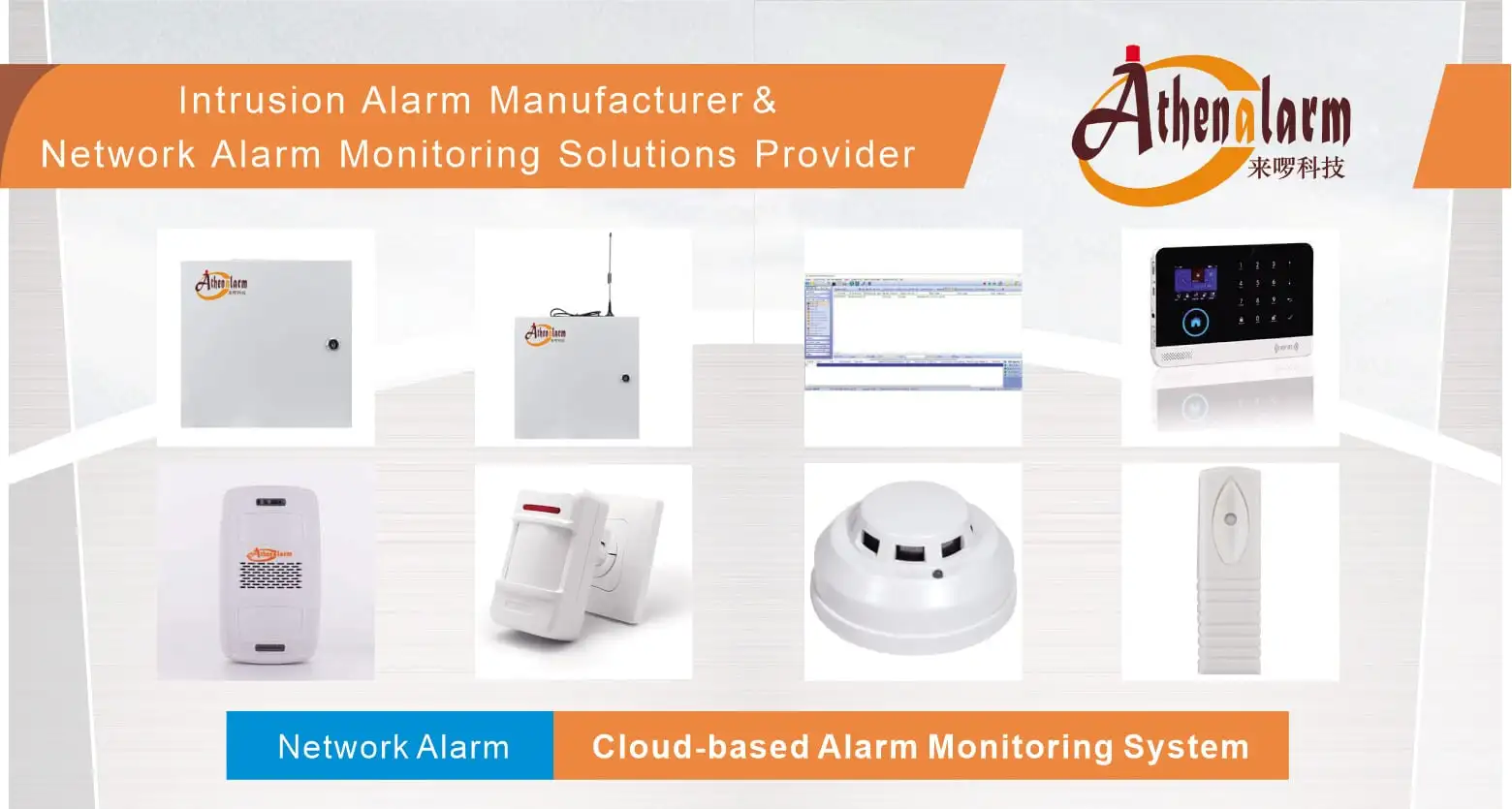
To support physical-layer resiliency and field deployment within modern networked security architectures, enterprise deployments incorporate the following certified edge components for physical zone verification and local event triggers:
- Perimeter & Volumetric Detection: High-immunity PIR Motion Sensors and Wide-Angle PIR Motion Sensors for continuous space coverage.
- Physical Barrier & Access Point Monitoring: Industrial-grade Magnetic Door Contacts to register physical perimeter breach signals.
- Structural Integrity & Vibration Sensing: High-sensitivity Digital Vibration Detectors for vault wall, ATM, and safe enclosure protection.
- Environmental Hazard & Life-Safety Sensing: Certified Photoelectric Smoke Detectors and industrial Combustible Gas Detectors for early hazard prevention.
- Manual Duress & Emergency Signaling: High-reliability wired Panic Buttons and long-range Wireless Panic Buttons for rapid localized dispatch.
- Local Deterrence & Voice Prompt Interfaces: Strobe-integrated Visual Warning Lights and automated Motion Sensor Audio Players for immediate site deterrence and zone warnings.
- Banking & Vault-Specific Solutions: Customized Bank Vault Alarm Systems and specialized ATM Alarm Systems for high-risk financial infrastructure.
