
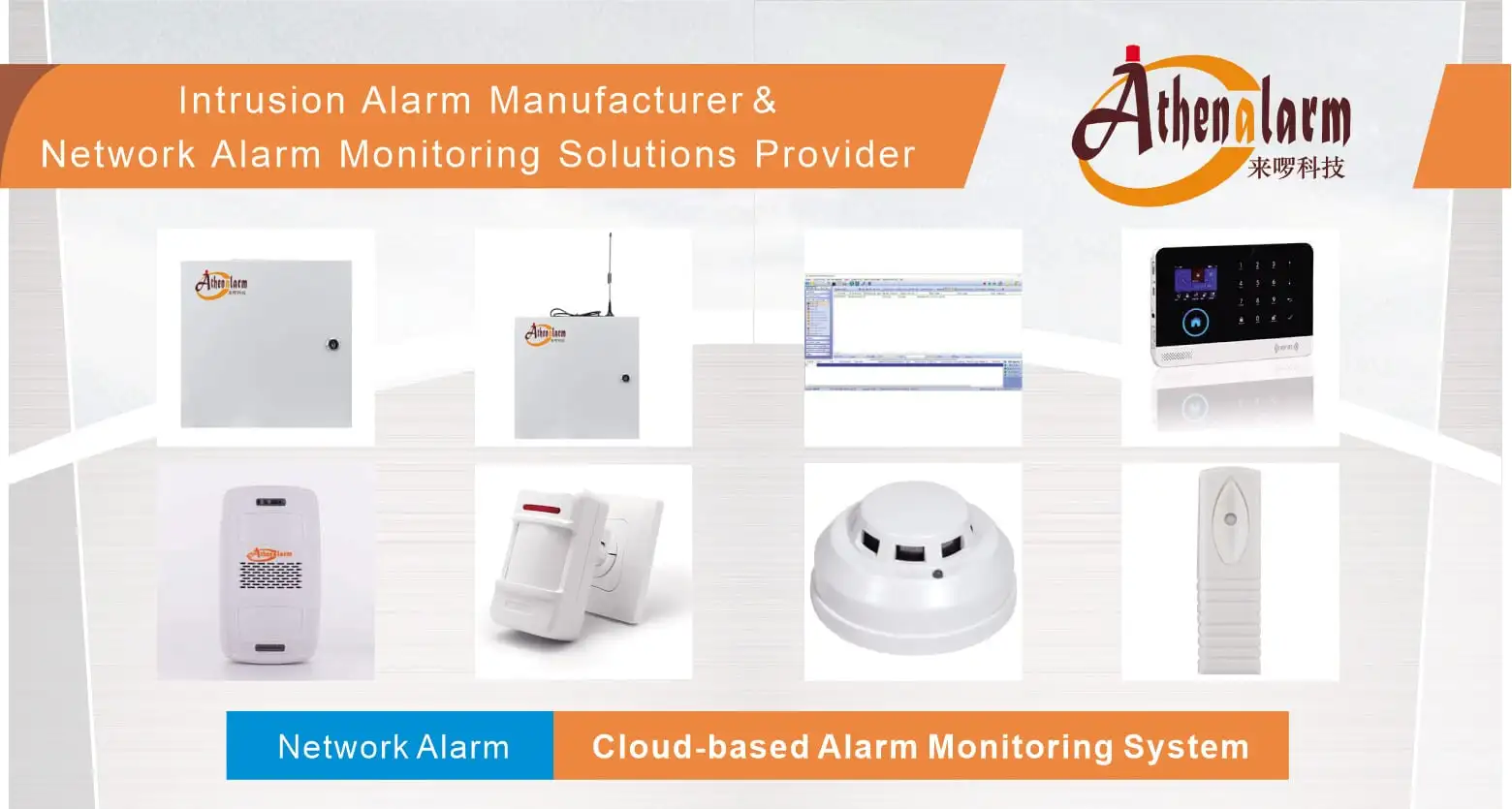
4. Essential Features of Commercial Alarm Control Panels
Beyond the basic ability to detect and report alarm events, enterprise-grade business alarm control panels offer a range of advanced capabilities that directly affect operational performance, integration depth, and long-term value.
Multi-zone management with granular customization. Commercial panels support anywhere from 8 to 512+ zones, each independently programmable for detection type, response behavior, time schedules, and arming state. Zones can be grouped into partitions—logical subsets that operate semi-independently. A retail business, for example, might partition the system so that the stockroom is armed during business hours while the sales floor remains disarmed, with separate user codes and schedules for each area.
Role-based user access controls. Every user interacting with the system should hold credentials tied to a specific permission profile. Administrator accounts carry full system access; manager accounts can arm or disarm designated zones and retrieve event reports; staff accounts are restricted to specific zones within defined time windows. All activity is logged against the individual user credential, creating meaningful accountability at every level.
Comprehensive event logging and audit trails. Enterprise panels maintain detailed, tamper-evident records of all system events: sensor activations, arming and disarming actions, user logins, configuration changes, communication faults, and self-test results. Logs should be exportable in standard formats—CSV, PDF, XML—for integration with incident management systems or regulatory reporting workflows.
Redundant communication paths. A panel that relies on a single communication channel represents a single point of failure. Leading commercial panels support simultaneous operation across multiple communication paths—Ethernet as primary, cellular as secondary, and optionally Wi-Fi or PSTN as tertiary backup—with automatic failover to the next available channel when the primary path is disrupted.
Integration with building management systems. Modern commercial panels expose API and protocol interfaces—Modbus, BACnet, KNX, REST—enabling bidirectional integration with HVAC systems, lighting controllers, energy management platforms, and fire suppression systems. This enables scenario-based automation: when the alarm is set to “away” mode, the HVAC setpoint automatically adjusts to an energy-saving schedule; when a fire alarm triggers, all access-controlled doors release to their fail-safe (open) position.
Self-monitoring and predictive diagnostics. High-quality panels run continuous self-tests on every connected device and communication path, routing fault reports—low battery, sensor supervision failure, communication path degradation, tamper detection—to maintenance teams via email, SMS, or integration with a facilities management platform. This capability transforms security maintenance from a reactive process into a proactive one.
Intuitive user interfaces. Keypads and touchscreens should support multilingual operation, role-appropriate menu structures, and clear status visualization. In high-traffic facilities with diverse workforces, this is a practical operational requirement for consistent and correct system use, not an optional convenience.
5. 9 Key Selection Criteria for a Business Alarm Control Panel
The following nine criteria form a structured, field-tested framework for commercial alarm control panel procurement. Each factor has direct implications for system performance, total cost of ownership, regulatory standing, and long-term operational resilience.
5.1 Criterion 1: System Scalability
A control panel that meets your current requirements but cannot grow with your organization is not a long-term solution—it is a deferred replacement cost. When evaluating scalability, assess the following dimensions:
- Zone capacity and expansion path: What is the maximum zone count, and how is expansion achieved? Panels that scale via wired zone expansion modules offer the most reliable path. Confirm that expansion does not require replacing the core panel hardware.
- User capacity: How many unique user credentials can the system support? For large organizations with high staff turnover, panels supporting thousands of codes rather than hundreds are essential.
- Partition support: Can the system be logically subdivided to accommodate multiple tenants, departments, or operational units without deploying separate hardware?
- Processing performance under load: As more sensors and integrated systems feed data into the panel, does the architecture maintain real-time responsiveness, or does performance degrade?
Demand written specifications from vendors covering maximum zone counts, expansion module compatibility, and the hardware generations supported by their current software platform. A panel with a five-year-old processing architecture may be approaching end-of-life on its scalability roadmap even if it appears fully functional today.
5.2 Criterion 2: Integration Capability
The commercial security ecosystem does not exist in isolation. A business alarm control panel that cannot communicate with other security and building systems forces operators to manage multiple disconnected platforms—a significant operational liability.
Evaluate integration capability across three dimensions:
- Protocol support: Does the panel natively support open standards such as ONVIF (IP cameras), BACnet or Modbus (building automation), Wiegand or OSDP (access control), and REST or MQTT (cloud and IoT platforms)? Open protocol support eliminates vendor lock-in and enables best-of-breed component selection.
- API availability: Does the vendor publish a documented, version-controlled API? A well-documented API allows your internal IT team or a systems integrator to build custom integrations with enterprise tools—HR platforms, visitor management systems, security information and event management (SIEM) solutions.
- Scenario-based physical integration: Can alarm events trigger actions in connected systems? A door-forced-open alarm should trigger video recording on the nearest camera, send a push notification to the on-call security manager, and log a video bookmark—automatically, without operator intervention.
Avoid panels that achieve “integration” only through proprietary middleware requiring ongoing vendor licensing. True integration is built on open standards and documented interfaces.
| Integration Standard | Application Domain | Key Benefit |
|---|---|---|
| ONVIF | IP Camera Systems | Vendor-agnostic video integration |
| OSDP / Wiegand | Access Control | Secure reader-to-panel communication |
| BACnet / Modbus | Building Automation | HVAC, lighting, energy coordination |
| REST / MQTT | Cloud & IoT Platforms | Flexible API-based data exchange |
| SIA DC-09 | Monitoring Centers | Standardized alarm signal transmission |
5.3 Criterion 3: Cybersecurity Architecture
As commercial alarm panels migrate to IP-based architectures, they become network endpoints—and potential attack surfaces. A poorly secured panel can serve as an entry point into your enterprise network, a vector for alarm signal spoofing, or a target for service disruption.
Minimum cybersecurity requirements for any commercial panel under consideration:
- Encryption: All wireless device communication must use AES-128 or higher. All IP communications must use TLS 1.2 or TLS 1.3.
- Authentication: Remote access to the panel management interface must enforce multi-factor authentication (MFA). Default factory credentials must be changed at commissioning, and the panel must reject weak or previously compromised passwords.
- Firmware integrity: Firmware updates must be digitally signed by the manufacturer and verified by the panel prior to installation. Rollback protection should prevent attackers from forcing a downgrade to a vulnerable firmware version.
- Network segmentation: IP-based panels should be deployed on a dedicated security VLAN, isolated from general corporate network traffic, with firewall rules restricting connections to specifically authorized IP addresses and ports.
- Cloud platform compliance: Verify that cloud management platforms hold SOC 2 Type II or ISO 27001 certification, and review vendor data processing agreements and incident response commitments.
- Administrative audit logging: Every configuration change, remote access session, and firmware update should be logged with user ID, timestamp, and source IP address.
5.4 Criterion 4: Communication Redundancy
Communication path reliability is the single most testable—and most frequently neglected—dimension of alarm system resilience.
A panel with only one active communication channel can be rendered unable to report alarms by a localized network outage, a cut cable, or a deliberate jamming attack. The consequences range from delayed emergency response to a complete security blackout during the precise events the system was built to detect.
Best practices for commercial alarm panel communication:
- Dual-path active operation: Configure the panel to report over two independent paths simultaneously—typically Ethernet and cellular. Both paths should be live at all times, not merely on standby. Monitoring center protocols such as SIA DC-09 support dual-path supervision, allowing the station to detect path failure even in the absence of an alarm event.
- Supervision frequency: For high-security environments, configure supervision intervals of 90 seconds or less so that a communication failure is detected and escalated quickly.
- Automatic failover and recovery: The panel should fail over to the secondary path without manual intervention when the primary path fails, and restore primary path operation automatically when connectivity returns.
- Anti-jamming and carrier redundancy: Select panels that support multiple cellular bands and can switch carriers if the primary carrier’s signal is degraded. Dual-SIM support provides additional carrier redundancy in high-risk deployments.
Test all communication paths at commissioning and at least quarterly thereafter. Document every test result as part of your compliance record.
5.5 Criterion 5: Regulatory Compliance and Certification
In many industries and jurisdictions, alarm system compliance is mandatory, not advisory. Deploying a non-certified or non-compliant system can invalidate insurance coverage, trigger regulatory penalties, and create direct liability following a security incident.
Key certifications and standards to verify:
- UL Listed (Underwriters Laboratories): UL 2050 governs central station monitoring services; UL 681 covers installation requirements for burglary alarm systems. UL listing is required by many commercial property insurers as a coverage condition.
- EN 50131 (Europe): Defines graded performance levels (Grade 1 through Grade 4) based on threat environment. Verify that the selected panel achieves the grade appropriate to your risk assessment.
- IEC 60839: The international framework standard for alarm systems, referenced in many national building codes and procurement specifications.
- HIPAA: Requires access controls, audit logging, and physical security for areas containing protected health information. The control panel’s event logging and authentication features directly support HIPAA compliance.
- PCI-DSS: Requires physical access controls and monitoring for cardholder data environments. Panel audit logs and zone-based access restrictions are directly applicable.
- SOC 2: Cloud-connected panels whose management platforms process operational data may be subject to SOC 2 requirements for the service provider.
Always request current certification documentation before final vendor selection. Certifications can lapse or be withdrawn, and an expired listing provides no coverage benefit.
5.6 Criterion 6: Remote Management Capability
For multi-site organizations, remote management capability is an operational necessity, not a convenience feature. A panel system that requires on-site access for configuration changes, firmware updates, or event log retrieval places an unsustainable burden on security operations teams.
Key remote management capabilities to specify in your RFP or procurement criteria:
- Centralized multi-site dashboard: A single interface providing real-time status visibility across all panels at all locations, with the ability to acknowledge alarms, review event logs, and issue remote arm or disarm commands.
- Remote configuration and programming: The ability to modify zone parameters, user credentials, time schedules, and communication settings without dispatching a technician. This capability typically reduces configuration labor costs by 60–80% compared to on-site-only management.
- Over-the-air firmware updates: Centralized firmware deployment with scheduling controls that prevent updates during business hours or elevated-risk periods.
- Remote diagnostics and health monitoring: Real-time visibility into panel health—communication path status, battery voltage, sensor supervision, tamper detection—with automated alert escalation when anomalies are detected.
- Secure mobile access: A mobile application that enforces MFA and session timeouts, enabling authorized personnel to receive push notifications, acknowledge alarms, and perform basic system control from any location.
Evaluate the remote management platform on its own security posture—not merely its feature set. The management platform is an additional attack surface requiring the same level of scrutiny as the panel hardware itself.
5.7 Criterion 7: User Access Control and Credential Management
Poorly managed user credentials are among the most common and costly sources of security system vulnerabilities in commercial environments. Shared PIN codes, credentials that are never deactivated after employee departures, and unrestricted system access for all staff create significant and entirely preventable operational risks.
Requirements for robust credential management in a commercial alarm control panel:
- Role-based access profiles: Distinct permission levels—at minimum, administrator, supervisor, and user—with granular control over which zones, functions, and time windows each role can access.
- Individual user codes: Every person requiring system access should hold a unique credential. Shared codes eliminate individual accountability and render audit trails meaningless.
- Time-limited and scheduled access: The ability to define active time windows per user. A cleaning contractor’s code should be valid only between defined hours on specified days. Temporary employee codes should carry automatic expiration dates.
- Automated credential revocation: Integration with HR or identity management systems to disable credentials immediately when an employee terminates, transfers, or changes role. Manual revocation processes are consistently unreliable.
- Activity logging: All credential use—successful and unsuccessful—should generate a log entry with timestamp, zone identifier, and user ID. Invalid credential attempts should trigger an immediate alert.
- Duress codes: Designated duress codes that arm the system normally while simultaneously transmitting a silent alert to the monitoring station—critical for environments with robbery or coercion exposure.
5.8 Criterion 8: Energy Efficiency and Sustainable Deployment
Energy efficiency has become a substantive criterion in commercial alarm panel procurement, driven by operational cost management and corporate sustainability mandates. A panel system operating continuously—24 hours a day, 365 days a year—accumulates a meaningful energy footprint over its operational life, particularly across multi-site deployments.
Practical efficiency features to evaluate:
- Standby power consumption: Compare standby power specifications across competing panels. Differences of 5–10 watts may appear minor but translate to significant energy costs over multi-year, multi-site deployments.
- Solar and alternative power compatibility: Solar-ready power supply units capable of integrating with photovoltaic systems are increasingly available from major panel manufacturers—particularly relevant for remote locations, outdoor facilities, and organizations with renewable energy commitments.
- Intelligent battery management: Continuous battery health monitoring with optimized charging cycles that maximize battery lifespan, reducing both replacement costs and electronic waste.
- Sensor-level power optimization: Wireless sensor networks supporting dynamic transmission power adjustment—reducing RF output when signal quality is strong—extend battery life without compromising supervision integrity.
- Green certifications: RoHS compliance (restriction of hazardous substances) and applicable energy efficiency certifications are increasingly relevant in procurement processes with formal sustainability criteria.
Include power consumption specifications in your technical evaluation scoring matrix. From a lifecycle perspective, energy-efficient panels reduce total cost of ownership in a measurable and documentable way.
5.9 Criterion 9: Vendor Ecosystem and Support Quality
A business alarm control panel is a long-term infrastructure commitment. The quality of the vendor relationship—financial stability, support infrastructure, certified installer network, and product roadmap transparency—has a direct bearing on the panel’s operational value across its entire service life.
Vendor evaluation criteria:
- Financial stability and market longevity: Panel systems are typically designed for 10–15 year operational lifespans. A vendor who exits the market or discontinues a product line before that horizon creates significant replacement and integration costs. Assess vendor financial health, market position, and installed base size.
- Certified installation and service network: Verify that the vendor maintains factory-certified installation and service partners in your region with defined SLAs for emergency service calls.
- Software and firmware update commitment: Request documentation of the support lifecycle for specific panel models—particularly the end-of-life date for software updates and security patches.
- Training and documentation quality: Comprehensive, current technical documentation—installation manuals, configuration guides, API references, integration guides—is a reliable indicator of a vendor’s commitment to the professional installer and integrator community.
- Reference customers and case studies: Request references from organizations of comparable scale and operational complexity. Direct conversations with existing customers are more informative than vendor-produced testimonials.
- Open ecosystem vs. proprietary lock-in: Panels requiring proprietary sensors, keypads, and expansion modules create long-term vendor dependency at the vendor’s pricing. Open architecture panels that work with standard third-party devices provide significantly greater procurement flexibility and competitive pricing throughout the system’s lifespan.
