
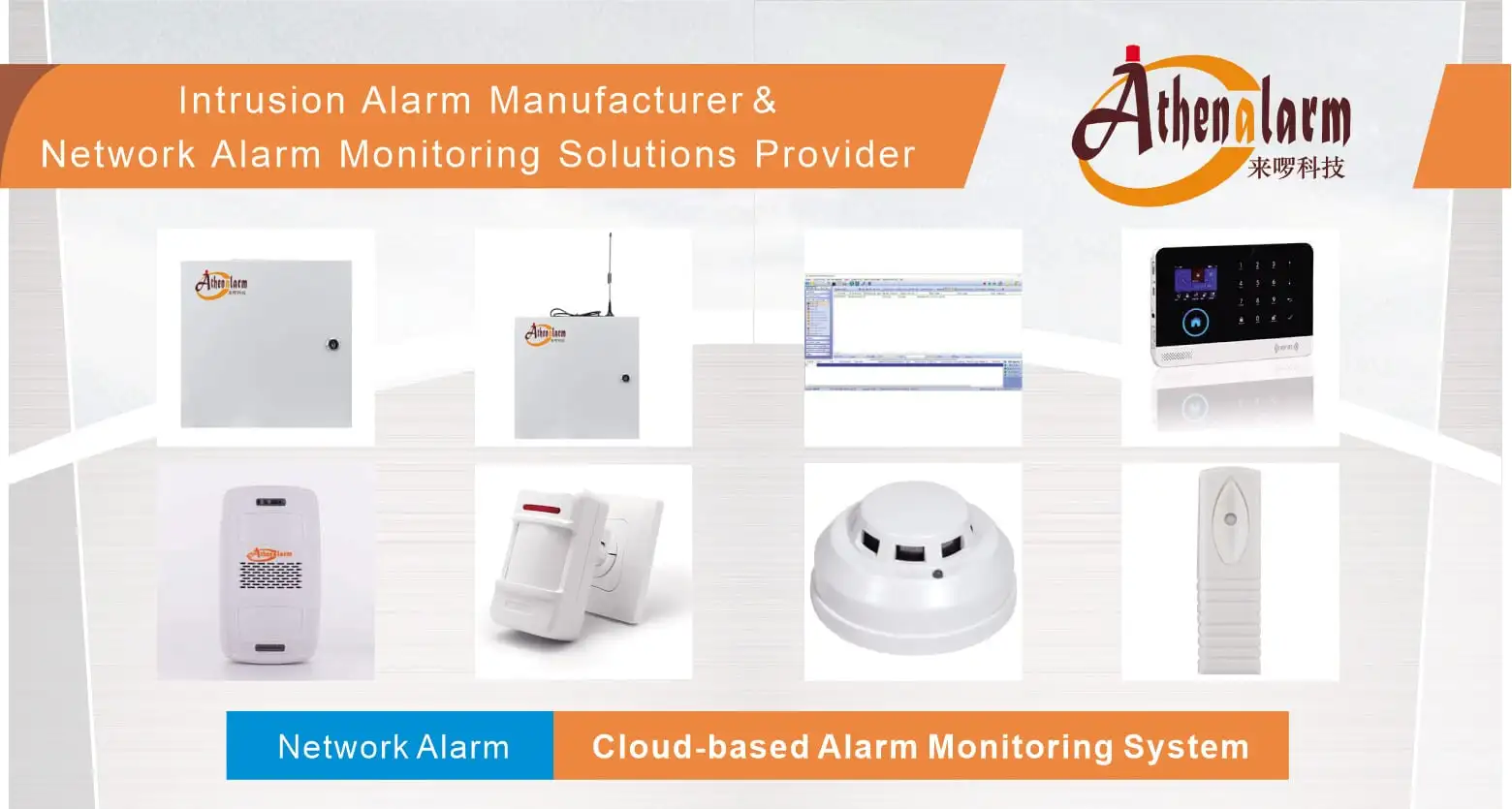
Key Technological Trends Driving Modern Burglar Alarm Products: From Reactive Alarms to Connected Security Platforms
Burglar alarm products occupy a specific position inside a physical security architecture: they generate the initiating event that triggers detection, verification, and response workflows across a facility or a portfolio of sites. In a legacy deployment, this position was narrow. An alarm control panel monitored a fixed set of hardwired sensors and transmitted a signal over a dedicated PSTN line to a central monitoring station, with no additional context and no coordination with other building systems.
That narrow architectural role is changing, and the change is not cosmetic. Alarm control panels increasingly sit inside networked, IP-connected environments. Detection inputs are combined rather than treated individually. Alarm events are linked to video, access control, and mapping systems instead of standing alone. Monitoring and diagnostics increasingly happen through cloud platforms rather than at a single physical console.
This matters directly to deployment, procurement, and long-term operation. A system specified as an isolated alarm device behaves differently — and creates different dependencies — than a system specified as a node inside an integrated security platform. Communication method affects installation feasibility in cabling-constrained buildings. Detection method affects false-alarm frequency and operator workload. Integration depth affects how many subsystems must be commissioned, tested, and maintained together. Management model affects whether diagnostics and firmware updates happen remotely or require site visits.
The twelve technological trends discussed in current industry commentary on burglar alarm products are not independent features to be selected individually. They are evidence of one underlying architectural transition: from isolated, reactive alarm hardware toward connected, context-aware, centrally managed security platforms. The remainder of this analysis follows that transition layer by layer — communication, verification, intelligence, integration, management, and market structure — and closes with the trade-offs a system designer or procurement team should weigh before specifying or expanding a deployment.
1. Why Modern Burglar Alarm Products Are Evolving Beyond Isolated Alarm Signaling
A traditional burglar alarm product performs a narrow function: it detects a condition and signals that condition to a receiver. It does not, by itself, explain what happened, confirm whether the event is genuine, or coordinate a response with other building systems. This model is sufficient for a single detection zone with a static risk profile, but it becomes a limiting factor as soon as an organization operates multiple sites, requires faster event validation, or wants alarm data to inform access control, video, or centralized monitoring decisions.
1.1 From Isolated Alarm Devices to Connected Security Platforms
The architectural shift described across current burglar alarm product development follows a consistent progression:
Isolated alarm device → networked alarm node → integrated security subsystem → data-driven security platform.
At each stage, the alarm control panel and its sensors remain the origin point of the security event, but the surrounding architecture around that event becomes progressively richer. A networked alarm node can be reached and diagnosed remotely. An integrated security subsystem can trigger or receive triggers from video and access control. A data-driven platform can apply centralized analytics, cloud-based monitoring, and cross-site visibility to events originating from many physical locations. This progression does not imply that every deployment must reach the final stage — it describes the direction in which product capability and buyer expectations are moving.
1.2 The Functional Layers of a Modern Alarm Architecture
To interpret the individual technology trends discussed later in this analysis, it is useful to separate a modern burglar alarm architecture into functional layers rather than treating it as a single device category.
| Layer | Primary Function | Representative Elements |
|---|---|---|
| Detection | Identify a potential intrusion-related condition | Sensors, PIR/microwave/acoustic/vibration inputs, edge AI analytics |
| Processing | Interpret and coordinate raw detection inputs into an alarm event | Alarm control panel, intelligent event-analysis logic |
| Communication | Transport the event and system status to a receiving party | IP networks, LTE, 5G, Wi-Fi, LPWAN, legacy PSTN |
| Verification | Add context that supports interpretation of the event | Video verification, video pop-ups, time-synchronized playback |
| Integration | Connect the alarm event to other security subsystems | ONVIF, MQTT, access control, video surveillance, intercoms, GIS |
| Management | Provide centralized visibility, diagnostics, and maintenance | Cloud platforms, monitoring platforms, remote diagnostics, firmware management |
| Response | Support a decision or action based on the event | Monitoring personnel, automated subsystem actions |
Not every burglar alarm product implementation includes every layer. A single-site residential installation may stop at detection, processing, and basic communication. A distributed enterprise deployment is more likely to extend through verification, integration, and management. The functional-layer view is a way of describing what a given product or deployment covers, not a claim that all layers are universally present.
1.2.1 Detection and Event Generation
Detection is the point at which a sensor input — motion, microwave reflection, acoustic disturbance, or vibration — is converted into a candidate security event. This is the layer where multi-sensor fusion and edge AI analytics operate, because the quality of everything downstream depends on how well this initial condition is identified.
1.2.2 Communication and Event Transport
Once a candidate event exists, it must reach a processing or monitoring destination. This is the layer where the industry’s migration from PSTN toward IP, cellular, Wi-Fi, and LPWAN communication takes place, and it is the layer most directly affected by a building’s physical infrastructure.
1.2.3 Verification, Integration, and Response
The final layers determine what happens to the event after it is transported: whether it is enriched with video context, whether it triggers actions in other subsystems such as access control, and whether it is ultimately handled by monitoring personnel, an automated workflow, or both.
2. Network and Wireless Communication Are Reshaping Alarm System Architecture
Communication method determines how, and how reliably, an alarm event reaches a monitoring destination. It is also one of the first architectural decisions a system designer makes, because it is constrained by the physical characteristics of the site.
2.1 IP Networking as the Foundation for Distributed Alarm Systems
IP-based architecture allows an alarm control panel to be reached as a network endpoint rather than a stand-alone device wired to a single receiver. This underpins several operational capabilities referenced throughout current burglar alarm product development: remote diagnostics, centralized monitoring across multiple sites, and integration with other IP-connected security subsystems. For campuses, logistics centers, and distributed enterprises, IP networking is the mechanism that allows a single monitoring or management layer to represent many physical locations.
2.2 The Shift From PSTN to Cellular and Other Wireless Paths
Legacy burglar alarm communication relied heavily on PSTN lines. As PSTN infrastructure is progressively phased out and cabling is not always practical, alarm products are adopting LTE, 5G, Wi-Fi, and LPWAN as alternative or primary transmission paths.
| Communication Path | Architectural Role | Deployment Implication |
|---|---|---|
| PSTN | Legacy dedicated telephone-line signaling | Declining availability; limited flexibility |
| IP Network | Networked, endpoint-based communication | Enables remote diagnostics and centralized monitoring |
| LTE / 5G | Cellular wireless transmission | Reduces dependency on site cabling |
| Wi-Fi | Local wireless network transmission | Suited to sites with existing wireless infrastructure |
| LPWAN | Low-power wide-area wireless transmission | Supports distributed or hard-to-cable installations |
2.2.1 Deployment Environments That Influence Communication Choice
The relevance of each communication path is tied to the physical environment. Rental spaces and heritage buildings, where structural cabling is impractical or restricted, benefit from wireless options that avoid new wiring runs. Large campuses and distributed enterprises benefit from IP-based architecture that allows a single monitoring layer to reach many buildings. The communication decision is therefore a deployment-specific engineering choice, not a single universally preferred option.
2.2.2 Wireless Flexibility vs Communication Dependency
Adopting wireless transmission improves installation flexibility and extends alarm products into environments where cabling is difficult. At the same time, it makes the communication path itself a more central part of system performance: the alarm’s ability to signal an event now depends on the availability of a cellular, Wi-Fi, or LPWAN connection rather than a dedicated wired line. The article base underlying this analysis identifies flexibility and installation benefits explicitly, but does not provide quantified reliability, coverage, or failover data — this distinction should be treated as a design consideration, not resolved by an assumption that wireless communication is inherently more resilient than a wired path.
3. Event Verification and Intelligent Detection Are Changing What an Alarm Event Means
A raw alarm signal indicates that a condition occurred; it does not, by itself, indicate what that condition was. A second major trend in burglar alarm products addresses this gap by adding context and validation to the event before or during the response.
3.1 Video Verification Adds Context to Alarm Events
Video verification connects an alarm trigger to live or recorded footage of the same location, allowing monitoring personnel to assess whether the triggering condition reflects an actual intrusion or a benign occurrence. The value of this capability is operational rather than purely technical: it changes the sequence from “alarm signal → dispatch decision” to “alarm signal → visual context → dispatch decision,” which supports faster and better-informed judgment by the operator.
3.1.1 Real-Time Video Pop-Ups
When an alarm is triggered, an automatic video pop-up presents the associated camera feed to monitoring personnel without requiring a manual search for the relevant video source. This reduces the time between event generation and human assessment.
3.1.2 Time-Synchronized Event Playback
Time-synchronized playback aligns recorded video with the exact moment of the alarm trigger, which supports post-event review and forensic analysis. This is distinct from live pop-ups: it addresses investigation after the fact rather than immediate response.
3.2 AI and Edge Analytics Expand Detection Beyond Simple Triggers
Edge AI analytics extend detection beyond a binary “triggered / not triggered” signal by classifying objects, analyzing behavior, and identifying anomalies at the point of detection. Capabilities referenced in current product development include object classification, behavior analysis, facial recognition, dwell-time analysis, and behavior prediction. These functions should be understood as an event-interpretation layer added on top of basic detection hardware rather than as a replacement for the detection layer itself, and their described role is to improve the informational quality of an event, not to guarantee a specific accuracy level. No quantified detection-accuracy figures are established in the source material, and none should be implied.
3.2.1 AI as an Event Interpretation Layer
The practical function of AI in this architecture is interpretive: it helps distinguish between a person, an animal, and an environmental disturbance, and it can flag behavioral patterns that warrant closer attention. This positions AI within the processing and detection layers described in Section 1.2, rather than as an independent product category.
3.3 Multi-Sensor Fusion Addresses the Limitations of Single-Input Detection
A single detection input — for example, a PIR sensor alone — can register a triggering condition without sufficient information to confirm whether that condition represents an actual intrusion. Multi-sensor fusion combines PIR, microwave, acoustic, and vibration inputs so that an event is validated across more than one physical detection mechanism before it is escalated.
PIR + Microwave + Acoustic + Vibration → Multi-Sensor Fusion → Event Validation → Alarm Decision
3.3.1 Detection Accuracy vs Architectural Complexity
Combining multiple sensor types can produce a more reliable basis for validating an event than a single-input design, but it also introduces additional sensors, additional processing logic, and additional configuration requirements compared with a simple single-trigger architecture. This is a direct engineering trade-off rather than an unconditional improvement: the added complexity is the cost of the added validation.
4. Open Integration Is Turning Alarm Systems Into Coordinated Security Platforms
Once an alarm event carries verified, contextual information, the next architectural question is what other systems should act on that information. This is the layer where burglar alarm products stop functioning as isolated devices and start functioning as one node inside a coordinated security workflow.
4.1 From Hardware Relay Logic to Event-Driven Security Workflows
Older alarm architectures relied on direct hardware relay triggers: a fixed physical connection caused a fixed physical action. Modern architectures replace this with event-driven logic, in which an alarm control panel evaluates multiple inputs — sensor data, schedules, camera feeds — before generating a contextual response. The sequence changes from a hardwired trigger to a software-mediated decision:
Sensor / alarm input → event analysis → contextual decision → cross-system action.
This shift reduces dependence on fixed wiring between subsystems, but it also means that the reliability of a triggered response now depends on the correctness of the event-analysis logic rather than a direct physical connection.
4.2 ONVIF and MQTT as Integration Mechanisms
Cross-subsystem communication between alarm products, video systems, and access control platforms is commonly supported through open protocols, with ONVIF and MQTT explicitly referenced as integration mechanisms in current product development.
| Protocol | Integration Role | Boundary of This Analysis |
|---|---|---|
| ONVIF | Supports interoperability between security devices, particularly video-related systems | Specific ONVIF profiles and implementation details are not addressed here |
| MQTT | Supports event-oriented, message-based communication between connected security components | Broker architecture, topic structure, and payload format are not addressed here |
These protocols support cross-subsystem communication at a conceptual level; their presence in a product’s specification sheet does not by itself guarantee interoperability with every third-party device, since actual interoperability depends on implementation details outside the scope of this analysis.
4.3 Linking Intrusion Events With Video and Access Control
A practical illustration of event-driven integration is the sequence triggered when an intrusion event occurs in a facility with linked video and access control:
Intrusion Event → Video Activation / Pop-Up → Access-Control Function (for example, a localized door-locking action) → Operator or Automated Response.
This sequence allows a single detected event to produce a coordinated set of actions across previously separate systems, rather than requiring an operator to manually cross-reference each subsystem after the fact.
4.4 GIS Visualization Adds Spatial Context to Security Events
In deployments spanning multiple zones or multiple sites, a digital map or GIS-based visualization associates a security event with its physical location, allowing monitoring personnel to localize an incident and see the status of adjacent zones. This is primarily relevant to multi-zone or multi-site operations; a single-zone deployment gains comparatively little from spatial visualization, since the location of any event is already self-evident.
5. Cloud Management Is Moving Alarm Operations From Sites to Centralized Platforms
As alarm products increasingly operate as networked, integrated components, the management of those systems is also shifting — from a site-by-site model toward centralized, cloud-based operation.
5.1 Centralized Visibility Across Distributed Sites
Cloud platforms allow alarm status, event history, and diagnostic information from multiple sites to be represented in one operational view. This directly addresses the fragmentation that occurs when an organization operates several sites with independently managed alarm systems: rather than checking each site separately, a monitoring or management team can access a consolidated status layer.
5.2 Remote Diagnostics and Maintenance
Cloud connectivity supports remote diagnostics, firmware updates, and ongoing system monitoring without requiring a technician to be physically present for every maintenance activity. This does not eliminate the need for on-site work — physical sensor faults, wiring issues, and hardware replacement still require a site visit — but it does shift a portion of maintenance activity toward remote administration, particularly for software-related updates and status checks.
5.3 Cloud Visibility vs Cloud/Network Dependency
Centralized cloud management improves multi-site visibility and reduces the operational burden of managing systems individually. The corresponding dependency is that this visibility now relies on network and cloud-service availability: if connectivity to the cloud platform is interrupted, centralized status and remote diagnostic functions are affected, even if the underlying local alarm detection continues to operate. This trade-off should be part of the evaluation for any deployment considering cloud-based management, rather than an assumption that centralization carries no operational cost.
6. Modularity and Market Segmentation Are Expanding Where Burglar Alarm Products Fit
Beyond architecture and operations, burglar alarm products are also evolving in how they are packaged, expanded, and sold, reflecting a broader range of deployment contexts than a single standardized product line can address.
6.1 Modular Integration Supports Incremental Capability Expansion
Modular design allows additional functionality — such as expanded sensor coverage, added automation features, or additional integration points — to be introduced incrementally rather than requiring a full system replacement. This is relevant for both residential and commercial deployments where requirements may grow over time.
6.1.1 Modularity vs Integration Overhead
Incremental expansion avoids the cost and disruption of full replacement, but each additional connected function introduces its own configuration and interoperability requirements. A modular system with many added components is not automatically simpler to maintain than a smaller, less-expanded one; it is simpler to expand, which is a related but distinct benefit.
6.2 Residential Smart-Home Integration as an Expansion Path
In residential deployments, burglar alarm products are increasingly connected to voice assistants, mobile applications, and home automation functions such as lighting control and energy management. This represents one branch of the broader modular-expansion trend rather than a separate topic: the same architectural principle — adding functionality without full system replacement — applies whether the added function is an access-control link in a commercial deployment or a voice-assistant integration in a residential one. This analysis addresses smart-home integration only as an expansion path within the broader burglar alarm product architecture, not as a consumer setup guide.
6.3 Product Differentiation by Deployment and Market Requirements
Vendors are increasingly differentiating burglar alarm products by deployment context and market segment rather than offering a single configuration for all buyers.
| Differentiation Basis | Example Distinction |
|---|---|
| Geography | Urban deployments vs rural deployments |
| Deployment scale | Residential systems vs enterprise systems |
| Sector | Finance-sector configurations vs logistics-sector configurations |
| Commercial model | System-as-a-Service (SaaS) vs conventional product sale |
| Support model | Localized support vs centralized support |
| Distribution channel | E-commerce kits vs integrator-installed systems |
This segmentation reflects the same underlying pattern seen in the technical trends above: burglar alarm products are being evaluated and configured against specific deployment requirements rather than treated as a single generic product category.
7. What These Trends Mean for System Design and Product Selection
The preceding sections describe individual technology directions. For an integrator, system designer, or procurement team, the practical task is translating those directions into a selection process for a specific deployment.
7.1 Match Technology to the Deployment Problem
Technology selection should follow the deployment problem, not the popularity of a given trend. A practical evaluation sequence is:
Deployment environment → communication constraints → detection requirements → verification needs → integration scope → management model.
A single-zone retail unit with reliable cabling has different communication requirements than a distributed logistics network spanning several unconnected buildings, even though both may be described as “modern burglar alarm deployments.”
7.2 Evaluate Integration Depth Before Selecting Components
Because integration affects commissioning and long-term maintenance, integration requirements should be defined before individual components are chosen, not added afterward. Relevant questions include whether video integration is required, whether access-control coordination is required, whether ONVIF or MQTT-based connectivity is needed for third-party subsystems, and whether cloud-based management is part of the operational model.
7.3 Evaluate False-Alarm Strategy as a System-Level Capability
False-alarm mitigation should be evaluated as a property of the overall detection architecture rather than a feature of a single detector.
| Evaluation Element | Question to Answer |
|---|---|
| Detection method | Is detection based on a single sensor type or multiple sensor types? |
| Event analysis | Is there software-based validation before an alarm is escalated? |
| Video verification | Can an operator visually confirm the event before dispatch? |
| Self-diagnostics | Can the system distinguish an environmental fault from an intrusion condition? |
Multi-sensor fusion, intelligent event analysis, and video verification each contribute to event validation; none of them, individually, is described in the source material as eliminating false alarms outright.
7.4 Evaluate Scalability Against Integration Complexity
Greater capability — more sensors, more subsystem connections, more centralized management functions — generally introduces more configuration, integration testing, and maintenance dependencies. Scalability should be evaluated together with the integration and maintenance burden it introduces, rather than treated as a benefit without a corresponding cost.
7.5 Evaluate Long-Term Operational Requirements
Selection decisions should also account for operation beyond initial commissioning: remote diagnostic capability, firmware update processes, ongoing monitoring requirements, integration maintenance as connected subsystems change, and the practical path for future expansion. A system that is straightforward to commission but difficult to maintain over several years of operation represents a different total cost profile than one evaluated only at the point of purchase.
8. The Architectural Direction of Modern Burglar Alarm Products
8.1 From Reactive Signaling to Context-Aware Security Operations
Across the trends discussed above, a single direction is consistent: burglar alarm products are moving from simple signal generation toward context-aware, coordinated security operations.
Signal → Context → Analysis → Coordination → Management.
Each layer added to this chain — video context, multi-sensor validation, cross-subsystem integration, centralized management — addresses a specific operational limitation of the earlier, signal-only model rather than existing as an isolated feature.
8.2 The Key Engineering Tensions Behind the Trend
None of the technology directions discussed in this analysis is without a corresponding dependency or cost. These tensions should inform, rather than discourage, technology selection.
| Technology Direction | Primary Advantage | Main Dependency / Trade-off |
|---|---|---|
| Wireless communication (LTE, 5G, Wi-Fi, LPWAN) | Installation flexibility in cabling-constrained sites | Greater reliance on wireless network availability |
| Cross-system integration (ONVIF, MQTT) | Coordinated, event-driven security workflows | Increased integration and interoperability complexity |
| AI / edge analytics | Richer interpretation of detected events | Greater dependence on software and processing logic |
| Cloud management | Centralized multi-site visibility and diagnostics | Dependence on cloud and network availability |
| Multi-sensor fusion | Stronger validation of detection events | Additional sensors, processing, and configuration |
| Modular architecture | Incremental capability expansion | Added integration overhead per additional function |
8.3 What “Modern” Should Mean in a Burglar Alarm Product
Based on the architecture described throughout this analysis, a burglar alarm product should be evaluated less by how many discrete features it lists and more by how effectively it supports the full operational chain: Detection → Processing → Communication → Verification → Integration → Management → Response. A system that performs well at detection but has no verification or integration layer addresses only part of the operational problem that modern deployments are structured to solve. Evaluating a product against this chain — rather than against a feature checklist — gives integrators, designers, and procurement teams a more consistent basis for comparing systems intended for different deployment contexts.
9. FAQ
How does video verification improve intrusion alarm monitoring performance?
Video verification improves monitoring performance by linking an alarm event to live or recorded footage, giving monitoring personnel visual context before deciding on a response. This matters because a signal-only alarm indicates that a condition occurred without indicating what that condition was; adding a video pop-up or time-synchronized playback moves the decision point from “signal received” to “signal received and visually assessed,” which supports faster and better-informed judgment during the operator’s evaluation.
What open protocols enable modern burglar alarm panels to integrate with physical security platforms?
ONVIF and MQTT are the two open protocols explicitly referenced as integration mechanisms in current burglar alarm product development. ONVIF supports interoperability primarily among video-related security devices, while MQTT supports event-oriented, message-based communication between connected security components. Both function at the level of cross-subsystem integration described in this analysis; specific protocol profiles, broker architecture, and implementation details fall outside the scope of a system-selection discussion and depend on the specific products being connected.
How does multi-sensor fusion reduce false alarms in commercial environments?
Multi-sensor fusion reduces false alarms by requiring validation across more than one detection input — typically PIR, microwave, acoustic, and vibration sensors — before an event is escalated, rather than relying on a single sensor’s trigger. This matters because a single-input detector can register environmental triggers as intrusion events; combining multiple physically distinct detection mechanisms gives the system more information to confirm whether a condition represents an actual intrusion before generating an alarm.
Why are security integrators replacing legacy PSTN lines with cellular and LPWAN wireless transmission?
Integrators are moving away from PSTN because it is a declining legacy infrastructure with limited installation flexibility, particularly in buildings where new cabling is impractical. LTE, 5G, Wi-Fi, and LPWAN provide alternative transmission paths that do not depend on dedicated telephone lines, which is particularly relevant for rental spaces, heritage buildings, and distributed sites where wired infrastructure is constrained. This shift does not imply that every wireless option provides equal reliability or redundancy; it reflects a move toward communication paths that are less dependent on aging, site-specific wired infrastructure.
10. System Component Checklist Appendix
- System Manufacturer: Burglar Alarm System Manufacturer
- Core Network Architecture: Network Alarm System
- Monitoring Management Software: Network Alarm Center Management Software
- Banking Alarm Solution: Network Bank Alarm Monitoring System Solution
- ATM Protection Module: Bank ATM Alarm Monitoring System Solution
- Bank Vault Subsystem Solution: Network Bank Vault Alarm Monitoring System Solution
- Retail Store Protection: Network Store Alarm System Solution
- Hospitality Security System: Network Hotel Alarm System Solution
- Residential Community Solution: Network Community Alarm System Solution
- Perimeter Intrusion Protection: Network Perimeter Alarm System Solution
- Motion Sensor (Wide Angle): Wide Angle PIR Motion Sensor
- Photoelectric Smoke Sensing: Photoelectric Smoke Detector
- Hazardous Gas Detection: Gas Detector
- Digital Vibration Sensing: Digital Vibration Detector
- Physical Perimeter Contact: Magnetic Door Contact
- Manual Emergency Trigger: Panic Button
- Wireless Emergency Trigger: Wireless Panic Button
- Visual Alert Component: Warning Light Indicator
- Audio Alert Module: Motion Sensor Sound Player
