
Network Store Alarm System Solution
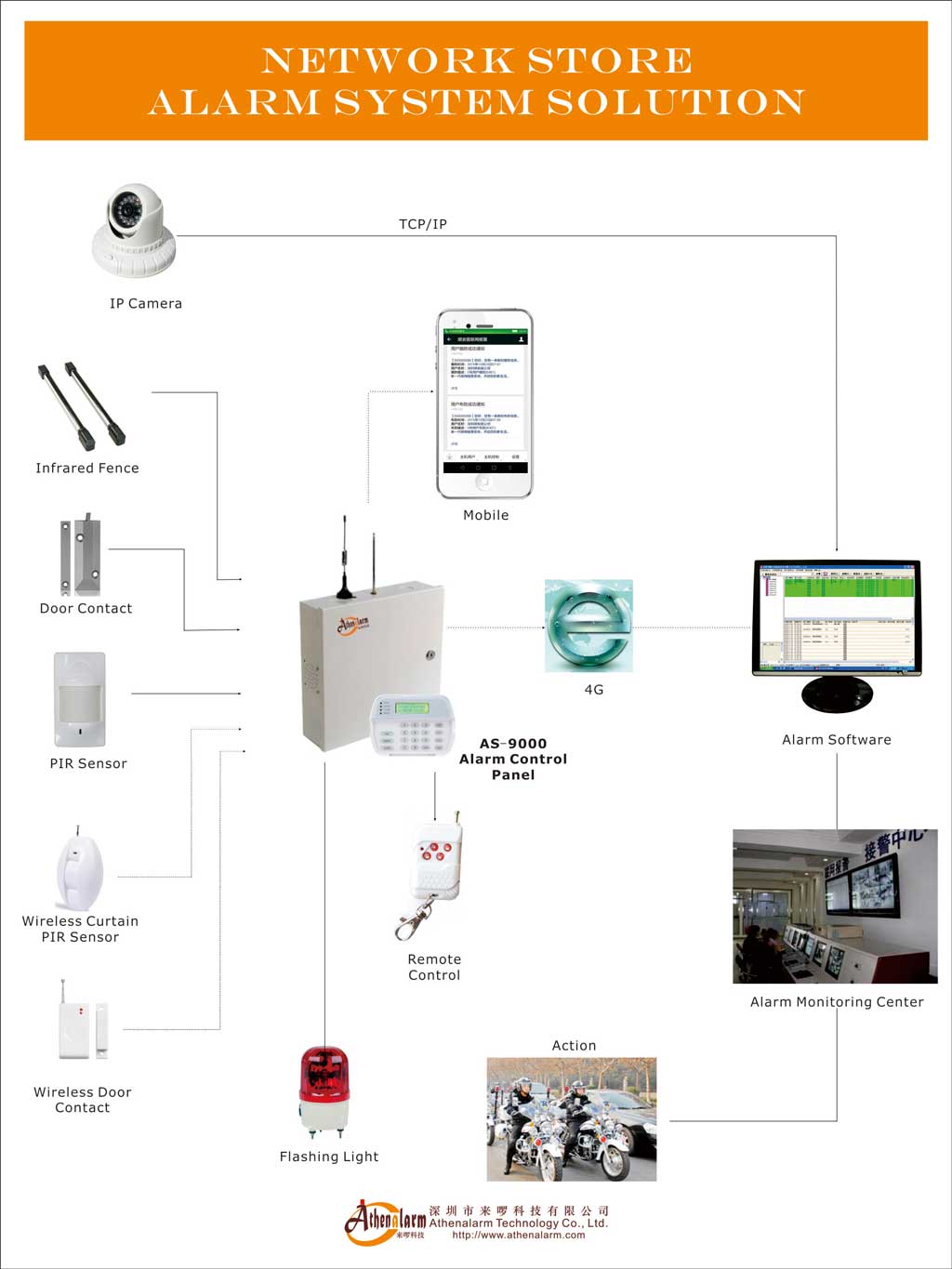
Network Store Alarm System Solution diagram showing AS-9000 alarm control panel, CCTV surveillance, motion sensors, Smart Motion-Activated Voice Reminders, door contacts, panic buttons, alarm monitoring center, and remote security management for retail stores.
1. Overview
Retail stores and chain stores are the backbone of modern consumer shopping, yet their security challenges differ significantly from the centralized management systems of large shopping malls. Due to their dispersed locations and often insufficient security measures, these stores become prime targets for criminals, leading to substantial financial losses and negatively impacting public safety. Business owners seek a reliable store alarm system to safeguard their premises from theft while minimizing costs.
The most effective approach to tackling this issue involves a combination of human surveillance, physical barriers (such as fences and security gates), and advanced technological solutions. A network store alarm system integrates human security measures with cutting-edge technology, providing round-the-clock protection for retail stores and chain outlets. By leveraging alarm networks, these systems significantly enhance theft prevention, deter robberies, and reduce security incidents—ultimately safeguarding both assets and lives.
Beyond retail environments, network store alarm systems are widely applicable across various sectors, including government institutions, corporate offices, residential properties, shopping malls, supermarkets, wholesale markets, financial institutions, educational facilities, correctional facilities, factories, and warehouses.
2. Importance of Store Alarm Systems
- The rising threats of shoplifting, break-ins, and internal theft in retail businesses.
- The impact of theft on businesses, including financial losses, inventory shrinkage, and insurance costs.
- The deterrent effect of visible security measures, such as alarms, CCTV, warning signage, and intelligent audio/visual alerts.
- Compliance with insurance requirements and local regulations.
3. Types of Store Alarm Systems
- Burglar Alarm Systems: Detect unauthorized entry using motion sensors, door/window contacts, and glass break detectors.
- Smart Voice & Interaction Security Systems: Combine automated customer greetings, directional movement recognition, custom audio playback, and discreet security notifications.
- Panic Button Systems: Enable instant emergency alerts to law enforcement or security personnel.
- Fire and Smoke Detection Systems: Integrated fire alarms to prevent loss due to fire hazards.
- Integrated Store Security Systems: A combination of intrusion alarms, access control, and video surveillance for comprehensive security.
- Cloud-Based Alarm Monitoring: Enables remote access and management via mobile apps and web platforms.
4. Key Features to Look for in a Store Alarm System
- 24/7 Monitoring: How real-time monitoring ensures rapid response.
- Wireless vs. Wired Systems: The benefits and drawbacks of each.
- Smartphone Integration: Ability to receive alerts and control the system remotely.
- Backup Power Supply: Ensuring the alarm remains operational during power outages.
- False Alarm Reduction: Features like pet-friendly motion sensors, directional recognition, and AI-driven detection to minimize false alerts.
- Scalability: The ability to expand the system as the store grows.
5. Network Store Alarm Functions
Every store alarm system is directly linked to a centralized alarm monitoring center. When an intruder enters a store, the system immediately activates spotlights and sounds a siren to deter the criminal. Simultaneously, an alert is triggered at the monitoring center, where security personnel can view real-time footage of the incident on their screens and respond promptly. The AS-ALARM network alarm center management software further enhances security by automatically displaying live video feeds and recording footage locally for future evidence.
Key features and functions of the network store alarm system include:
- Instant Alarm Activation: The system triggers an on-site alarm while simultaneously notifying the alarm monitoring center, store management, and other designated security personnel.
- Real-Time Video Integration: Live video feeds are displayed instantly, with automatic recording for documentation and evidence.
- Detailed Alarm Information: Provides precise details such as the store’s name, alarm location on a map, alarm type, and other relevant data.
- Multi-User Alert System: Multiple personnel can receive alarm notifications to ensure swift response.
- Reduced Manpower Requirements: The system enables remote monitoring, minimizing the need for frequent manual inspections and optimizing resource allocation.
- Cost-Effective Solution: Connected via the Internet or 4G network, the system offers a low-cost security solution with minimal communication expenses and easy maintenance.
By integrating advanced alarm technology with remote monitoring capabilities, a network store alarm system delivers enhanced security, real-time surveillance, and cost-effective protection for retail businesses.
6. Solution Design
The network store alarm system consists of four key components: user equipment, communication channels, alarm monitoring center equipment, and auxiliary security devices.
6.1 User Equipment & Its Functions
User equipment includes a network alarm control panel, PIR motion sensors, Smart Motion-Activated Voice Reminders, beam sensors, glass break detectors, smoke detectors, door contacts, panic buttons, and various wired and wireless security accessories.
- Network Alarm Control Panel (AS-9000): Operates in two states—armed mode (active security monitoring) and disarmed standby mode. It receives alarm signals from connected detectors via wired or wireless transmission and automatically sends alarm reports and system status updates (arming/disarming notifications) to the alarm monitoring center through a public telephone network, 4G, or the Internet when in armed mode.
- PIR Motion Sensors: Available in curtain-type (for windows and narrow areas) and wide-angle (for larger spaces). These sensors detect movement based on heat signatures. When unauthorized motion is detected within an armed zone, the PIR sensor immediately sends an alert to the alarm control panel, which then reports the incident to the alarm monitoring center, preventing potential break-ins.
- Smart Motion-Activated Voice Reminder: An advanced intelligent motion-sensing device functioning as both a commercial interaction module and a security integration node.
- Bidirectional Entry and Exit Recognition: Detects movement direction and triggers different voice messages for entry (“Welcome to our store”) and exit scenarios (“Thank you, have a nice day”).
- Custom MP3 Audio Playback: Allows users to upload tailored audio files via USB for promotional greetings, operational instructions, or safety warnings.
- Alarm System Integration & Dry Contact Output: Connects directly with the AS-9000 alarm control panel or automation platforms to relay security triggers during breach attempts.
- Silent Active Notification Mode: Disables audible voice feedback in high-security settings (such as jewelry stores or banks) to transmit a discreet trigger signal to the monitoring center without alerting intruders.
- Door Contacts: Installed on doors and windows, these devices detect unauthorized openings while the system is armed, triggering an alarm when tampered with.
- Panic Button: A manual emergency alert switch that instantly activates the alarm system when pressed. Commonly used in banks, supermarkets, offices, and commercial establishments to request immediate assistance during emergencies such as robberies.
6.2 Communication Channels & Their Role
The network store alarm system transmits security alerts and data through stable and reliable communication channels, ensuring real-time reporting to the alarm monitoring center.
The system supports multiple transmission methods:
- Public Switched Telephone Network (PSTN)
- GSM Wireless Network
- GPRS Wireless Network
- Broadband Internet Network
Users can choose the most suitable networking option based on their security requirements, budget, and infrastructure.
6.3 Alarm Monitoring Center Equipment & Functions
The alarm monitoring center is responsible for receiving, processing, and displaying security alerts from user devices. It consists of:
- Alarm Server & Client Computers: Store, analyze, and manage alarm data.
- External Speakers & Alarm Phones: Facilitate real-time communication and response.
- Network Alarm Management Software: The AS-ALARM networked alarm center management software is the core component, offering an intelligent management platform with powerful features, including:
- Real-time alarm data processing
- Electronic map display of alarm locations
- Automated billing and customer reminders
- Detailed event logging and report generation
6.4 Auxiliary Security Equipment & Functions
- Surveillance Cameras: Enable real-time video monitoring and record footage for evidence collection.
- Alarm Response Devices (Spotlights, Sirens, Voice Announcers, etc.): Activate in alarm situations to deter intruders, provide audio warnings, and alert security personnel.
7. Work Process of the Alarm Monitoring Center
When the network alarm center management software detects an alarm (whether from a perimeter door contact, motion sensor, or integrated smart voice reminder device in silent mode), it immediately displays a pop-up alert window containing detailed information about the affected store. The system also triggers live video surveillance, allowing security personnel to assess the situation in real time. Simultaneously, audible and visual notifications (such as sirens and flashing lights) alert monitoring center staff, while the store’s location is pinpointed on an interactive security map.
Based on the severity of the incident and real-time assessment, the alarm monitoring center determines the appropriate response. Security personnel can:
- Evaluate the risk level of the alarmed location.
- Notify store owners or managers about the situation.
- Dispatch security teams or law enforcement to respond immediately.
By leveraging advanced alarm automation and real-time video monitoring, the network store alarm system ensures a swift and effective response, minimizing risks and enhancing overall store security.
8. Installing Store Alarm Systems
Even with a top-tier alarm system, improper installation can lead to security gaps.
- Strategic sensor placement: Ensuring door/window contacts, PIR motion detectors, Smart Motion-Activated Voice Reminders, and cameras cover all vulnerable entry points and pathways.
- Regular system testing: Ensuring sensors, voice modules, and alarms are functioning correctly.
- Employee training: Educating staff on how to arm/disarm the system, update customized audio files, and respond to alarms.
- Integration with other security measures: Combining alarms with surveillance cameras, access control, smart voice announcers, and lighting for enhanced security.
9. Industry-Specific Store Alarm Solutions
Different industries have unique security and communication needs:
- Jewelry Stores & High-Value Retail: Advanced safes, glass-break sensors, silent alarms, and Smart Motion-Activated Voice Reminders operating in Silent Active Notification Mode to alert security discreetly.
- Convenience Stores & Gas Stations: Panic buttons for staff protection, late-night security, and directional voice reminders to greet customers or notify staff of entrances.
- Supermarkets & Large Retail Chains: Integrated alarms with RFID anti-theft systems and multi-zone voice notification prompts.
- Small Businesses & Boutiques: Cost-effective wireless alarm solutions combined with customizable entry greetings and customer engagement audio features.
10. Conclusion
In today’s retail environment, protecting stores from theft, burglary, and security threats is more important than ever. A network store alarm system provides a comprehensive security solution, integrating real-time monitoring, automated alarms, advanced video surveillance, and intelligent voice interaction to safeguard businesses. By leveraging smart alarm technology, directional motion triggers, remote access, and multi-channel alerts, store owners can ensure 24/7 protection with minimal cost and effort.
