
Enterprise Smart Security Systems: Strategic Advantages, Operational ROI, and Procurement & Deployment Decision Framework
1. When Fragmented Legacy Security Starts Creating Business Costs
A mid-sized distribution center running analog CCTV, a standalone alarm panel, and a separate badge-access system does not lack security equipment — it lacks a coordinated operating model. Each device performs its narrow function in isolation: cameras record, the panel arms and disarms, the badge reader logs entry. None of them share context with the others, and none of them tell a facility manager whether an event actually requires a response.
This fragmentation becomes a measurable business cost once an organization operates more than one site or faces increasing compliance scrutiny. Guards review hours of footage after the fact instead of receiving classified alerts. Alarm dispatches trigger on wind-blown debris as often as genuine intrusions. Multi-site oversight requires either physical travel or a patchwork of vendor-specific logins. None of these problems are solved by buying a newer camera; they are solved by changing how detection, decision-making, and response are architected.
This is the procurement question a Smart Security System is meant to answer: not “should we replace old hardware,” but “should we change the operating model that governs detection, response, and administration across our facilities.”
1.1 From Passive Monitoring to Event-Driven Security Operations
Legacy CCTV and standalone alarm panels are built around passive recording and binary triggering — a camera records continuously regardless of relevance, and a panel triggers on a fixed threshold regardless of context. An enterprise Smart Security System is built around an event-driven model: physical devices generate data, software analyzes that data for relevance, and the system escalates only what qualifies as an actionable event.
The operational difference is not cosmetic. In a passive model, incident awareness depends on someone reviewing recorded material after the fact. In an event-driven model, the system is expected to classify and prioritize events as they occur, shifting security staff from manual review toward exception handling. This shift is the foundation for nearly all of the operational advantages discussed later in this article — false-alarm reduction, remote response, and automated workflows all depend on this event-driven premise.
1.2 Where Fragmentation Creates Administrative and Operational Overhead
Disconnected systems create overhead in several predictable places:
- Security staff manually cross-reference camera footage, alarm logs, and access records because the systems do not share a common event timeline.
- Multi-site organizations either travel to individual sites for configuration changes or maintain separate administrative logins per facility.
- Visitor and employee access changes require manual coordination between HR, facilities, and security teams because access control is not linked to business systems.
- Audit preparation becomes a manual exercise in reconciling logs from unrelated systems rather than a report generated from a single source.
Each of these frictions is a labor cost, not merely an inconvenience, and each is a candidate for measurement in the ROI framework introduced later in this article.
1.3 The Procurement Question: Hardware Replacement or Operating-Model Modernization?
Buyers evaluating a Smart Security System should distinguish between two different investment decisions. One is a hardware refresh: replacing aging cameras or panels with newer equivalents that perform the same function. The other is an operating-model change: adopting analytics, centralized management, enterprise integration, and governance capabilities that alter how security is run day to day.
The second decision carries materially different implementation requirements — integration testing, role-based permission design, staff training, and ongoing administration — and it is this second decision that the remainder of this article is structured to support.
2. What an Enterprise Smart Security System Actually Connects
An enterprise Smart Security System is the combination of physical security devices — cameras, sensors, and locks — with software layers that analyze, manage, store, and connect security data to enterprise operations. It is not a single appliance; it is an architecture in which detection, decision logic, administration, and business-system integration are separated into distinct functional layers that depend on one another.
2.1 The Core System Layers
2.1.1 Physical Security Layer
This layer consists of the devices that generate raw security data: security cameras, smart locks, and motion, heat, sound, and environmental sensors. These components produce video data, detection events, and environmental readings but do not, on their own, determine whether an event is significant.
2.1.2 Detection and Analytics Layer
AI video analytics and sensor fusion process the physical layer’s output — classifying objects, analyzing behavior, and correlating multiple sensor types to determine whether an event warrants escalation. This layer is where raw data becomes a candidate security event rather than an unfiltered recording.
2.1.3 Control and Automation Layer
This layer executes decisions: arming or disarming zones, triggering lockdowns, unlocking doors on a schedule, or initiating an automated workflow such as a maintenance ticket. It converts analytics output into physical or procedural action.
2.1.4 Management and Data Layer
Centralized dashboards, mobile applications, role-based access control, cloud storage, and audit logging sit in this layer. It is where personnel interact with the system, where permissions are enforced, and where security events are retained for later review.
2.1.5 Enterprise Integration Layer
This layer connects the security platform to business systems — ERP, HR, visitor management, HVAC, and time-tracking systems — through application programming interfaces (APIs). The supplied source material confirms that this integration mechanism exists at a high level; it does not specify a particular API standard, authentication method, or data schema, and buyers should treat those implementation details as provider-specific verification points rather than assumed properties.
2.2 The Event-to-Action Operating Model
Across these layers, a single security event follows a consistent operating chain:
Physical Event → Detection → Analytics → Rule / Decision → Alert or Automation → Human or System Response → Recording / Audit
This chain is the architectural backbone of the entire system. Every advantage discussed later — from false-alarm reduction to audit readiness — is a variation on where and how this chain is optimized. A buyer evaluating a specific vendor’s platform can use this chain as a checklist: ask where analytics occurs, how decisions are made, who or what receives the alert, and how the resulting record is retained.
2.3 Smart Security System vs. Fragmented Legacy Security
| Decision Dimension | Fragmented / Legacy Model | Integrated Smart Security System |
|---|---|---|
| Detection | Primarily passive recording or device-specific triggering | Analytics-supported event classification |
| Management | Facility- or device-specific administration | Centralized management capability |
| Multi-site visibility | Fragmented across separate logins/systems | Centralized dashboard visibility |
| Integration | Limited or disconnected from business systems | API-based integration capability |
| Automation | Minimal, largely manual | Rule- and workflow-driven |
| Access governance | Device- or facility-level permissions | Role-based access control (RBAC) |
| Audit preparation | Manual reconciliation across systems | Centralized logging capability |
| Expansion | Site-specific configuration and administration | Centralized configuration approach |
This comparison reflects the operating model described in the source architecture. It should not be read as a claim that every legacy deployment or every commercial smart security offering shares identical characteristics; individual systems vary, and buyers should verify a given provider’s actual capability against each dimension.
3. How Intelligent Detection Changes Incident Response and False-Alarm Economics
3.1 AI-Assisted Real-Time Monitoring
Rather than relying on personnel to review recorded footage after an incident, AI video analytics classify objects (human, vehicle, animal) and analyze behavioral patterns such as loitering, tailgating, or crowd formation as they occur. When an event is classified, the system delivers an alert that includes camera location, timestamp, and object type, allowing security staff to respond to a specific, contextualized notification instead of scanning hours of unfiltered recording.
This is a change in workload distribution, not a claim that monitoring becomes fully automated: staff still evaluate the alert and decide on a response.
3.2 False-Alarm Reduction Through Analytics and Sensor Fusion
False alarms are one of the largest sources of unnecessary operational cost in fragmented security systems, because benign activity — a swaying tree, a stray animal, incidental motion — can trigger the same response as a genuine intrusion. An enterprise Smart Security System addresses this by combining multiple sensor types (motion, heat, sound) with geo-fencing, time-based rules, and behavior-based filtering to distinguish benign activity from actionable events.
The supplied case example — a logistics operation reducing alarm dispatches by 90% through behavior-based filtering — should be read as a specific source-supplied result rather than a general benchmark. Actual false-alarm reduction depends on the sophistication of the analytics deployed, the quality of rule configuration, and site-specific conditions, and buyers should establish their own baseline before assuming a comparable outcome.
3.3 Emergency Lockdown and Live Communication
Integrated control extends beyond detection into response: a Smart Security System can support one-touch lockdown of specific zones or entire buildings, automated public-address alerts, and two-way communication with on-site personnel during an intrusion or emergency. These capabilities are described in the source material as workplace-safety-relevant functions; they support incident response procedures rather than replace them, since a human decision to initiate lockdown or communicate with staff remains part of the operating chain.
3.4 Detection Capability Versus Configuration Discipline
Increasing detection sophistication is not a one-time technical upgrade — it introduces an ongoing configuration requirement. Behavioral analytics, geo-fencing, and time-based rules must be tuned to the specific site, reviewed as conditions change (new equipment, new traffic patterns, seasonal changes), and periodically tested to confirm they still discriminate correctly between benign and actionable events. A reasonable engineering interpretation of this architecture is that more sophisticated detection logic increases both event-discrimination quality and the configuration/maintenance burden required to keep that quality stable — a trade-off procurement teams should plan for rather than assume away.
4. How Centralized Management Changes Multi-Site Security Operations
4.1 Remote Access and Multi-Site Control
A centralized dashboard allows authorized users to arm or disarm systems remotely, view live feeds, communicate via two-way audio, and lock down specific zones from outside the facility. For organizations operating multiple sites, this replaces the need for either on-site presence or facility-specific administrative logins with a single point of oversight.
Case Study: A retail chain operating over 80 locations reduced travel and response costs by an estimated $120,000 annually using a cloud-based control dashboard — an example illustrating the type of savings this capability can produce, not a guaranteed figure applicable to every deployment.
4.2 Automated Scheduling and Environmental Triggers
Automation routines can arm or disarm systems based on business hours, auto-lock doors left open beyond a set threshold, and trigger alerts for environmental anomalies such as humidity or CO₂ spikes. The source material references a pharmaceutical use case in which environmental-trigger monitoring detected vaccine storage temperature deviations, supporting product-integrity and compliance objectives. This is presented as an illustrative operational scenario rather than a claim that environmental monitoring guarantees regulatory compliance.
4.3 Operational Efficiency and Labor Cost Reduction
Automated video patrols, incident-triggered workflows (such as automatically generated maintenance alerts), and unified dashboards can reduce dependence on continuous manual monitoring and shorten staff training time. The source material’s example — a medium distribution center reducing third-party security costs by 45% — should be treated as a specific, source-supplied case result. Buyers evaluating a comparable reduction should measure their own pre-deployment labor baseline rather than assuming this percentage will transfer directly to their operation.
4.4 Centralization Versus Operational Dependency
Centralized dashboards reduce the administrative burden of managing multiple sites individually, but this benefit comes with a corresponding dependency: the operating model becomes more reliant on centralized management infrastructure and network connectivity. If centralized services or connectivity are disrupted, the practical value of remote administration is reduced during that period. This dependency is a logical engineering interpretation of the architecture rather than an explicit failure mode documented in the source material, and it is a relevant consideration for procurement teams evaluating backup power, failover, and business-continuity planning during site surveys.
5. How Enterprise Integration Turns Security Into an Operational Platform
5.1 Integrating Security With ERP, HR, Visitor, and Facility Systems
The source architecture describes a security platform that connects, at a high level, with ERP, HR systems, visitor management, HVAC, and time-tracking systems through APIs. This positions the security system as a participant in broader enterprise workflows rather than an isolated monitoring function. A manufacturing site example in the source material describes a 70% reduction in manual approvals and elimination of after-hours breaches following this type of integration — a supplied illustrative result, not a universal outcome.
5.2 From Business Data to Security Automation
The practical value of enterprise integration lies in the relationship between business data and security action: shift schedules can inform automated door-unlocking, visitor badges can sync with access permissions, and occupancy data can inform HVAC-related automation. In each case, business-system information becomes an input to a security decision, reducing manual approval steps that would otherwise require coordination between separate departments.
5.3 Integration Value Versus Integration Dependency
Every integration point is also a dependency point. Connecting a security platform to ERP, HR, or visitor-management systems requires compatibility verification, data-exchange testing, and commissioning before the automated behavior can be trusted in production. If an upstream system changes its data format, credentials, or availability, the dependent security automation may behave incorrectly until the integration is reviewed. Buyers should treat integration testing and ongoing review as an operational cost of adopting this capability rather than a one-time setup task, and should verify with any provider what specific integration protocols, data formats, and authentication mechanisms are supported — the source material confirms that API-based integration exists as a mechanism but does not specify its technical implementation.
6. How Security Data Governance and Access Control Affect Enterprise Risk
6.1 Cloud-Based Security Data, Archives, and Recovery
Cloud-connected storage is described in the source material as offering encrypted video, continuous backups, and centralized archives across multiple locations, in contrast to vulnerable on-site DVR storage. This is a meaningful governance improvement over isolated local storage, but “tamper-proof” should not be treated as an absolute property of any cloud storage implementation; the strength of tamper resistance depends on the specific encryption, authentication, and access-control measures a given provider implements, which is a buyer verification point rather than a universal guarantee.
6.2 Role-Based Access Control for Enterprise Security Teams
Role-based access control (RBAC) separates system visibility from system control: guards may view live camera feeds without configuration access, HR personnel may access access logs without live-feed visibility, and IT staff may update firmware without viewing footage. This separation supports both operational security (limiting who can alter system behavior) and audit readiness (maintaining traceable records of who accessed what).
6.3 Audit Readiness and Security Governance
Centralized access logs, configurable retention policies, and security-event history support audit preparation for internal reviews or external regulatory inquiries. The source material references frameworks such as GDPR, HIPAA, and OSHA as contextual examples of the kind of audit or compliance activity this logging can support. It does not establish that any specific platform automatically satisfies these frameworks — regulatory compliance depends on organizational policy, data handling practices, and implementation choices that extend beyond the security platform itself, and this distinction should be preserved in any compliance discussion with stakeholders.
6.4 Governance Versus Administration Overhead
RBAC, retention policies, and audit logging are not self-maintaining. Permission structures require periodic review as staff roles change; retention settings require verification against actual regulatory or organizational requirements; and audit logs require someone responsible for generating and reviewing reports. Buyers should account for this ongoing administrative responsibility when comparing the governance value of an integrated system to the manual reconciliation costs of a fragmented one.
7. How Scalability and Emerging Technologies Affect Long-Term Value
7.1 Modular Expansion Across New Facilities
Centralized management supports the addition of new cameras, locks, and sensors, and allows existing configurations to be cloned to new locations rather than rebuilt from scratch. The source material references a case in which a client deployed to new international facilities within 48 hours without travel costs. This should be read as a specific deployment example under specific conditions — provider support, network readiness, and site preparation all affect actual rollout speed — rather than a guaranteed deployment timeline for any given organization.
7.2 AI, Edge Computing, 5G, and Blockchain as Future-Oriented Capabilities
The source material references predictive analytics, 5G for low-latency video streaming, edge computing for on-site processing, and blockchain for immutable access logs as technologies associated with “future-ready” security platforms. These are referenced as emerging or potentially relevant capabilities rather than components confirmed to be present in every enterprise smart security deployment. A buyer should not assume that a given provider’s platform includes any of these specific technologies; each should be treated as a distinct capability to verify rather than an inherent property of “smart security systems” as a category.
7.3 Scalability Versus Configuration Management
Adding sites and devices through centralized management and configuration cloning genuinely reduces the effort of standing up a new location. It does not eliminate the need to manage that larger footprint over time — more sites and devices mean a larger surface area for permission management, rule tuning, and integration consistency. Configuration cloning addresses initial setup speed; it does not substitute for ongoing configuration governance as the estate grows.
8. How to Evaluate Smart Security System ROI Before Approving the Project
8.1 ROI Categories That Matter to Enterprise Buyers
Building a defensible business case requires measuring specific operational categories rather than citing a single aggregate savings figure.
| ROI Category | What to Measure | Relevant Source Reference |
|---|---|---|
| False-alarm/dispatch cost | Number and cost of dispatches before and after deployment | Logistics behavior-filtering example |
| Guard/security labor cost | Third-party or in-house security labor spend | Distribution-center labor-reduction example |
| Travel/site-management cost | Travel expenses tied to multi-site administration | Retail chain remote-dashboard example |
| Manual approval workload | Time spent on access/approval coordination | Manufacturing-site integration example |
| Administrative overhead | Hours spent reconciling logs across disconnected systems | Governance/audit discussion |
| Audit and compliance effort | Time required to prepare for internal or regulatory review | Audit-readiness discussion |
| Incident-response efficiency | Time from event detection to response | Real-time monitoring discussion |
| Operational continuity | Downtime or disruption avoided through automation and lockdown capability | Emergency-response discussion |
8.2 How to Interpret Supplied Case-Study Figures
The percentages and dollar figures referenced throughout this article — a 90% reduction in false-alarm dispatches, a 45% reduction in security labor costs, $120,000 in annual travel savings, and similar figures — originate from specific source-supplied examples in logistics, retail, and pharmaceutical contexts. They illustrate the type of impact these capabilities can produce under particular conditions; they are not universal benchmarks. A defensible ROI case measures an organization’s own baseline before deployment, tracks the same metrics after deployment, and compares the two directly rather than assuming a supplied percentage will transfer.
8.3 Procurement Trade-Off Framework
| Benefit Direction | Corresponding Dependency |
|---|---|
| Automation | Configuration complexity and rule maintenance |
| Centralization | Central operational and connectivity dependency |
| Remote/cloud access | Security administration (authentication, permissions) |
| Analytics sophistication | Tuning and rule-management requirements |
| Scalability | Configuration-management scope |
| Enterprise integration | External-system dependency and testing overhead |
None of these trade-offs invalidate the associated benefit; they identify what operational discipline is required to realize it in practice.
8.4 Vendor Evaluation Criteria
Before committing capital expenditure, procurement teams should verify a provider’s actual capability against the following criteria rather than accepting marketing claims at face value:
- Integration capability, including which enterprise systems have been connected in practice and how
- Cybersecurity controls covering authentication, encryption, and access management
- Multi-site administration and configuration-cloning functionality
- RBAC granularity and audit-log completeness
- Maintenance, update, and patching process
- Training and operational support model
- Deployment methodology, including site-survey and commissioning process
Vendor names, pricing structures, and specific product certifications are outside the scope of this evaluation framework and should be assessed directly with candidate providers.
8.5 When Modernization May Not Be Justified
A procurement team should reconsider or scale back a proposed modernization project when:
- the operational problem being solved is not clearly defined or measurable;
- KPIs cannot be established against a credible pre-deployment baseline;
- required integrations (ERP, HR, visitor management, HVAC) cannot be technically validated in advance;
- governance requirements — RBAC design, retention policy, audit obligations — cannot be met by the proposed architecture;
- the operational complexity of managing the new system exceeds the value it is expected to create;
- a narrower, less integrated architecture addresses the identified problem adequately without the additional integration and governance overhead.
This is a decision threshold, not a general recommendation against modernization; it exists to prevent capital expenditure being approved on the strength of feature descriptions alone.
9. What an Enterprise Smart Security Deployment Requires From Assessment to Audit
9.1 Risk Assessment
9.1.1 Current-State Security and Operational Baseline
Before solution design begins, the organization should document existing vulnerabilities, current false-alarm and labor costs, and compliance obligations relevant to the facilities in scope.
9.1.2 Site, Workflow, and Multi-Site Requirements
This baseline should also capture facility-specific requirements — number of sites, existing workflows that security touches, and integration points with business systems already in use.
9.2 Define Objectives and KPIs
9.2.1 Security KPIs
Objectives such as reduced false-alarm rate, faster incident response time, and improved visitor-tracking accuracy should be defined explicitly.
9.2.2 Financial and Operational KPIs
Corresponding financial measures — labor-cost targets, travel-cost targets, and administrative-time targets — should be defined alongside the security KPIs so that both operational and financial value can be tracked.
9.3 Provider Selection
9.3.1 Integration and Architecture Criteria
Providers should be evaluated on demonstrated integration capability with the organization’s actual ERP, HR, or visitor-management systems, and on their approach to multi-site centralized management.
9.3.2 Governance and Lifecycle Criteria
Providers should also be evaluated on RBAC granularity, audit-logging capability, cybersecurity credentials relevant to the organization’s risk profile, and their maintenance and update process.
9.4 Site Survey and Installation Planning
Planning should cover camera and sensor coverage, backup power, and failover considerations at a facility level. This article does not address wiring, mounting heights, or electrical specifications; those details are provider- and site-specific and fall outside a procurement decision framework.
9.5 Configuration and Commissioning
This phase includes configuring alerts, RBAC permissions, automation rules, and — critically — testing the enterprise integrations and automation workflows defined earlier before the system is relied upon operationally.
9.6 Staff Training and Response Protocols
Personnel need to understand alert workflows, remote controls, escalation procedures, and dashboard operation. Training should be built around actual incident scenarios rather than passive system familiarization, since the operating chain still depends on a human or system response after an alert is generated.
9.7 Maintenance, Testing, and Audits
Ongoing responsibilities include firmware and software updates, usage reviews, penetration testing, and periodic audits of permissions and configurations. The source material and this architecture treat the platform as an operated system with recurring lifecycle obligations, not a one-time installation.
10. What Should Be Verified Before Scaling Beyond the Pilot
10.1 Security Performance Validation
Confirm that detection accuracy, alert quality, and false-alarm rates during the pilot are meeting the KPIs defined in Section 9.2, not simply that the system is technically operational.
10.2 Operational Workflow Validation
Confirm that automation is actually reducing manual work rather than shifting it into new forms of administration, and that staff can execute response protocols reliably.
10.3 Integration and Permission Validation
Confirm that ERP, HR, visitor-management, or HVAC integrations behave correctly under real operating conditions, and that RBAC permissions match intended organizational boundaries.
10.4 Financial Validation
Compare the original business case against measured pilot results directly:
Original Business Case → Measured Pilot Results → Revised Financial Case
10.5 Multi-Site Expansion Readiness
Confirm that configuration cloning, governance processes, training programs, and support arrangements can realistically be replicated across additional sites without a proportional increase in administrative burden.
10.6 Final Procurement Decision Gate
A defensible decision to scale should confirm each of the following before broader rollout:
Problem Confirmed → Required Capability Confirmed → Measured Operational Effect → Acceptable Lifecycle Complexity → Governance Requirements Satisfied → Business Case Validated → Scale / Revise Scope / Do Not Proceed
This sequence is a decision framework intended to structure the evaluation, not a universal recommendation to proceed with any specific deployment.
11. FAQ
Q1: How does an AI-driven smart security system reduce false alarms and operational dispatch costs?
It combines AI video analytics with sensor fusion, geo-fencing, and time-based rules to filter benign activity — such as environmental motion or animals — from genuine security events before an alert is escalated. This reduces the number of unnecessary dispatches security staff or contracted guard services must respond to. The 90% dispatch-reduction figure referenced in industry case examples reflects a specific deployment outcome under particular site conditions and should be treated as an illustrative example rather than a guaranteed result for every facility.
Q2: How do smart security platforms integrate with enterprise ERP, HR, and visitor management systems?
Integration occurs at a high level through APIs that allow business data — such as shift schedules or visitor credentials — to inform security actions like automated door unlocking or badge-based access permissions. This reduces manual coordination between departments. The specific integration protocols, data formats, and authentication mechanisms vary by provider and should be confirmed directly during vendor evaluation rather than assumed.
Q3: How do multi-site enterprises maintain consistent security configurations and access permissions across locations?
Centralized dashboards allow administrators to manage role-based access control and clone existing configurations to new facilities rather than rebuilding settings from scratch. This reduces initial setup time but does not eliminate the ongoing need to manage a larger configuration and permissions footprint as more sites are added.
Q4: What ROI metrics should an enterprise track after deploying a smart security system?
Relevant metrics include false-alarm dispatch costs, security labor costs, travel and multi-site administration costs, manual approval workload, audit preparation time, and incident-response speed. These should be measured against a documented pre-deployment baseline rather than compared to generic industry figures, since actual results depend on site-specific conditions and implementation quality.
Q5: Is cloud-based security data automatically secure and compliant?
No. Cloud storage with encryption, authentication, and retention policies can support governance and compliance efforts, but it does not automatically satisfy frameworks such as GDPR, HIPAA, or OSHA. Compliance depends on how data handling, access control, and retention are actually implemented and governed by the organization, which should be verified with the provider rather than assumed from marketing claims.
Q6: What role do AI, edge computing, and 5G play in future smart security systems?
These technologies are referenced as potentially relevant to future security architectures — AI for predictive analytics, edge computing for on-site processing, and 5G for lower-latency video streaming. They are not confirmed as standard components of every enterprise smart security deployment, and buyers should verify which of these capabilities, if any, a specific provider actually implements.
Q7: What are the main operational trade-offs when adopting a smart security platform?
Increased automation requires more configuration and rule maintenance; centralized management increases dependency on connectivity and centralized infrastructure; cloud access requires disciplined authentication and permission management; more sophisticated analytics require more tuning; scalability increases the configuration-management surface; and enterprise integration creates dependency on external business systems. None of these trade-offs negate the associated benefit, but each represents an operational responsibility that accompanies the capability.
Q8: How long should an enterprise smart security deployment take?
Deployment duration depends on site complexity, the number of integrations required, and the scope of configuration and commissioning needed. Source material references a deployment completed within 48 hours for a specific international rollout under favorable conditions; this should not be treated as a standard or guaranteed timeline, since site surveys, integration testing, and staff training can extend the schedule considerably in more complex environments.
Q9: What staff training is required after deploying a smart security system?
Personnel need to understand alert workflows, dashboard operation, remote control functions, and escalation procedures for actual incidents. Training should be built around realistic incident scenarios rather than general system orientation, since detection and automation still depend on a human or system response to complete the operating chain.
Q10: How often should an enterprise smart security platform be maintained and audited?
At minimum, quarterly reviews covering firmware and software updates, permission audits, penetration testing, and usage reviews are appropriate, with more frequent review warranted in higher-risk environments. This maintenance is part of the platform’s ongoing lifecycle cost rather than a one-time post-installation task.
12. Appendix: System Component Checklist & Hardware Reference
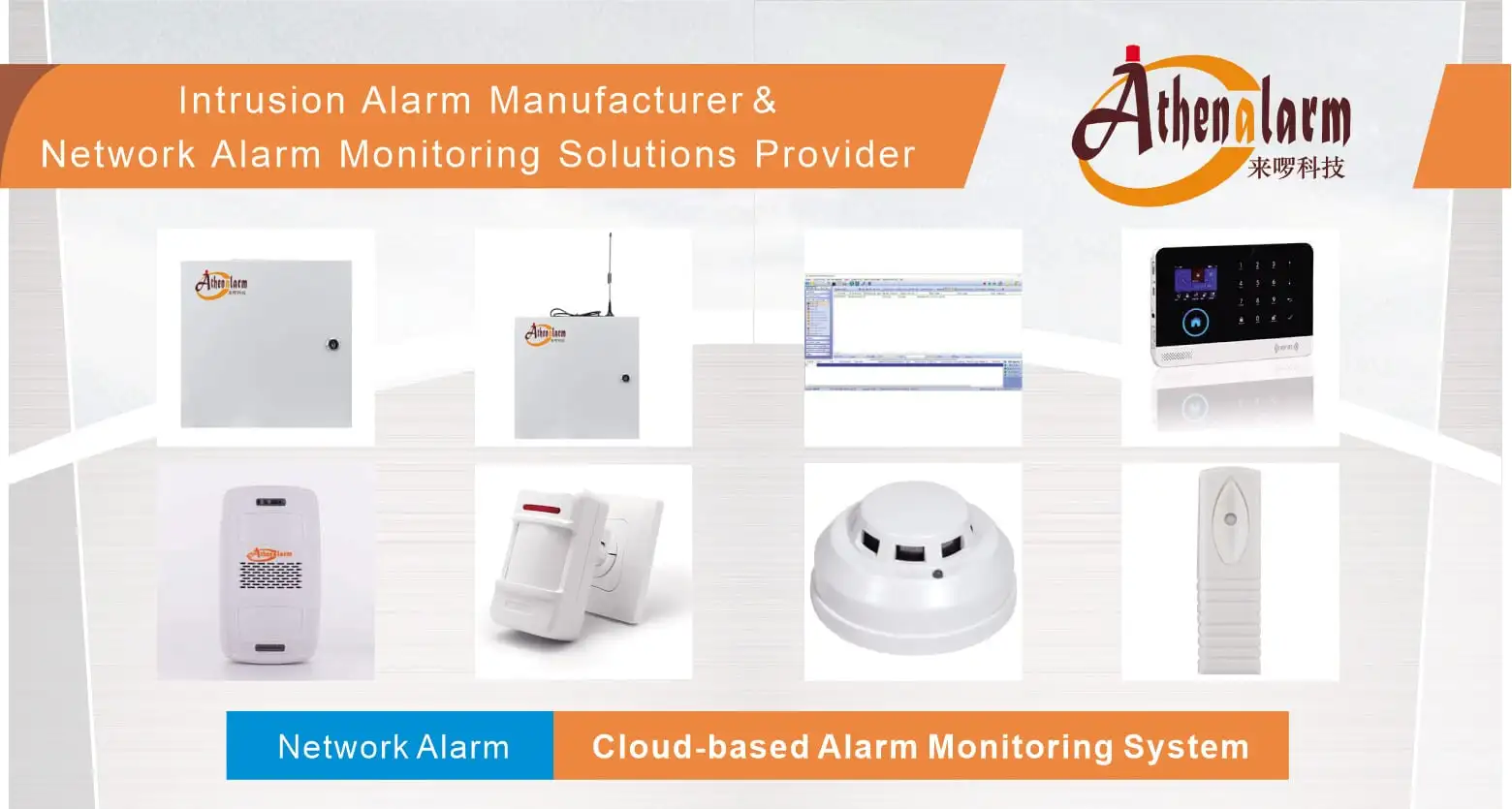
For enterprise procurement and operational design, the following hardware components and vertical deployment solutions form the foundational layer of complete network-integrated security infrastructures:
- System Infrastructure & Platforms:
- Main Site: Athenalarm Security Platform
- Network Alarm Platform: Network Alarm System Solutions
- Enterprise Alarm Operations: Network Alarm Monitoring System Solution
- Application Scenarios: Network Security Applications Overview
- Intrusion Hardware Hubs: Commercial Burglar Alarm Hardware
- Central Control & Gateway Hardware:
- Control Panels: Commercial Alarm Control Panels
- Dual-Path Gateways: GSM/Wi-Fi Alarm Systems
- Edge Detection & Environmental Sensors:
- Volumetric Detection: Industrial PIR Motion Sensors
- Wide-Area Monitoring: Wide-Angle PIR Motion Detectors
- Life Safety & Smoke: Photoelectric Smoke Detectors
- Gas & Environmental Hazards: Combustible Gas Detectors
- Structural Intrusion: Digital Structural Vibration Sensors
- Perimeter & Entry Contacts: Heavy-Duty Magnetic Door Contacts
- Boundary Protection: Network Perimeter Alarm Solutions
- Emergency Response & Annunciation Devices:
- Duress Controls: Hardwired Emergency Panic Buttons
- Mobile Duress Controls: Wireless Duress Panic Buttons
- Visual Deterrence: Industrial Warning Strobe Lights
- Audible Annunciation: Motion-Activated Voice Alert Players
- Vertical Industry Solutions:
- Financial Institutions: Network Bank Alarm Monitoring Systems
- Banking Terminal Protection: Bank ATM Alarm Monitoring Solutions
- High-Security Storage: Bank Vault Alarm Monitoring Solutions
- Commercial & Hospitality: Hotel Security System Solutions
- Residential & Multi-Tenant: Community Alarm System Solutions
- Residential Estate Systems: House Alarm System Solutions
