
How IoT Is Reshaping Commercial Security Architecture: 9 Key Implications
Commercial security systems no longer operate as isolated, self-contained installations. A modern facility—whether a distribution warehouse, a hospital campus, a data center, or an airport terminal—now runs security functions on top of a network of connected sensors, cameras, access control devices, and cloud-linked platforms. This is not a cosmetic upgrade to existing alarm and surveillance infrastructure. It is a structural change in how security systems acquire data, process it, communicate across platforms, and respond to events.
For security integrators and system designers, this shift creates a practical problem: the architectural assumptions that governed traditional security design—centralized control panels, isolated subsystems, physical-only threat models—no longer describe the environment they are building for. A facility with IoT-connected sensors, AI-enabled cameras, and cloud-linked access control does not simply have “more devices.” It has a different architecture, with different data flows, different integration requirements, and a materially larger cybersecurity boundary.
This matters directly for deployment and procurement decisions. An integrator selecting sensors, planning legacy-system coexistence, or specifying cross-platform integration is making architectural choices that determine whether a system scales, whether it remains securable over its operating life, and whether it can be maintained without constant vendor dependency. Getting this wrong does not usually cause immediate failure—it accumulates as integration friction, data-management overhead, and unmanaged endpoint risk.
The following nine implications examine what specifically changes at the architectural level when the Internet of Things becomes part of commercial security—starting with the foundation of any connected system: how it perceives the physical environment.
1. IoT Changes the Security Architecture at the Perception Layer
Before a commercial security system can analyze, escalate, or automate anything, it must first perceive a physical or environmental event. In an IoT-enabled architecture, this perception layer is no longer a single sensor type feeding a single panel—it is a distributed set of heterogeneous sensing devices, each generating a stream of data that downstream systems depend on. The perception layer includes RFID tags for asset tracking, infrared and motion sensors for intrusion detection, gas and smoke detectors for environmental monitoring, and cameras with embedded AI for visual analytics.
This reframing matters architecturally because it moves sensor selection from a procurement detail to a design-level dependency. Every analytics function, automated workflow, and escalation rule downstream is only as reliable as the data entering the system at this layer.
1.1 Why Security Intelligence Starts With the Quality of Sensed Data
Analytics, AI-based filtering, and automated response logic cannot compensate for poor-quality input. If a motion sensor generates excessive false triggers or a camera’s field of view produces ambiguous visual data, every subsequent processing stage—edge analysis, cloud correlation, automated escalation—inherits that weakness. In an IoT architecture, sensing quality is therefore not a peripheral hardware decision; it is the first architectural constraint the rest of the system must work around.
1.2 From Single-Mode Detection to Connected Multi-Modal Awareness
Traditional intrusion detection typically relied on a single sensor type reporting a binary state to a central panel. IoT-enabled architectures instead combine multiple sensing modes—motion, infrared, environmental, visual, and asset-tracking data—into a shared data environment where correlation across sensor types can reduce false positives and improve situational awareness. This does not eliminate the need for careful sensor selection; it changes the design question from “which single sensor is best” to “how do multiple sensing modes complement each other within the architecture.”
1.2.1 Examples of Security and Environmental Sensing
- RFID tags for asset tracking
- Infrared and motion sensors for intrusion detection
- Gas and smoke detectors for environmental monitoring
- AI-enabled cameras for visual analytics
1.2.2 Where Sensor Limitations Affect Downstream Security Intelligence
A sensor that lacks embedded filtering or produces high false-positive rates does not just create a local nuisance alarm—it consumes analytics processing capacity, increases the volume of events requiring human review, and can degrade the credibility of automated escalation logic over time. This dependency chain is why perception-layer decisions are treated as an architectural concern rather than a standalone device choice.
2. Legacy Security Systems Must Adapt to a Distributed IoT Architecture
Traditional commercial security infrastructure was built around relatively static, centralized designs: a control panel or head-end managing a fixed set of wired devices with predictable, limited communication paths. IoT-enabled security environments are structurally different—dynamic, distributed across many endpoints, and continuously connected to local networks and cloud services. This is not simply “more connectivity.” It is a different architectural model that legacy systems were not originally built to participate in.
2.1 From Static and Centralized to Dynamic and Distributed
| Characteristic | Traditional Security Architecture | IoT-Enabled Security Architecture |
|---|---|---|
| Topology | Relatively static | Dynamic |
| Control model | More centralized | More distributed |
| System relationships | More isolated subsystems | Cross-system connectivity |
| Cross-domain interaction | Limited | Extends into building automation and IT |
| Security boundary | Primarily physical | Cyber-physical |
This comparison reflects the general architectural contrast described in the transition to IoT-enabled environments. It should be read as a conceptual distinction rather than a claim that every legacy deployment matches this profile exactly.
2.2 The Legacy-to-IoT Integration Problem
Introducing IoT devices into an environment with existing security infrastructure does not automatically mean replacing that infrastructure. It means the architecture must accommodate coexistence: legacy panels and wiring continuing to operate alongside cloud-connected sensors, cameras, and access devices that use different communication assumptions. The core integration challenge is managing thousands of endpoints with varied protocols while keeping physical security and cybersecurity considerations aligned rather than treated as separate domains.
2.3 Architectural Flexibility as the Bridge
Rather than a wholesale system replacement, architectural flexibility is the practical bridge between legacy and IoT environments. Service-oriented architecture (SOA), microservices, and open APIs are the mechanisms by which newer connected components can interface with existing infrastructure without requiring a single, monolithic redesign.
2.3.1 What Open APIs Change
An open API changes the integration model from point-to-point, vendor-specific wiring of functionality toward a defined interface that other systems—new or legacy—can connect to without custom engineering for every pairing. This reduces the degree to which each new IoT device requires a bespoke integration path.
2.3.2 Why Modular Architecture Matters as Systems Expand
As the number and variety of connected endpoints grows, a monolithic architecture becomes progressively harder to extend without disrupting existing functions. Microservice-oriented and modular approaches allow individual functions—analytics, escalation logic, device management—to be updated or scaled independently, which is architecturally significant as heterogeneous device populations expand over time.
3. IoT Moves Commercial Security From Passive Monitoring Toward Intelligent Response
A traditional security system primarily records and reports. An IoT-enabled architecture, by contrast, is capable of analyzing connected data streams in real time and initiating a response—shifting the system’s role from passive observation to active participation in threat handling.
3.1 Connected Data Enables Real-Time Threat Analysis
Because perception-layer devices continuously generate data across a connected network, security platforms can apply AI/ML-based analysis to that data as it arrives, rather than only after an operator reviews a recorded event. This is what allows real-time threat detection to function as a system-level capability rather than a manual review process.
3.2 Automated Escalation Changes the Role of Security Systems
When a system can correlate sensor input and trigger an automated escalation workflow—rather than simply displaying an alert—it becomes an active participant in the response process. This is architecturally significant in mission-critical environments such as airports or data centers, where the speed of escalation directly affects operational risk.
3.3 Intelligence Creates New Architecture Dependencies
Intelligent behavior does not exist independently of the rest of the architecture. It depends on two things: reliable input data and dependable communication between the systems that must act on analytical output.
3.3.1 Intelligence Depends on Data Quality
Predictive analytics and behavioral-trend detection are only as useful as the sensor and video data feeding them. This reinforces the dependency established at the perception layer: intelligence is not a standalone add-on, but a function that inherits the strengths and weaknesses of the data architecture beneath it.
3.3.2 Intelligence Depends on Reliable System Integration
An automated escalation workflow that cannot reliably communicate with access control, lighting, or notification systems has limited practical value. Intelligence therefore creates a dependency on the integration architecture discussed in the following sections—analytics without integration produces insight without action.
4. Video Surveillance Is Becoming an Intelligent IoT Sensing Layer
Video surveillance has historically been treated as a recording function—useful primarily for after-the-fact review. In an IoT-enabled architecture, cameras equipped with edge computing and AI operate as active sensing and analytics nodes, generating structured event data rather than only footage.
4.1 From Recording Device to Active Security Sensor
Modern camera capabilities—facial and license plate recognition, object classification, anomaly detection, and environmental awareness such as smoke or lighting-level shifts—turn the camera into a source of interpreted events rather than raw video alone. This is a functional shift: the camera participates in detection and analysis, not just documentation.
4.2 Why Edge Processing Matters in Connected Video Architectures
Continuous, high-resolution video generation from many connected cameras creates a substantial data and bandwidth burden if all processing is centralized. Edge computing addresses this by performing analysis at or near the camera itself.
4.2.1 Edge Processing Near the Data Source
Processing video locally allows relevant events—an anomaly, a recognized object, an environmental change—to be identified and acted upon without transmitting continuous raw video to a central system for every frame of activity.
4.2.2 Centralized or Cloud Functions for Broader Analysis and Storage
Centralized or cloud infrastructure retains an important role: long-term storage, remote access, and broader trend correlation across multiple cameras and sites benefit from centralized aggregation that a single edge device cannot provide on its own.
4.3 The Architectural Trade-Off Between Local and Centralized Processing
| Factor | Edge Processing | Centralized / Cloud Processing |
|---|---|---|
| Processing location | At or near the camera | Central server or cloud infrastructure |
| Primary role | Real-time event detection | Storage, remote access, broader analytics |
| Bandwidth implication | Reduces continuous data transmission | Requires network capacity for aggregation |
| Response characteristic | Faster local event identification | Supports trend correlation across sites |
| Storage role | Limited, event-focused | Centralized, longer-term retention |
Neither model replaces the other. IoT-enabled video architecture depends on both functioning as complementary layers rather than treating edge and cloud processing as competing alternatives.
5. Integration Determines Whether IoT Creates a Connected Security Ecosystem
A collection of connected devices does not, by itself, produce the operational value associated with IoT security. That value depends on integration—security systems exchanging information with each other and with broader building automation and IT infrastructure so that events in one system can trigger coordinated responses in another.
5.1 Security Systems Become Participants in Broader Operational Workflows
Once integrated, a security event is no longer confined to a single subsystem’s response logic. Access control, fire detection, lighting, and HVAC systems can participate in a shared event-driven workflow, which is a materially different operating model than isolated systems each handling their own alerts independently.
5.2 Examples of Event-Driven Cross-System Orchestration
| Triggering Event | System Involved | Resulting Action |
|---|---|---|
| Fire detection | Door release / exit lighting | Automated egress support |
| Access control event | HVAC | Lockdown procedure initiation |
| Intrusion alert | Smart lighting | Deterrent lighting response |
5.2.1 Fire Detection and Emergency Functions
A fire detection event can trigger automated door release and exit lighting, connecting a life-safety detection function directly to physical egress systems rather than relying solely on manual intervention.
5.2.2 Access Control and Lockdown-Related Workflows
Access control events can interact with HVAC and lockdown procedures, allowing a security event to initiate coordinated facility-level responses beyond the access control system itself.
5.2.3 Intrusion Alerts and Lighting Responses
An intrusion alert can trigger a smart lighting response, using a building automation function as a deterrent mechanism rather than limiting the response to an audible alarm alone.
5.3 Integration Creates Both Value and Dependency
Cross-system automation only works if the communication between systems is reliable. As more automated workflows are introduced, the architecture becomes more dependent on consistent, well-managed integration—value and dependency increase together, not independently.
6. IoT Turns Security Data Management Into an Architectural Requirement
Connected sensors, cameras, and access systems do not just generate events—they generate continuous volumes of data that must be processed, stored, and analyzed. In an IoT-enabled architecture, data management is no longer an operational afterthought; it is a design-level requirement.
6.1 Why Connected Security Generates a Data Architecture Problem
Because sensing is distributed and continuous, data is generated simultaneously from many endpoints rather than from a single centralized source. This changes the design question from “where do we store recordings” to “how do we architect processing, correlation, and retention across a distributed data environment.”
6.2 Edge, Cloud, and Centralized Analytics Have Different Roles
6.2.1 Local Processing
Edge computing handles local event processing, reducing the volume of raw data that must be transmitted for every sensor or camera reading.
6.2.2 Centralized Storage and Remote Access
Cloud infrastructure supports centralized storage and remote access, allowing authorized personnel to review data and system status without being physically present at each site.
6.2.3 Broader Analytics and Trend Correlation
AI-based analytics operating on aggregated data can identify trends and correlate threats across multiple sensors, cameras, or locations in ways that a single local device cannot.
6.3 Data Retention and Processing Must Be Planned as Part of Architecture
Because data volume scales with the number of connected endpoints, organizations need clear retention policies and scalable processing architecture as a design input—not a decision deferred until storage or processing constraints become operationally apparent. This is a direct consequence of the distributed sensing and intelligent video capabilities described in the preceding sections.
7. Every Connected Endpoint Expands the Commercial Security Attack Surface
Each additional connected device in a commercial security environment is also a potential network entry point. This is the architectural consequence that distinguishes IoT-enabled security from traditional, largely isolated physical security systems: the security boundary is no longer purely physical—it is cyber-physical.
7.1 Connected Devices Become Part of the Security Boundary
A sensor, camera, or access control device connected to a network is not just a security tool; it is also a network endpoint that must be governed under the organization’s cybersecurity posture. Physical security devices can no longer be treated as separate from IT security scope.
7.2 Common Endpoint Weaknesses Identified by the Source
| Weakness | Description |
|---|---|
| Default login credentials | Devices deployed without changing manufacturer defaults |
| Weak or absent encryption | Data transmitted without adequate protection |
| No firmware update support | Devices that cannot receive security patches over time |
Any one of these weaknesses can turn a connected security device into a network liability rather than a security asset.
7.3 Device Governance Must Extend Through Operations
Addressing endpoint weakness is not a one-time deployment task; it requires ongoing governance across the device’s operating life.
7.3.1 Network Segmentation
Segmenting IoT security devices from broader IT networks limits how far a compromised endpoint can be leveraged within the organization’s systems.
7.3.2 Strong Authentication
Replacing default credentials and enforcing strong authentication reduces the likelihood that a connected device becomes an easy entry point.
7.3.3 Firmware and Device Monitoring
Continuous device monitoring and attention to firmware support status help identify devices that have fallen out of a secure operating state before they are exploited.
7.4 The Connectivity-versus-Exposure Trade-Off
Greater connectivity enables the integration, analytics, and automation benefits described in earlier sections—but it also enlarges the attack surface described here. Neither side of this trade-off can be treated in isolation: an architecture optimized purely for connectivity without device governance increases risk, while an architecture that limits connectivity to minimize risk also limits the operational value IoT is intended to provide.
8. Smart-Home IoT Reveals Expectations That Commercial Security Will Need to Address
Residential IoT security adoption offers a useful, subordinate reference point for commercial security architecture—not because commercial systems should mirror consumer designs, but because smart-home deployments reveal user and interoperability expectations that increasingly influence commercial requirements.
8.1 What Smart-Home Deployments Demonstrate
Current smart-home security trends include voice-activated locks and alarms, mobile app integration for remote monitoring, and multi-sensor systems tied to cloud-based platforms. These trends demonstrate demand for modular systems, intuitive interfaces, and remote accessibility—expectations that are migrating into commercial environments as well.
8.2 What Cannot Simply Be Transferred to Commercial Environments
Despite these useful signals, consumer-grade assumptions do not transfer directly to enterprise-scale deployments.
8.2.1 Scale and Operational Complexity
A commercial facility with hundreds or thousands of connected endpoints faces device-management and monitoring demands that a residential deployment with a handful of devices does not.
8.2.2 Security and Governance Expectations
Enterprise environments require stricter device governance, authentication, and network segmentation than typical consumer-grade smart-home products are designed to support.
8.2.3 Interoperability Requirements
Commercial environments must integrate across multiple vendor systems and building functions, whereas smart-home ecosystems are often built around a narrower set of consumer platforms.
9. Interoperability Determines Whether IoT Security Can Scale
A commercial security architecture built on proprietary, closed systems can function at a single-site scale, but interoperability becomes the limiting factor as the environment grows across multiple systems, vendors, or locations.
9.1 Why Proprietary Silos Create Architectural Friction
When devices and platforms cannot communicate outside their own vendor ecosystem, organizations end up with technology silos—isolated pockets of functionality that require separate management, increase integration cost, and limit the cross-system workflows described earlier in this article.
9.2 The Role of Open Standards and Vendor-Neutral Approaches
Open standards and vendor-neutral platforms reduce the degree to which an organization’s architecture is locked into a single vendor’s roadmap, and they support the cross-platform communication that cross-system integration depends on.
9.2.1 ONVIF as an Example of Interoperability
ONVIF is referenced as an example of an open interoperability approach relevant to connected video and security devices, illustrating how a shared interface standard can reduce vendor-specific integration work.
9.2.2 Zigbee and Matter as Explicitly Named IoT Examples
Zigbee and Matter are cited as examples of IoT interoperability technologies. These should be understood as illustrative examples of standardization efforts rather than universally applicable solutions for every commercial security architecture.
9.3 Interoperability Is a Lifecycle Decision, Not Just an Integration Feature
Interoperability affects more than initial system integration—it affects how easily an architecture can be expanded, modernized, or partially replaced over time without requiring a full system overhaul. This connects directly back to the legacy-coexistence challenge discussed earlier: an interoperable architecture is more capable of absorbing new IoT components without discarding existing infrastructure.
10. What These Nine Changes Mean for Commercial Security Architecture
The preceding sections describe nine distinct architectural implications rather than nine independent features. Read together, they describe a single underlying shift: IoT does not simply add connected devices to a security system—it changes how that system senses, processes, communicates, integrates, and must be governed over time.
10.1 The Architecture Must Be Designed as a Connected Ecosystem
A security environment built around IoT functions more like an interconnected ecosystem of sensing, processing, and response components than a collection of independent devices. Design decisions in one layer—perception, processing, or integration—affect the others.
10.2 Connectivity Must Be Matched by Device and Network Governance
Every connectivity benefit described in this article—intelligent analytics, cross-system automation, remote access—comes with a corresponding governance requirement. An architecture that adds connectivity without adding device and network oversight increases risk disproportionately to the value gained.
10.3 Intelligence Must Be Supported by Data and Integration Architecture
Analytics and automated escalation are only as useful as the data feeding them and the integration connecting them to systems capable of acting on their output. Intelligence is a downstream function of architecture, not a substitute for it.
10.4 Scalability Depends on Interoperability
As connected environments grow across more devices, systems, and sites, the ability to scale efficiently depends on how well those components can communicate without vendor-specific custom integration for every pairing.
10.5 Modernization Does Not Necessarily Mean Treating Legacy Infrastructure as Irrelevant
Throughout this article, legacy-system coexistence—not wholesale replacement—has been the practical starting point for IoT integration. Architectural flexibility, open APIs, and interoperable standards exist precisely because most commercial environments must accommodate existing infrastructure while adopting connected capabilities incrementally.
11. FAQ
How does the Internet of Things (IoT) change traditional commercial security architecture?
IoT shifts commercial security architecture from a relatively static, centralized model to a dynamic, distributed, and continuously connected one. This matters architecturally because centralized systems were designed around a limited, predictable set of wired devices, while IoT environments involve heterogeneous, cloud-connected endpoints generating continuous data that must be processed, integrated, and secured across a broader cyber-physical boundary.
How can security integrators bridge legacy systems with cloud-connected IoT devices?
Legacy-to-IoT coexistence is generally supported through architectural flexibility—specifically service-oriented architecture (SOA), microservices, and open APIs—rather than full system replacement. These approaches allow new IoT components to interface with existing infrastructure through defined integration points, which reduces the need for custom engineering every time a new device type is introduced.
What is the difference between edge processing and cloud processing in IoT video surveillance?
Edge processing analyzes video data locally, at or near the camera, enabling faster identification of relevant events and reducing the volume of raw data transmitted across the network. Cloud or centralized processing complements this by supporting long-term storage, remote access, and broader analytics across multiple cameras or sites. The two are complementary architectural layers rather than competing options.
Why do IoT endpoints increase cybersecurity risks in B2B environments?
Every connected security device is also a network endpoint, and endpoints with default credentials, weak or absent encryption, or no firmware update support can become entry points for network compromise. This is why device governance—network segmentation, strong authentication, and continuous device monitoring—must extend through the operational lifecycle rather than being addressed only at deployment.
Why are open standards like ONVIF, Zigbee, and Matter important for IoT security integration?
Open standards and vendor-neutral platforms reduce the architectural friction created by proprietary silos, which otherwise require separate integration work for each vendor ecosystem and limit cross-system workflows. ONVIF, Zigbee, and Matter are cited as examples of this kind of interoperability approach; they should be treated as illustrative examples rather than universally required solutions for every deployment.
12. System Component Checklist Appendix
To support the physical perception layer and domain-specific security architectures referenced in this paper, system designers and integrators can consult the following specialized system topologies and device specifications:
12.1 Vertical & Industry-Specific Solution Architecture
- Enterprise & Network Operations: Network Alarm Monitoring System Solution | Network Alarm Monitoring System Applications
- Financial Security Infrastructure: Bank Alarm Monitoring Solution | Bank ATM Monitoring Solution | Bank Vault Alarm Monitoring Solution
- Facility & Sector Deployment: Hospitality & Hotel Security Solution | Commercial Retail Store Security Solution | Community Alarm Monitoring System | Residential Security Solution
12.2 Edge Sensing Hardware & Intrusion Detectors
- Motion & Intrusion Sensors: PIR Motion Sensor | Wide Angle PIR Motion Sensor
- Perimeter & Structural Safety: Digital Vibration Detector | Magnetic Door Contact Sensor
- Environmental Sensors: Photoelectric Smoke Detector | Gas Detector Sensor
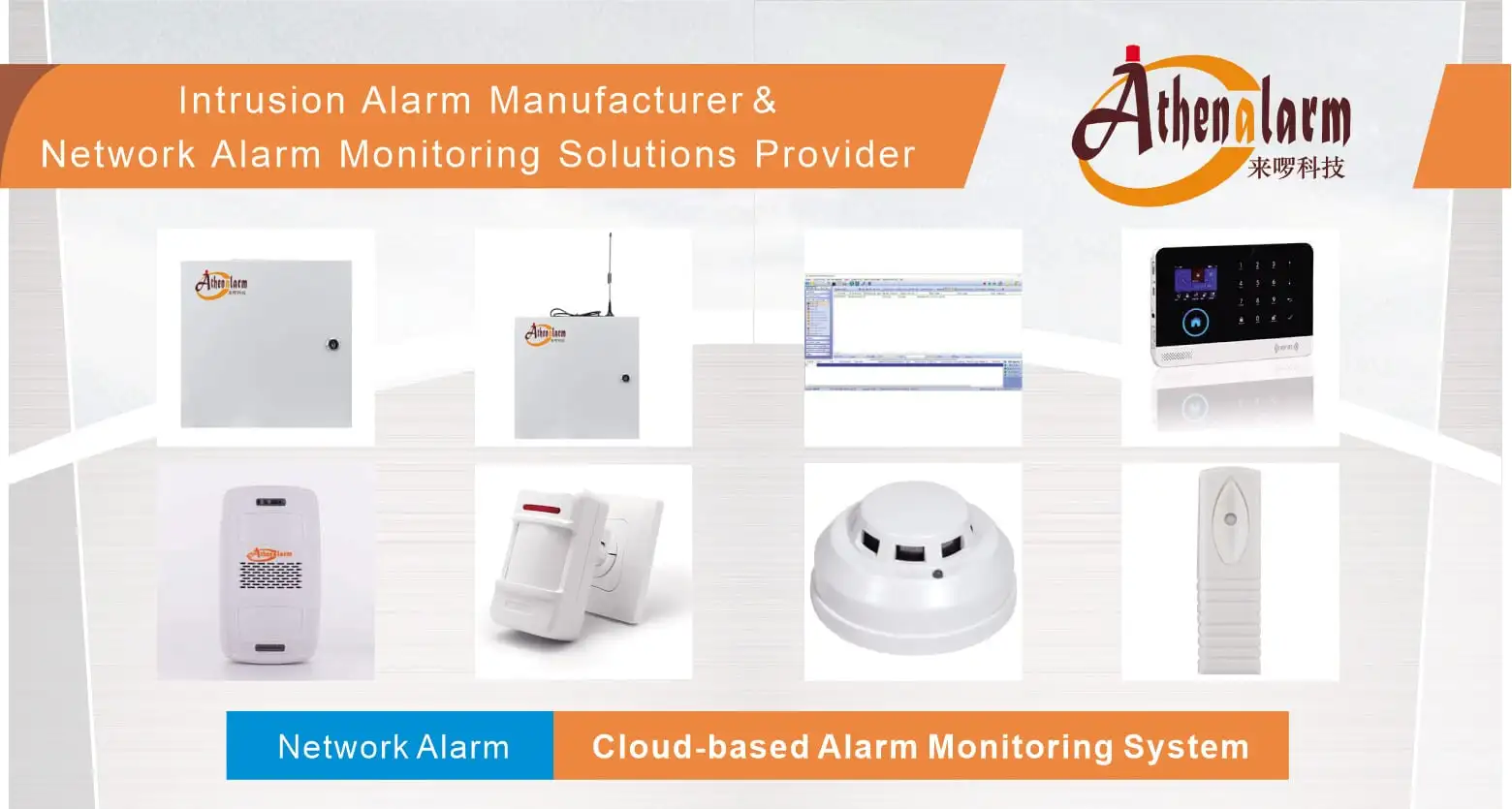
- Emergency Trigger & Annunciation Units: Emergency Panic Button | Wireless Panic Button | Visual Warning Light Strobe | Motion Sensor Voice Alert Unit
- Modular Gateway Protocols: GSM/WiFi Smart Alarm System Gateway
For comprehensive manufacturing specifications and OEM/ODM system integrations, refer to the Commercial Security Systems Manufacturer Directory or the Athena Security Global Portal.
