
Customizable Alarm Systems: Enterprise Architecture and Deployment Tactics
A control panel that supports ten additional sensor zones is not automatically a flexible security system. In enterprise environments, “customizable” is frequently used as a marketing description for hardware that accepts more accessories, while the deployment itself remains rigid: it cannot absorb legacy equipment without a forklift upgrade, it cannot scale across sites without re-architecting communications, and it cannot reduce false dispatch rates without adding operator workload that was never budgeted.
This is the operational tension that enterprise security integrators, facility managers, and technical decision-makers actually face. A system can be technically expandable — more sensors, more panels, more zones — and still be operationally inflexible, because expansion capacity is not the same as architectural adaptability. Every additional integration path, communication protocol, automation layer, or legacy dependency introduces both new capability and new complexity. Customization, in an enterprise context, is the discipline of managing that trade-off deliberately rather than accumulating features reactively.
This distinction matters for procurement and deployment planning. Retail chains managing dozens of sites, healthcare facilities under regulatory scrutiny, manufacturing plants with sabotage and safety exposure, and financial institutions with real-time compliance obligations all encounter the same underlying problem: existing security infrastructure — often a mix of aging panels, newer IP-based sensors, and disconnected monitoring tools — was not designed to evolve alongside the business.
The remainder of this article follows the practical sequence integrators and enterprise security teams use to move from that starting condition to a working, adaptable alarm architecture: risk assessment, modular design, technology integration, verification logic, operational readiness, controlled validation of new technology, and lifecycle management. Rather than treating customization as a checklist of nine independent features, this structure treats it as a single deployment logic in which each decision affects the ones that follow it.
1. Start With Risk Profiling Before Configuring the Alarm Architecture
Architecture decisions made before risk is understood tend to be corrected later, usually at higher cost. A customizable alarm system does not need to support every available sensor type or communication protocol — it needs to support the specific threat, environmental, and operational conditions of the facility it protects. Risk profiling is the input that determines which of those options are actually relevant.
1.1 Map Security Requirements to the Actual Operating Environment
Different enterprise environments generate different detection and response requirements, and a configuration that performs well at one site will not necessarily transfer to another without adjustment.
1.1.1 Industry-Specific Threat Conditions
| Industry Context | Primary Risk Category | Representative Concern |
|---|---|---|
| Retail | Loss and fraud | Theft, point-of-sale (POS) system vulnerabilities |
| Healthcare | Regulatory and controlled-access risk | HIPAA-related exposure, controlled substance security |
| Manufacturing | Operational and physical safety risk | Sabotage, safety hazard zones |
| Finance | Compliance and asset protection | Real-time compliance requirements, vault protection |
These categories illustrate why a single sensor and communication configuration cannot be assumed to fit every enterprise vertical; the detection priorities, response urgency, and compliance context differ by sector.
1.1.2 Environmental and Infrastructure Constraints
Beyond industry context, the physical operating environment affects which detection and communication technologies are appropriate. Moisture, temperature extremes, vibration, and radio-frequency interference can all degrade sensor accuracy or communication reliability. Cyber exposure — particularly IP-based vulnerabilities such as ransomware or denial-of-service activity — is a separate but related risk dimension that must be assessed alongside physical conditions, since many customizable alarm components now operate on IP-connected infrastructure.
A risk profile should be built from on-site audits and infrastructure mapping, supplemented where appropriate by simulated social-engineering or penetration testing, so that digital, physical, and operational risks are identified together rather than in isolation.
1.2 Turn Risk Findings Into Architecture Requirements
Risk findings should translate directly into architecture decisions rather than remaining a static assessment document. A risk profile that identifies high sabotage exposure in a manufacturing environment points toward multi-sensor verification and stronger perimeter detection. A risk profile that identifies significant legacy infrastructure points toward middleware-based integration rather than full replacement. A risk profile that identifies multi-site expansion points toward modular, incrementally deployable components rather than fixed-capacity hardware.
In practice, the risk profile determines:
- What must be detected, and where
- Which environmental conditions the hardware must tolerate
- Which legacy assets must remain functional
- Which communication paths are realistic for the site
- How alarm events should be verified before dispatch
- How much room the architecture needs for future scaling
1.3 Treat the Risk Profile as a Living Deployment Input
A risk profile produced during initial design becomes inaccurate as the business changes. Reassessment on at least a quarterly basis — or immediately following a major operational, regulatory, or technology change — keeps the architecture aligned with current conditions rather than conditions that existed at the time of the original deployment. This reassessment cadence is not a formality; it is the mechanism that prevents a customizable system from becoming a static one by neglect.
2. Build a Modular Architecture That Can Expand Without Replacing the Entire Environment
Modularity is the architectural mechanism that allows a system to change over time without wholesale replacement. In an enterprise context, this means the alarm environment should be understood as a set of interacting layers rather than a single device.
2.1 Separate the Architecture Into Functional Layers
Based on the components described across customizable alarm deployments, the architecture can be interpreted as a layered structure — this is an architectural interpretation useful for planning, not a formally standardized reference model:
| Layer | Function | Representative Elements |
|---|---|---|
| Detection | Generates raw security events | Smart intrusion sensors, glass-break, vibration, microwave sensors |
| Control and Processing | Evaluates and routes alarm conditions | Expandable control panels with logic programming |
| Communication | Transports alarm data | IP, LTE, LoRaWAN |
| Integration | Bridges legacy and modern systems | Middleware, virtualization layers, RESTful API/SDK |
| Intelligence and Verification | Filters and assesses event validity | AI analytics, false-alarm filtering, predictive diagnostics |
| Operator | Provides human review and control | Cloud dashboards, mobile access, VMS integration |
| Response | Executes escalation or dispatch | Alert escalation, lockdown, video feed activation |
Each layer depends on the one before it: detection events are meaningless without a control layer to process them, and a control layer is only as reliable as the communication path connecting it to monitoring infrastructure.
2.2 Design for Incremental Expansion
Modularity is only useful if the architecture actually supports staged growth. Practical expansion planning includes auditing existing infrastructure for compatibility, selecting platforms built on open APIs rather than closed proprietary stacks, and running a pilot deployment before expanding across multiple sites. Vendor support lifecycle and the strength of third-party integration ecosystems are relevant selection criteria, since a platform with a short support horizon undermines the long-term value of modular design.
2.3 Balance Flexibility Against Architecture Complexity
Greater customizability does not automatically improve system performance. Each additional sensor type, communication path, integration layer, or automation feature increases the number of components that must be tested, maintained, and kept compatible with one another. This is the first explicit engineering trade-off in the architecture:
Flexibility vs. Complexity — a more adaptable system accommodates more use cases but also introduces more interdependencies, more configuration decisions, and a larger surface area for integration failure. Deployment teams should treat modularity as a bounded design goal tied to actual operational requirements, not an open-ended feature checklist.
3. Use AI and Automation Where They Improve Event Intelligence and Operational Efficiency
Detection is not the same as decision-making. A sensor generates a raw event; determining whether that event warrants escalation is a separate function, and this is where AI and automation are positioned in a customizable alarm architecture.
3.1 Distinguish Detection From Event Intelligence
A motion sensor or glass-break detector reports that a condition occurred; it does not report whether that condition represents a genuine threat. Behavioral analytics, false-alarm filtering, and predictive diagnostics sit between raw detection and human decision-making, interpreting the event before it reaches an operator.
3.2 Apply AI to Filtering, Analytics, and Diagnostics
Within a customizable architecture, AI functions are best understood as specific, bounded capabilities rather than a single generic layer:
- Behavioral analytics — identifies anomalies in sensor data in near real time
- False-alarm filtering — distinguishes non-target movement (wind, animals) from genuine intrusion indicators
- Predictive diagnostics — flags probable sensor or component failure before it occurs
- Automated escalation — triggers defined actions such as alerts, lockdowns, or video feed activation based on configured rules
Embedding these functions within the VMS and alarm control system, rather than operating them as disconnected add-ons, supports more unified event handling.
3.3 Preserve Human Oversight in High-Impact Response Workflows
AI functions support event intelligence; they do not eliminate the need for human judgment in verified-alarm workflows. Automated escalation can trigger an immediate response for defined conditions, but the described verification workflow explicitly retains operator review before dispatch. This reflects a second engineering trade-off:
Automation vs. Human Oversight — automation reduces manual monitoring load and speeds up initial event processing, but workflow governance — deciding which events require human confirmation — remains a design requirement, not something automation removes. The supplied material does not establish that AI is a technical necessity for enterprise alarm operation; it establishes AI as a capability that improves specific functions when deployed with defined boundaries.
4. Bridge Legacy Security Equipment With Modern Platforms Through Controlled Integration Layers
Enterprise facilities rarely deploy security infrastructure from a blank slate. Existing panels, sensors, and monitoring tools frequently remain functional and represent sunk capital investment; replacing them outright is often neither necessary nor cost-effective. The integration challenge is bridging that legacy equipment with modern platforms without disrupting operations.
4.1 Map the Existing Security Asset Before Designing Integration
Integration architecture designed around assumptions rather than an actual asset inventory tends to fail during deployment. A detailed asset map — identifying which legacy devices remain functional, what interfaces they expose, and what data they generate — is the prerequisite for realistic integration planning.
4.2 Use Middleware or Virtualization as an Integration Boundary
Middleware and virtualization layers function as a translation boundary between legacy equipment and modern platforms, allowing each side to operate using its native protocols while presenting a unified interface upward.
4.2.1 Legacy Equipment
Existing panels, sensors, or monitoring tools that remain operationally functional but were not designed for open integration.
4.2.2 Integration Layer
Middleware or virtualization software that translates legacy data and commands into formats consumable by modern platforms.
4.2.3 Modern Security Platform
The current-generation alarm and monitoring environment that provides unified dashboards, mobile access, and API-based extensibility.
4.3 Use Open APIs and SDKs as Integration Mechanisms, Not Marketing Labels
RESTful API and SDK access are frequently advertised as evidence of an “open” platform, but availability of an API does not by itself guarantee that a specific legacy device will integrate successfully. Before assuming compatibility, integration teams should verify actual API documentation, confirm SDK support for the relevant legacy protocols, and run integration testing rather than relying on vendor claims of openness. The supplied material does not specify exact API schemas, authentication mechanisms, or SDK implementation details, and none should be assumed without direct vendor verification during deployment.
4.4 Use Phased Modernization to Control Operational Disruption
Because legacy integration touches systems that are already in active use, modernization should proceed in phases rather than as a single cutover. This limits the operational impact of any single integration failure and allows validation at each stage before the next legacy component is bridged. This reflects a third trade-off:
Legacy Compatibility vs. Modernization — retaining functional legacy equipment reduces replacement cost and disruption, but bridging older and newer systems adds an integration layer that must itself be maintained and tested over time.
5. Design Remote Monitoring Around Communication Resilience and Access Security
Remote and mobile monitoring capability is now an operational expectation rather than an optional feature, but it introduces both a communications-architecture question and a security-boundary question that must be addressed together.
5.1 Match Communication Options to Deployment Requirements
| Communication Path | Common Role in the Architecture | Engineering Consideration |
|---|---|---|
| IP | Primary connectivity for networked sites | Depends on stable local network infrastructure |
| LTE | Cellular backup or primary path for distributed sites | Subject to signal availability and carrier coverage |
| LoRaWAN | Long-range, low-power connectivity | Suited to specific low-bandwidth sensor use cases |
| 5G | Emerging high-bandwidth transmission option | Still an emerging technology for alarm transmission (see Section 8) |
IP and LTE redundancy is explicitly used in enterprise deployments to reduce the risk that a single connectivity failure isolates a site from monitoring. The supplied material does not establish that all of these communication paths operate simultaneously within a single implementation, and deployment teams should select communication technology according to site-specific conditions rather than assuming universal interoperability.
5.2 Treat Remote Access as a Security Boundary
Once alarm data and control functions are accessible remotely, the mobile and cloud layer becomes an access-security boundary, not merely a convenience feature. Core mobile capabilities — instant push alerts, geofenced arming/disarming, cross-site dashboard control — should be paired with corresponding access controls: multi-factor authentication (MFA), FIPS-grade encryption, and ongoing patch management for mobile applications. Referencing FIPS-grade encryption indicates the type of security measure applied; it does not by itself establish the certification or validation status of a specific deployment.
5.3 Balance Communication Diversity Against Architecture Complexity
Communication Diversity vs. Architecture Complexity — supporting multiple communication paths improves deployment flexibility across varied site conditions, but each additional communication technology introduces its own configuration, monitoring, and failure-mode considerations that the integration team must account for.
6. Use Tiered Alarm Verification to Control False Dispatch Risk
False dispatches carry both operational and relationship costs: they consume operator time and can degrade the working relationship between a monitoring center and emergency responders. Tiered alarm verification is the operational control layer that addresses this problem directly.
6.1 Combine Multiple Evidence Sources
A single sensor event — motion detected, for example — provides limited context. Combining motion detection with audio and visual evidence gives an operator meaningfully more information before a dispatch decision is made, reducing reliance on any one sensor type that may be prone to environmental false triggers.
6.2 Apply the Four-Stage Verification Chain
6.2.1 Sensor
A detection event is generated by an intrusion sensor or combination of sensors.
6.2.2 AI Filter
The event is evaluated against configured filtering logic — for example, distinguishing human movement from wind or animal activity — before being escalated further.
6.2.3 Operator Review
Events that pass automated filtering are presented to a human operator for contextual judgment, potentially supported by two-way audio engagement with the site.
6.2.4 Dispatch / Response
Based on the operator’s assessment, the event proceeds to dispatch or another defined response action.
This produces the core retrieval and operational formula:
Sensor → AI Filter → Operator Review → Dispatch
6.3 Match Verification Depth to Operational Risk
This is a recommended workflow drawn from enterprise deployment practice, not a mandatory universal industry protocol. Sites with lower risk exposure may require fewer verification stages, while sites with higher-value assets or regulatory exposure may justify additional evidence sources before dispatch. The depth of the verification chain should be matched to the risk profile established in Section 1, rather than applied uniformly across every site.
7. Make Training, Support, and Maintenance Part of the System Design
A system that is architecturally sound but poorly understood by its users will underperform its technical capability. Training, support, and maintenance are operational dependencies of a customizable alarm system, not optional add-ons.
7.1 Train Users Around Real Alarm Workflows
Training should reflect the actual workflows the system will execute — including how verification and escalation function — rather than generic product orientation. Interactive, user-friendly dashboards reduce the training burden by making day-to-day operation more intuitive.
7.2 Validate Operator Response Through Simulation
On-site simulation drills test whether operators respond correctly under conditions that resemble real alarm events, revealing gaps that documentation alone does not surface. This is distinct from initial training: it validates that training was effective.
7.3 Establish Continuing Maintenance and Support
7.3.1 Software Updates and Patch Management
Ongoing patch management addresses vulnerabilities in IP-connected components and mobile applications over the system’s operational life.
7.3.2 Scheduled Maintenance
Routine maintenance activities — sensor checks, connectivity verification, power-system inspection — reduce the likelihood of undetected component failure.
7.3.3 Routine Performance Review
Periodic review of system performance, ideally structured as part of a defined client-success framework from pre-installation through quarterly reviews, connects day-to-day operation back to the risk-reassessment cycle described in Section 1.3.
8. Pilot Emerging Technologies Before Enterprise-Wide Deployment
Technologies such as 5G alarm transmission, edge computing, blockchain-based event logs, and AI-assisted drone patrols represent emerging capability areas relevant to enterprise perimeter and compliance use cases. Their operational suitability for a specific deployment is not established simply by their existence in the market.
8.1 Separate Technology Evaluation From Production Deployment
Introducing an unvalidated technology directly into a live monitoring environment risks disruption if the technology behaves unpredictably. A sandbox environment isolates evaluation from production operations, allowing failure modes to surface without affecting live security coverage.
8.2 Define Validation Criteria Before the Pilot
Pilot testing is only useful if success and failure are defined in advance. Relevant validation criteria include:
- Defined evaluation objectives specific to the technology being tested
- Measurable key performance indicators (KPIs)
- Compatibility with existing detection, control, and communication layers
- Observed operational impact during the pilot period
- Effect on existing user and operator workflows
8.3 Use Phased Rollout After Successful Validation
Technologies that meet defined criteria in the sandbox can move to a phased rollout, expanding gradually rather than deploying enterprise-wide immediately. This reflects a further trade-off:
Innovation Speed vs. Deployment Control — piloting new technology early can provide a capability advantage, but skipping structured validation increases the risk of operational disruption once the technology reaches production scale. The supplied material does not establish that blockchain event logs, AI drones, 5G transmission, or edge computing are universally appropriate; it establishes a method for evaluating them before committing to enterprise-wide use.
9. Incorporate Energy Efficiency and Sustainability Into Lifecycle Planning
Sustainability considerations increasingly intersect with enterprise procurement decisions, including for security infrastructure. Within a customizable alarm architecture, this is a lifecycle design consideration rather than a separate initiative.
9.1 Evaluate Energy Requirements Across the Deployment
Low-power IoT devices reduce the cumulative energy draw of distributed sensor networks, which becomes relevant as deployments scale across multiple sites.
9.2 Consider Solar and Automated Power Management Where Appropriate
Solar panels on perimeter installations and automated power cycling based on usage patterns are design options for reducing grid dependency, particularly at remote or perimeter locations. RoHS and Energy Star references indicate component-level design standards; they do not by themselves establish system-wide energy performance or certification for a specific deployment.
9.3 Track Sustainability Through Operational Metrics
A structured sustainability report — tracking metrics such as battery cycle activity and observed energy use over time — allows sustainability considerations to be monitored as an operational metric rather than an unquantified claim. The supplied material does not include quantified figures for carbon reduction or energy savings; any such reporting framework should be built on the organization’s own measured data rather than assumed outcomes.
10. Govern the Entire Architecture as a Continuous Deployment Lifecycle
The preceding nine deployment decisions function together as a single operating model rather than as independent tactics. Governing that model as a continuous lifecycle — rather than a one-time installation project — is what allows a customizable alarm system to remain aligned with the business over time.
10.1 Design
Risk Profile → Architecture Requirements. Risk findings from Section 1 determine the modular components, communication paths, and verification depth selected in Sections 2, 5, and 6.
10.2 Integrate
Legacy Systems → Middleware / API / SDK → Modern Platform. The integration approach from Section 4 determines how much of the existing infrastructure investment is preserved during modernization.
10.3 Commission and Validate
Pilot → Verification → KPI Assessment → Controlled Rollout. Sandbox and pilot practices from Section 8 apply not only to emerging technology but to any new architectural component before enterprise-wide activation.
10.4 Operate
Detection → Processing → Verification → Operator → Response. The day-to-day operational flow established in Sections 3 and 6 governs how events move from sensor to dispatch decision.
10.5 Maintain and Reassess
Maintenance → Performance Review → Risk Reassessment → Upgrade Decision. Section 7’s maintenance activities feed back into Section 1.3’s recurring risk reassessment, closing the lifecycle loop.
10.5.1 Flexibility vs. Complexity
10.5.2 Legacy Compatibility vs. Modernization
10.5.3 Automation vs. Human Oversight
10.5.4 Scalability vs. Deployment Control
10.5.5 Communication Diversity vs. Architecture Complexity
| Trade-off | Benefit | Engineering Cost |
|---|---|---|
| Flexibility vs. Complexity | Greater adaptability to changing requirements | More components and interdependencies to maintain |
| Legacy Compatibility vs. Modernization | Preserves existing capital investment | Additional integration layer requiring ongoing support |
| Automation vs. Human Oversight | Faster event processing, reduced manual load | Continued need for workflow governance and operator review |
| Communication Diversity vs. Architecture Complexity | More deployment options across varied site conditions | Additional configuration and monitoring considerations |
| Scalability vs. Deployment Control | Easier multi-site and future expansion | More validation stages before enterprise-wide rollout |
These five trade-offs recur throughout the architecture because they are structural to customization itself: every mechanism that increases adaptability also increases the number of variables the deployment team must manage.
11. FAQ
Q1: How do middleware and RESTful APIs help customizable alarm systems integrate with legacy equipment?
Middleware and virtualization layers translate data and commands between legacy devices and modern platforms, while RESTful APIs and SDKs provide the integration interface that modern platforms expose. This combination allows older, functional equipment to remain in service while gaining access to cloud dashboards and unified management, without requiring full replacement. The reason this matters is that legacy hardware often represents significant sunk investment, and middleware-based bridging avoids forcing an unnecessary rip-and-replace cycle.
Q2: What is the recommended multi-sensor verification workflow for preventing false dispatches?
The workflow follows a four-stage chain: Sensor → AI Filter → Operator Review → Dispatch. A detection event is first generated by an intrusion sensor, filtered by AI-assisted logic to screen out non-threat triggers, reviewed by a human operator using multi-sensor evidence such as audio or visual data, and only then escalated to dispatch. This sequence exists because a single unverified sensor trigger carries a meaningfully higher risk of generating a false emergency response than a filtered, human-reviewed event.
Q3: How frequently should an enterprise re-evaluate its security risk profile?
At minimum quarterly, or immediately following a major operational, regulatory, or technological change. This cadence matters because a risk profile is only accurate for the conditions that existed when it was built; enterprises that skip reassessment risk operating an architecture that no longer matches their actual threat and infrastructure conditions.
Q4: What role do open communication technologies such as IP, LTE, and LoRaWAN play in modular alarm architecture?
They provide the communication layer connecting detection and control components to remote monitoring infrastructure, with IP and LTE commonly used together for redundancy and LoRaWAN suited to long-range, low-power sensor scenarios. This matters because signal interference or connectivity loss on a single path can otherwise isolate a site from monitoring, and communication diversity is a deliberate architectural response to that risk.
Q5: Can customizable alarm systems work with my legacy equipment?
Compatibility depends on the specific legacy equipment and the integration mechanisms available, not on a general guarantee. With middleware, API layers, and modular panels, many legacy devices can be bridged into a modern platform, but this requires asset mapping and integration testing rather than an assumption of universal compatibility. This distinction matters because assuming compatibility without verification is a common source of deployment delay.
Q6: How do AI features improve customizable alarm systems?
AI supports specific functions — behavioral analytics, false-alarm filtering, predictive diagnostics, and automated escalation — that improve event intelligence between raw detection and operator decision-making. It does not replace operator review in verified-alarm workflows. This distinction matters because treating AI as a full replacement for human oversight would remove a control point that the described verification workflow specifically retains.
Q7: Is mobile remote access secure for customizable alarm systems?
Mobile remote access can be implemented securely when paired with controls such as multi-factor authentication, FIPS-grade encryption, and regular patch management, but security depends on how these controls are implemented rather than on mobile access being inherently secure. This matters because remote access expands the system’s attack surface, and the access-security layer must be designed with the same rigor as the detection layer.
Q8: Can I test new technologies before full deployment?
Yes. A sandbox or pilot environment allows technologies such as 5G transmission, edge computing, blockchain event logs, or AI-assisted drones to be evaluated against defined KPIs before enterprise-wide rollout. This matters because introducing unvalidated technology directly into production monitoring risks operational disruption if the technology does not perform as expected under real site conditions.
Q9: How do customizable alarm systems support sustainability goals?
By incorporating low-power IoT devices, solar-powered perimeter installations, and automated power cycling as design considerations, and by tracking the resulting energy use through operational reporting. This matters for enterprises with ESG-related procurement requirements, though the effect of these measures on detection performance or system availability should be validated with the organization’s own operational data rather than assumed in advance.
Q10: What support should vendors offer post-deployment?
Look for onboarding support, simulation-based training, SLA-based technical support, and scheduled performance reviews. This matters because a technically capable system still depends on trained users, maintained components, and periodic reassessment to remain effective over its operational life.
12. System Component Checklist Appendix
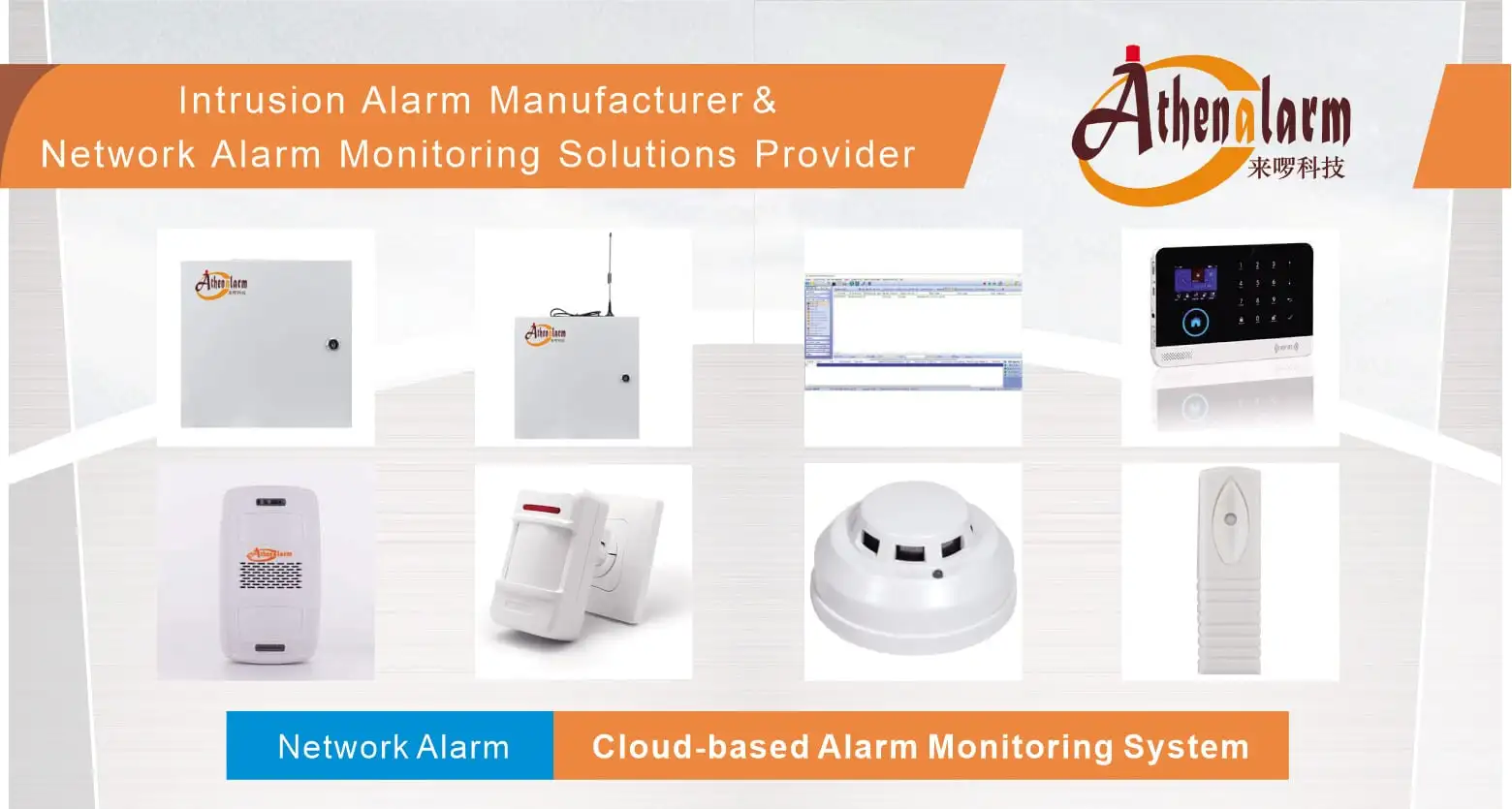
For enterprise deployments requiring specific physical detection devices, edge sensors, and scenario-tailored architecture extensions, reference the standardized specification index below:
- Core Network Architecture Platform: Athenalarm Official System Architecture Portal
- Intrusion Alarm System Components: Burglar Alarm System Hardware
- Network Alarm Systems: Network Alarm Systems Overview
- Network Alarm Monitoring Solutions: Network Alarm Monitoring System Solution
- Application Deployment Scenarios: Network Alarm Monitoring System Application
- Banking ATM Security Solution: Bank ATM Alarm Monitoring System Solution
- Residential & Community Security: Network Community Alarm System Solution
- Single-Family Security Solutions: Network House Alarm System Solution
- Hospitality Industry Solutions: Network Hotel Alarm System Solution
- Motion Detection (Standard PIR): PIR Motion Sensor
- Motion Detection (Wide-Angle Coverage): Wide Angle PIR Motion Sensor
- Environmental Detection (Smoke): Photoelectric Smoke Detector
- Environmental Detection (Gas): Gas Detector
- Structural Integrity Monitoring: Digital Vibration Detector
- Perimeter Contact Sensors: Door Contact Sensor
- Duress Signal Initiators: Hardwired Panic Button
- Wireless Duress Signal Initiators: Wireless Panic Button
- Visual Alert Annunciators: Strobe Warning Light
- Hybrid Small-Footprint Controls: GSM / WiFi Alarm System Panel
- Audible Warning Modules: Motion Sensor Audio Player
