
Wired, Wireless, and Hybrid Commercial Security System Installation: A Seven-Factor Decision Framework
Choosing how to install a commercial security system is not a binary decision between wired and wireless technology. Wired, wireless, and hybrid installation represent three distinct deployment approaches, differentiated primarily by how devices connect to the system and how that connectivity is distributed across a facility. For integrators, system designers, and procurement teams, the more useful question is not “which technology is better,” but “which combination of reliability, cost, installation impact, scalability, compliance, maintenance, and integration characteristics fits this facility’s zones and operational requirements.” This comparison examines wired, wireless, and hybrid commercial security system installation across seven established decision factors, and treats hybrid deployment as a deliberate, zone-based strategy rather than a compromise between the other two options.
1. Three Deployment Approaches for Commercial Security System Installation
Commercial security system installation can be organized around three connectivity models: wired, wireless, and hybrid. The distinction between them is primarily a matter of how devices such as cameras, sensors, controllers, and alarms connect to the system’s centralized hardware, and how that connectivity method is allocated across a facility.
1.1 Wired Security System Characteristics
A wired security system connects devices — including cameras, sensors, controllers, and alarms — to centralized hardware through physical cabling such as Ethernet or coaxial cabling. This physical connection is associated with consistent connectivity and minimal signal loss, giving wired systems a stable data path between devices and the central control point.
That stability comes with a trade-off in installation effort. Because each device requires a physical cable run, wired installation generally involves greater upfront physical work. In exchange, wired deployment is associated with lower long-term maintenance once the cabling infrastructure is in place.
1.2 Wireless Security System Characteristics
A wireless security system connects devices using RF-based technologies, including Wi-Fi, Zigbee, and LTE, and may integrate with mobile applications and cloud storage. Because devices do not require a physical cable run to centralized hardware, wireless deployment can reduce physical installation work and increase placement flexibility.
This flexibility is conditional rather than absolute. Wireless performance can vary with interference, walls, machinery, network congestion, signal strength, and range, so connectivity is not uniform across every environment. Ongoing operation also introduces battery maintenance and firmware updates, along with cybersecurity considerations that are inherent to any RF-based, network-connected system.
1.3 Hybrid Security System: Zone-Based Allocation
A hybrid security system combines wired and wireless technologies within the same installation, allocating each connectivity method according to the requirements of specific facility zones rather than applying one technology uniformly across the entire site. In this model, wired connections are positioned for mission-critical zones where consistent connectivity is the priority, while wireless devices are used in flexible or remote areas where physical cabling is impractical or unnecessary.
Hybrid deployment is not a fallback between wired and wireless; it is an intentional allocation strategy that treats different areas of a facility as having different connectivity requirements. No single rule determines how zones should be divided between wired and wireless — the allocation depends on the specific requirements of each zone.
2. Comparing Wired, Wireless, and Hybrid Installation Across Seven Decision Factors
Wired, wireless, and hybrid installation differ across seven decision factors that commercial decision-makers use to evaluate deployment options: reliability, cost and lifecycle cost, installation complexity and downtime, scalability, compliance and security, maintenance and sustainability, and technology integration and future-proofing. The table below summarizes these differences at a qualitative level; the sections that follow explain the reasoning behind each comparison.
| Decision Factor | Wired | Wireless | Hybrid |
|---|---|---|---|
| Reliability | Consistent connectivity, minimal signal loss | Conditional on interference, obstructions, congestion, and range | Wired reliability in critical zones; wireless flexibility elsewhere |
| Installation Complexity / Downtime | Greater upfront physical work (drilling, trenching, construction) | Faster, less disruptive installation | Mixed installation effort depending on zone allocation |
| Cost / Lifecycle Cost | Higher upfront installation cost; lower long-term maintenance | Lower upfront installation burden; ongoing battery/firmware costs | Combines upfront and ongoing cost patterns by zone |
| Scalability | Expansion requires additional cabling | Easier to deploy additional devices | Mixed expansion approach per zone |
| Compliance / Security | Subject to NEC, NFPA, UL, and local codes | Same codes plus wireless cybersecurity considerations | Subject to both sets of considerations across zones |
| Maintenance / Sustainability | Lower ongoing maintenance once cabling is installed | Requires recurring battery replacement and firmware updates | Mixed maintenance combining physical and wireless tasks |
| Technology Integration / Future-Proofing | Centralized hardware control | Supports mobile applications, automation, cloud storage | Combines centralized control with flexible remote integration |
2.1 Reliability and Connectivity Stability
Wired connectivity is generally more consistent than wireless connectivity, but wireless is not inherently unreliable — its performance is conditional on environmental and network conditions.
Wired systems are associated with consistent connectivity and minimal signal loss because the connection between a device and the centralized hardware is a fixed physical path. Wireless connectivity, by contrast, can vary with interference, walls, machinery, network congestion, signal strength, and range. This means reliability differences between wired and wireless are environment-dependent rather than fixed, and no quantitative reliability comparison is established here. In practice, this makes reliability a factor to evaluate against the specific physical environment of a zone rather than a blanket ranking of one technology over the other.
2.2 Installation Complexity and Operational Disruption
Wired installation generally requires more physical work and causes more operational disruption than wireless installation.
Wired deployment may involve drilling, trenching, construction, and other labor-intensive infrastructure work to route cabling to each device location. Wireless deployment is presented as faster and less disruptive because it removes the need for this physical cable routing. For facilities where continuity of operations during installation is a priority — such as active retail or office environments — installation disruption is a meaningful factor independent of the system’s other characteristics. No specific downtime figures are established; the distinction here is one of relative installation burden, not measured time loss.
2.3 Cost and Lifecycle Considerations
Cost comparisons between wired and wireless installation should account for the full lifecycle, not only the initial installation.
Wired deployment is characterized by higher upfront installation cost, driven by the physical infrastructure work described above, offset by lower long-term maintenance once that infrastructure is in place. Wireless deployment reduces the upfront installation burden but introduces ongoing costs associated with battery maintenance and firmware updates. Neither approach is presented as categorically less expensive; the trade-off is between upfront infrastructure investment and ongoing operational upkeep. No monetary values, ROI calculations, or labor rates are established in the underlying technical scope, so this comparison remains qualitative.
2.4 Scalability and Future Expansion
Wired expansion depends on running additional cabling to new devices, while wireless expansion is presented as easier to deploy.
Because wired devices require a physical connection to centralized hardware, adding devices or extending coverage generally means extending the cabling infrastructure. Wireless devices can typically be added without this physical dependency, which is presented as making wireless expansion comparatively easier. Hybrid deployment allows expansion to follow whichever approach fits a given zone, rather than being constrained to a single expansion method across the entire facility. No specific device-count limits or network capacity figures are established for either approach.
2.5 Compliance and Security Considerations
Compliance and security are relevant decision factors, but they do not reduce to a simple wired-versus-wireless rule.
Codes and standards such as NEC, NFPA, UL, and applicable local codes are referenced as relevant to commercial security installation. Wireless deployment adds cybersecurity as an additional consideration, given its reliance on RF communication and, in some cases, cloud connectivity. However, the specific provisions that apply, and how they apply, depend on jurisdiction and the particular installation context. Neither wired nor wireless installation should be treated as universally more or less compliant; compliance and cybersecurity are conditions to evaluate for a given project rather than a fixed advantage of one deployment method.
2.6 Maintenance and Operational Sustainability
Ongoing maintenance requirements differ according to the physical and wireless characteristics involved, separate from the upfront cost trade-off described above.
Once wired cabling infrastructure is installed, it is associated with comparatively lower ongoing maintenance. Wireless devices, by contrast, require recurring attention in the form of battery replacement and firmware updates to remain operational and current. In a hybrid deployment, maintenance planning has to account for both types of upkeep — physical infrastructure on the wired side and battery/firmware cycles on the wireless side — across the zones where each technology is used.
2.7 Technology Integration and Future-Proofing
Wired and wireless technologies support different integration paths, and hybrid deployment can draw on both.
Wired systems are built around centralized hardware, which supports direct, controlled data paths for connected devices. Wireless systems more readily support mobile application connectivity, automation, and cloud storage, since they are already built on network-based communication. A hybrid deployment can combine centralized control for mission-critical zones with the more flexible, remotely accessible integration options that wireless and cloud-connected devices provide in other zones. Beyond these established characteristics, no specific protocols, platforms, or automation architectures are defined here.
3. Selecting a Deployment Approach for Facility-Specific Requirements
The seven factors above are not meant to be resolved into a single “best” technology. Because facilities typically contain zones with different operational requirements, the same seven-factor comparison can point toward different conclusions for different areas of the same site — which is the underlying logic behind hybrid deployment.
3.1 When Zone Requirements Point Toward Hybrid Deployment
Retail chains, corporate offices, and multi-site enterprises are commonly referenced examples of organizations where zones differ enough in connectivity, infrastructure, or security requirements to justify a hybrid approach. These examples illustrate zone-specific or organizational deployment contexts; they are not deterministic rules stating that a given facility type must use hybrid deployment. The appropriate allocation between wired and wireless still depends on the specific requirements of each zone within that facility, evaluated against the seven decision factors described above.
3.2 Operational Practices Supporting Deployment Selection
Several high-level operational practices support the process of selecting and validating a deployment approach, without prescribing a specific installation procedure:
- Risk assessment — identifying which zones carry higher security or operational stakes, which informs where reliability and consistent connectivity matter most.
- Zone mapping — documenting the connectivity, infrastructure, and access requirements of each area before assigning a wired, wireless, or hybrid approach.
- RF surveys — an explicit consideration for wireless zones, used to understand how interference, obstructions, or network conditions may affect performance in that specific environment.
- Response testing — verifying that devices and alarms function and communicate as expected after installation.
- Documentation — recording the deployment approach used in each zone to support future maintenance, expansion, or compliance review.
- Staff training — ensuring personnel understand the operational differences between wired and wireless components they may need to support.
These practices are presented here at a high level as relevant considerations for deployment selection, not as detailed procedures or mandatory regulatory steps.
4. FAQ
Q1: Is wireless less reliable than wired commercial security systems?
Not inherently. Wired connectivity is generally more consistent because it relies on a fixed physical path, while wireless reliability depends on environmental and network conditions such as interference, walls, machinery, congestion, and range. Wireless is a conditional performance factor, not an absolute reliability disadvantage.
Q2: Does wireless installation always cost less than wired installation?
Not on a full lifecycle basis. Wireless installation typically involves lower upfront cost because it avoids extensive cabling work, but it introduces ongoing battery replacement and firmware maintenance costs. Wired installation has the opposite pattern: higher upfront cost with lower long-term maintenance. Neither is categorically cheaper across the full lifecycle, and no specific cost figures are established for this comparison.
Q3: What makes hybrid deployment different from a compromise between wired and wireless?
Hybrid deployment is an intentional, zone-based allocation rather than a default fallback. Wired connections are positioned for mission-critical zones where consistent connectivity matters most, and wireless devices are used in flexible or remote zones where cabling is impractical. The allocation is driven by each zone’s specific requirements, not by splitting the difference between the two technologies.
Q4: Are RF site surveys required for wireless commercial security installation?
RF surveys are an explicit consideration in wireless deployment planning, used to understand how interference, obstructions, and network conditions may affect a specific site. They are not established here as a universal regulatory or engineering requirement, and applicability depends on the specific installation.
Q5: Do wired and wireless commercial security systems have different compliance requirements?
Compliance considerations such as NEC, NFPA, UL, and local codes apply to commercial security installation generally, and wireless deployment adds cybersecurity as an additional consideration. A universal compliance distinction specifically between wired and wireless systems is not established; specific obligations depend on jurisdiction and the particular installation context.
5. Conclusion
Wired, wireless, and hybrid commercial security system installation each carry distinct characteristics across reliability, cost, installation impact, scalability, compliance, maintenance, and integration. Wired installation offers consistent connectivity and lower long-term maintenance at the cost of greater upfront installation effort; wireless installation reduces installation effort and adds flexibility at the cost of conditional performance and ongoing battery and firmware maintenance; hybrid installation allocates each approach according to the requirements of individual facility zones. The decision is best approached by evaluating these seven factors against the specific zones of a facility, rather than searching for a single technology that is universally superior — which is precisely the reasoning that makes hybrid deployment a substantive option rather than a compromise.
6. System Component Checklist Appendix
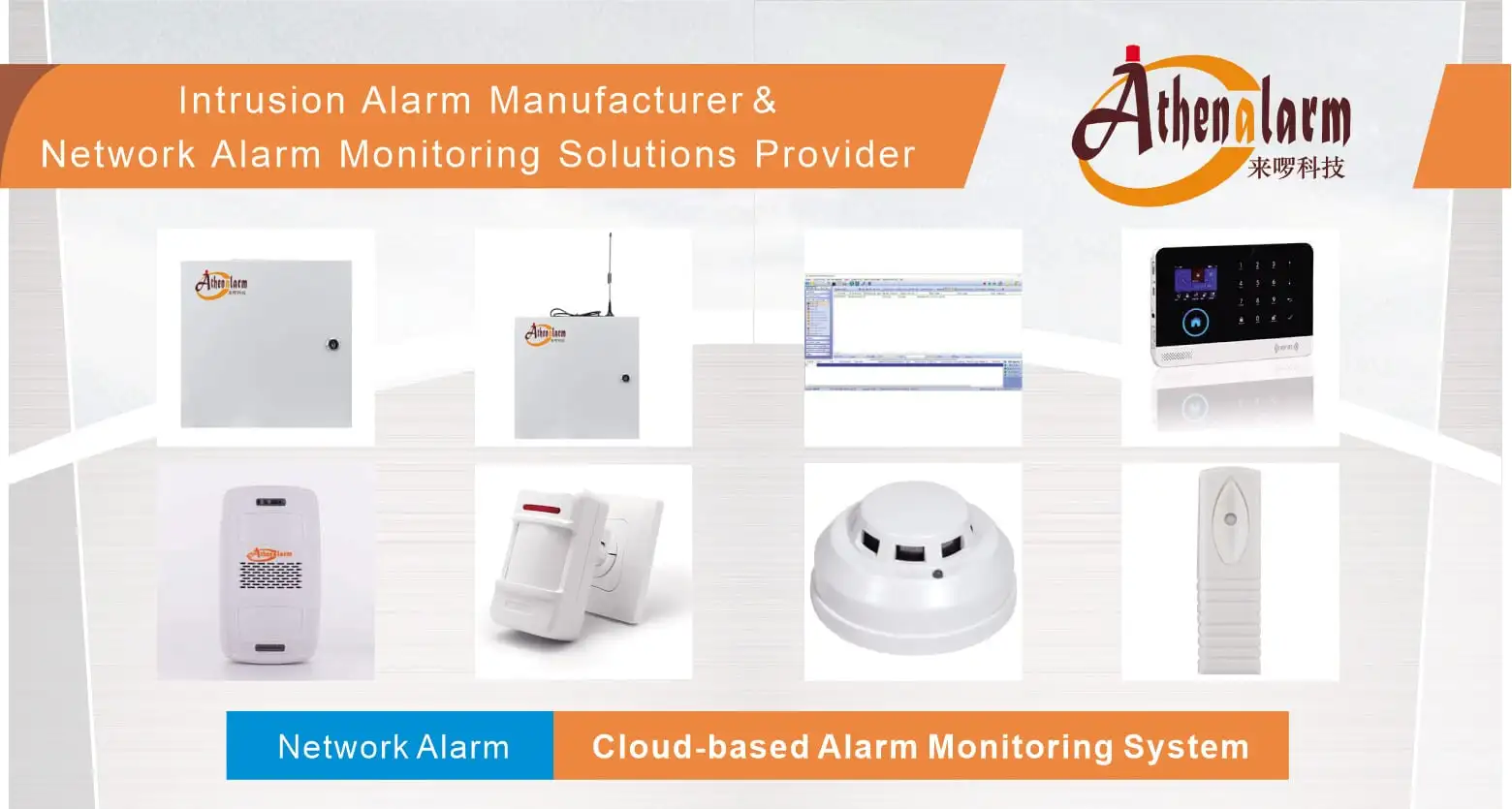
To support hybrid security system deployment across specialized facility zones, system architects and integrators can evaluate the following hardware components, platform software, and vertical scenario solutions:
6.1 Management & Central Infrastructure
- Central Management Software: Network Alarm Center Management Software
- System OEM/ODM Manufacturing: Burglar Alarm System Manufacturer
- Comprehensive Security Hardware Platform: Commercial Burglar Alarm Systems
- Dual-Path Gateway Controller: GSM & Wi-Fi Alarm System Panel
6.2 Edge Detection & Field Peripherals
- Volumetric Motion Detection: Standard PIR Motion Sensor
- Wide-Angle Coverage Sensor: Wide-Angle PIR Motion Sensor
- Environmental Safety Detectors: Photoelectric Smoke Detector & Industrial Gas Detector
- Structural Physical Intrusion Sensing: Digital Vibration Detector
- Perimeter Portal Contacts: Heavy-Duty Door Contact Switch
- Duress Emergency Triggers: Hardwired Panic Button & Wireless Panic Button
- Visual Annunciator: Strobe Warning Light Unit
- Audio Verification Device: Motion-Activated Voice Alert Player
6.3 Vertical Application Architecture
- Financial Sector Infrastructure: Network Bank Alarm Monitoring System Solution
- ATM Kiosk Security: Bank ATM Alarm Monitoring System Solution
- Secure Vault Infrastructure: Network Bank Vault Alarm Monitoring System Solution
- Perimeter Intrusion Defense: Network Perimeter Alarm System Solution
- Hospitality Premises: Network Hotel Alarm System Solution
- Community & Multi-Tenant Buildings: Network Community Alarm System Solution
- Residential & Smart Home Security: Network House Alarm System Solution
- Monitoring Center Operations: Network Alarm Monitoring System Applications
