
Procuring Enterprise Anti-Theft Alarm Systems: 9 Key Procurement Risks and Strategic Solutions
1. Why Enterprise Alarm Procurement Is an Architecture Decision, Not Just a Hardware Purchase
An enterprise security manager evaluating alarm proposals for a multi-site retail chain, a logistics network, or a critical infrastructure facility rarely fails because a sensor did not detect an intrusion. The procurement failures that surface months after signing a contract are architectural: the system cannot scale past a certain device count, it cannot exchange event data with the video management platform, the vendor charges undisclosed recurring fees, or the cybersecurity posture does not meet what the organization’s insurer or IT department expects. These outcomes are procurement risks, not product defects, and they originate in decisions made before installation ever begins.
An Anti-Theft Alarm System purchased today is rarely a standalone appliance. It functions as one node inside a larger enterprise security architecture that includes detection sensors, local or distributed control panels, an IP communication layer, a central monitoring environment, and — in most enterprise deployments — integration points with video surveillance, access control, and building management systems (BMS). Because these dependencies exist, a procurement decision that evaluates only the alarm panel and sensor specifications is evaluating an incomplete system.
1.1 From Isolated Alarm Events to Integrated Security Workflows
A legacy alarm/siren configuration generates a single event: detection, followed by a local audible alert. An integrated enterprise environment instead treats detection as the first step in a workflow that can involve verification, notification, and coordinated response across multiple subsystems. This shift changes what “the alarm system” means procedurally: it is no longer just the detector and the control panel, but the sum of the detection layer, the communication layer, the integration layer, and the monitoring layer that acts on the detection event.
1.2 The Enterprise Procurement Dependency Chain
Because these layers are interdependent, a weakness in one layer constrains the value of the others. A scalable network architecture with no integration standard cannot correlate an alarm with video footage. A well-integrated system with no cybersecurity controls exposes the enterprise network to risk through the same connectivity that enables integration. A technically sound architecture with an unfavorable vendor contract can still produce high total cost of ownership or lock-in.
The operational information flow that underlies this dependency chain can be summarized as:
Detection → Communication → Central Monitoring → Integration → Verification → Response
The corresponding procurement dependency chain follows a parallel structure:
Enterprise Requirements → Architecture Evaluation → Integration Requirements → Cybersecurity Requirements → Lifecycle Cost Analysis → Compliance Requirements → Vendor/SLA Evaluation → Pilot Deployment → Enterprise Rollout
The remainder of this article works through nine procurement risk domains that correspond to this dependency chain, followed by a synthesis of how these risks interact and a validation framework buyers can apply before committing to a full-scale deployment.
2. Risk 1 — Scalability and Network Architecture Must Match Enterprise Expansion
2.1 Where Scaling Problems Appear
As an organization adds locations or expands device counts within existing facilities, legacy star-topology alarm wiring — where every device connects directly back to a central panel — creates increasing cabling costs. Beyond wiring cost, larger device populations can introduce bandwidth and latency pressure on the communication layer and compatibility friction with existing enterprise IT networks that were not designed around alarm traffic. These are architectural constraints that surface progressively as the deployment grows, rather than defects visible at the pilot stage.
2.2 Distributed and IP-Based Architectures as Procurement Options
Two architectural approaches are commonly referenced for addressing this friction:
- IP-based architectures, where alarm infrastructure communicates over standard TCP/IP networks, enabling centralized monitoring and remote configuration updates.
- Distributed controllers, where local panels process alarm information and transmit summarized data to central servers, reducing the wiring burden associated with a pure star topology.
Neither approach is established as a mandatory design; they represent architectural options that buyers should evaluate against their own site count, device density, and existing network capacity. Standardized, open communication protocols such as MQTT and Modbus are referenced in the context of reducing dependency on a single vendor’s proprietary communication stack, though no single alarm system should be assumed to support every listed protocol by default.
2.3 Communication Redundancy and Continuity
Dual-path communication — for example, a primary Ethernet connection paired with a secondary LTE or RF mesh path — is presented as a reliability strategy rather than a required architecture. The underlying principle is that a single communication path represents a single point of failure for event reporting; a secondary path is intended to preserve reporting continuity if the primary path is disrupted. Buyers evaluating this criterion should confirm which communication paths a proposed system actually supports, rather than assuming redundancy exists by default.
What buyers should verify in the network topology: a vendor’s network topology diagram before procurement, the device-count ceiling supported by the proposed controller architecture, and whether local processing at distributed controllers reduces dependency on the central server for basic event handling.
3. Risk 2 — Multi-System Integration Determines Whether Alarm Events Become Actionable
3.1 Why Security System Silos Create Operational Friction
When alarm, video, access control, and BMS platforms operate as separate systems, an intrusion event may trigger a siren while the video system fails to activate a nearby camera and the access-control log remains unlinked. Operators are then required to manually cross-reference multiple interfaces, which delays verification and response. This is an integration-architecture problem, not a detection problem, and it is one of the most consequential procurement risks because it directly affects how quickly a detected event becomes an actioned event.
3.2 Integration Standards as Procurement Criteria
Several open standards are associated with specific integration functions in enterprise security environments. The table below summarizes these associations as identified in available reference material. It should be read as a map of which standard applies to which integration function, not as a claim that any single alarm system supports all of them simultaneously.
| Integration Area | Associated Standard/Protocol | Procurement Question to Verify |
|---|---|---|
| Video Surveillance | ONVIF | Can alarm events trigger or correlate with camera activation and recording? |
| Building Management (BMS) | BACnet | Can the alarm system exchange information with building-management infrastructure? |
| Access Control | PSIA | What interface mechanism links alarm events to access-control logs? |
| Cross-System Aggregation | PSIM | Does a unified platform aggregate alarm, video, and IoT data into one dashboard? |
| Field/Device Interoperability | MQTT, Modbus | What open-standard interoperability does the proposed architecture actually support? |
Stated protocol or API support in a vendor’s documentation does not automatically guarantee a functioning integration. Procurement evaluation should distinguish between four separate claims: stated protocol support, actual subsystem compatibility in the buyer’s environment, correct event mapping between systems, and observed workflow behavior. Only the last two are confirmed through testing rather than documentation review.
3.3 Event-Based Automation and Alarm Verification
A frequently cited integration pattern is an event-driven workflow such as: after-hours intrusion detected → strobe activated → nearest camera pans to the affected zone → patrol or operator notified. This workflow illustrates how integration converts a single detection signal into a coordinated response sequence involving multiple subsystems, rather than a single siren output.
Video analytics can serve as an alarm-verification layer, cross-checking a sensor trigger against camera footage before an operator commits to dispatch. One retail-chain case referenced in industry material reported a 40% reduction in false dispatches after integrating alarm triggers with video analytics. This figure should be understood as a single reported case outcome rather than a guaranteed or universal performance result for every integration; actual reduction depends on sensor placement, camera coverage, and analytics configuration in a specific deployment.
4. Risk 3 — Real-Time Data Exchange Determines Operational Visibility
4.1 From Alarm Generation to Centralized Visibility
Integration establishes whether systems can exchange information; real-time data exchange determines whether that information reaches operators quickly enough to be useful. Without real-time interoperability, alarm data can remain effectively isolated even when the underlying systems are technically connected, forcing operators to monitor multiple screens rather than a unified interface. Centralized command centers and geo-mapping dashboards are referenced as mechanisms for consolidating sensor location, status, and history into a single operational view.
4.2 Data Formats and Interface Compatibility
Interoperable data formats — including XML, JSON, RTSP, and MQTT — are referenced as mechanisms supporting future integrations and automated alarm-driven workflows such as SMS or email notification and instant incident reporting. As with integration protocols, buyers should confirm which specific formats a proposed platform actually exchanges with its existing command-center or notification infrastructure, rather than treating a listed data format as evidence of guaranteed compatibility.
5. Risk 4 — IP Connectivity Expands Integration Capability and Cybersecurity Responsibility
5.1 Why Network Connectivity Changes the Security Model
The same IP connectivity that enables centralized monitoring, remote updates, and multi-system integration also expands the alarm system’s exposure to network-based threats, including ransomware, spoofing, and denial-of-service activity. This is a direct engineering trade-off: connectivity and cybersecurity responsibility increase together. A procurement decision that evaluates connectivity benefits without evaluating the corresponding security requirements addresses only half of the architectural picture.
5.2 Cybersecurity Controls to Evaluate
The following controls represent evaluation criteria referenced for IP-connected alarm environments. They should be assessed against the buyer’s own deployment, jurisdiction, and risk profile rather than treated as a fixed universal checklist.
| Control Category | Referenced Control | Evaluation Purpose |
|---|---|---|
| Encryption | AES-256 | Protects data in transit/at rest between devices and servers |
| Access Control | Zero Trust authentication | Requires verification for every device/user session |
| Firmware Management | Patch management | Addresses known vulnerabilities over the system’s operating life |
| Monitoring | SIEM / continuous monitoring | Supports anomaly detection across networked alarm infrastructure |
| Assurance Testing | Penetration testing, red teaming | Validates security posture through periodic adversarial testing |
5.3 Procurement Boundary: Baseline vs. Universal Requirement
Should every anti-theft alarm system automatically be required to implement every control listed above? No. The applicability of AES-256 encryption, Zero Trust architecture, or a specific monitoring stack depends on the deployment’s network exposure, the buyer’s regulatory environment, integration scope, and internal security policy. Some enterprises — particularly those in finance, healthcare, or critical infrastructure — may treat several of these controls as contractual requirements, while other deployments may apply a reduced subset. Buyers should request explicit documentation of which controls a proposed system implements by default versus which require additional licensing or configuration, rather than assuming a vendor’s marketing language equates to a verified security posture. Industry commentary also suggests that insurers are increasingly attentive to cyber-hardening in connected alarm systems, though this should be treated as an emerging consideration to confirm with the buyer’s own insurer rather than a fixed industry-wide mandate.
6. Risk 5 — Maintenance and Operational Continuity Determine Long-Term Reliability
6.1 Why “Install-and-Forget” Creates Procurement Risk
An alarm system evaluated only at the point of installation does not account for the ways detection reliability degrades over time. Sensor drift, dead batteries, and undetected downtime are common causes of reduced detection reliability in systems that lack structured maintenance processes. Because these failures are often silent — a dead battery does not announce itself until the sensor fails to trigger — procurement decisions should account for how failures are detected, not only how events are detected.
6.2 Health Monitoring and Preventive Maintenance
Tiered maintenance protocols (monthly, quarterly, and annual checklists), predictive analytics that flag early sensor deterioration, and remote health monitoring with automated self-diagnostics are referenced as mechanisms for surfacing degradation before it causes a detection gap. These mechanisms shift maintenance from a reactive process — responding after a failure is discovered — to a preventive one.
6.3 Human Operations Remain Part of System Reliability
Even with automated diagnostics, staff training and documented standard operating procedures (SOPs) remain part of the reliability chain, since personnel must know how to interpret diagnostic alerts, execute troubleshooting steps, and escalate unresolved issues. Buyers should clarify, before contracting, which maintenance responsibilities belong to internal staff and which are covered under vendor support — this distinction directly affects the escalation and support terms that should appear in the SLA (see Section 9).
7. Risk 6 — Lifecycle Cost Matters More Than Initial Purchase Price
7.1 What Belongs in the Lifecycle Cost Model
Budget pressure often narrows procurement evaluation to the initial purchase price, which excludes several categories of ongoing expense that materially affect total cost of ownership (TCO).
| Cost Category | Description |
|---|---|
| Hardware | Sensors, controllers, panels, and central infrastructure |
| Installation | Deployment and commissioning labor |
| Licensing | Software, platform, or integration licensing fees |
| Maintenance | Scheduled inspection, diagnostics, and repair |
| Upgrades | Firmware, hardware refresh, and capacity expansion |
| Operations | Monitoring, staffing, and support-related expenses |
7.2 CapEx Purchase vs. SaaS/OpEx Model
A traditional CapEx purchase concentrates cost at the point of acquisition, while a Security-as-a-Service (SaaS) model converts the same functionality into a predictable recurring OpEx charge. This is a financial structuring trade-off rather than a guaranteed cost reduction: SaaS models can lower upfront capital requirements and shift budget planning to operating expense cycles, but they do not automatically produce a lower cumulative cost over the system’s operating life. Buyers should model both structures against their organization’s specific procurement cycle and capital constraints before selecting one.
7.3 How to Use the 2–3× TCO Benchmark Correctly
Reference material for enterprise alarm procurement states that lifecycle cost typically reaches 2–3 times the initial hardware purchase price once installation, licensing, maintenance, and upgrades are included. This figure should be treated as a stated benchmark for budgeting purposes, not a guaranteed multiplier applicable to every deployment; actual lifecycle cost depends on system complexity, integration scope, maintenance frequency, and contract terms. A phased implementation approach and controlled pilot programs are referenced as methods for testing actual cost and return-on-investment assumptions before committing to full-scale procurement.
8. Risk 7 — Compliance Requirements Must Be Defined Before Vendor Selection
8.1 Separate Applicable Requirements from Generic Certification Lists
Reference material identifies UL, CE, FCC, CNPP, and GDPR as certifications and regulatory frameworks associated with alarm-system compliance. These should not be treated as a universal checklist applicable to every enterprise deployment; applicability depends on the jurisdiction, industry sector, and specific regulatory environment in which the system operates. A deployment in a healthcare or financial-services facility, for example, may carry additional regulatory obligations not captured by a generic certification list, and buyers in those sectors should seek specific regulatory consultation before finalizing equipment selection.
8.2 Auditability and Operational Compliance
Compliance is not established solely through certified equipment; it also depends on operational practices, including maintained digital audit trails of system activity and staff training that embeds compliance procedures into daily operations. A system without documented audit logging can undermine compliance status even if the underlying hardware carries relevant certifications. Non-compliance risk extends beyond regulatory exposure to insurance claim validity and potential operational disruption, though the specific consequences vary by jurisdiction and policy terms.
9. Risk 8 — Vendor Selection and Contract Terms Can Create Long-Term Dependency
9.1 Evaluate the Vendor, Not Only the Product
A technically capable alarm system can still create procurement risk if the supplying vendor lacks the support structure, documentation practices, or long-term viability the deployment requires. Vendor due diligence — reviewing case studies, references, and demonstrated integration history — extends the evaluation beyond product specifications to supplier capability across the system’s operating life.
9.2 SLA Requirements That Affect Operational Risk
A Service Level Agreement (SLA) should define support responsibilities, response expectations, and escalation paths for the deployed system. Reference material does not specify universal response-time guarantees, warranty terms, or support commitments that apply across all vendors; these terms vary by contract and should be negotiated explicitly rather than assumed. Buyers should treat the absence of clearly defined SLA terms as a contractual risk indicator, independent of the underlying product’s technical capability.
9.3 Open Standards and Pilot Deployment as Lock-In Controls
Two mechanisms are referenced for reducing vendor dependency:
- Open standards and APIs, which allow multi-vendor interoperability and reduce reliance on a single supplier’s proprietary interfaces.
- Pilot deployments, which validate real-world performance, integration behavior, and vendor commitments before enterprise-wide rollout, reducing the risk of discovering integration or support gaps only after full-scale purchase.
What a pilot should validate: actual interoperability with existing video, access-control, and BMS systems; event-mapping and workflow behavior under real conditions; operational assumptions about maintenance and diagnostics; and whether the vendor’s stated support commitments hold up under a live support request.
10. Risk 9 — Future-Proofing Determines Whether the System Can Adapt
10.1 Architectural Adaptability
A system without modular hardware or API-based integration flexibility can become difficult to expand or upgrade as enterprise requirements change, even if it performed adequately at initial deployment. Future-proofing in this context refers to architectural adaptability — the capacity to add devices, integrate new subsystems, or adopt updated communication standards without a full system replacement — rather than a guarantee that a specific technology will remain current indefinitely.
10.2 Cloud/Hybrid and Sustainability Considerations
Cloud and hybrid deployment models are referenced as offering flexible scaling and remote upgrade capability. This flexibility comes with an offsetting dependency: cloud and hybrid architectures increase reliance on networked infrastructure and its associated management requirements, meaning connectivity and cloud-service availability become part of the system’s operational dependency chain. Low-power devices and vendor recycling programs are referenced as sustainability considerations relevant to long-term hardware lifecycle planning, though these should be evaluated as one factor among the broader future-proofing criteria rather than a standalone justification for a specific system choice.
11. How the Nine Procurement Risks Interact
Treating the nine risk domains as independent checklist items understates how they influence one another during actual deployment. The following trade-offs recur across enterprise procurement decisions:
| Trade-off | Engineering Relationship |
|---|---|
| Scalability vs. Complexity | Larger, distributed, integrated architectures support more locations and devices but introduce greater network and integration management complexity |
| Centralization vs. Distributed Control | Centralized monitoring improves unified visibility; distributed controllers reduce local wiring and distribute processing load |
| Connectivity vs. Cybersecurity Exposure | IP connectivity enables integration and centralized management but expands the cybersecurity attack surface |
| Open Interoperability vs. Integration Complexity | Open standards reduce vendor dependency but require additional configuration and validation effort across multiple systems |
| Upfront Cost vs. Lifecycle Cost | Lower initial purchase price can conflict with higher long-term installation, licensing, maintenance, and upgrade expenses |
| Automation vs. Operational Complexity | Automated event workflows reduce manual response steps but depend on reliable integration between the systems involved |
| Cloud/Hybrid Flexibility vs. Infrastructure Dependency | Cloud and hybrid models facilitate scaling and remote upgrades while increasing dependence on networked infrastructure |
These trade-offs explain why a procurement decision optimized for a single risk domain — for example, minimizing upfront cost — can increase exposure in another domain, such as lifecycle cost or integration flexibility.
12. A Procurement Validation Framework for Enterprise Anti-Theft Alarm Systems
Converting the nine risk domains into a pre-contract validation sequence gives procurement teams a practical checkpoint structure rather than nine separate evaluations conducted in isolation.
Define Enterprise Requirements — Establish site count, projected device growth, required integrations (video, access control, BMS), and applicable compliance obligations before requesting vendor proposals.
Evaluate Architecture and Interoperability — Review network topology documentation, distributed-controller capacity, communication redundancy, and which specific open standards the proposed system actually supports.
Evaluate Cybersecurity and Operational Controls — Confirm which encryption, authentication, patching, and monitoring controls apply to the proposed deployment, and which are optional or require additional configuration.
Model Lifecycle Cost — Build a cost model spanning hardware, installation, licensing, maintenance, and upgrades, and compare CapEx and SaaS/OpEx structures against the organization’s budget cycle.
Evaluate Vendor and SLA Risk — Review vendor due diligence materials, negotiate explicit SLA terms covering support and escalation, and confirm the extent of open-standard support relevant to future flexibility.
Validate Through Pilot Deployment — Test integration behavior, event workflows, and vendor support responsiveness under real operating conditions before committing to enterprise-wide rollout.
This sequence positions the pilot deployment as the final evidence gate: a point at which architectural assumptions, integration claims, and vendor commitments are tested against observed behavior rather than accepted from a proposal document.
13. FAQ
Q1. How does alarm communication reliability affect monitoring performance?
Communication reliability determines whether a detection event actually reaches the central monitoring environment in time to support a response. A single communication path represents a single point of failure; dual-path communication (for example, Ethernet paired with LTE or RF mesh) is referenced as a strategy to preserve event reporting if the primary path is disrupted. This is presented as a reliability option to evaluate, not a mandatory architecture for every deployment.
Q2. What is the true lifecycle cost of an enterprise anti-theft alarm system?
Lifecycle cost extends beyond the initial hardware purchase to include installation, licensing, maintenance, and upgrade expenses. Reference material states that total cost of ownership typically reaches 2–3 times the initial purchase price once these categories are included. This figure should be used as a budgeting benchmark rather than a guaranteed outcome, since actual lifecycle cost varies with system complexity and contract terms.
Q3. How can enterprise buyers prevent vendor lock-in when purchasing an alarm system?
Prioritizing systems that support open standards and APIs (such as ONVIF, BACnet, PSIA, MQTT, or Modbus) reduces dependency on a single vendor’s proprietary interfaces. Combining this with vendor due diligence, clearly defined SLA terms, and a pilot deployment before full rollout provides both architectural and contractual protection against lock-in, rather than relying on open-standard support alone.
Q4. How do integrated video analytics reduce false dispatches in alarm systems?
Video analytics can cross-verify a sensor trigger against camera footage before an operator commits to dispatch, filtering out triggers caused by environmental interference or sensor drift. One referenced retail-chain case reported a 40% reduction in false dispatches after this type of integration. This result should be understood as a single case outcome rather than a guaranteed reduction for every deployment, since actual results depend on sensor placement and analytics configuration.
Q5. What cybersecurity baseline should be evaluated for IP-based alarm systems?
Relevant evaluation criteria include encryption (such as AES-256), Zero Trust-style authentication, patch management, continuous monitoring or SIEM integration, and periodic penetration or red-team testing. These represent evaluation criteria to confirm against a specific deployment’s risk profile and regulatory environment, not a universal requirement set that every alarm system must implement identically.
Q6. How should buyers evaluate integration with CCTV, access control, and BMS?
Buyers should distinguish between a vendor’s stated protocol or API support and actual verified interoperability. This means confirming real subsystem compatibility, correct event mapping between systems, and observed workflow behavior — ideally validated during a pilot deployment — rather than relying on a protocol name listed in a datasheet.
Q7. What should a vendor SLA cover when procuring an enterprise alarm system?
An SLA should explicitly define support responsibilities, response expectations, and escalation paths for the deployed system. Because response-time guarantees and support commitments vary by vendor and contract, these terms should be negotiated and documented directly rather than assumed from marketing materials.
Q8. Why should an enterprise buyer conduct a pilot deployment before a full alarm-system rollout?
A pilot deployment tests integration behavior, event workflows, and vendor support responsiveness under real operating conditions, functioning as a validation layer before committing budget and staff resources to an enterprise-wide rollout. It reduces the risk of discovering integration gaps or unmet vendor commitments only after full-scale purchase.
Q9. Which certifications and regulatory requirements apply to enterprise anti-theft alarm systems?
Certifications such as UL, CE, FCC, and CNPP, along with regulatory frameworks like GDPR, are referenced in enterprise alarm procurement contexts, but applicability depends on jurisdiction, industry sector, and the specific deployment environment. Buyers in regulated sectors such as healthcare or finance should confirm applicable requirements through regulatory consultation rather than treating this list as universally required.
14. System Component Checklist Appendix
To support standard engineering procurement evaluations, the following modular security hardware components and specialized sector solutions provide the underlying detection and response capabilities referenced in enterprise security architectures:
14.1 Core Detection & Intrusion Sensors
- Perimeter & Space Motion Sensing: Wide-Angle PIR Motion Detector & PIR Motion Sensor Series
- Boundary & Structural Contact: Industrial Magnetic Door Contact Sensor
- Environmental & Hazard Detection: Photoelectric Smoke Detector & Combustible Gas Detector
- Structural Intrusion Sensing: Digital Vibration Detector
14.2 Emergency Signaling & Audible Alert Devices
- Manual Duress Signalers: Hardwired Emergency Panic Button & Wireless Panic Button
- Visual & Voice Deterrence: Strobe Warning Light Unit & Motion-Activated Sound Player
14.3 Sector-Specific Application Architectures
- Banking & Financial Facilities: Network Bank Security Solution, ATM Alarm Monitoring Architecture, and Bank Vault Protection Architecture
- Perimeter & Commercial Facilities: Network Perimeter Intrusion Detection Architecture, Hotel Security Monitoring Solution, and Community Security Monitoring Architecture
- Residential & Light Commercial Security: Network House Alarm System Solution & GSM/WiFi Smart Alarm Hub
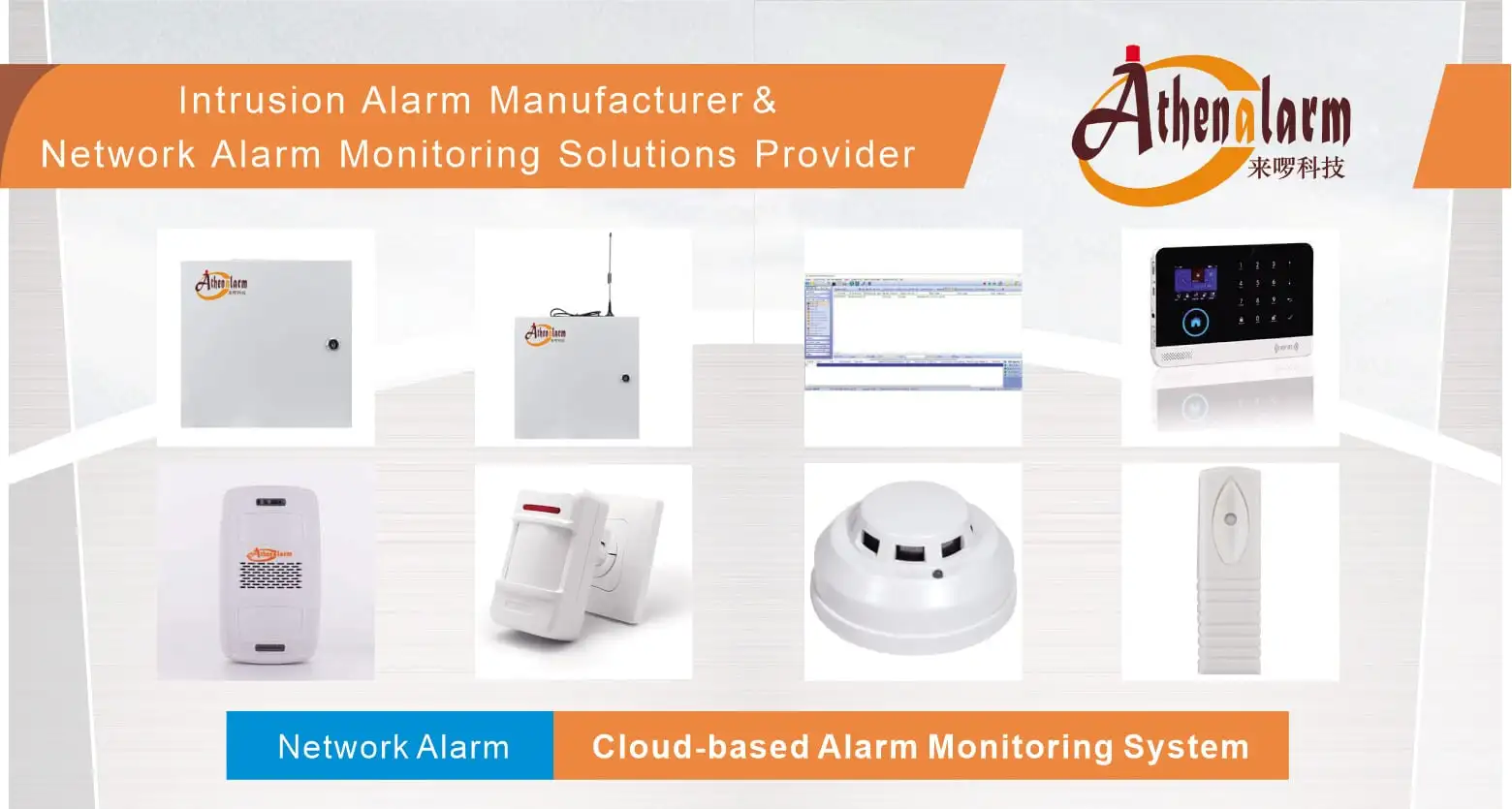
For full product portfolios and system integration specifications, refer to the Commercial Burglar Alarm Systems Catalog or consult Athenalarm Systems Official Portal.
