
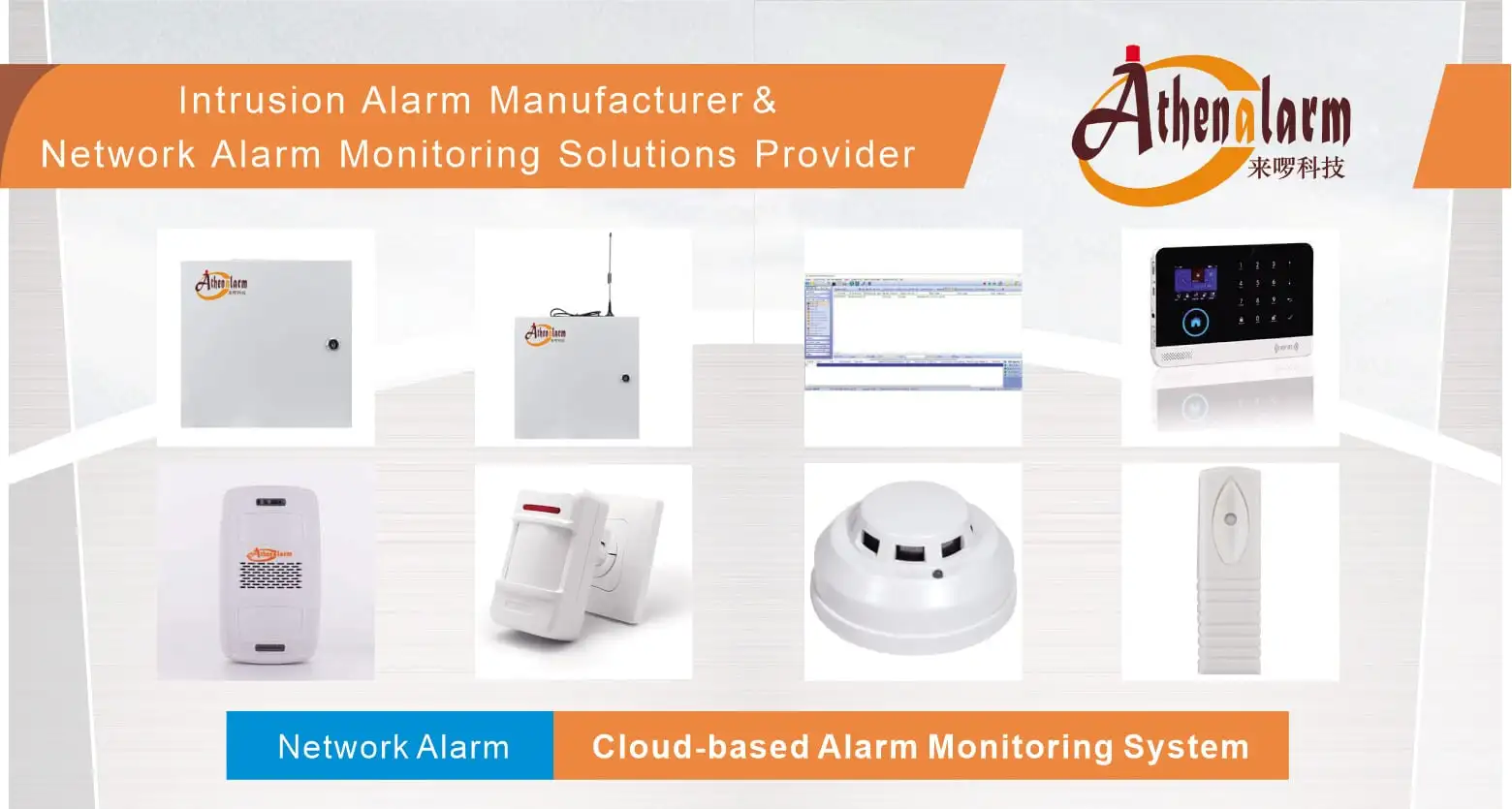
Commercial Alarm Systems with Remote Arming/Disarming: Selection and Operational Deployment Guide
1. When Remote Alarm Control Becomes an Operational Requirement
A distribution warehouse closes at midnight, but the next inbound truck is scheduled for 4 a.m. A regional retail chain opens forty branches on staggered morning schedules. A corporate campus grants a cleaning contractor access three nights a week, then revokes it the following month. In each case, the organization faces the same underlying question: who is responsible for changing the alarm state, and does that person need to be physically present at a keypad to do it?
This is the operational condition that determines whether a commercial alarm system with remote arming/disarming is a relevant procurement decision, rather than a discretionary upgrade. The system’s core function — allowing an authorized user to arm or disarm a facility’s alarm state from a mobile app, web platform, or computer instead of a physical keypad — only creates measurable value when an organization’s operating pattern already produces friction around physical presence.
1.1 Physical Keypad Dependence Can Create Operational Friction
Traditional alarm architectures assume that whoever changes the alarm state is standing at the panel. This assumption holds reasonably well in single-shift, single-location businesses with predictable hours. It becomes strained when:
- Shift patterns vary day to day.
- After-hours access is required for deliveries, maintenance, or emergencies.
- Multiple facilities need coordinated but independent state changes.
- Non-employee personnel (contractors, vendors) require temporary access.
In these conditions, physical-keypad dependence translates into supervisor call-outs, delayed openings, or informal workarounds — such as sharing codes — that reduce accountability rather than improve it.
1.2 Variable Schedules Change Alarm-State Requirements
Remote arming/disarming does not change the alarm’s underlying detection logic. It changes who can initiate a state change, from where, and under what authorization. This distinction matters for selection: a facility with a fixed 9-to-5 schedule and no after-hours access has a fundamentally different requirement than a facility with rotating shifts, delivery windows, or emergency access needs. The operational value of remote control scales with schedule variability, not with alarm sophistication.
1.3 Multi-Site Operations Increase the Value of Centralized Oversight
Centralized remote management becomes operationally meaningful once an organization must coordinate alarm-state activity across more than one location, or must give a single operations team visibility into distributed sites without physically visiting each one.
1.3.1 After-Hours Deliveries
A logistics depot can be disarmed for a scheduled delivery window without a supervisor traveling to the site, provided the action is authorized and logged.
1.3.2 Contractor Access Windows
Time-limited access — cleaning crews, maintenance vendors — requires a permission mechanism that can grant and later revoke control without reissuing physical keys or codes.
1.3.3 Distributed Facility Management
Retail or corporate organizations operating multiple branches gain the ability to observe and manage state changes across sites from a single management interface, though this depends on the platform actually supporting multi-site administration rather than one-facility-at-a-time control.
2. What Remote Arming/Disarming Changes in the Commercial Security Architecture
Before evaluating benefits, a buyer needs a working model of what actually changes when alarm-state control moves from a physical keypad to a remote-management architecture. The underlying alarm detection hardware at the facility is not eliminated or replaced by remote control — what changes is the pathway through which an authorized command reaches that hardware, and the accountability layer surrounding that command.
2.1 The Remote Control Path
The basic relationship, as described across commercial remote-alarm deployments, follows this sequence:
Authorized User → Authentication → Mobile App / Web Platform → Cloud Management Platform → Commercial Alarm System → Alarm/Zone Security State
This flow is intentionally described at the architectural level rather than at the protocol level. The source material does not establish a specific alarm panel model, field bus, or command protocol, and none should be assumed during vendor evaluation unless a specific vendor discloses it directly.
2.1.1 User Authentication
Before any command is accepted, the user’s identity must be verified. This is the first control point in the accountability chain.
2.1.2 Remote Command Transmission
The arm/disarm instruction travels from the user’s device through a cloud management layer to the facility’s alarm environment. This transmission depends on active network connectivity between the user’s device, the cloud platform, and the alarm system.
2.1.3 Alarm-State Change and Status Feedback
Once the command is received and executed, the alarm system’s state changes, and status or event information is typically returned to the management platform, which can then notify the user.
2.2 The Authorization and Accountability Layer
Remote accessibility without controlled authorization would simply move the same risks of a shared keypad code into a mobile app. Commercial deployments address this through a distinct accountability layer.
2.2.1 Role-Based Permissions
Different users are typically assigned different levels of control — for example, full operational access for facility managers versus zone-limited access for security staff.
2.2.2 MFA and Authentication Controls
Multi-factor authentication and biometric verification are commonly referenced as additional layers protecting the initiation of remote commands, beyond a single password or PIN.
2.2.3 Activity and Audit Logging
Each arm/disarm action is associated with a user identity and recorded, which supports later investigation, accountability review, or internal compliance processes. This logging capability is a system feature; it does not by itself constitute certification against any specific compliance standard.
2.3 Remote Accessibility Introduces New Dependencies
This is the central engineering trade-off underlying the entire selection decision:
Remote accessibility increases operational flexibility, but it also increases the organization’s dependence on network connectivity, authentication systems, cloud/platform availability, and the internal governance processes needed to manage user roles and permissions correctly. Removing physical-presence dependency does not remove dependency altogether — it relocates it to a digital layer that must be actively managed.
3. The Seven Operational Outcomes Buyers Should Evaluate
The following outcomes are frequently presented as generic benefits of remote arming/disarming. For a selection decision, each should instead be treated as a claim to be verified against a specific operating environment — not assumed to apply universally.
| Operational Outcome | Commercial Problem It Addresses | Remote Capability Involved | Selection Implication |
|---|---|---|---|
| Time Savings | Physical intervention required for state changes | Remote arm/disarm command | Verify actual remote accessibility and command latency in practice |
| Operational Flexibility | Variable schedules, shifts, deliveries | Remote/zone-level state control | Verify what level of granularity (facility vs. zone) is supported |
| False Alarm Risk Management | Avoidable, unauthorized, or accidental state changes | Permissions + notifications + verification | Verify governance controls, not just feature presence |
| Tiered Control / Oversight | Distributed users with different responsibilities | Role-based permissions, credentials | Verify how roles are defined, assigned, and revoked |
| Response Workflow | Delayed incident verification | Notifications + CCTV integration | Verify integration depth, not just notification speed |
| Ecosystem Integration | Security systems operating in isolation | API-based integration | Verify interoperability with the organization’s existing systems |
| Scalability | Growing site footprint | Multi-site management interface | Verify governance model at scale, not just technical capacity |
3.1 Convenience and Time Savings
The clearest example is disarming a depot for a scheduled after-hours delivery without a supervisor traveling to the site. The value is proportional to how frequently physical intervention would otherwise be required.
3.2 Operational Flexibility
Some platforms support zone-level control — arming a server room while leaving public areas accessible, for instance. This level of granularity is not guaranteed by every remote-alarm implementation and should be verified rather than assumed.
3.3 False Alarm Risk Management
Permission restrictions and event notifications can reduce the likelihood of unauthorized or accidental state changes reaching a monitoring center or dispatch. This is a plausible mechanism for reducing avoidable disruptions; the source material does not provide a quantified reduction figure, and none should be implied.
3.4 Tiered Control and Security Oversight
Different roles — executives, on-site security staff, temporary contractors — can be assigned different operational privileges, with each action tied to a specific credential and recorded in an audit log.
3.5 Faster Response Workflows
When alarm events trigger a notification, and CCTV integration allows a manager to review the corresponding video before deciding on next steps, the incident-handling workflow can move faster than a purely manual verification process. No specific response-time figure is established, and none should be promised during evaluation.
3.6 Security Ecosystem Integration
Alarm events can participate in a broader workflow involving CCTV, access control, and environmental sensors, rather than functioning as an isolated system. The depth of this integration depends on the specific platform’s API and configuration.
3.7 Scalability and Long-Term Operational Flexibility
A remote-management platform can, in principle, extend across additional sites without requiring new physical infrastructure at each location’s keypad. Whether this scales without disproportionate administrative burden depends on the governance structure discussed in Section 6.8, not on the remote-control feature alone.
4. Commercial Selection Criteria: What Buyers Should Verify Before Procurement
This section is the article’s primary decision framework. The seven outcomes above describe what a remote alarm platform can produce; this section describes what a buyer must verify before assuming those outcomes will materialize in a specific deployment.
Two categories of capability should be distinguished during evaluation:
Core selection capabilities — required in nearly all commercial deployments:
- Remote-control scope
- Authentication method
- Role-based permissions
- Auditability
- Connectivity resilience assessment
Use-case-dependent capabilities — relevant depending on the specific operating environment:
- CCTV integration
- Access-control integration
- Environmental/event integration
- Multi-site management depth
- Specific authentication method (biometric vs. token-based MFA)
4.1 Remote Control Scope
Buyers should confirm exactly which alarm functions, zones, or states can be controlled remotely — full facility arming only, or zone-level granularity — rather than assuming “remote access” implies complete operational control.
4.2 User Roles, Permissions, and Credential Lifecycle
4.2.1 Permanent Users
Full or broad operational access, typically for facility managers or owners.
4.2.2 Security Personnel
Access limited to arming/disarming specific zones or functions relevant to their role.
4.2.3 Temporary Contractors
Time-bound, revocable credentials that expire or can be manually withdrawn once access is no longer needed.
4.3 Authentication and Remote Command Security
Buyers should verify what authentication mechanisms — MFA, biometric verification, credential-based login — govern the initiation of a remote command, and how those mechanisms are managed across a growing user base.
4.4 Auditability and Activity Logging
The platform should allow an organization to determine who performed a given alarm operation and when, supporting internal investigation or accountability review. This is a system capability, not evidence of compliance with any specific external standard.
4.5 Integration and API Capability
Buyers should confirm whether the platform can interoperate with CCTV, access control, environmental sensors, or incident-management tools already in use — and at what level of depth, since API availability alone does not guarantee functional interoperability.
4.6 Connectivity Resilience
Buyers should ask what happens to remote-management availability when the primary network connection is unavailable, and whether cellular backup (commonly referenced as 4G/5G) is available as an alternative communication path. This should not be assumed to be automatic; it should be demonstrated and tested during evaluation.
4.7 Multi-Site Management
For organizations operating more than one facility, buyers should verify whether the platform genuinely supports centralized administration of users, permissions, and monitoring across sites, or whether it requires separate management per location.
4.8 Evidence Required From the Vendor
A vendor’s description of a capability is not equivalent to a demonstrated or operationally validated capability. Before selection, buyers should request:
| Claimed Capability | Evidence to Request |
|---|---|
| Remote-control workflow | A live or recorded demonstration of an actual arm/disarm command |
| Authentication controls | Demonstration of MFA/credential enforcement in practice |
| Permission management | Demonstration of role assignment and revocation |
| Audit logging | Sample of actual logged activity records |
| Integration capability | Documentation of the specific API and confirmed integration with the buyer’s existing CCTV/access-control systems |
| Outage behavior | Demonstrated or tested behavior during a simulated connectivity loss, where applicable |
| Multi-site administration | Demonstration of the management interface across multiple facilities |
This distinction — Vendor Claim → Demonstrated Capability → Operational Validation — should structure every stage of vendor comparison.
5. Integration Architecture: From Remote Alarm Control to Coordinated Security Workflows
Section 4.5 identified integration as a selection criterion to verify. This section explains how that integration functions operationally once selected, rather than repeating what to look for.
5.1 CCTV and Event Verification
When an alarm event occurs, a manager receiving a notification can access associated video information to visually assess the situation before deciding whether to escalate — for example, contacting law enforcement or dismissing a likely false trigger. The value of this workflow depends on the video feed actually being tied to the specific alarm event and zone in question.
5.2 Access Control and Alarm-State Workflows
Access-control events — such as a badge read at a specific entry point — can be configured to interact with alarm-state logic, such as automatically flagging an inconsistency between an authorized badge entry and an armed zone. The specific behavior depends on the platform’s configuration rather than being an inherent property of “integration” in general.
5.3 Environmental and Other Event Inputs
Environmental sensors (fire, flood, HVAC) can be linked into the broader security workflow so that non-intrusion events also generate alerts through the same notification and management infrastructure. The source material establishes this as a general integration category rather than a specific sensor-to-alarm behavior.
5.4 API Interoperability
5.4.1 Interface Availability
An available API indicates that integration is technically possible, not that it is already functioning with a given buyer’s existing systems.
5.4.2 Integration Testing
Because interface availability alone is insufficient, integration behavior should be tested against the buyer’s specific CCTV, access-control, and monitoring infrastructure prior to full deployment.
5.4.3 Long-Term Compatibility Management
As either the alarm platform or the integrated systems are updated over time, compatibility should be actively monitored rather than assumed to remain stable indefinitely.
6. Engineering Trade-Offs That Should Influence the Buying Decision
Every operational advantage identified in Section 3 is accompanied by a corresponding dependency. Presenting only the advantage without its trade-off would misrepresent the selection decision.
| Capability / Benefit | Dependency Introduced | Operational Consequence | Selection Question |
|---|---|---|---|
| Remote convenience | Network/cloud connectivity | Remote management may be unavailable during outages | What is the connectivity-loss behavior? |
| Operational flexibility | Configuration complexity | Zone-level and schedule-based control requires careful setup | How is configuration managed and reviewed? |
| Centralized oversight | Platform dependency | Multi-site visibility concentrates dependence on one platform | What happens if the platform is unavailable? |
| Integration capability | Integration complexity | Connecting multiple systems increases maintenance requirements | What ongoing compatibility management is required? |
| Open APIs | Ongoing integration management | Interoperability still requires configuration and testing | Who is responsible for integration upkeep? |
| Strong authentication (MFA) | User friction | Additional steps required for every remote action | How is authentication balanced against usability? |
| Remote automation | Reduced human oversight | Faster actions can also mean faster errors | What manual checks remain in place? |
| Multi-site scalability | Governance burden | More sites mean more users, permissions, and logs to manage | Who governs permissions across the organization? |
6.1–6.8 Reading the Trade-Off Table
Each row above follows the same underlying logic: Capability → Dependency → Operational Consequence → Selection Implication. A buyer evaluating remote arming/disarming should treat each advantage in Section 3 as paired with the corresponding row here, rather than evaluating benefits and dependencies separately.
7. Failure Modes and Risk-Mitigation Framework
Where Section 6 addresses trade-offs to weigh before purchase, this section addresses conditions that can occur during or after deployment, and how each should be mitigated.
| Risk | Cause | Operational Impact | Mitigation to Evaluate |
|---|---|---|---|
| Network or connectivity loss | Internet/network outage | Reduced remote-management availability | 4G/5G cellular backup as a proposed mitigation; test actual outage behavior |
| Incorrect user action | Human error, unclear procedures | Incorrect alarm state, disruption, or exposure | SOPs, training, recurring refresher training |
| Excessive user privileges | Weak permission governance | Unnecessary control capability retained by users | Tiered and temporary/revocable permissions |
| Integration failure | API limitations, compatibility problems, configuration errors | Reduced verification or coordinated workflow capability | Integration testing and pilot deployment |
| Vendor lock-in | Dependence on proprietary interfaces | Reduced flexibility to switch platforms later | Evaluate API openness and integration portability |
| Inadequate auditability | Weak identity, authorization, or logging controls | Reduced accountability and investigation capability | Enforced identity controls, role-based permissions, activity logs |
| Operational drift | Stale permissions, missed updates, weak monitoring | Gradual decline in operational effectiveness over time | Continuous monitoring, log audits, permission reviews, updates |
It is worth noting that 4G/5G cellular backup is an explicitly proposed mitigation for connectivity loss, not a guarantee of uninterrupted service. Whether a specific platform switches to backup connectivity automatically, and how quickly, should be confirmed and tested rather than assumed.
Similarly, open APIs reduce — but do not eliminate — the practical difficulty of switching vendors, since migrated data, retrained staff, and reconfigured integrations still carry switching costs regardless of API openness.
8. Commercial Deployment and Governance Lifecycle
The seven-phase sequence below reflects how a commercial remote-alarm deployment typically proceeds from initial evaluation to ongoing operation.
- Risk Assessment — Identify assets, entry points, vulnerable zones, operating schedules, and multi-site requirements.
- Vendor Selection — Evaluate remote-control scope, authentication, permissions, audit logs, API capability, connectivity resilience, and multi-site management against the criteria in Section 4.
- System Integration — Connect required CCTV, access-control, and incident-management systems, and test the resulting behavior.
- Access Configuration — Define user roles, permissions, contractor access windows, and credential lifecycle rules.
- Employee Training — Establish SOPs for remote-control procedures, error prevention, incident handling, and shift handovers.
- Testing and Pilot Deployment — Validate remote command workflows, notifications, permissions, integration behavior, and network-outage scenarios under realistic operating conditions before full rollout.
- Continuous Monitoring and Maintenance — Regularly review audit logs, permissions, software updates, training currency, connectivity performance, and integration behavior across all managed sites.
Each phase depends on the one before it: access configuration is not meaningful without a completed risk assessment, and testing is not meaningful without configured access. Skipping directly from vendor selection to full operational rollout — without a documented testing and pilot phase — removes the opportunity to validate outage behavior and integration performance before they affect live operations.
9. Industry Application Patterns
The following scenarios illustrate where the selection criteria and trade-offs discussed above tend to apply most directly. They are not intended as a general industry survey.
9.1 Retail Chains
Centralized management of opening/closing state changes across multiple branches directly exercises the multi-site governance criteria discussed in Sections 4.7 and 6.8.
9.2 Logistics and Distribution
After-hours re-arming following night deliveries is a direct application of the remote-control scope and connectivity-resilience criteria in Section 4.1 and 4.6.
9.3 Healthcare Facilities
Variable access requirements around restricted areas (labs, operating theaters) exercise the zone-level control and tiered-permission criteria in Sections 3.2 and 4.2.
9.4 Corporate Campuses and Offices
Tiered access for employees and contractors exercises the credential-lifecycle criteria in Section 4.2.3.
9.5 Manufacturing Facilities
Coordination between alarm states and broader facility systems (including fire suppression, where integrated) exercises the integration criteria in Sections 4.5 and 5.3.
9.6 Multi-Site Commercial Operations
Centralized oversight combined with distributed day-to-day responsibility is the clearest expression of the scalability-versus-governance trade-off in Section 6.8.
10. How to Determine Whether Remote Arming/Disarming Fits the Operation
10.1 Strong-Fit Conditions
Remote arming/disarming is more likely to deliver measurable operational value where an organization has:
- Variable operating hours or shift patterns
- Recurring after-hours access needs
- Contractor or temporary-access requirements
- Multiple facilities requiring coordinated oversight
- An existing need for auditable, accountable state changes
- Existing CCTV or access-control infrastructure to integrate with
10.2 Conditions Requiring Additional Engineering Review
Additional review is warranted where an organization has:
- Unreliable or unverified network connectivity at the facility
- Complex, overlapping permission requirements across many user types
- Extensive integration requirements with legacy systems
- Strict internal governance or compliance obligations that require detailed documentation
- Heavy dependence on cloud-service availability with limited internal IT support
- A large number of sites or users requiring administration
10.3 Limited-Fit or Low-Value Conditions
Remote arming/disarming is less likely to justify the associated governance overhead where:
- Operating hours are fixed and physical presence at the keypad is not a practical constraint
- After-hours or distributed access needs are minimal or nonexistent
- The organization lacks the administrative capacity to manage permissions, training, and testing on an ongoing basis
- Connectivity or integration dependencies cannot be reasonably managed given the facility’s infrastructure
10.4 Minimum Vendor Evaluation Questions
- What alarm functions can be controlled remotely?
- How are users authenticated?
- How are roles and permissions managed and revoked?
- What activity is logged, and how is it reviewed?
- What integrations and APIs are available, and with which systems have they been demonstrated?
- What happens to remote management during a network disruption?
- Is cellular backup connectivity available, and has its activation been tested?
- How is integration behavior tested before deployment?
- How are temporary users (contractors) managed?
- How does the platform administer users and permissions across multiple sites?
These questions summarize the selection framework developed throughout this article and should form the basis of a vendor comparison rather than a feature checklist alone.
11. FAQ
1. How does a cloud-connected alarm system maintain remote functionality during local network outages?
Remote management depends on active network connectivity between the user’s device, the cloud platform, and the alarm system at the facility. When the primary connection is unavailable, cellular backup — commonly referenced as 4G/5G connectivity — is an explicitly proposed mitigation for maintaining an alternative communication path. This should be confirmed and tested for a specific platform rather than assumed to activate automatically or guarantee uninterrupted protection.
2. How can remote arming systems help reduce costly false-alarm disruptions in commercial facilities?
Controlled permissions limit who can trigger a state change, and notification plus CCTV verification allow a manager to review an event before escalating it to emergency services. Together these reduce the likelihood of avoidable or unauthorized triggers reaching dispatch. No specific quantified reduction figure is established here, and vendors claiming a fixed percentage reduction should be asked for supporting evidence.
3. Why are open APIs important when selecting a commercial remote alarm platform?
Open APIs support interoperability with CCTV, access control, and other security systems, and can reduce dependence on a single vendor’s proprietary interfaces. However, open APIs do not automatically eliminate vendor lock-in or switching costs — integration still requires configuration, testing, and ongoing compatibility management regardless of interface openness.
4. What security mechanisms should protect remote alarm commands from unauthorized access?
Authentication (including MFA and biometric verification where available), role-based permissions, and audit logging together form the accountability layer around remote commands. These mechanisms strengthen control over who can initiate an alarm-state change, but they do not by themselves establish compliance with a specific external standard such as ISO 27001 or SOC 2 — actual compliance depends on the organization’s broader implementation and governance practices.
5. What commercial environments benefit most from remote-enabled alarm systems?
Environments with variable operating schedules, recurring after-hours access needs, contractor access requirements, or multiple facilities requiring coordinated oversight tend to show the clearest operational case, as detailed in Section 10.1.
6. What should businesses evaluate before selecting a remote alarm system?
Buyers should verify remote-control scope, authentication method, permission and credential management, auditability, integration capability, connectivity resilience, and multi-site administration — and request demonstrated, not merely claimed, evidence for each, as outlined in Section 4.
7. How should businesses manage user permissions for remote alarm control?
Through role-based access tied to job responsibility, with temporary or revocable credentials for contractors, and periodic review of assigned permissions to prevent privilege accumulation over time.
8. How should a commercial organization test a remote alarm platform before full deployment?
Through a pilot phase that validates remote command workflows, notification delivery, permission enforcement, integration behavior with existing systems, and — where applicable — behavior during a simulated network outage, before the platform is relied upon across full operations.
9. What are the main trade-offs of remote arming and disarming?
Convenience is paired with connectivity dependency; operational flexibility with configuration complexity; centralized oversight with platform dependency; integration capability with ongoing integration management; and multi-site scalability with increased governance burden, as detailed in Section 6.
10. How should remote alarm systems be maintained after deployment?
Through recurring log review, periodic permission audits, software updates, refresher training, connectivity monitoring, and ongoing integration compatibility checks — treating deployment as the start of an operational lifecycle rather than a one-time installation.
12. System Component Checklist Appendix
To maintain high architectural integrity while ensuring complete technical operational readiness, the physical field hardware and specialized domain deployment options referenced across remote arming architectures include:
- Manufacturer Overview: Burglar Alarm Manufacturer Overview
- Core Commercial Hardware Architecture: Burglar Alarm System Components
- Platform Application Scenarios: Network Alarm Monitoring System Applications
- Banking & Financial Security Infrastructure: Network Bank Alarm Monitoring System Solution
- ATM Remote Monitoring & Defense: Bank ATM Alarm Monitoring System Solution
- High-Security Vault Protection: Network Bank Vault Alarm Monitoring System Solution
- Perimeter Intrusion Defense: Network Perimeter Alarm System Solution
- Hospitality Access Control & Alarm: Network Hotel Alarm System Solution
- Multi-Tenant & Community Deployment: Network Community Alarm System Solution
- Residential & Executive Facilities: Network House Alarm System Solution
- Wireless / Standalone Hub Integration: GSM/WiFi Alarm System
- Space Intrusion Sensing: PIR Motion Sensor
- Wide-Area Coverage Motion Detection: Wide Angle PIR Motion Sensor
- Environmental Fire/Smoke Sensing: Photoelectric Smoke Detector
- Hazardous Gas Intrusion Monitoring: Industrial Gas Detector
- Physical Breach Sensing: Digital Vibration Detector
- Entry Point Contact Sensing: Heavy-Duty Door Contact Sensor
- Hardwired Emergency Triggering: Panic Button
- Wireless Emergency Triggering: Wireless Panic Button
- On-Site Visual Annunciation: Strobe Warning Light
- Audio Alert Verification Device: Motion Sensor Audio Player
