
Enterprise Alarm Monitoring Service Deployment: Operational Tactics and Redundancy Standards
A commercial facility that relies on an Alarm Monitoring Service for 24/7 protection is not purchasing a single product — it is depending on a chain of communication paths, monitoring-center operations, verification procedures, and escalation logic that must all function correctly at the moment an event occurs. When any link in that chain is weak, “24/7 monitoring” becomes a description of intent rather than a description of performance.
This is the operational reality that security decision-makers, facility managers, and procurement teams encounter when specifying an enterprise Alarm Monitoring Service: the failure modes that matter most are rarely the alarm-generating equipment itself. They are communication-path outages, unvalidated monitoring-center redundancy, delayed or absent alarm verification, and monitoring providers whose accreditation claims are not independently substantiated. A single IP connection without a supervised secondary path, a “redundant” monitoring center that has never demonstrated failover under load, or an escalation workflow that treats every signal as equally urgent — each of these can silently undermine a monitoring program that appears complete on paper.
Because these failure points are structural rather than cosmetic, they cannot be resolved by selecting a provider based on marketing language such as “rapid response” or “guaranteed protection.” They require an evaluation framework built around measurable criteria: monitoring-center continuity, dual-path signaling, response-time benchmarks referenced against recognized standards, structured alarm verification, and auditable provider evidence.
This article organizes that evaluation framework into nine operational tactics, structured around the underlying chain that determines whether an alarm event actually becomes an effective response: Event → Transmission → Monitoring Reception → Verification → Escalation → Continuity → Audit → Integration → Lifecycle Management. Each tactic addresses a specific point in that chain where deployment or procurement decisions materially affect operational reliability.
1. Define the Full Alarm Monitoring Chain Before Selecting a Service
Before comparing monitoring providers, communication technologies, or accreditation claims, it is necessary to establish what must remain operational, continuously, for an alarm event to result in an effective response. An Alarm Monitoring Service is not a single component; it is a sequence of dependent operations, and a weakness anywhere in that sequence reduces the reliability of the entire deployment.
1.1 From Alarm Event to Response
The monitoring chain can be described as a sequence of discrete operational stages, each depending on the one before it.
1.1.1 Event Generation and Signal Transmission
An alarm-generating source — categorized in this framework as Intrusion, Fire, CO, Flood, or Duress — produces a signal that must be transmitted to the Alarm Monitoring Service through a communication path. The reliability of this stage depends entirely on the availability of that communication path at the moment the event occurs, not on the sophistication of the originating equipment.
1.1.2 Monitoring Reception and Verification
Signal arrival at the monitoring center does not, by itself, constitute a completed operational response. The Alarm Monitoring Service must receive the signal, classify it by threat category, and subject it to a verification process before deciding how to escalate it. Treating “signal received” as equivalent to “event handled” is one of the most common conceptual errors in monitoring specification.
1.1.3 Escalation and Response
Escalation is the operational transition from a verified event to a defined response action — dispatch coordination, notification, or another predefined procedure. This stage depends on the verification outcome from the previous stage and on whether escalation logic has been defined clearly enough to avoid ambiguity during an actual event.
1.2 Where 24/7 Monitoring Can Break
Each stage of the chain above corresponds to a distinct failure domain:
- Communication-path failure — the signal never reaches the monitoring center.
- Monitoring-center disruption — the center receiving the signal is degraded or offline.
- Verification delay or absence — the event is escalated without adequate confirmation, or a legitimate event is delayed pending verification.
- Escalation ambiguity — the response action is unclear, inconsistent, or misapplied to the threat category.
- Provider capability weakness — the monitoring organization itself lacks the operational maturity to execute the above stages consistently.
A monitoring specification that does not explicitly address each of these domains leaves the corresponding risk unmanaged.
1.3 Translate the Monitoring Chain into Procurement Requirements
Each stage of the chain converts directly into a procurement question:
- What communication paths are supported, and is a secondary path supervised?
- What monitoring-center redundancy exists, and has failover been demonstrated?
- What verification procedure applies before escalation, and how does it vary by threat category?
- What response-time benchmark applies to the provider’s operations, and against what standard is it measured?
- What evidence can the provider produce for accreditation, audit history, and operational readiness?
The remaining sections of this article expand each of these questions into a structured evaluation tactic.
2. Build Monitoring-Center Redundancy Around Continuity, Not Marketing Claims
2.1 Why a Single Monitoring Location Creates System Risk
An Alarm Monitoring Service that operates from a single monitoring center introduces a service-side single point of failure that is independent of the reliability of the alarm equipment or communication paths on the customer side. If the monitoring center experiences a disruption — for any operational reason — every facility relying on that center loses monitoring coverage simultaneously, regardless of how well each individual site’s communication architecture was designed.
This risk is structurally different from equipment redundancy: it applies at the aggregate level of the provider’s entire monitored portfolio, not at the level of a single customer deployment.
2.2 Evaluate Dual-Site and Failover Architecture
Dual-site monitoring-center redundancy and a defined failover mechanism are the architectural response to this risk.
2.2.1 Primary and Secondary Monitoring Capability
A resilient architecture assumes a primary monitoring center backed by a secondary site capable of assuming operational responsibility. The existence of a secondary site is a necessary but not sufficient condition for continuity.
2.2.2 Failover Mechanism and Operational Continuity
The failover mechanism is the operational process by which monitoring responsibility transfers from the primary to the secondary site. Its design determines whether continuity is preserved or whether a transition gap exists during the handover.
2.2.3 Evidence of Failover Testing and Auditability
The distinction that matters most to a buyer is not whether redundancy exists on paper, but whether the failover mechanism has been operationally validated and can be independently audited. A redundant architecture that has never been tested under representative conditions is a theoretical control, not a demonstrated one.
2.3 Audit Monitoring-Center Resilience
Rather than accepting a general statement of “24/7 redundant monitoring,” procurement evaluation should request specific evidence across the following dimensions:
| Audit Dimension | What to Request | Why It Matters |
|---|---|---|
| Redundancy architecture | Description of primary/secondary site relationship | Confirms a secondary capability actually exists |
| Failover capability | Evidence of failover testing or exercised transitions | Distinguishes theoretical redundancy from validated redundancy |
| Operational readiness | Description of monitoring-center staffing and process continuity | Confirms the secondary site can sustain full operations, not partial coverage |
| Accreditation/certification evidence | Current certificates or audit reports referencing standards such as UL 827, EN 50518, or TMA Five Diamond | Provides a third-party reference point for operational standards |
| Auditability | Willingness to support ongoing or periodic review | Confirms resilience is maintained, not a one-time claim |
Claim-control note: references to UL 827, EN 50518, or TMA Five Diamond indicate the standards a provider states it is evaluated against. They should be treated as evaluation criteria to verify, not as automatic proof that a specific provider currently holds or maintains that status.
3. Specify Measurable Response Benchmarks Instead of “Rapid Response”
3.1 Why Response Time Must Be a Defined Metric
“24/7 availability” describes when a service operates, not how quickly it processes an event once received. Response-time performance is a separate, measurable property of the monitoring chain, and it should be defined as a specific metric within a procurement specification rather than accepted as an unquantified marketing claim.
3.2 Compare the Source-Stated Regional Benchmarks
The following benchmarks are the response-time reference points associated with the standards most commonly cited in commercial alarm monitoring evaluation. They should be understood as benchmarks referenced against these standards, evaluated during procurement, not as guarantees applicable to every provider or deployment.
| Standard / Framework | Stated Response Benchmark | Procurement Relevance |
|---|---|---|
| EN 50518 | ≤ 60 seconds | Response-performance evaluation reference for monitoring centers operating under this standard |
| UL 827 | ≤ 90 seconds | Response-performance evaluation reference for monitoring centers operating under this standard |
| AS/NZS 2201.2 | ≤ 90 seconds | Response-performance evaluation reference for monitoring centers operating under this standard |
3.3 Convert Benchmarks into SLA Evaluation Criteria
Once an applicable benchmark is identified, it should be incorporated into the Service Level Agreement as a measurable performance requirement — not as an implicit assumption. This allows a buyer to track actual response performance against a defined target and to raise a specific, evidence-based question if performance deviates, rather than relying on a general sense of whether the provider “seems responsive.”
4. Eliminate Single-Path Communication Dependency with Supervised Dual-Path Signaling
4.1 Understand the Single-Path Failure Problem
If an alarm system communicates through a single path — for example, IP only — then any interruption to that path, regardless of cause, prevents the alarm signal from reaching the monitoring center for the duration of the interruption. This creates a direct dependency: monitoring continuity for that facility is only as reliable as the single communication path it relies on.
4.2 Compare IP, Cellular, and Radio Signaling Paths
Dual-path signaling addresses this dependency by combining a primary path with a secondary path using a different transport medium. The following comparison reflects the relative considerations associated with each medium; it does not represent specific measured performance values for any particular deployment.
| Path | Latency Consideration | Failure-Risk Consideration | Security Consideration | Operational Role |
|---|---|---|---|---|
| IP | Generally low under normal network conditions | Dependent on facility network/internet availability | Requires transport-layer protection such as TLS 1.2+ | Commonly used as the primary path |
| Cellular | Independent of the facility’s wired network | Exposed to cellular network coverage and carrier availability | Operates over a separate carrier infrastructure from IP | Commonly used as a secondary path when IP is primary |
| Radio | Independent of both IP and cellular infrastructure | Exposed to radio-specific coverage and interference factors | Operates on dedicated signaling infrastructure | Used as an alternative secondary path where appropriate |
4.3 Why Dual-Path Architecture Changes the Risk Profile
The purpose of a second communication path is not to increase overall connectivity for its own sake — it is to remove the dependency on any single path being available at the moment an alarm event occurs. A dual-path architecture changes the risk profile from “the facility loses monitoring if this one path fails” to “the facility loses monitoring only if both independent paths fail simultaneously,” which is a materially different reliability position.
4.4 Use Supervised Line Monitoring to Detect Path Failure
Redundancy alone does not guarantee that a failed path will be noticed. Supervised line monitoring is the mechanism by which the health of a communication path is actively checked, so that a failure is detected rather than silently assumed away. Without supervision, a secondary path may itself have failed without anyone being aware, effectively returning the deployment to single-path dependency without warning. The supplied source material does not establish specific polling intervals or detection timeframes; procurement evaluation should request this information directly from the provider rather than assume a default value.
5. Design Alarm Verification Around Threat Type and Escalation Risk
5.1 Map Threat Categories to Verification Requirements
An Alarm Monitoring Service typically handles multiple threat categories, each with different operational implications:
| Threat Category | Verification Consideration | Escalation Consideration |
|---|---|---|
| Intrusion | Distinguish confirmed intrusion indicators from incidental triggers | Escalation urgency depends on verification outcome |
| Fire | Life-safety category generally requiring prompt handling | Escalation path may differ from property-security categories |
| CO | Life-safety category associated with environmental/health risk | Escalation path may differ from property-security categories |
| Flood | Property-protection category with lower immediate life-safety urgency in most cases | Escalation typically follows property-risk workflows |
| Duress | Indicates an active safety concern requiring dedicated handling | Escalation path is typically distinct from standard alarm categories |
This table reflects category distinctions established in the source framework; it is not a substitute for category-specific emergency procedures, which fall outside the scope of this deployment-practice discussion.
5.2 Distinguish Verification from Signal Reception
Receiving a signal confirms that the communication path functioned. It does not confirm that the underlying event is genuine, current, or accurately categorized. Verification is the operational step that closes this gap — reviewing available information associated with the event before deciding on an escalation action.
5.3 Structure Escalation Logic
A coherent escalation model follows the sequence: Threat Category → Verification Outcome → Escalation Action. Defining this sequence explicitly, category by category, prevents ambiguity during an actual event and gives the buyer a basis for asking the provider how each category is handled operationally.
5.4 Balance False Escalation Against Delayed Legitimate Response
Verification introduces an inherent trade-off. Escalating every signal immediately, without verification, increases the likelihood of false escalations. Requiring extensive verification before any escalation increases the risk of delaying a legitimate event. Neither extreme is acceptable for enterprise deployment; the objective of a well-designed verification process is to manage this trade-off deliberately rather than defaulting to one extreme by omission.
6. Qualify the Monitoring Provider Through Accreditation, Audit, and Operational Evidence
6.1 Verify Accreditation and Certification Claims
References to standards such as UL 827, EN 50518, and TMA Five Diamond describe the operational benchmarks a monitoring center may be evaluated against. A provider stating that these standards are relevant to its operations is not the same as that provider holding current, verifiable certification. Procurement evaluation should request documentary evidence rather than accept the reference itself as proof.
6.2 Audit Operational Resilience
An operational audit of a monitoring provider should independently examine each of the following:
6.2.1 Monitoring-Center Redundancy
Whether a genuine secondary monitoring site exists and under what conditions it assumes responsibility.
6.2.2 Failover Readiness
Whether the failover mechanism has been tested, and what evidence supports that testing.
6.2.3 Response Performance
Whether the provider tracks and reports actual response times against the applicable benchmark.
6.2.4 Verification Procedures
Whether alarm verification is a defined, consistent procedure rather than an ad hoc operator judgment.
6.2.5 Ongoing Auditability
Whether the provider supports periodic review of the above items rather than a one-time onboarding disclosure.
6.3 Separate Technology Capability from Provider Capability
A technically resilient signaling architecture — dual-path communication, supervised line monitoring, encrypted transport — can still underperform if the monitoring provider’s operational procedures, staffing continuity, or verification discipline are inadequate. Technology capability and provider capability are independent variables, and evaluating only the former leaves a material gap in the overall risk assessment. This distinction is one of the more consequential judgments a procurement team can make, because it determines whether monitoring reliability is treated as a hardware property or as an operational one.
7. Secure Remote Oversight and Monitoring Communications Without Expanding the System Boundary
7.1 Secure Alarm Communication Transport
TLS 1.2+ encryption is the transport-security requirement referenced for alarm communication in this framework. Its role is to protect the confidentiality and integrity of signaling data in transit between the alarm system and the monitoring center. This should be treated as a stated transport-layer requirement rather than as a description of a complete cybersecurity architecture, which extends beyond the scope of an alarm monitoring specification.
7.2 Use Real-Time Mobile Alerts for Operational Visibility
Real-time mobile alerts and remote oversight capabilities give facility managers and security decision-makers visibility into monitored events as they occur, supporting internal coordination alongside the monitoring center’s own escalation process.
7.3 Do Not Confuse Remote Visibility with Monitoring Continuity
Remote mobile notification is a visibility feature, not a substitute for redundant, professionally staffed monitoring. A facility that receives a mobile alert but has no underlying monitoring-center redundancy or verification process has not achieved resilient monitoring — it has achieved awareness of an event that may still be poorly handled operationally. These two capabilities should be evaluated separately.
8. Integrate Alarm Monitoring with the Facility Security and Building Ecosystem
8.1 Access Control Integration
Access control data can provide contextual information relevant to an alarm event — for example, whether authorized access activity coincided with an intrusion signal. This is an operational relationship at the level of shared event context, not a description of a specific integration protocol.
8.2 Video Analytics Integration
Video analytics can support verification by supplying visual context associated with a monitored event, which the monitoring center can factor into its verification decision.
8.3 BMS Integration
Building Management System integration allows alarm events to be considered alongside broader facility operating conditions, supporting a more complete operational picture during an event.
8.4 Manage Integration Complexity
Each of these integrations improves contextual awareness at the cost of additional interface dependencies and lifecycle maintenance requirements. Connecting the Alarm Monitoring Service to access control, video analytics, or BMS platforms is an architectural decision that should be weighed against the operational value it provides, rather than adopted by default. This article addresses these relationships at the level of operational integration; it does not address the API structures, message formats, or protocol-level implementation required to build them, which fall outside the deployment-practice scope defined here.
9. Manage Scalability, Compliance Alignment, and TCO Across the Service Lifecycle
9.1 Evaluate Scalability Before Expansion Creates Complexity
As a monitoring deployment expands — more sites, more signal categories, more integrations — the number of operational dependencies increases correspondingly. Each additional site or integration adds to the administrative and monitoring workload, and the relationship between scale and complexity should be assessed before expansion occurs, not discovered afterward.
9.2 Evaluate Cloud Adoption as a Lifecycle Decision
Cloud platform adoption supports centralized management and scalable deployment of monitoring operations. It should be evaluated as part of the service’s overall lifecycle architecture — including its implications for communication dependency and remote accessibility — rather than treated as an isolated technology upgrade.
9.3 Map Compliance Requirements to the Monitoring Environment
PCI DSS, HIPAA, and GDPR are compliance frameworks that may be relevant depending on the type of data or operational environment associated with a facility’s monitoring deployment. Their relevance should be mapped against the specific facility context. Referencing these frameworks identifies areas requiring compliance alignment; it does not, by itself, establish that a given provider or deployment satisfies them. Independent verification remains necessary.
9.4 Evaluate TCO Beyond Initial Service Cost
Total cost of ownership for an enterprise Alarm Monitoring Service should account for more than the initial monitoring fee. Relevant lifecycle cost factors include:
- redundancy architecture (dual-site, dual-path);
- communication infrastructure and ongoing connectivity costs;
- ecosystem integration development and maintenance;
- scaling costs associated with additional sites or signal volume;
- ongoing provider audit and compliance-review effort.
9.5 Treat Insurance Value as a Verification Item
Accredited 24/7 monitoring and resilient signaling architecture are commonly cited as factors insurers consider when evaluating commercial facility risk, with a stated range of 5–20% in potential premium reduction referenced in industry evaluation material. This figure should be treated as a source-stated evaluation marker to raise directly with the relevant insurer, not as a guaranteed financial outcome of deploying any specific monitoring configuration.
10. Apply the Nine-Tactic Enterprise Selection Framework
The preceding tactics converge into a single evaluation framework a buyer can apply before approving an Alarm Monitoring Service deployment or provider.
10.1 Continuity
- Dual-site monitoring capability confirmed with evidence
- Failover mechanism tested, not only described
- 24/7 operational continuity demonstrated, not assumed from marketing language
10.2 Communication Resilience
- Primary communication path defined
- Secondary path defined using an independent transport medium
- Supervised path monitoring in place to detect failure
10.3 Performance
- Applicable response benchmark identified (e.g., EN 50518, UL 827, AS/NZS 2201.2)
- Benchmark incorporated into SLA as a measurable requirement
- Provider performance reviewed against that benchmark over time
10.4 Verification
- Threat categories defined (Intrusion, Fire, CO, Flood, Duress)
- Verification procedure defined for each category
- Escalation workflow explicitly linked to verification outcome
10.5 Provider Qualification
- Accreditation/certification evidence requested and reviewed
- Auditability of provider operations confirmed
- Operational readiness independently assessed, not accepted from self-reporting alone
10.6 Lifecycle Suitability
- Integration requirements (Access Control, Video Analytics, BMS) scoped at a high level
- Scalability implications assessed before expansion
- TCO evaluated across redundancy, integration, and maintenance factors
- Compliance alignment mapped to the specific facility context
Applying these six dimensions consistently allows a procurement or security team to move from a general intention — continuous protection — to a specification that can be verified, audited, and maintained throughout the service lifecycle.
11. FAQ
Q1. What is dual-path signaling, and why is it required for commercial alarm monitoring?
Dual-path signaling combines a primary communication path with a secondary path using a different transport medium, such as IP paired with Cellular or Radio, so that the alarm system does not depend on a single path being available at the moment an event occurs. This becomes materially effective only when the paths are supervised, so that a failure in either path is detected rather than silently assumed to be functioning.
Q2. How do UL 827, EN 50518, and AS/NZS 2201.2 response time benchmarks differ?
The source framework associates EN 50518 with a benchmark of ≤ 60 seconds, and both UL 827 and AS/NZS 2201.2 with a benchmark of ≤ 90 seconds. These figures represent stated benchmarks referenced against each standard and should be verified against the specific provider’s operations rather than treated as universal guarantees applicable to every monitoring center.
Q3. How does alarm verification reduce false dispatch and operational disruption?
Alarm verification reduces false dispatch by requiring confirmation of an event’s validity before escalation, rather than escalating every raw signal automatically. This matters because unverified escalation increases false dispatch costs, while excessive verification delay risks slowing a legitimate response — the objective is a defined balance between the two, not the elimination of either risk.
Q4. What criteria should be included in an enterprise monitoring-center audit?
An enterprise monitoring-center audit should cover redundancy architecture, failover testing evidence, accreditation/certification documentation, response-performance tracking, verification procedures, secure communication practices, and ongoing auditability. This matters because a monitoring center’s continuity depends on operational evidence across all of these dimensions, not on any single claim in isolation.
Q5. Can commercial alarm monitoring reduce facility insurance premiums?
Accredited 24/7 monitoring and dual-path signaling are referenced in industry evaluation material as factors associated with a potential 5–20% reduction in insurance premiums. This figure should be confirmed directly with the relevant insurer for a specific facility, because it is a stated evaluation marker rather than a guaranteed outcome of any particular deployment.
Q6. What are the main trade-offs between IP, Cellular, and Radio alarm communication?
IP is commonly used as a primary path due to its integration with existing network infrastructure, but it depends on facility network availability. Cellular and Radio provide independence from the facility’s wired network and are typically used as secondary paths, each carrying different considerations for coverage, carrier dependency, and infrastructure independence. This matters because the choice of secondary path should complement, not duplicate, the failure characteristics of the primary path.
Q7. Why is supervised line monitoring important in a dual-path alarm architecture?
Supervised line monitoring actively checks the health of each communication path so that a failure is identified rather than discovered only when an event fails to transmit. This matters because dual-path redundancy without supervision can silently degrade to single-path dependency if a secondary path fails unnoticed.
Q8. How can an Alarm Monitoring Service integrate with Access Control, Video Analytics, and BMS?
Integration operates at the level of shared operational context — access events, visual confirmation, and building-system status can inform how an alarm event is verified and handled. This matters because additional context can improve verification quality, but each integration also introduces interface and lifecycle-maintenance dependencies that should be weighed against that benefit.
Q9. How should enterprises evaluate the TCO of an Alarm Monitoring Service?
TCO evaluation should include redundancy architecture, communication infrastructure, ecosystem integration maintenance, scaling costs, and ongoing provider audit effort, not only the initial monitoring service fee. This matters because deployments that appear cost-efficient at initial procurement can carry materially higher lifecycle costs once redundancy, integration, and scaling requirements are accounted for.
Q10. What should enterprises verify before approving an Alarm Monitoring Service provider?
Enterprises should verify monitoring-center redundancy with evidence of tested failover, communication-path resilience with supervised dual-path signaling, response performance against an applicable benchmark, verification and escalation procedures by threat category, accreditation and audit evidence, and lifecycle factors including integration scope, scalability, and TCO. This matters because provider approval based on general claims of “24/7 monitoring” leaves each of these underlying risk factors unverified.
12. System Component Checklist Appendix
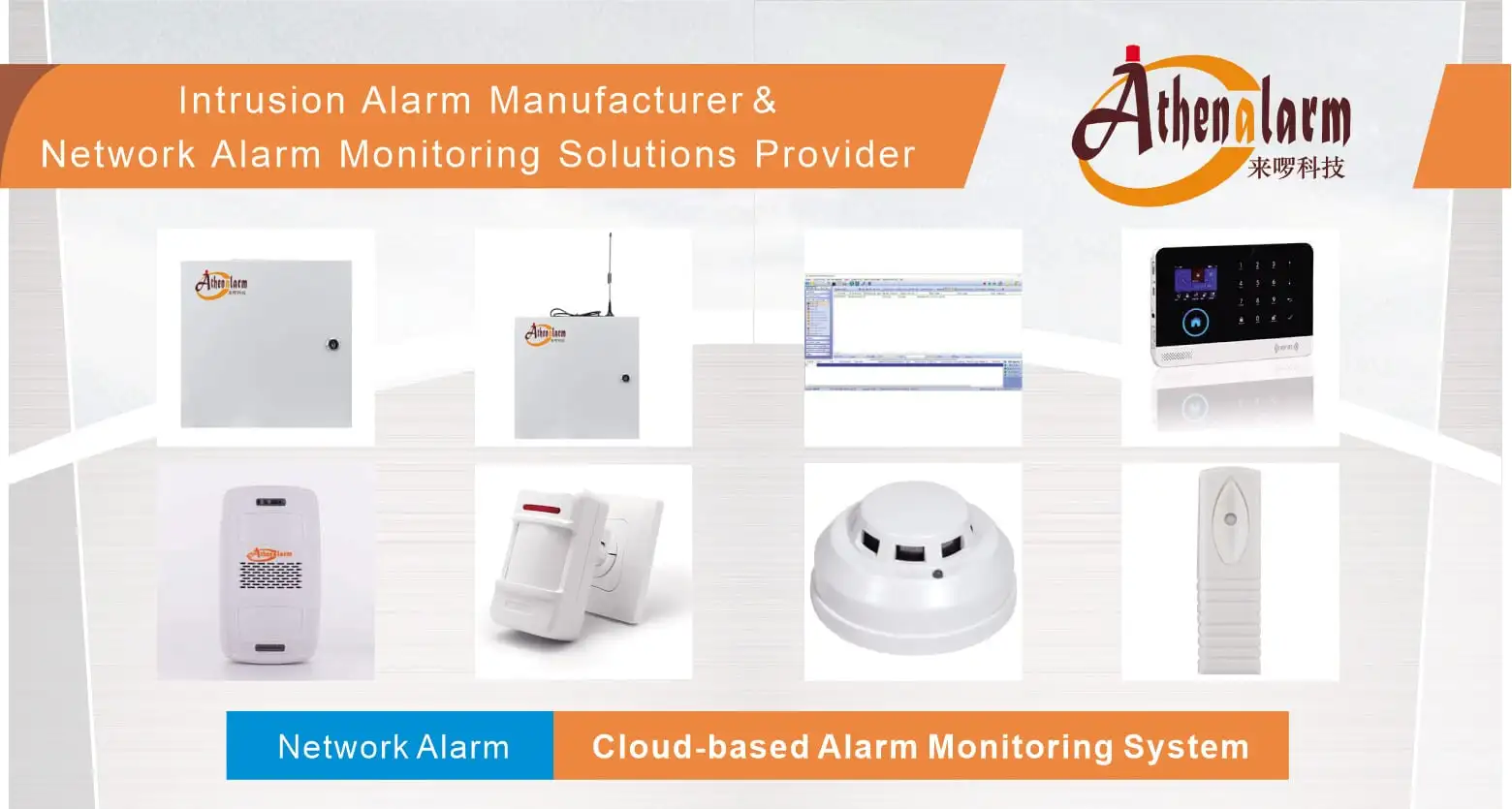
To support comprehensive system engineering, risk mapping, and deployment compliance, the following high-grade hardware modules and industry-specific solution frameworks are specified within the overall alarm monitoring ecosystem:
12.1 Central Control & Platform Management
- Central Alarm Control Unit: Network Alarm Control Panel Specification
- Centralized Monitoring Software: Network Alarm Center Management Software
- Hybrid Redundant Control Module: GSM/WiFi Alarm System Hub
12.2 Edge Detection & Sensing Hardware
- Volumetric Space Protection: PIR Motion Sensor
- Wide-Angle Motion Monitoring: Wide Angle PIR Motion Sensor
- Life-Safety Smoke Detection: Photoelectric Smoke Detector
- Hazardous Environmental Sensing: Industrial Gas Detector
- Structural Intrusion Sensing: Digital Vibration Detector
- Perimeter Access Contact: Heavy-Duty Door Contact
- Duress Signaling Unit: Hardwired Panic Button
- Mobile Emergency Trigger: Wireless Panic Button
- Visual Annunciation Module: Strobe Warning Light Unit
- On-Site Voice Alerts: Motion Sensor Sound Player
12.3 Sector-Specific Monitoring Solutions
- Banking & Financial Branch Protection: Network Bank Alarm Monitoring System Solution
- ATM Infrastructure Monitoring: Bank ATM Alarm Monitoring System Solution
- Vault & High-Value Storage Security: Network Bank Vault Alarm Monitoring System Solution
- Commercial & Retail Facilities: Network Store Alarm System Solution
- Hospitality Enterprise Infrastructure: Network Hotel Alarm System Solution
- Multi-Tenant & Community Systems: Network Community Alarm System Solution
- Residential & Executive Real Estate Protection: Network House Alarm System Solution
- Comprehensive Security Manufacturing Architecture: Burglar Alarm System Manufacturer Platform
